
Ruth 2:15
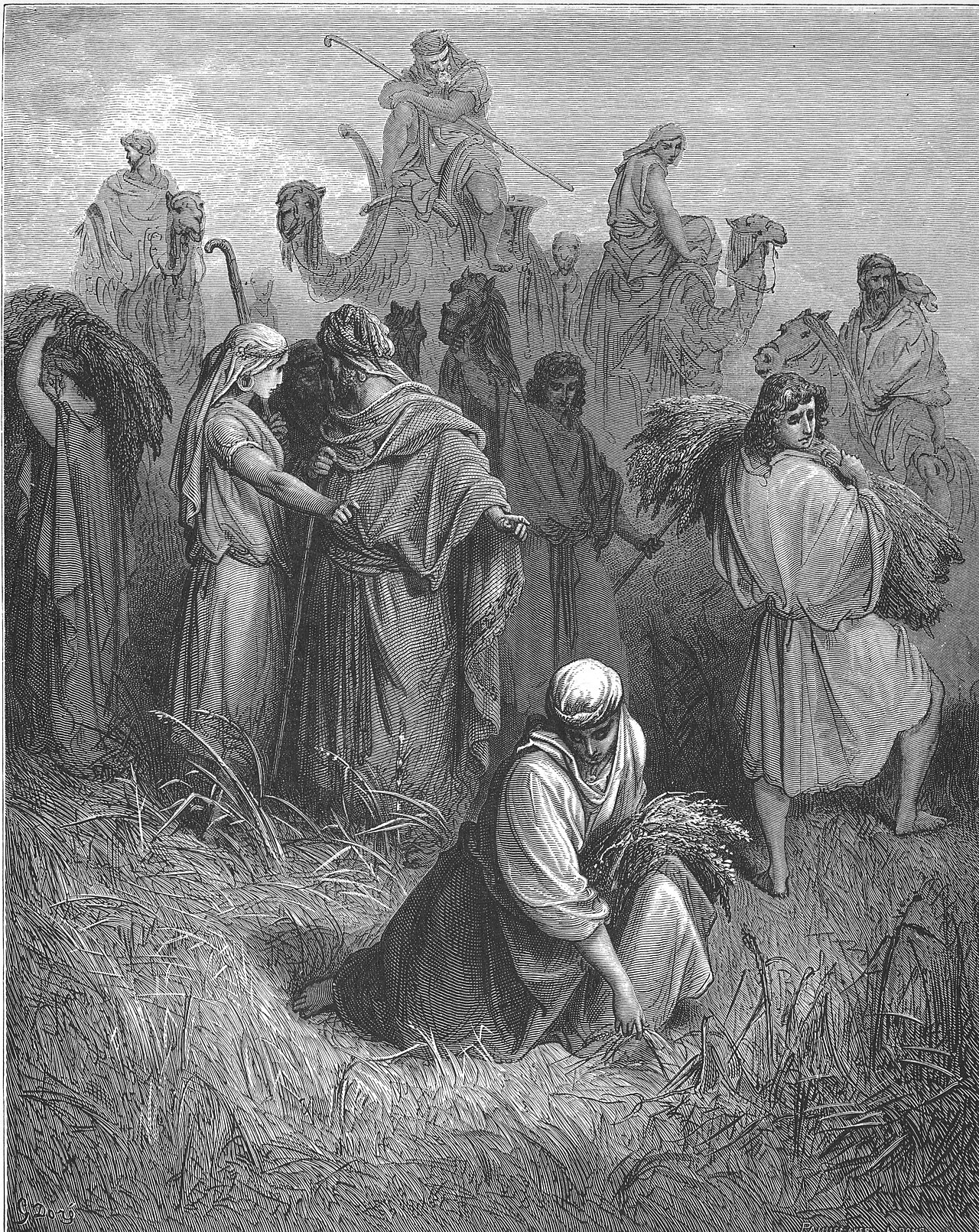
in Ruth 2When Ruth got up to glean, Boaz ordered his young men, “Even if she gathers among the sheaves, do not insult her.
BSB
The same verse in ASV and KJV ▾
ASV
And when she was risen up to glean, Boaz commanded his young men, saying, Let her glean even among the sheaves, and reproach her not.
KJV
And when she was risen up to glean, Boaz commanded his young men, saying, Let her glean even among the sheaves, and reproach her not:
⋯
This verse in Ruth 2
Commentary
10 notes on this verseLet her glean even among the sheaves - This was a privilege; for no person should glean till the sheaves were all bound, and the shocks set up.
This site's exposition
At mealtime come thou hither
on Ruth 2:14-16
He seats her beside the reapers and reaches her the parched corn himself, and the verse ends with she did eat, and was sufficed, and left, which is the portion she carries home at verse 18. Then he commands the young men twice over, to let her glean among the sheaves and to let fall handfuls of purpose for her. The law set a floor at the corners and the forgotten sheaf, and nothing in Leviticus 19 or Deuteronomy 24 asks a man to drop grain deliberately.
The record, by era
The Puritans and the Awakening4 voices
And when she was risen up to glean,....
Boaz was very kind to Ruth, and showed her a great deal of favour, induced to it by the account he had of her, and what he observed concerning her, God also inclining his heart to countenance her. Coming among his reapers, he observed this stranger among them, and got intelligence from his steward who she was, and here is a very particular account of what passed concerning her.
Ruth received his favours with a great deal of humility and gratitude, and conducted herself with as much propriety in her place as he did himself in his, but little thinking that she should shortly be the mistress of that field she was now gleaning in.
She did not, under pretence either of her want or of her labour, eat more than was convenient for her, nor so much as to unfit her for work in the afternoon. Temperance is a friend to industry; and we must eat and drink to strengthen us for business, not to indispose us to it.
The Nineteenth Century1 voice
A commentator
Charles Spurgeon1834–1892
The Metropolitan Tabernacle Pulpit, Sermon No. 2585: “Spiritual Glean1ng” (lightly modernized text, CCEL edition) · Written before 1892.
proposed
OUR country cousins have been engaged recently in harvest occupations and most of them understand what is meant by gleaning. Perhaps they are not, all of them, so wise as to understand the heavenly art of spiritual'gleaning. That is the subject which I have chosen for our meditation on this occasion—my attention having been called to it while I have been riding along through the country and, as I like to improve the seasons of the year as they come and go, I shall give you a few homely remarks with regard to spiritual gleaning.
3 more voices on this verse
The Nineteenth Century3 voices
Boaz commanded his young men, saying, Let her glean even among the sheaves, and reproach her not. And let fall also some of the handfuls on purpose for her and leave them, that she may glean them, and rebuke her not." Ruth 2:15,16. ALL the world depends upon the labor of the field and the king himself is served of the plow and of the sickle. The dwellers in the country who watch the springing up of the blade through all its perils, who mark the ear as it bursts from its sheath, and who anxiously observe it until it hangs downward through ripeness and becomes yellow in the sun— these, being brought constantly into contact with clods and crops—are not able to forget their entire dependence upon the staff of life. One can hardly live where the operations of farming are carried on without often looking up to the God of Providence in anxious prayer and later, lilting up the heart in grateful praise. But the most of us are condemned to live in this huge wilderness of bricks, where scarcely a green thing salutes our eyes. If we try to rear a plant, it is but a sickly thing, neither tempting for beauty, nor fragrant with perfume. In the absence of the bright-eyed flowers, it is small wonder if we grow a little blind towards our mother earth. We are too apt to think that we are independent of the operations of the country. That our trade, our commerce, our manufactures, are sufficient to support us. We forget, all the while, that in vain is yonder forest of masts unless the earth shall yield her fruit. In vain the emporium, the exchange, and the place of merchandise, unless the land is plowed and harrowed, and at last yields to the farmer his reward. I would that I could recall to your memories, O you dwellers in the city, how much you depend upon the Lord God of the earth for your daily bread.
Boaz commanded his young men, saying, Let her glean even among the sheaves, and reproach her not. And let fall also some of the handfuls on purpose for her and leave them, that she may glean them, and rebuke her not." Ruth 2:15,16. ALL the world depends upon the labor of the field and the king himself is served of the plow and of the sickle.
A commentator
Charles Spurgeon1834–1892
The Metropolitan Tabernacle Pulpit, Sermon No. 2585: “Spiritual Glean1ng” (lightly modernized text, CCEL edition) · Written before 1892.
proposed
OUR country cousins have been engaged recently in harvest occupations and most of them understand what is meant by gleaning. Perhaps they are not, all of them, so wise as to understand the heavenly art of spiritual'gleaning. That is the subject which I have chosen for our meditation on this occasion—my attention having been called to it while I have been riding along through the country and, as I like to improve the seasons of the year as they come and go, I shall give you a few homely remarks with regard to spiritual gleaning. In the first place, we shall observe that there is a great Husbandman. It was Boaz in this case. It is our Heavenly Father who is the Husbandman in the other case. Secondly, we shall notice a humble gleaner. It was Ruth in this instance. It is every Believer who is represented by her—at least we shall so consider the subject. And, in the third place, here is a very gracious permission given—"Let her glean even among the sheaves, and reproach her not." I. In the first place, then, we will consider something concerning THE GREAT HUSBANDMAN—GOD. The God of the whole earth is a great Husbandman. In fact, all farming operations are really dependent on Him. Man may plow the soil and he may sow the seed, but God alone gives the increase. It is He that sends the clouds and the sunshine, it is He that directs the winds and the rain and so, by various processes of Nature, He brings forth the food for man. All the farming, however, which God does, He does for the benefit of others and never for Himself. He has no need of any of those things which are so necessary for us. Remember how He spoke to Israel of old?—"I will take no bullock out of your house, no he goats out of your folds. For every beast of the forest is Mine and the cattle upon a thousand hills. I know all the fowls of the mountains: and the wild beasts of the field are Mine.
How the passage was read
What the Jewish commentators add
Do not reproach her. Derived from the root שלל (to plunder). Some say it is like an error from [the word] של.
1 more on this passage, in their own words ▾
And dip your bread in the vinegar. From here [we derive] that vinegar is good for the heat. 12 Maseches Shabbos 113b. It is a popular and refreshing drink for those who toil in extremely hot climates.
This section is reception history: how the passage was read and kept in the Jewish tradition. Where a reading parts from an essential of the Christian faith, the section says so at that point.
Texts and citation data: Sefaria; each excerpt follows its version’s licence. 2 further sources are cited on this chapter that carry no English text this site may quote or only restate the verse.
The words behind it
13 Hebrew wordsEvery Hebrew word of this verse in the order it stands, with what it means and the door to its own study. The last column counts the times a word stands in the whole Bible: the rarer the word, the more the places it appears belong together.
| Hebrew | Sound | Meaning | Word study | In the Bible |
|---|---|---|---|---|
| וַתָּ֖קָם | vatakom | and she arose | H6965 → | 628 times |
| לְלַקֵּ֑ט | lelaket | to glean | H3950 → | 37 times |
| וַיְצַו֩ | vaytzav | and he commanded | H6680 → | 494 times |
| בֹּ֨עַז | boaz | Boaz | H1162 → | 24 times |
| אֶת־ | ʾet- | <obj.> | H853 → | 10935 times |
| נְעָרָ֜יו | nearav | servants his | H5288 → | 239 times |
| לֵאמֹ֗ר | lemor | <to> saying | H559 → | 5305 times |
| גַּ֣ם | gam | also | H1571 → | 769 times |
| בֵּ֧ין | bein | between | H996 → | 407 times |
| הָֽעֳמָרִ֛ים | hoomarim | the sheaves | H6016 → | |
| תְּלַקֵּ֖ט | telaket | she will glean | H3950 → | 37 times |
| וְלֹ֥א | velo' | and not | H3808 → | 5168 times |
| תַכְלִימֽוּהָ׃ | takhlimuha | you must humiliate her | H3637 → |
וַתָּ֖קָםand she arose
vatakomH6965 →628 times
לְלַקֵּ֑טto glean
lelaketH3950 →37 times
וַיְצַו֩and he commanded
vaytzavH6680 →494 times
בֹּ֨עַזBoaz
boazH1162 →24 times
אֶת־<obj.>
ʾet-H853 →10935 times
נְעָרָ֜יוservants his
nearavH5288 →239 times
לֵאמֹ֗ר<to> saying
lemorH559 →5305 times
גַּ֣םalso
gamH1571 →769 times
בֵּ֧יןbetween
beinH996 →407 times
הָֽעֳמָרִ֛יםthe sheaves
hoomarimH6016 →
תְּלַקֵּ֖טshe will glean
telaketH3950 →37 times
וְלֹ֥אand not
velo'H3808 →5168 times
תַכְלִימֽוּהָ׃you must humiliate her
takhlimuhaH3637 →
A shaded row is a word that stands 400 times or fewer in the Bible.
The walk
5 stopsEach card is a verse this one points to, and under it the verses that one points to in turn. Where several paths arrive at the same place, that place is listed first: the text keeps returning to it.
Through
James 1:5Now if any of you lacks wisdom, he should ask God, who gives generously to all without finding fault, and it will be given to him.
it leads to
- Proverbs 2:3–6
if you truly call out to insight and lift your voice to understanding,
- John 15:7
If you remain in Me and My words remain in you, ask whatever you wish, and it will be done for you.
- Jeremiah 29:12–13
Then you will call upon Me and come and pray to Me, and I will listen to you.
- Proverbs 3:5–7
Trust in the LORD with all your heart, and lean not on your own understanding;
- 1 John 5:14–15
And this is the confidence that we have before Him: If we ask anything according to His will, He hears us.
- Proverbs 2:3–6
Where this verse is studied
On this page
About Ruth
Who and where
2 names in this verse with a page on the site.
This page draws on Adam Clarke, Commentary on the Bible; Charles Spurgeon, The Metropolitan Tabernacle Pulpit, Sermon No. 2585: “Spiritual Glean1ng” (lightly modernized text, CCEL edition); Charles Spurgeon, The Metropolitan Tabernacle Pulpit, Sermon No. 464: “A Sermon For Gleaners” (lightly modernized text, CCEL edition); John Gill, Exposition of the Old Testament (1748-1763) and Matthew Henry, Commentary on the Whole Bible.