
Ruth 2:6
in Ruth 2The foreman answered, “She is the Moabitess who returned with Naomi from the land of Moab.
BSB
The same verse in ASV and KJV ▾
ASV
And the servant that was set over the reapers answered and said, It is the Moabitish damsel that came back with Naomi out of the country of Moab:
KJV
And the servant that was set over the reapers answered and said, It is the Moabitish damsel that came back with Naomi out of the country of Moab:
⋯
This verse in Ruth 2
Commentary
5 notes on this verseThis site's exposition
Whose damsel is this
on Ruth 2:5-7
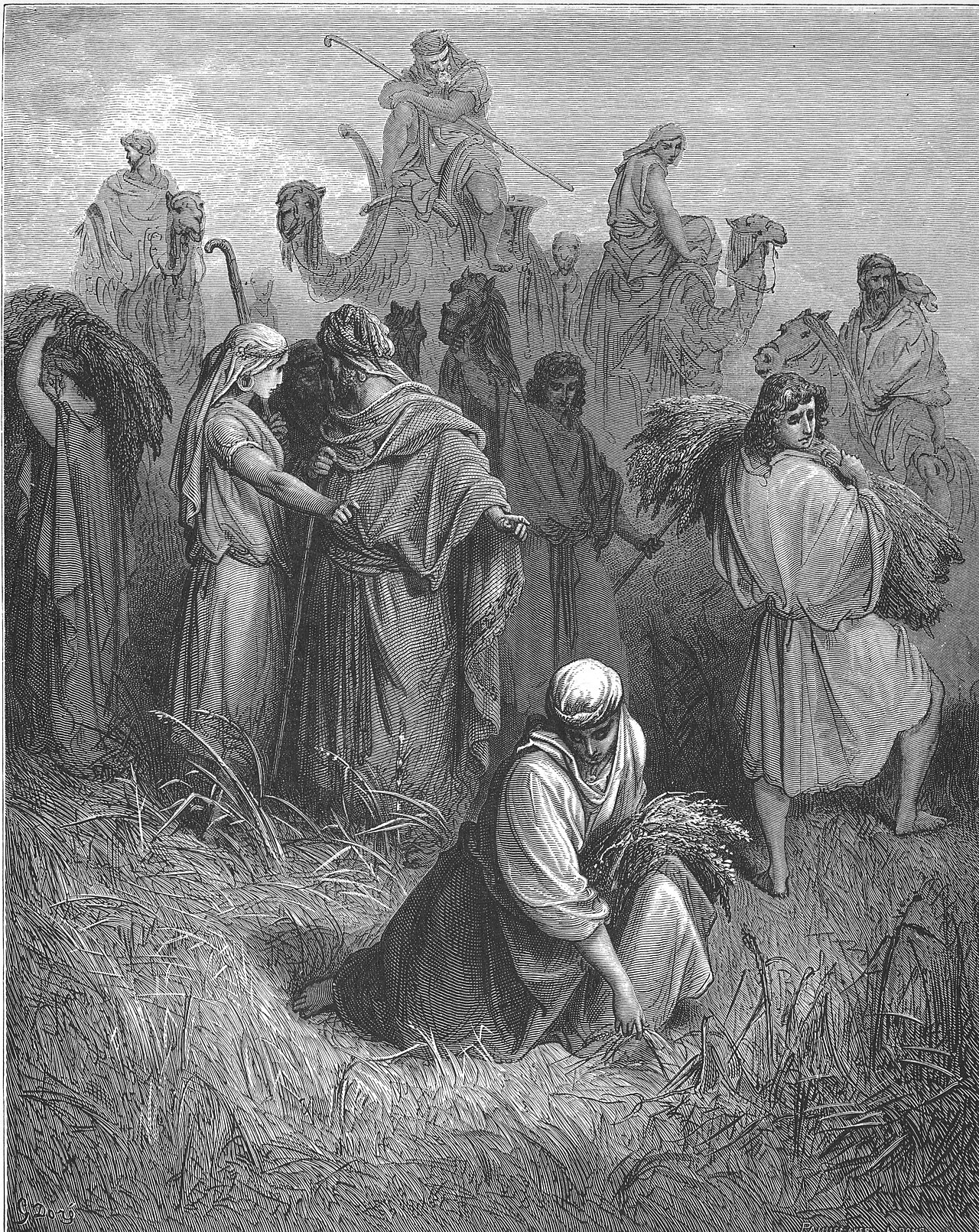
Boaz asks whose she is rather than who she is, which is the question a landowner asks about a household. The overseer answers by nation before name, the Moabitish damsel that came back with Naomi, and she is still unnamed when the exchange ends. Her request in verse 7 asks for more than the statute gives, since gleaning among the sheaves is neither the corners of Leviticus 19:9 nor the forgotten sheaf of Deuteronomy 24:19, and the servant reports the request without saying that he granted it. Boaz grants it himself at verse 15.
The record, by era
The Puritans and the Awakening4 voices
And the servant that was set over the reapers answered and said,....
This was both for his own interest (he that wholly leaves his business to others will have it done by the halves; the master's eye makes a fat horse) and it was also for the encouragement of his servants, who would go on the more cheerfully in their work when their master countenanced them so far as to make them a visit.
In great families it is requisite there should be one to oversee the rest of the servants, and appoint to each their portion both of work and meat. Ministers are such servants in God's house, and it is requisite that they be both wise and faithful, and show their Lord all things, as he here,
(1.) That she was a stranger, and therefore one of those that by the law of God were to gather the gleanings of the harvest, Lev. xix. She is the Moabitish damsel. (2.) That she was allied to his family; she came back with Naomi, the wife of Elimelech, a kinsman of Boaz.
The words behind it
14 Hebrew wordsEvery Hebrew word of this verse in the order it stands, with what it means and the door to its own study. The last column counts the times a word stands in the whole Bible: the rarer the word, the more the places it appears belong together.
| Hebrew | Sound | Meaning | Word study | In the Bible |
|---|---|---|---|---|
| וַיַּ֗עַן | vaiyaan | and he answered | H6030 → | 331 times |
| הַנַּ֛עַר | hanaar | the servant | H5288 → | 239 times |
| הַנִּצָּ֥ב | hanitzav | who was appointed | H5324 → | |
| עַל־ | ʾal- | over | H5921 → | 5755 times |
| הַקּוֹצְרִ֖ים | hakotzrim | the harvesters | H7114 → | 49 times |
| וַיֹּאמַ֑ר | vaiyomar | and he said | H559 → | 5305 times |
| נַעֲרָ֤ה | naarah | [is] a young woman | H5291 → | 63 times |
| מֽוֹאֲבִיָּה֙ | moaviyah | Moabite | H4125 → | 16 times |
| הִ֔יא | hi' | she | H1931 → | 1879 times |
| הַשָּׁ֥בָה | hashavah | who <she> returned | H7725 → | 1056 times |
| עִֽם־ | ʾim- | with | H5973 → | 1050 times |
| נָעֳמִ֖י | noomi | Naomi | H5281 → | 21 times |
| מִשְּׂדֵ֥ה | misedeh | from [the] region of | H7704 → | 334 times |
| מוֹאָֽב׃ | moav | Moab | H4124 → | 181 times |
וַיַּ֗עַןand he answered
vaiyaanH6030 →331 times
הַנַּ֛עַרthe servant
hanaarH5288 →239 times
הַנִּצָּ֥בwho was appointed
hanitzavH5324 →
עַל־over
ʾal-H5921 →5755 times
הַקּוֹצְרִ֖יםthe harvesters
hakotzrimH7114 →49 times
וַיֹּאמַ֑רand he said
vaiyomarH559 →5305 times
נַעֲרָ֤ה[is] a young woman
naarahH5291 →63 times
מֽוֹאֲבִיָּה֙Moabite
moaviyahH4125 →16 times
הִ֔יאshe
hi'H1931 →1879 times
הַשָּׁ֥בָהwho <she> returned
hashavahH7725 →1056 times
עִֽם־with
ʾim-H5973 →1050 times
נָעֳמִ֖יNaomi
noomiH5281 →21 times
מִשְּׂדֵ֥הfrom [the] region of
misedehH7704 →334 times
מוֹאָֽב׃Moab
moavH4124 →181 times
A shaded row is a word that stands 400 times or fewer in the Bible.
The walk
8 stopsEach card is a verse this one points to, and under it the verses that one points to in turn. Where several paths arrive at the same place, that place is listed first: the text keeps returning to it.
Through
Ruth 1:16But Ruth replied: “Do not urge me to leave you or to turn from following you. For wherever you go, I will go, and wherever you live, I will live; your people will be…
it leads to
- 2 Samuel 15:21
But Ittai answered the king, “As surely as the LORD lives, and as my lord the king lives, wherever my lord the king may be, whether it means life or death, there will your…
- Ruth 2:11–12
Boaz replied, “I have been made fully aware of all you have done for your mother-in-law since the death of your husband, how you left your father and mother and the land of your…
- 2 Kings 2:2–6
and Elijah said to Elisha, “Please stay here, for the LORD has sent me on to Bethel.” But Elisha replied, “As surely as the LORD lives and as you yourself live, I will not…
- Psalms 45:10
Listen, O daughter! Consider and incline your ear: Forget your people and your father’s house,
- Matthew 8:19
And one of the scribes came to Him and said, “Teacher, I will follow You wherever You go.”
- 2 Samuel 15:21
Through
Matthew 24:45Who then is the faithful and wise servant, whom the master has put in charge of his household, to give the others their food at the proper time?
it leads to
- Matthew 25:21
His master replied, ‘Well done, good and faithful servant! You have been faithful with a few things; I will put you in charge of many things. Enter into the joy of your master!’
- 1 Corinthians 4:1–2
So then, men ought to regard us as servants of Christ and stewards of the mysteries of God.
- Luke 16:10–12
Whoever is faithful with very little will also be faithful with much, and whoever is dishonest with very little will also be dishonest with much.
- Matthew 25:21
Where this verse is studied
On this page
About Ruth
Who and where
2 names in this verse with a page on the site.
This page draws on John Gill, Exposition of the Old Testament; John Gill, Exposition of the Old Testament (1748-1763); Keil and Delitzsch, Biblical Commentary on the Old Testament: Joshua, Judges, Ruth and Matthew Henry, Commentary on the Whole Bible.