
Ruth 2:5
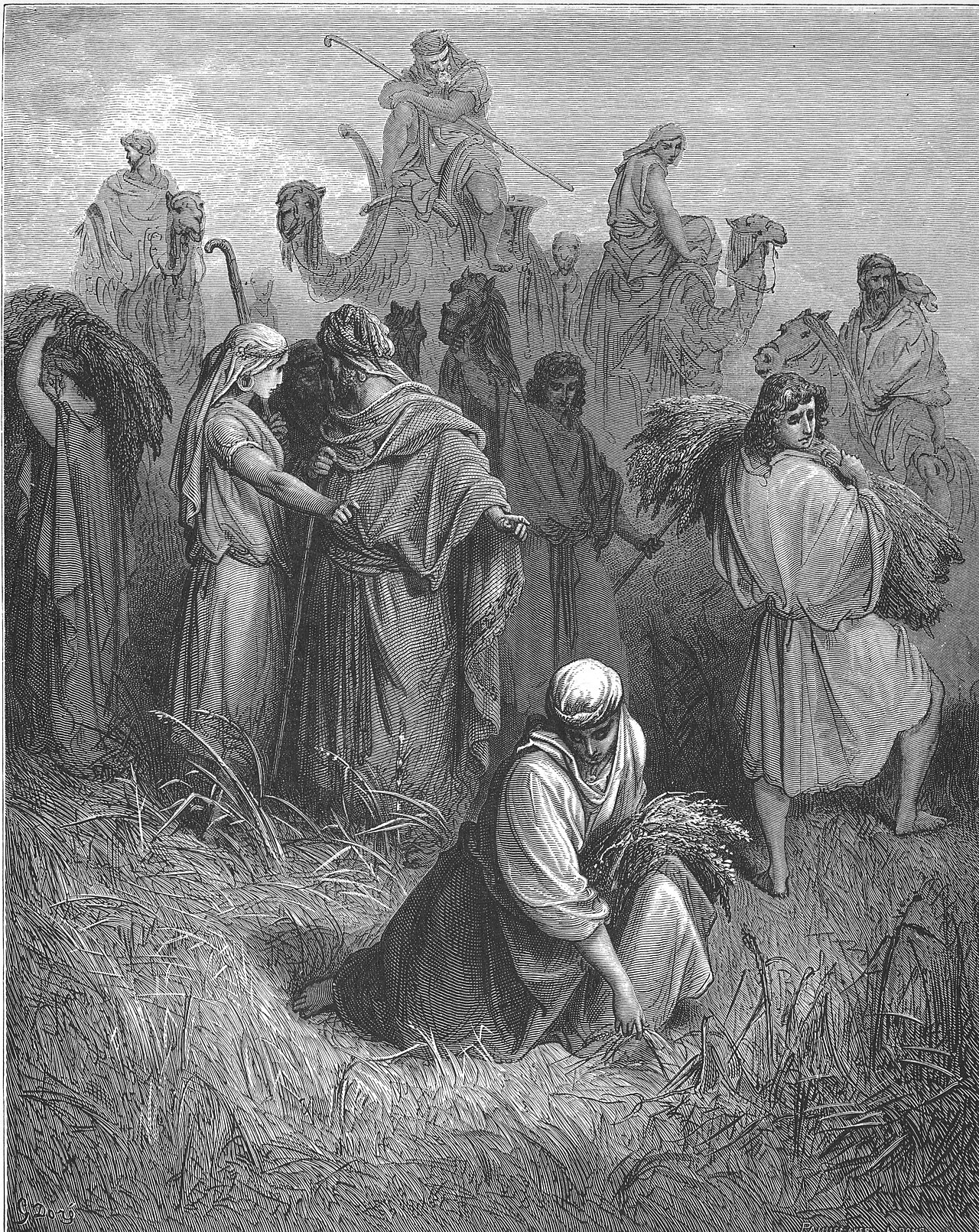
in Ruth 2And Boaz asked the foreman of his harvesters, “Whose young woman is this?”
BSB
The same verse in ASV and KJV ▾
ASV
Then said Boaz unto his servant that was set over the reapers, Whose damsel is this?
KJV
Then said Boaz unto his servant that was set over the reapers, Whose damsel is this?
⋯
This verse in Ruth 2
Commentary
4 notes on this verseHis servant that was set over the reapers - This was a kind of steward or hind who had the under management of the estate.
This site's exposition
Whose damsel is this
on Ruth 2:5-7
Boaz asks whose she is rather than who she is, which is the question a landowner asks about a household. The overseer answers by nation before name, the Moabitish damsel that came back with Naomi, and she is still unnamed when the exchange ends. Her request in verse 7 asks for more than the statute gives, since gleaning among the sheaves is neither the corners of Leviticus 19:9 nor the forgotten sheaf of Deuteronomy 24:19, and the servant reports the request without saying that he granted it. Boaz grants it himself at verse 15.
The record, by era
The Puritans and the Awakening1 voice
Then said Boaz unto his servant that was set over the reapers,.... To direct them their work, what part each was to do, and to see that they did it well; to take care for provisions for them, and to pay them their wages when their work was done.
The Nineteenth Century1 voice
A commentator
Jamieson, Fausset & Brown1802–1910
Commentary Critical and Explanatory on the Whole Bible (1871)
proposed
his servant that was set over the reapers--an overseer whose special duty was to superintend the operations in the field, to supply provision to the reapers, and pay them for their labor in the evening.
quarantine:debris (2026-07-29) — starts-lowercase
The words behind it
9 Hebrew wordsEvery Hebrew word of this verse in the order it stands, with what it means and the door to its own study. The last column counts the times a word stands in the whole Bible: the rarer the word, the more the places it appears belong together.
| Hebrew | Sound | Meaning | Word study | In the Bible |
|---|---|---|---|---|
| וַיֹּ֤אמֶר | vaiyomer | and he said | H559 → | 5305 times |
| בֹּ֙עַז֙ | boaz | Boaz | H1162 → | 24 times |
| לְנַעֲר֔וֹ | lenaaro | to servant his | H5288 → | 239 times |
| הַנִּצָּ֖ב | hanitzav | who was appointed | H5324 → | |
| עַל־ | ʾal- | over | H5921 → | 5755 times |
| הַקּֽוֹצְרִ֑ים | hakotzrim | the harvesters | H7114 → | 49 times |
| לְמִ֖י | lemi | [belongs] to whom? | H4310 → | 423 times |
| הַנַּעֲרָ֥ה | hanaarah | the young woman | H5291 → | 63 times |
| הַזֹּֽאת׃ | hazot | <the> this | H2063 → | 603 times |
וַיֹּ֤אמֶרand he said
vaiyomerH559 →5305 times
בֹּ֙עַז֙Boaz
boazH1162 →24 times
לְנַעֲר֔וֹto servant his
lenaaroH5288 →239 times
הַנִּצָּ֖בwho was appointed
hanitzavH5324 →
עַל־over
ʾal-H5921 →5755 times
הַקּֽוֹצְרִ֑יםthe harvesters
hakotzrimH7114 →49 times
לְמִ֖י[belongs] to whom?
lemiH4310 →423 times
הַנַּעֲרָ֥הthe young woman
hanaarahH5291 →63 times
הַזֹּֽאת׃<the> this
hazotH2063 →603 times
A shaded row is a word that stands 400 times or fewer in the Bible.
The walk
3 stopsEach card is a verse this one points to, and under it the verses that one points to in turn. Where several paths arrive at the same place, that place is listed first: the text keeps returning to it.
Through
Ruth 4:21Salmon was the father of Boaz, Boaz was the father of Obed,
it leads to
- Luke 3:32
the son of Jesse, the son of Obed, the son of Boaz, the son of Sala, the son of Nahshon,
- Matthew 1:5
Salmon was the father of Boaz by Rahab, Boaz the father of Obed by Ruth, Obed the father of Jesse,
- 1 Chronicles 2:11–12
Nahshon was the father of Salmon, and Salmon was the father of Boaz.
- Luke 3:32
Where this verse is studied
On this page
About Ruth
Who and where
1 name in this verse with a page on the site.
This page draws on Adam Clarke, Commentary on the Bible; Jamieson, Fausset & Brown, Commentary Critical and Explanatory on the Whole Bible; John Gill, Exposition of the Old Testament; John Gill, Exposition of the Old Testament (1748-1763) and Keil and Delitzsch, Biblical Commentary on the Old Testament: Joshua, Judges, Ruth.