
Ruth 2:16
in Ruth 2Rather, pull out for her some stalks from the bundles and leave them for her to gather. Do not rebuke her.”
BSB
The same verse in ASV and KJV ▾
ASV
And also pull out some for her from the bundles, and leave it, and let her glean, and rebuke her not.
KJV
And let fall also some of the handfuls of purpose for her, and leave them, that she may glean them, and rebuke her not.
⋯
This verse in Ruth 2
Commentary
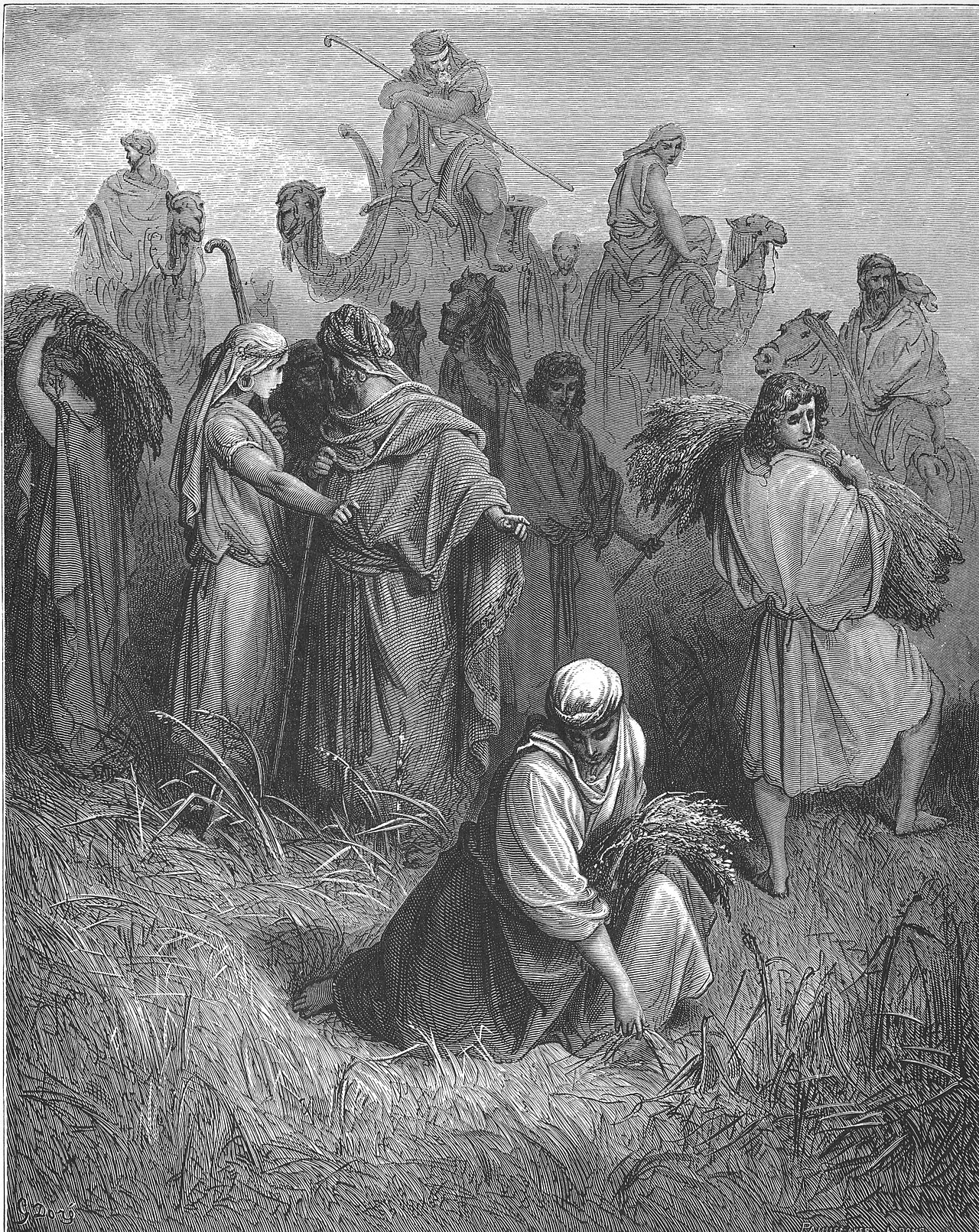
6 notes on this verseAnd let fall some of the handfuls on purpose for her,.... That is, when they had reaped an handful, instead of laying it in its proper order, to be taken up by those that gathered after them, or by themselves, in order to be bound up in sheaves, scatter it about, or let it fall where they reaped it: and leave them, that she may glean them, and rebuke her not for taking them, as if she did a wrong thing.
This site's exposition
At mealtime Boaz said to her
on Ruth 2:14-16
He seats her beside the harvesters and hands her roasted grain, and "she ate and was satisfied and had some left over", the portion she carries home at verse 18. He then orders the young men to "pull out for her some stalks from the bundles". The law set a floor, and nothing in Leviticus 19 or Deuteronomy 24 asks a man to drop grain on purpose.
This site's exposition
pull out for her some stalks from the bundles
John Gill reads the order as stalks pulled from the bundles and left on purpose for her to gather. Boaz arranges the gift so that it reaches her as gleaning, and his young men are told not to rebuke her. She keeps her dignity.
The record, by era
The Nineteenth Century3 voices
A commentator
Jamieson, Fausset & Brown1802–1910
Commentary Critical and Explanatory on the Whole Bible (1871)
proposed
let fall also some of the handfuls of purpose for her--The gleaners in the East glean with much success; for a great quantity of corn is scattered in the reaping, as well as in their manner of carrying it.
quarantine:debris (2026-07-29) — starts-lowercase
Boaz commanded his young men, saying, Let her glean even among the sheaves, and reproach her not. And let fall also some of the handfuls on purpose for her and leave them, that she may glean them, and rebuke her not." Ruth 2:15,16. ALL the world depends upon the labor of the field and the king himself is served of the plow and of the sickle. The dwellers in the country who watch the springing up of the blade through all its perils, who mark the ear as it bursts from its sheath, and who anxiously observe it until it hangs downward through ripeness and becomes yellow in the sun— these, being brought constantly into contact with clods and crops—are not able to forget their entire dependence upon the staff of life. One can hardly live where the operations of farming are carried on without often looking up to the God of Providence in anxious prayer and later, lilting up the heart in grateful praise. But the most of us are condemned to live in this huge wilderness of bricks, where scarcely a green thing salutes our eyes. If we try to rear a plant, it is but a sickly thing, neither tempting for beauty, nor fragrant with perfume. In the absence of the bright-eyed flowers, it is small wonder if we grow a little blind towards our mother earth. We are too apt to think that we are independent of the operations of the country. That our trade, our commerce, our manufactures, are sufficient to support us. We forget, all the while, that in vain is yonder forest of masts unless the earth shall yield her fruit. In vain the emporium, the exchange, and the place of merchandise, unless the land is plowed and harrowed, and at last yields to the farmer his reward. I would that I could recall to your memories, O you dwellers in the city, how much you depend upon the Lord God of the earth for your daily bread.
Boaz commanded his young men, saying, Let her glean even among the sheaves, and reproach her not. And let fall also some of the handfuls on purpose for her and leave them, that she may glean them, and rebuke her not." Ruth 2:15,16. ALL the world depends upon the labor of the field and the king himself is served of the plow and of the sickle.
How the passage was read
What the Jewish commentators add
On the verses either side of this one
Do not reproach her. Derived from the root שלל (to plunder). Some say it is like an error from [the word] של.
This section is reception history: how the passage was read and kept in the Jewish tradition. Where a reading parts from an essential of the Christian faith, the section says so at that point.
Texts and citation data: Sefaria; each excerpt follows its version’s licence. 2 further sources are cited on this chapter that carry no English text this site may quote or only restate the verse.
The words behind it
11 Hebrew wordsEvery Hebrew word of this verse in the order it stands, with what it means and the door to its own study. The last column counts the times a word stands in the whole Bible: the rarer the word, the more the places it appears belong together.
| Hebrew | Sound | Meaning | Word study | In the Bible |
|---|---|---|---|---|
| וְגַ֛ם | vegam | and also | H1571 → | 769 times |
| שֹׁל־ | shol- | indeed <pull out> | H7997 → | |
| תָּשֹׁ֥לּוּ | tasholu | you will pull out | H7997 → | |
| לָ֖הּ | lah | for <the> her | ||
| מִן־ | min- | some of | H4480 → | 1188 times |
| הַצְּבָתִ֑ים | hatzevatim | the bundles of grain | H6653 → | |
| וַעֲזַבְתֶּ֥ם | vaazavtem | and you will leave [them] | H5800 → | 215 times |
| וְלִקְּטָ֖ה | veliketah | and she will glean | H3950 → | 37 times |
| וְלֹ֥א | velo' | and not | H3808 → | 5168 times |
| תִגְעֲרוּ־ | tigaru- | you must rebuke | H1605 → | |
| בָֽהּ׃ | vah | <in> <the> her |
וְגַ֛םand also
vegamH1571 →769 times
שֹׁל־indeed <pull out>
shol-H7997 →
תָּשֹׁ֥לּוּyou will pull out
tasholuH7997 →
לָ֖הּfor <the> her
lah
מִן־some of
min-H4480 →1188 times
הַצְּבָתִ֑יםthe bundles of grain
hatzevatimH6653 →
וַעֲזַבְתֶּ֥םand you will leave [them]
vaazavtemH5800 →215 times
וְלִקְּטָ֖הand she will glean
veliketahH3950 →37 times
וְלֹ֥אand not
velo'H3808 →5168 times
תִגְעֲרוּ־you must rebuke
tigaru-H1605 →
בָֽהּ׃<in> <the> her
vah
A shaded row is a word that stands 400 times or fewer in the Bible.
The walk
8 stopsEach card is a verse this one points to, and under it the verses that one points to in turn. Where several paths arrive at the same place, that place is listed first: the text keeps returning to it.
Through
Proverbs 19:17Kindness to the poor is a loan to the LORD, and He will repay the lender.
it leads to
- Hebrews 6:10
For God is not unjust. He will not forget your work and the love you have shown for His name as you have ministered to the saints and continue to do so.
Reached by 3 separate paths from here.
- Proverbs 28:27
Whoever gives to the poor will not be in need, but he who hides his eyes will receive many curses.
- Luke 6:38
Give, and it will be given to you. A good measure, pressed down, shaken together, and running over will be poured into your lap. For with the measure you use, it will be measured…
- 2 Corinthians 9:6–8
Remember this: Whoever sows sparingly will also reap sparingly, and whoever sows generously will also reap generously.
- Matthew 25:40
And the King will reply, ‘Truly I tell you, whatever you did for one of the least of these brothers of Mine, you did for Me.’
- Hebrews 6:10
Through
Romans 12:13Share with the saints who are in need. Practice hospitality.
it leads to
- Hebrews 13:16
And do not neglect to do good and to share with others, for with such sacrifices God is pleased.
Reached by 2 separate paths from here.
- 2 Corinthians 9:12
For this ministry of service is not only supplying the needs of the saints, but is also overflowing in many expressions of thanksgiving to God.
- 1 John 3:17
If anyone with earthly possessions sees his brother in need, but withholds his compassion from him, how can the love of God abide in him?
- Hebrews 13:16
Where this verse is studied
On this page
About Ruth
This page draws on Adam Clarke, Commentary on the Bible; Charles Spurgeon, The Metropolitan Tabernacle Pulpit, Sermon No. 464: “A Sermon For Gleaners” (lightly modernized text, CCEL edition); Jamieson, Fausset & Brown, Commentary Critical and Explanatory on the Whole Bible; John Gill, Exposition of the Old Testament (1748-1763) and Matthew Henry, Commentary on the Whole Bible.