
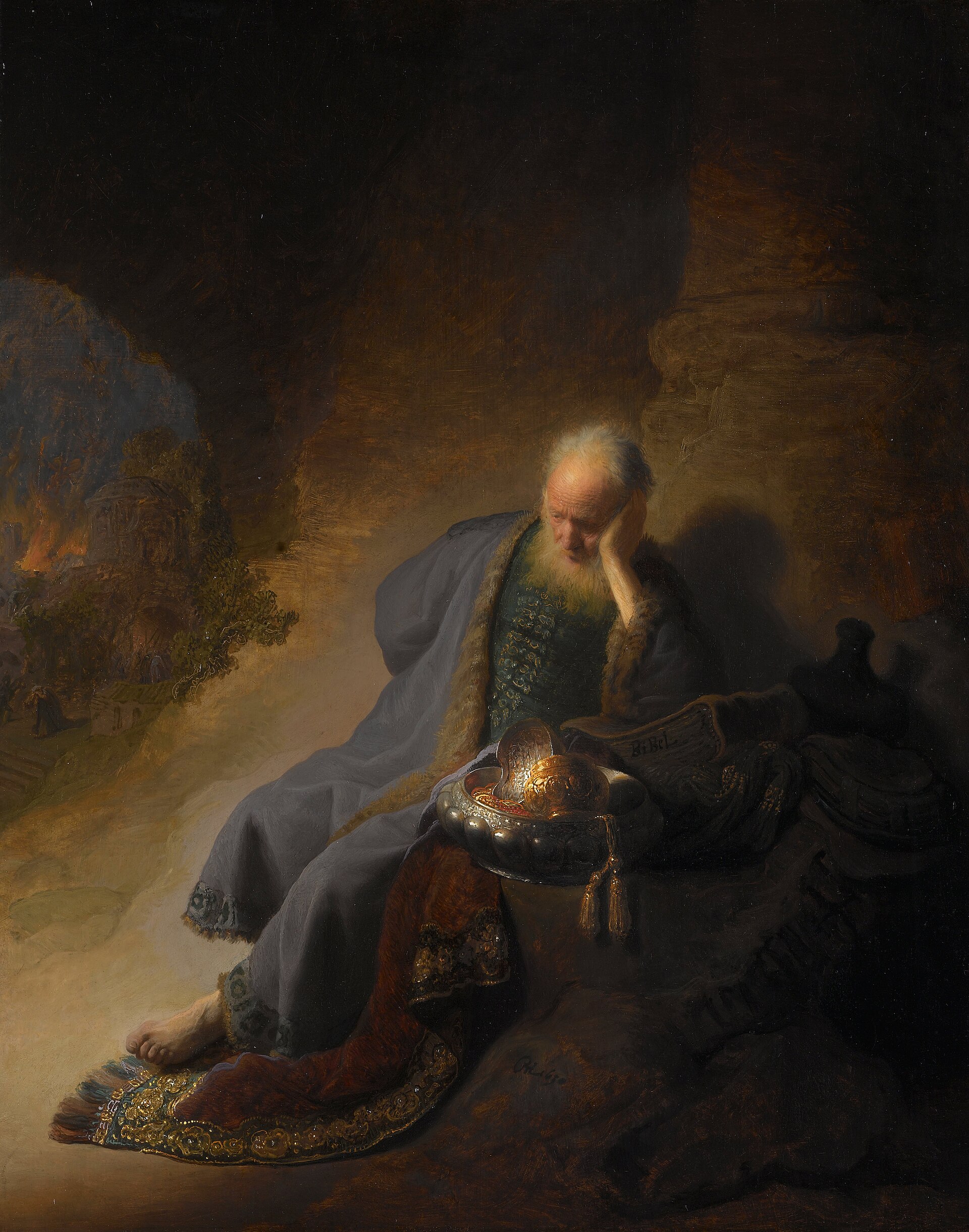
Jeremiahchapter 23
40 verses · Jeremiah, written by Baruch · 7th to 6th century BC · The Prophets
Behold, the days are coming, declares the LORD, when I will raise up for David a righteous Branch, and He will reign wisely as King and will administer justice and righteousness in the land.
Introduction
Jeremiah, written by Baruch, The Prophets, Jeremiah Overview.
Jeremiah spoke these words in the last decades of Judah, when many prophets claimed to speak for God and most of them promised peace. The people had no quick way to tell which preacher to believe. This chapter opens on the rulers and turns to the prophets, and it holds the two together. Its first hearers knew shepherd as a common title for a king. Listen for the promise of a king whose name answers the reigning king's own name. Then listen for the tests it gives for telling a true word from a false one. Read it as a guide for anyone who has to choose whom to believe.
Context
- Who
- People who had to choose between competing preachers, all claiming a word from God
- What
- A charge against the rulers of Judah, a promise of a righteous king from David's line, and a long indictment of the prophets who spoke peace.
- Where
- Jerusalem, where the court prophets preached in the temple and at the palace.
- When
- The last decades of the kingdom of Judah, about 609 to 588 BC.
- Why
- To give the people a king to hope for and plain tests for telling the LORD's word from a prophet's own dream.
Historical context
Shepherd was standard court language for a king across the whole region, Babylonian and Assyrian rulers called themselves the shepherd of their people. So a charge against the shepherds who destroy and scatter the sheep is not a pastoral metaphor; it is an indictment of the government.
Show the rest of the historical context, 3 more paragraphs
Against them stands a promise of a righteous Branch raised up for David, a shoot from a cut-down stump, who will reign as king, deal wisely, and execute justice. He is given the name The LORD our righteousness, which lands as a direct hit: the reigning king's own name, Zedekiah, meant the LORD is my righteousness.
The chapter then dissects false prophecy with unusual precision. These men steal words from one another, use their own tongues and declare it an oracle, tell dreams, and say to those who despise God that it will be well with them. The test given is whether a man has stood in the council of the LORD, the assembly around God's throne, and whether his preaching turns people from evil. Preaching that changes nobody is the evidence.
There is a wordplay in the middle of it. The Hebrew word for a prophetic message is the same word used for a heavy load. People were mocking the prophet by asking what the burden of the LORD is today, and the reply is that they themselves are the burden, and it will be dropped.
Significance
The first hearers had no way to check a prophet's credentials on the spot, and this chapter hands them working tests: does the man's life match his message, and does the message make anyone repent.
Show the rest of the significance, 1 more paragraph
The image that would have stayed with them is the wheat and the chaff. Let the dreamer tell his dream and the one with God's word speak it faithfully, what has straw in common with grain. Both come off the same threshing floor and only one of them feeds anybody.
This chapter in Jewish lifeWhat this chapter is in Jewish life and reading.
What is done
No part of this chapter is read in the synagogue. Probed for this lane, the site's own table in src/lib/hebraic/readings.ts printed parashot 0 and haftarah uses 0 for Jeremiah 23, and no festival reading for the book. Across chapters 1 to 26 of Jeremiah the same probe found a Haftarah only in chapters 1, 2, 3, 4, 7, 8, 9, 16 and 17.
How it is read
Rashi is the one commentator on this chapter whose English the corpus carries, quoted here from The Judaica Press complete Tanach with Rashi, translated by A. J. Rosenberg, which Sefaria reports as CC-BY.
Rashi reads the shepherds of the first verse as "The kings of Judah" (Rashi on Jeremiah 23:1:1). On the name the Lord is our righteousness he reads: "The Lord will vindicate us during this one’s days" (Rashi on Jeremiah 23:6:1).
On the prophets he reads who has stood in the council of the Lord as the man who heard God's Torah and kept His commandments (Rashi on Jeremiah 23:18:1). On the God near at hand he reads the question as God's knowledge of the lower creatures far from Him (Rashi on Jeremiah 23:23:1).
The corpus carries six further notes on this chapter without an English text, each marked linked because Sefaria holds no English version of the ref. They stand cited and unquoted at Radak on Jeremiah 23:3:1, 23:7:1, 23:15:1, 23:16:1 and 23:21:1. The same holds for Metzudat David on Jeremiah 23:8:1.
What the rabbis say
The corpus carries 40 rabbinic locators on the verses of this chapter, 9 in the Talmud and 31 in the Midrash. It carries the text of none, so each is cited by ref here and never quoted or paraphrased. The verse numbers are the Hebrew ones the corpus prints.
On verse 2 it holds Otzar Midrashim, Baraita of The 32 Midot of Aggadah 1:32. On verse 5 it holds Bamidbar Rabbah 18:21, Bereshit Rabbati, Parashat Lech Lecha 1 and Midrash Lekach Tov, Exodus 11:5:1. On verse 6 it holds Bava Batra 75b:4, Eikhah Rabbah 1:51 and Ein Yaakov (Glick Edition), Bava Batra 5:29. On verse 7 it holds Berakhot 12b:26, Ein Yaakov (Glick Edition), Berakhot 1:56 and Ein Yaakov (Glick Edition), Kiddushin 4:1.
On verse 8 it holds Mekhilta DeRabbi Yishmael, Tractate Pischa 16:20, Yalkut Shimoni on Torah 218:1 and Yalkut Shimoni on Torah 82:14. On verse 9 it holds Ein Yaakov (Glick Edition), Sanhedrin 11:37 and Sanhedrin 96a:9. On verse 10 it holds Ein Yaakov (Glick Edition), Kiddushin 1:2 and Ein Yaakov (Glick Edition), Shevuot 6:1. On verse 12 it holds Pesikta Rabbati 44:1. On verse 13 it holds Eikhah Rabbah 2:18. On verse 15 it holds Avot DeRabbi Natan, Recension B 48:12 and Bamidbar Rabbah 9:18.
On verse 18 it holds Aggadat Bereshit 18:1. On verse 19 it holds Chagigah 13b:14 and Ein Yaakov, Khagigah 2:8. On verse 20 it holds Midrash Aggadah, Numbers 21:30:12. On verse 22 it holds Mekhilta DeRabbi Yishmael, Tractate Vayehi Beshalach 1:25. On verse 23 it holds Mekhilta DeRabbi Yishmael, Tractate Amalek 3:32 and Midrash Sekhel Tov, Shemot 18:7:1. On verse 24 it holds Avot DeRabbi Natan, Recension B 43:25 and Bamidbar Rabbah 12:3. On verse 25 it holds Megillah 31b:3.
On verse 27 it holds Midrash Tanchuma Buber, Appendix to Vaetchanan 2:2 and Ruth Rabbah (Lerner) 4:5:2. On verse 28 it holds Berakhot 55a:16 and Ein Yaakov (Glick Edition), Berakhot 9:4. On verse 29 it holds Avot DeRabbi Natan 16:3 and Bamidbar Rabbah 11:7. On verse 32 it holds Midrash Sekhel Tov, Bereshit 49:4:1. On verse 33 it holds Midrash Lekach Tov on Lamentations 2:14:1. On verse 36 it holds Midrash Sekhel Tov, Bereshit 25:21:1.
Sources: Rashi, Rashi on Jeremiah 23:1:1 to 23:24:1, The Judaica Press complete Tanach with Rashi, translated by A. J. Rosenberg, reported CC-BY; Metzudat David, Metzudat David on Jeremiah 23:8:1, cited by ref because the corpus carries no English text; Radak, Radak on Jeremiah 23:3:1, 23:7:1, 23:15:1, 23:16:1 and 23:21:1, cited by ref because the corpus carries no English text; The Sefaria corpus, scripts/data/sources/sefaria/jeremiah/23.json, the 40 Talmud and Midrash locators on the verses of this chapter; The site's own files, src/lib/hebraic/readings.ts, probed for Jeremiah 23: parashot 0, haftarah uses 0, and no festival reading for the book.
The heads below are this chapter's scenes. The numbered points under each are its verses.
Woe to the Shepherds: the Branch of Righteousness Raised Up
Jeremiah 23:1-4
The oracle turns to the office itself: “Woe to the shepherds who destroy and scatter the sheep of My pasture!” Their fault is neglect: “You have scattered My flock and driven them away, and have not attended to them.” The LORD will “gather the remnant of My flock” Himself.
Jeremiah 23:1
“The pastors - shepherds, i. e., civil rulers Jer 2:8. The sheep of My pasture - literally, of My pasturing, the sheep of whom I am shepherd. The people do not belong to the rulers but to God.”
The same word turns against the shepherds. They did not attend to the flock, so the LORD will attend to them for their evil deeds. Clarke holds the bad rule of the leaders chiefly to blame for the people's sin.
Jeremiah 23:2
“Ye have scattered my flock - The bad government both in Church and State was a principal cause of the people’s profligacy.”
Adam Clarke · Commentary on the Bible (1810-1826)evangelical
I Myself will gather the remnant: The LORD says He banished the flock Himself, and He will gather the remnant Himself. Barnes notes that the promise of return is for the people, with none for the kings who led them astray. Henry sees justice scattering the sheep and mercy gathering them.
Jeremiah 23:3
“It was the justice of God, for the sin of their shepherds, that dispersed them; but the mercy of God shall gather in the sheep, when the shepherds that betrayed them are cut off.”
Matthew Henry · Commentary on the Whole Bible (1707-1721)puritan
2 more voices on this verse
Jeremiah 23:3
“While there is no promise of restoration for the kings, there is for the people (see Jer 4:27), because they had been led astray by their rulers. Have driven them - The evil shepherds drove the people into exile by leading them into sin: and God by inflicting punishment. Their folds - Or, their pastures.”
Jeremiah 23:3
“And this is what ought to be noticed, for as soon as God's mercy is offered, hypocrites apply to themselves whatever God promises, and become more and more insolent, as though they held him bound to them; for impunity leads them to take more liberty to sin. Hence it is that they boast that they are safe, for they consider themselves to be the people of God.”
John Calvin · Commentaries (1554)reformed
I will raise up shepherds over them: The new shepherds will tend the flock so well that none goes missing. Barnes names leaders such as Ezra and Nehemiah after the exile, and Gill adds Zerubbabel. Verse 5 then names the King above them all.
Jeremiah 23:4
“Shepherds - Men like Ezra, Nehemiah, and the Maccabees, raised up especially by God. It is a revocation of the promise made to David 2Sa 7:12-16 so far as the earthly throne was concerned. They shall fear no more ... - The effect of good government will be general security. Neither shall they be lacking - Not one sheep shall be missing or lost.”
1 more voice on this verse
Jeremiah 23:4
“And I will set shepherds over them, which shall feed them,.... Good shepherds, rulers and governors, that shall rule them with wholesome laws, and protect and defend them; such as Zerubbabel, Nehemiah, and others, after the captivity: or Christian kings and princes, when the Gospel came to be published and established in many kingdoms and provinces, and the sheep of Christ were gathered out of them.”
Jeremiah 23:5-6
Behold, the days are coming, declares: The shepherd is named, “a righteous Branch” raised “for David” who “will administer justice and righteousness in the land,” the test the kings failed. His name, “The LORD Our Righteousness,” answers Zedekiah’s name, which means the LORD is righteousness, and gives a son of David the covenant name.
Jeremiah 23:5
“Even with the temporal kingship abolished, David’s mercies are still sure. A righteous Branch - Or, sprout, germ (see Isa 4:2 note). The sprout is that in which the root springs up and grows, and which, if it be destroyed, makes the root perish also. And a king shall reign ... - Rather, and he shall reign as king. David’s family is to be dethroned (temporally), that it may reign gloriously (spiritually). But compare Jer 33:17, note; Jer 33:25, note.”
1 more voice on this verse
Jeremiah 23:5
“Behold - Even the Jewish doctors, as well as the Christian interpreters, understand this as a prophecy of the Messiah who is called the branch, Isaiah iv, 2; liii, 2. And here, he is called the righteous branch, not only because himself was righteous, but because he maketh his people righteous.”
John Wesley · Explanatory Notes upon the Old Testament (1765)evangelical
ConnectionsIsaiah 11:1
The LORD Our Righteousness: Judah and Israel are saved together under this King. Wesley reads the name as giving the Branch the LORD's own name, since only God can make sinners righteous. Jamieson, Fausset and Brown see His manhood in the word that ties Him to His people, and His Godhead in Righteousness.
Jeremiah 23:6
“In his days Judah shall be saved,.... In the days of the Messiah, the righteous Branch, and reigning prosperous King, not only the people of the Jews, God's elect among them, but all that truly embrace him, and confess him, as Judah's name signifies, shall be saved from all their sins; from the law, its curse and condemnation; and from wrath to come; and from all their spiritual enemies.”
1 more voice on this verse
Jeremiah 23:6
“And this - The name wherewith this branch shall be called, shall be, The Lord our righteousness. This place is an eminent proof of the Godhead of Christ, he is here called Jehovah, and what is proper to God alone, namely to justify, is here applied to Christ.”
John Wesley · Explanatory Notes upon the Old Testament (1765)evangelical
Jeremiah 23:7-8
So behold, the days are coming: A new oath will replace the one, “As surely as the LORD lives, who brought the Israelites up out of the land of Egypt.” The land of the north answers the boiling pot from the north at Jeremiah’s call in chapter 1.
Jeremiah 23:7
Now I have shown a short time ago that the church is the seed of Abraham; and for this reason, that we may know that He who in the New Testament "raises up from the stones children unto Abraham," is He who will gather, according to the Old Testament, those that shall be saved from all the nations, Jeremiah says: "Behold, the days come, saith the Lord, that they shall no more say, The Lord liveth, who led the children of Israel from the north, and from every region whither they had been driven; He will restore them to their…
Irenaeus · written before 202 · Against Heresies 5:34.1patristic
1 more voice on this verse
Jeremiah 23:7
“The Lord liveth which brought up - See on Jer 16:14 (note), Jer 16:15 (note).”
Adam Clarke · Commentary on the Bible (1810-1826)evangelical
out of the land of the north: The land of the north is Babylon, the same direction from which disaster came in the book's first chapter (1:14). Jerome notes that the Greek lacks this passage. The last line answers verse 3, where the scattered flock returns to its own pasture.
Prophets of Samaria and Jerusalem: Adultery, Lies, and Ungathered Words
Jeremiah 23:9-15
As for the prophets: My heart: Jeremiah’s own body bears the message: “My heart is broken within me, and all my bones tremble,” like “a man overcome by wine.” The prophets of Samaria “prophesied by Baal,” but the prophets of Jerusalem “commit adultery and walk in lies” and are “all like Sodom to Me.”
Jeremiah 23:9
“Mine heart within me is broken because of the prophets,.... The false prophets, as the Targum rightly interprets it.”
2 more voices on this verse
Jeremiah 23:9
“But Vulgate, Septuagint, &c., make this the inscription of the prophecy, CONCERNING THE PROPHETS: as in Jer 46:2; Jeremiah expresses his horror at the so-called "prophets" not warning the people, though iniquity so fearfully abounded, soon to be followed by awful judgments. bones shake-- (Hab 3:16). drunken--God's judgments are represented as stupefying like wine.”
Jamieson, Fausset & Brown · Commentary Critical and Explanatory on the Whole Bible (1871)reformed
Jeremiah 23:9
“Because of the prophets - Rather, concerning “the prophets.” These words should come first, as being the title of this portion of the prophecy Jer. 23:9-40.”
Clarke reads the adulterers as idolaters, faithless to the LORD as a wife can be to her husband. Under the curse, the land mourns and its pastures dry up. Jerome links that curse to false oaths and the failed crops that followed.
Jeremiah 23:10
“The land is full of adulterers - Of idolaters. Of persons who break their faith to ME, as an impure wife does to her husband. The pleasant places of the wilderness are dried up - He speaks here, most probably, in reference to dearth. Profane oaths, false swearing, evil courses, violence, etc., had provoked God to send this among other judgments; see Jer 23:19.”
Adam Clarke · Commentary on the Bible (1810-1826)evangelical
1 more voice on this verse
Jeremiah 23:10
“Swearing - By false-swearing, or by idle and profane swearing. The pleasant places - The wrath of God was extended to all places whether more or less inhabited. Their courses - The prophets did not only err in single acts, but the whole course of their actions was evil, and particularly their power, rule and government, was not right.”
John Wesley · Explanatory Notes upon the Old Testament (1765)evangelical
both prophet and priest are ungodly: Prophet and priest were set apart for God, and Barnes notes they had made themselves common by their sin. The wickedness reached the temple itself. Barnes compares the sons of Eli, or idol rites held in the LORD's house.
Jeremiah 23:11
“For both prophet and priest are profane - While by their office they are consecrated to God, they have made themselves common and unholy by their sins. See Jer 3:9 note. Yea, in my house - This may refer to sins such as those of the sons of Eli 1Sa 2:22, or that they had defiled the temple by idolatrous rites.”
their path will become slick: A slick path in the dark gives no footing, and those on it are driven until they fall. Barnes notes that every word makes the fall certain. The prophets and priests of verse 11 are the ones who slip.
Jeremiah 23:12
“Every word denotes the certainty of their fall. “Their path is like slippery places in darkness:” and on this path “they are pushed with violence.” External circumstances assist in urging on to ruin those who choose the path of vice.”
Samaria was the northern capital, already taken into exile. Gill recalls the four hundred and fifty prophets of Baal in Ahab's day. Barnes explains the offensive thing as folly, something tasteless, like food with no salt.
Jeremiah 23:13
“And I have seen folly in the prophets of Samaria,.... The ten tribes of Israel, among whom, in Ahab's time there were many false prophets, Baal's prophets, even four hundred and fifty; whose "folly" the Lord had formerly taken notice of; even their idolatry and impiety for giving into which the ten tribes had been carried captive years ago.”
1 more voice on this verse
Jeremiah 23:13
“And I have seen folly ... - Rather, “Also I have seen.” The prophet contrasts the prophets of Samaria with those of Jerusalem. In the conduct of the former God saw folly (literally that which is insipid, as being unsalted). It was stupidity to prophesy by Baal, an idol. In Baal - i. e., in the name of Baal.”
I have seen a horrible thing: Jerusalem's prophets are judged worse than Samaria's. Clarke notes they grew as corrupt as the north while claiming a pure faith. Henry says they urged the people on in sin, so the city stands with Sodom and Gomorrah.
Jeremiah 23:14
“I have seen also in the prophets of Jerusalem - That is, the prophets of Jerusalem, while professing a pure faith, have followed the ways, and become as corrupt as the prophets of Samaria. They are all of them unto me as Sodom - Incorrigible, brutish sinners, who will as surely be destroyed as Sodom and Gomorrah were.”
Adam Clarke · Commentary on the Bible (1810-1826)evangelical
1 more voice on this verse
Jeremiah 23:14
“By this means Judah and Jerusalem have become as Sodom and Gomorrah, that were wicked, and sinners before the Lord exceedingly; and God looked upon them accordingly as fit for nothing but to be destroyed, as they were, with fire and brimstone. That they encouraged people in sin by their false prophecies.”
Matthew Henry · Commentary on the Whole Bible (1707-1721)puritan
Wormwood is a bitter plant, and the poisoned water adds bitterness to bitterness. The LORD gave the same sentence to the people in 9:15. Jerome, citing Symmachus, reads wormwood as bitterness, a fit return for the ungodliness these prophets spread through the land.
Jeremiah 23:16-22
This is what the LORD of: A true word is tested by its source. These prophets “speak visions from their own minds, not from the mouth of the LORD,” and promise, “No harm will come to you.” Verse 22 gives the test, since true prophets would have “turned them back from their evil ways and deeds.”
Jeremiah 23:16
“Hearken not unto the words of the prophets - That is, of those who promise you safety, without requiring you to forsake your sins and turn unto the Lord; see Jer 23:17.”
Adam Clarke · Commentary on the Bible (1810-1826)evangelical
1 more voice on this verse
Jeremiah 23:16
“Hearken not - People are under no religious obligation to hear any thing but the revealed will of God, and are not to obey those that call to them for what that doth not call to them.”
John Wesley · Explanatory Notes upon the Old Testament (1765)evangelical
The false prophets promise peace to those who despise the LORD and follow their own stubborn hearts. Barnes calls this the chief test of a false prophet, a word that excuses sin. Henry adds that they put their lies in God's mouth.
Jeremiah 23:17
“And, which was worst of all, they told them, God has said so, so making him to patronize sin, and to contradict himself. Note, Those that are resolved to go on in their evil ways will justly be given up to believe the strong delusions of those who tell them that they shall have peace though they go on.”
Matthew Henry · Commentary on the Whole Bible (1707-1721)puritan
stood in the council of the LORD: The council is the LORD's inner circle, where a true prophet hears His word. Henry reads the question as a challenge to the false prophets, who never stood there. Wesley hears it as the false prophets' own taunt at Jeremiah.
Jeremiah 23:18
“For who - Which of those prophets, that prophesy such terrible things against this city is a privy-counsellor to God? The words seem to be the words of the false prophets.”
John Wesley · Explanatory Notes upon the Old Testament (1765)evangelical
1 more voice on this verse
Jeremiah 23:18
“Who of you has, that are so confident of this? You deliver this message with a great deal of assurance; but have you consulted God about it? No; you never considered whether it be agreeable to the discoveries God has made of himself, whether it will consist with the honour of his holiness and justice, to let sinners go unpunished.”
Matthew Henry · Commentary on the Whole Bible (1707-1721)puritan
the storm of the LORD: The storm answers the peace the false prophets promised in verse 17. Jamieson, Fausset and Brown describe the whirlwind as a spinning tornado. The same words return almost unchanged at 30:23.
Jeremiah 23:19
Rather, “Behold, the tempest of Yahweh, even hot anger hath gone forth and a whirlwind shall burst upon the head of the wicked.”
1 more voice on this verse
Jeremiah 23:19
“So far from all prosperity awaiting the people as the false prophets say (Jer 23:17), wrath is in store for them. grievous--literally, "eddying," whirling itself about, a tornado. In Jer 30:23, "continuing" is substituted for "grievous." fall grievously--it shall be hurled on.”
Jamieson, Fausset & Brown · Commentary Critical and Explanatory on the Whole Bible (1871)reformed
The anger of the LORD: Wesley pictures the LORD's anger as a messenger who will not come back until his errand is done. In the days to come, the people will understand what the false prophets denied. Nearly the same line closes 30:24.
Jeremiah 23:20
“It is the custom in Scripture, after what is bitter, to say kind things for encouragement, and after what is good to say more bitter words. Scripture does this in order that, when they have disdained the wealth of the goodness of God, they may not store up for themselves anger in a day of anger. Hence God said, "If anger comes, it will not withdraw unless God has accomplished what he wants." And if God wants, anger also occurs, in order that what God wants does occur.”
Origen of Alexandria · written before 253 · Fragments on Jeremiah 52patristic
1 more voice on this verse
Jeremiah 23:20
“The anger - The prophet speaks of the judgment as of a messenger, which should not return till it had done its errand, and executed what God had resolved it should effect.”
John Wesley · Explanatory Notes upon the Old Testament (1765)evangelical
I did not send these prophets: A true prophet is sent and then speaks, and these men did both without the LORD. Clarke says they ran for their own profit and passed off their own ideas as His word. The test comes in the next verse.
Jeremiah 23:21
“I have not sent these prophets, yet they ran - Not to save souls, but to profit themselves. I have not spoken to them, yet they prophesied - They never received the word at my mouth; yet they went, publishing their own deceits, and pretending them to be revelations from God. The churches which have legal emoluments are ever in danger of being overrun and ruined by worldly and self-interested priests.”
Adam Clarke · Commentary on the Bible (1810-1826)evangelical
if they had stood in My council: Verse 22 gives the proof of a true call. A prophet who had stood in the LORD's council would have turned the people from their evil ways. Henry notes that these men did the opposite, urging sinners on in their sins.
Jeremiah 23:22
“This enables us to see, brethren, that they of Nicaea breathe the spirit of Scripture, in that God says in Exodus, `I am that I am,' and through Jeremiah, `Who is in His substance and hath seen His word;' and just below, `if they had stood in My subsistence and heard My words:' now subsistence is essence, and means nothing else but very being, which Jeremiah calls existence, in the words, `and they heard not the voice of existence.' For subsistence, and essence, is existence: for it is, or in other words exists.”
Athanasius of Alexandria · written before 373 · Letter to the Bishops of Africa 4patristic
1 more voice on this verse
Jeremiah 23:22
“They would have encouraged and assisted the reformation of manners, would have made this their scope in all their preaching, to part between men and their sins; but it appeared that this was a thing they never aimed at, but, on the contrary, to encourage sinners in their sins.”
Matthew Henry · Commentary on the Whole Bible (1707-1721)puritan
Am I a God at Hand Only? What Is the Chaff to the Wheat?
Jeremiah 23:23-24
The LORD asks whether He is “only a God nearby” and whether “a man” can “hide in secret places where I cannot see him.” His answer, “Do I not fill the heavens and the earth?”, grounds the charge of verse 25 against dreams told in secret.
Jeremiah 23:23
“The eye of God is the same on earth that it is in heaven. Here it runs to and fro as well as there ( 2 Chron. xvi. 9 ); and what is in the minds of men, whose spirits are veiled in flesh, is as clearly seen by him as what is in the mind of angels, those unveiled spirits above that surround his throne.”
Matthew Henry · Commentary on the Whole Bible (1707-1721)puritan
1 more voice on this verse
Jeremiah 23:23
“Let not the false prophets fancy that their devices (Jer 23:25) are unknown to Me. Are ye so ignorant as to suppose that I can only see things near Me, namely, things in heaven, and not earthly things as being too remote?”
Jamieson, Fausset & Brown · Commentary Critical and Explanatory on the Whole Bible (1871)reformed
Jamieson, Fausset and Brown apply the questions to prophets who think their lies go unseen. Henry notes that the eye of God sees the earth as plainly as heaven. No secret place hides a false dream (verse 25).
Jeremiah 23:24
Wherefore, if we sensibly hold to those things which be worthy of the Son of God, we ought to understand Him to have been sent in such a way that the Word of God, out of the incomprehensible and ineffable mystery of the depths of His majesty, gave Himself for comprehension to our minds, so far as we could lay hold of Him, not only when He "emptied" Himself, but also when He dwelt in us, as it is written: "I will dwell in them."
Ambrose of Milan · written before 397 · Exposition of the Christian Faith 5.7.98patristic
Jeremiah 23:25-32
The prophets’ doubled cry, “I had a dream!”, is mocked, and verse 28 sets the two side by side: “what is straw compared to grain?” The LORD’s word is “like fire” and “like a hammer that smashes a rock,” with a force the invented word lacks.
Jeremiah 23:25
“In Deu 13:1 “a dreamer of dreams” is used in a bad sense, and with reason. God communicating His will by dreams was a thing too easy to counterfeit for it not to be misused.”
How long will this continue: The question shows Jeremiah's patience running out. Jamieson, Fausset and Brown note that the word for prophets here is an unusual form, like prophesiers. The lies come from their own minds, and verses 29 to 34 give the LORD's answer.
Jeremiah 23:26
Some translate, “How long? Is it in the heart of the prophets that prophesy lies, and prophesy the deceit of their heart - do they purpose to make My people forget My name by their dreams which they tell one to another?”
1 more voice on this verse
Jeremiah 23:26
“How long shall this be in the heart of the prophets that prophesy lies?....”
make My people forget My name: The dreams do what Baal once did, making the people forget the LORD's name. Barnes notes that trust in dreams shuts God out of the mind as fully as idol worship. The Greek reads law for name, Gill notes.
Jeremiah 23:27
“To his neighbor - i. e., to one another, to the people about him, to anyone. As their fathers ... - Rather, “as their fathers forgot My name through Baal.” The superstition which attaches importance to dreams keeps God as entirely out of men’s minds as absolute idolatry.”
1 more voice on this verse
Jeremiah 23:27
“Which think to cause my people to forget my name,.... The Septuagint and Arabic versions render it, "my law".”
Straw and grain grow on the same stalk, yet only grain feeds anyone. Jamieson, Fausset and Brown read the verse as a call to set the dream beside the LORD's word and compare. Clarke warns against mixing human ideas with God's word.
Jeremiah 23:28
“What is the chaff to the wheat? saith the Lord - Do not mingle these equivocal matters with positive revelations. Do not consider a dream, even from a prophet, as that positive inspiration which my prophets receive when their reason, judgment, and spiritual feelings are all in full and in regular exercise. Mix none of your own devices with my doctrines.”
Adam Clarke · Commentary on the Bible (1810-1826)evangelical
1 more voice on this verse
Jeremiah 23:28
“The test is adherence to, or forgetfulness of, Me and My law (Jer 23:27). that hath a dream--that pretends to have a divine communication by dream, let him tell it "faithfully," that it may be compared with "my word" (2Co 4:2).”
Jamieson, Fausset & Brown · Commentary Critical and Explanatory on the Whole Bible (1871)reformed
The LORD's word is set against the prophets' dreams. Barnes reads the fire as a refiner that burns away what is false, and the hammer as the force that breaks a hard heart. Jamieson, Fausset and Brown say the same word that feeds the faithful crushes those who oppose it.
Jeremiah 23:29
“Like as a fire - God’s word is the great purifier which destroys all that is false and aves, only the genuine metal. Compare Heb 4:12. Like a hammer ... - God’s word rouses and strengthens the conscience and crushes within the heart everything that is evil.”
3 more voices on this verse
Jeremiah 23:29
“Note, The word of God is like fire. The law was a fiery law ( Deut. xxxiii. 2 ), and of the gospel Christ says, I have come to send fire on the earth, Luke xii.”
Matthew Henry · Commentary on the Whole Bible (1707-1721)puritan
Jeremiah 23:29
"Fire" is called "the Gospel" and "salvation" is called "preaching," or "fire" could also refer to participation in the Holy Spirit, which is similar to experiencing fire. And indeed, this is also why the most wise John the Baptist concerning himself and all of us said, "I baptize you with water for repentance" etc., [looking ahead] to our Savior Jesus Christ [who will baptize with the Holy Spirit and with fire]. Rightly, therefore, did Christ say, "I have come to bring fire upon the earth, and I wish that it were already kindled."
Cyril of Alexandria · written before 444 · Fragments on Jeremiah in Catenapatristic
Jeremiah 23:29
"My word" which is "wheat" [Jer 23:28], that is, food to the true prophet and his hearers, is a consuming "fire," and a crushing "hammer" (Mt 21:44) to false prophets and their followers (2Co 2:16). The Word of the false prophets may be known by its promising men peace in sin.
Jamieson, Fausset & Brown · Commentary Critical and Explanatory on the Whole Bible (1871)reformed
who steal from one another: These prophets steal words and claim them as the LORD's. Clarke thinks they mixed with true prophets, picked up their messages and spread them as their own. Henry notes that the borrowed sayings never fit the rest of what they said.
Jeremiah 23:30
“I am against the prophets - Three cases are mentioned here which excited God’s disapprobation: 1. The prophets who stole the word from their neighbor; who associated with the true prophets, got some intelligence from them, and then went and published it as a revelation which themselves had received, Jer 23:30. 2. The prophets who used their tongues; הלקחים לשונם hallokechim leshonam, who lick or smooth with their tongues - gave their own counsels as Divine revelations, flattering them in their sins, and promising peace, when God had not spoken; and prefaced them, “Thus saith the Lord,” Jer 23:31.”
Adam Clarke · Commentary on the Bible (1810-1826)evangelical
1 more voice on this verse
Jeremiah 23:30
“Those that were strangers to the spirit of the true prophets mimicked their language, picked up some good sayings of theirs, and delivered them to the people as if they had been their own, but with an ill grace; they were not of a piece with the rest of their discourses. The legs of the lame are not equal, so is a parable in the mouth of fools, Prov. xxvi.”
Matthew Henry · Commentary on the Whole Bible (1707-1721)puritan
who wag their own tongues: The words The LORD declares it marked a true message. Barnes notes these men had only their tongues and used the formula to make empty words sound real. Henry reads the phrase as smooth speech, pleasing the people and never rebuking them.
Jeremiah 23:31
“That use their tongues - literally, that take their tongues. Their second characteristic. They have no message from God, but they take their tongues, their only implement, and say, He saith, using the solemn formula by which Yahweh affirms the truth of His words. Solemn asseverations seemed to give reality to their emptiness.”
1 more voice on this verse
Jeremiah 23:31
“Some read it, They smooth their tongues; they are very complaisant to the people, and say nothing but what is pleasing and plausible; they never reprove them nor threaten them, but their words are smoother than butter.”
Matthew Henry · Commentary on the Whole Bible (1707-1721)puritan
who prophesy false dreams: The charges gather here, false dreams, lies told again, and no word from the LORD. Gill reads the reckless lies as both false teaching and loose living, one leading the people's minds astray and the other their lives. Such prophets bring no benefit at all.
Jeremiah 23:32
“Behold, I am against them that prophesy false dreams, saith the Lord,.... And not true ones, such as the Lord spoke in to his prophets, and which they communicated from him to his people; see Num 12:6; and do tell them, and cause my people to err by their lies, and by their lightness; by the false doctrines and prophecies which they delivered, and by their loose and disorderly lives which they led; so that they debauched the principles of the people by the former, and their practices by the latter.”
The Burden of the LORD Shall Be Mentioned No More
Jeremiah 23:33-40
The Hebrew massa means both a burden carried and an oracle spoken, and the people ask, “What is the burden of the LORD?” as a taunt. The LORD answers, “I will forsake you,” then punishes prophet, priest and people, since “you pervert the words of the living God.”
Jeremiah 23:33
“The sin here charged upon them is bantering God's prophets and dialect they used, and jesting with sacred things. They asked, What is the burden of the Lord?”
Matthew Henry · Commentary on the Whole Bible (1707-1721)puritan
2 more voices on this verse
Jeremiah 23:33
“Burden - Here a prophecy, either (1) as being something weighty: or (2) a something said aloud. Isaiah brought the word into general use: Jeremiah never used it, though his predictions were all of impending evil. The false prophets, however, applied it in derision to Jeremiah’s prophecies, playing upon its double sense, and so turning solemn realities into mockery (see Jer 23:34). What burden? - Or, according to another reading, Ye are the burden. I will even forsake you - Rather, and I will cast you away.”
Jeremiah 23:33
“What is the burden--play on the double sense of the Hebrew: an oracle and a burden. They scoffingly ask, Has he got any new burden (burdensome oracle: for all his prophecies are disasters) to announce (Mal 1:1)?”
Jamieson, Fausset & Brown · Commentary Critical and Explanatory on the Whole Bible (1871)reformed
I will punish that man and his household: Saying burden of the LORD had become a jeer at Jeremiah's messages of doom. Wesley notes the punishment reaches the mocker's whole household. Prophet, priest and people are all included.
Jeremiah 23:34
“That shall say - That is, that shall in derision say thus, mocking at my threatenings. And his house - I will not only punish him, but his whole family.”
John Wesley · Explanatory Notes upon the Old Testament (1765)evangelical
to his friend and to his brother: The people are given reverent words for asking about a prophecy. Barnes notes that answer fits a reply to someone who came to ask the LORD, and spoken fits a word He sends unasked. Jamieson, Fausset and Brown see the change as a mark of new respect for the prophet.
Jeremiah 23:35
The result of My judgments shall be, ye shall address the prophet more reverentially hereafter, no longer calling his message a burden, but a divine response or word. "What hath the LORD answered?"
Jamieson, Fausset & Brown · Commentary Critical and Explanatory on the Whole Bible (1871)reformed
1 more voice on this verse
Jeremiah 23:35
“The proper words for prophecy. It is to be called an answer when the people have come to inquire of Yahweh: but His word when it is sent unasked.”
refer no more to the burden: The word burden is turned back on the speaker. Clarke reads the verse to mean that each man's own mocking word becomes his load. Treating God's messages as burdens twisted the words of the living God, which would have been a blessing.
Jeremiah 23:36
“Every man’s word shall be his burden - Ye say that all God’s messages are burdens, and to you they shall be such: whereas, had you used them as you ought, they would have been blessings to you. For ye have perverted the words of the living God - And thus have sinned against your own souls.”
Adam Clarke · Commentary on the Bible (1810-1826)evangelical
Thus you are to say to the prophet: The words of verse 35 are repeated, now for speaking to the prophet himself. Gill says the repeat makes the rule firm and shows the LORD's approval of such honor for His prophet. They ask what the LORD has answered or spoken.
Jeremiah 23:37
“Thus shall thou say to the prophet,.... To Jeremiah, or any true prophet of the Lord; after the following manner should everyone address him, that made any inquiry of the will of the Lord by him: what hath the Lord answered thee? and what hath the Lord spoken? this is repeated from Jer 23:35; for the confirmation of it, and for the direction of the people, and to show how much the Lord approved of such a way of behaving towards his prophet, and himself by him.”
I specifically told you: The ban is plain, and the penalty follows for anyone who breaks it. Henry notes that true prophets used burden in earnest, for the weight of God's word on them. These men kept the word only to mock it.
Jeremiah 23:38
“This was the word that gave great offence to God, that, whenever they spoke of the word of the Lord, they called it, in scorn and derision, the burden of the Lord. This was a word that the prophets much used, and used it seriously, to show what a weight the word of God was upon their spirits, of what importance it was, and how pressingly it should come upon those that heard it.”
Matthew Henry · Commentary on the Whole Bible (1707-1721)puritan
I will surely forget you: Barnes reads the Hebrew as a play on burden, the LORD lifting the people like a load and throwing it away. Gill explains forgetting as removing His care and protection. The city given to their fathers goes with them.
Jeremiah 23:39
Translate, “Therefore, behold, I will even take you up (or will burden you), and I will cast you, and the city which I gave you and your fathers, out of my presence.”
1 more voice on this verse
Jeremiah 23:39
“Therefore, behold, I, even I, will utterly forget you,.... That is, so behave towards them, as though they were entirely out of his sight and mind; show no affection to them; take no care of them; bestow no favours upon them; and no more have them under his protection.”
everlasting shame and perpetual humiliation: Gill, on verse 39, reads the LORD's forgetting as the end of His care. The people are forgotten, yet their shame is never forgotten. Jeremiah's persecutors at 20:11 hear the same sentence of lasting disgrace.
Jeremiah 23:40
“I will bring an everlasting reproach upon you - And this reproach of having rebelled against so good a God, and rejected so powerful a Savior, follows them to this day through all their dispersions, in every part of the habitable earth. The word of the Lord cannot fail.”
Adam Clarke · Commentary on the Bible (1810-1826)evangelical
Keep studying
Studies10
Words12
Subjects1
Sources for this chapter
The summary
Jamieson, Fausset & Brown, Commentary Critical and Explanatory; John Calvin, Commentaries; John Wesley, Notes on the Old Testament and Matthew Henry, Complete Commentary.
The exposition
Adam Clarke, Commentary on the Bible; Albert Barnes, Notes on the Old Testament; Carl Friedrich Keil, The Prophecies of Jeremiah; Jamieson, Fausset & Brown, Commentary Critical and Explanatory on the Whole Bible; Jerome, Commentary on Jeremiah; John Gill, Exposition of the Old Testament; John Wesley, Explanatory Notes upon the Old Testament and Matthew Henry, Commentary on the Whole Bible.