
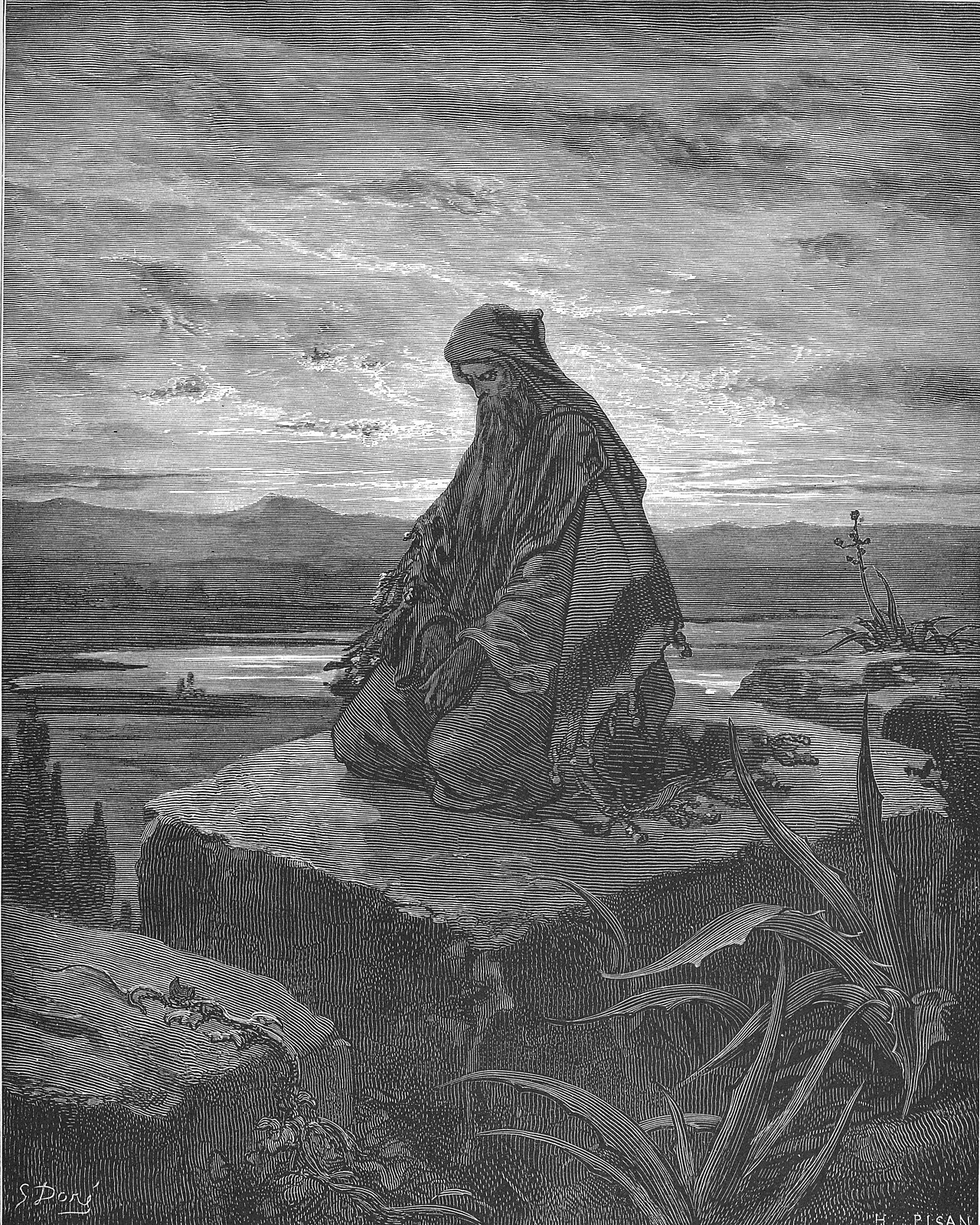
Isaiahchapter 43
28 verses · Isaiah · 8th century BC · The Prophets
When you pass through the waters, I will be with you; and when you go through the rivers, they will not overwhelm you. When you walk through the fire, you will not be scorched; the flames will not set you ablaze.
Introduction
Isaiah, The Prophets, Isaiah Overview.
Isaiah wrote this chapter for exiles who knew the story of the escape from Egypt and could not see what it had to do with them. It is spoken as a promise to a people God says He formed and named as His own. The chapter moves between tender assurance and a sharp complaint about how little they had given Him. Listen for the old rescue at the sea retold in a line or two, and then for the command to stop looking backward. It closes on the reason God gives for forgiving them, which is His own sake.
Context
- Who
- Exiles who knew the Red Sea story and could not see how it applied to them
- What
- A promise of a second exodus, in which God ransoms, gathers and forgives His people.
- Where
- Spoken to the exiles in Babylon, with a road home through the desert.
- When
- Spoken about 700 to 690 BC by the book's own reading, and addressed to the years of the exile.
- Why
- To assure a guilty people that God will bring them home and blot out their sins for His own sake.
Historical context
The ransom language is commercial. God says he gave Egypt for Israel's ransom, and Cush and Seba in exchange. That is the language of a redemption price paid to buy back a person sold into slavery, and in the century after Isaiah spoke, Assyria did in fact conquer Egypt and Cush, which readers would come to see as the price being handed over.
Show the rest of the historical context, 4 more paragraphs
The old rescue is retold in one line of imagery: the LORD who makes a way in the sea and a path in the mighty waters, who brings out the chariot and horse, the army and the power, and they lie down together and do not rise, quenched like a wick. That is the Red Sea seen from the far bank.
Then the surprising instruction: do not remember the former things, or consider the things of old. For a people whose entire faith ran on remembering the Exodus, that is nearly shocking. The reason follows, behold, I do a new thing, now it springs forth, and I will make a road in the wilderness and rivers in the desert. The first exodus was through water and out of it. The second is through desert, with water added.
The animals in that desert are named as worshippers, which is an unusual touch: the wild beasts will honor me, the jackals and the ostriches, because I give waters in the wilderness to give drink to my people.
The complaint at the end is an accountant's complaint about the sacrificial system, and it is worth knowing what each item cost. You have not brought me the lamb of your burnt offerings, and you have not honored me with your sacrifices, and then, you have bought me no sweet cane with money. Aromatic cane was an imported ingredient of the holy anointing oil, and it had to be paid for. God says he never wore them out with demands for grain offerings or incense; what they gave him instead was their sins.
Significance
The opening promise is not that the water and fire will be cancelled. It is that when you pass through the waters I will be with you, and when you walk through the fire you will not be burned. Exiles were being told the route ran through, not around.
Show the rest of the significance, 1 more paragraph
And the reason given for the whole rescue is not their worth: I, even I, am he who blots out your transgressions for my own sake, and will not remember your sins. That is the ground they were standing on.
This chapter in Jewish lifeWhat this chapter is in Jewish life and reading.
What is done
Two Haftarot are drawn from this chapter, as the site's table in src/lib/hebraic/readings.ts records them. Its first ten verses close the Ashkenazi Haftarah of Bereshit, which runs from Isaiah 42:5 to 43:10 and is read with Genesis 1:1 to 6:8. The Sephardi reading of that week stops at 42:21. Its twenty-first verse opens the Haftarah of Vayikra in both rites, which runs from Isaiah 43:21 to 44:23 and is read with Leviticus 1:1 to 5:26, the laws of the offerings.
How it is read
Rashi is quoted here from The Judaica Press complete Tanach with Rashi, translated by A. J. Rosenberg, which Sefaria reports as CC-BY, and Ibn Ezra from the Commentary of Ibn Ezra on Isaiah translated by M. Friedlander in 1873, which Sefaria reports as public domain. Rashi reads the promises of this chapter through the Exodus. The waters Israel passes through are the Reed Sea (Rashi on Isaiah 43:2:1). Egypt was Israel's ransom because Egypt's firstborn died while Israel, God's firstborn, was spared though deserving of destruction, as Ezekiel 20:8 says (Rashi on Isaiah 43:3:1). The command at the eighteenth verse to remember not the former things he reads as an instruction for the future redemption. Of the miracles of Egypt Rashi writes, "do not remember them from now on, for you shall be engaged in this redemption, to thank and to praise" (Rashi on Isaiah 43:18:1).
The witnesses of the tenth verse are "and My servant Jacob", the people again (Rashi on Isaiah 43:10:1). The Haftarah of Bereshit ends at that verse in the Ashkenazi rite. Ibn Ezra reads the doubled I of the eleventh verse as God who does not change, as the heavens and the earth change (Ibn Ezra on Isaiah 43:11:1). He can therefore help at every time. At the nineteenth verse he weighs two readings of the new thing and chooses one. The capture of Babylon is no new thing, since Babylon had been taken before, so the new thing is that Israel alone escapes (Ibn Ezra on Isaiah 43:19:1).
The Haftarah of Vayikra begins at the twenty-first verse, and its portion opens the laws of the offerings. Rashi's notes here are about offerings withheld. Israel did not bring God the lambs of their burnt offerings, and brought them to idols (Rashi on Isaiah 43:23:1). They did not need to buy the fragrant cane for the incense, because "Cinnamon grew in the Land of Israel", as Rabbi Abba said in the Midrash on Lamentations (Rashi on Isaiah 43:24:1).
What the rabbis say
The corpus carries forty rabbinic locators on this chapter and the text of none, so each is cited by ref here and none is quoted or paraphrased. On the first verse it holds Aggadat Bereshit 8:4 and Aggadat Bereshit 84:2. On the second verse it holds Aggadat Bereshit 15:1 and Aggadat Bereshit 20:4. On the third verse it holds Aggadat Bereshit 13:3 and Mekhilta DeRabbi Shimon Ben Yochai 12:12. On the fourth verse it holds Bamidbar Rabbah 4:1 and Berakhot 62b:6. On the fifth verse it holds Midrash Tehillim 118:7 and Otzar Midrashim, Perek Shirah ('Chapter of Song') 1:14.
On the sixth verse it holds Bamidbar Rabbah 13:2 and Ein Yaakov, Menakhot 13:3. On the seventh verse it holds Avot DeRabbi Natan 41:16 and Bava Batra 75b:3. On the eighth verse it holds Tanna DeBei Eliyahu Rabbah 16:1. On the ninth verse it holds Avodah Zarah 2a:3 and Avodah Zarah 2a:8. On the tenth verse it holds Bereshit Rabbah 95:1 and Ein Yaakov (Glick Edition), Taanit 1:44.
On the eleventh verse it holds Sifrei Devarim 333:2. On the twelfth verse it holds Bereshit Rabbati, Parashat Bereshit 24 and Chagigah 16a:17. On the thirteenth verse it holds Bereshit Rabbah 36:2. On the fourteenth verse it holds Aggadat Bereshit 64:2 and Bamidbar Rabbah 7:10. On the fifteenth verse it holds Sifrei Aggadah on Esther, Midrash Panim Acherim, Version II 6:20.
On the sixteenth verse it holds Bereshit Rabbah 6:5 and Bereshit Rabbati, Parashat Bereshit 31. On the seventeenth verse it holds Mekhilta DeRabbi Shimon Ben Yochai 15:7. On the eighteenth verse it holds Berakhot 13a:1. On the nineteenth verse it holds Bamidbar Rabbah 23:4. On the twentieth verse it holds Chullin 64b:6.
On the twenty-first verse it holds Bamidbar Rabbah 5:6. On the twenty-second verse it holds Eikhah Rabbah, Petichta 10. On the twenty-third verse it holds Pesikta Rabbati 29:10. On the twenty-fourth verse it holds Midrash Tehillim 32:2. On the twenty-fifth verse it holds Midrash Tanchuma Buber, Shmini 6:1.
On the twenty-sixth verse it holds Pesikta Rabbati 40:1. On the twenty-seventh verse it holds Avot DeRabbi Natan, Recension B 25:5. On the twenty-eighth verse it holds Eikhah Rabbah 2:5. What each of them teaches is a saying of the rabbis, and it is reported as theirs wherever this site quotes one. The quotations wait on a fetch that carries the text.
Sources: Rashi, Rashi on Isaiah 43:1:1 to 43:24:1, The Judaica Press complete Tanach with Rashi, translated by A. J. Rosenberg, reported CC-BY; Ibn Ezra, Ibn Ezra on Isaiah 43:5:1 to 43:19:1, Commentary of Ibn Ezra on Isaiah, translated by M. Friedlander, 1873, reported public domain; The Sefaria corpus, scripts/data/sources/sefaria/isaiah/43.json, the 40 Talmud and Midrash locators of this chapter; The site's own files, src/lib/hebraic/readings.ts, the Haftarah of Bereshit (Ashkenazi, Isaiah 42:5 to 43:10) and of Vayikra (both rites, Isaiah 43:21 to 44:23), and src/data/bible/chapter-verse-counts.json for the verse count.
The heads below are this chapter's scenes. The numbered points under each are its verses.
When Thou Passest Through the Waters I Will Be With Thee
Isaiah 43:1-2
I have called you by your name: The command Do not fear rests on a claim of ownership, I have called you by your name, you are Mine. The waters and the fire name two deliverances, the sea crossed and a fire still ahead. The commentators set this beside the three men Nebuchadnezzar threw into the furnace.
Isaiah 43:1
“But now - This expression shows that this chapter is connected with the preceding. The sense is, “Though God has punished the nation, and showed them his displeasure Isa 42:24-25, yet now he will have mercy, and will deliver them.’ That created thee - The word ‘thee’ is used here evidently in a collective sense as denoting the Jewish people. It is used because the names ‘Jacob’ and ‘Israel’ in the singular number are applied to the people.”
When you walk through the fire: Gill records that the Targum and Jarchi read the waters as the Red Sea crossing, and Kimchi as the armies of Sennacherib. Barnes reads one general promise. Waters, rivers, fire and flames cover every danger Israel would pass through, and the promise was given to comfort the exiles in Babylon.
Isaiah 43:2
“When thou passest through the waters - This is a general promise, and means that whenever and wherever they should pass through water or fire, he would protect them. It had been true in their past history as a people; and the assurance is here given in order that they might be comforted in view of the calamities which they were then suffering in Babylon.”
Isaiah 43:3-4
the Holy One of Israel, your Savior: Verse 3 names God three ways, the LORD your God, the Holy One of Israel, your Savior. I give Egypt for your ransom sets great nations as the price of one small people. Verse 4 gives the reason, Because you are precious and honored in My sight.
Isaiah 43:3
“God chose that Egypt, though so much more mighty, should be destroyed, in order that His people might be delivered; thus Egypt stood, instead of Israel, as a kind of "ransom." The Hebrew, kopher, means properly "that with which anything is overlaid," as the pitch with which the ark was overlaid; hence that which covers over sins, an atonement.”
Jamieson, Fausset & Brown · Commentary Critical and Explanatory on the Whole Bible (1871)reformed
1 more voice on this verse
Isaiah 43:3
“I gave Egypt - This was fulfilled when the king of Assyria, Esar-haddon, who designed to revenge his father's disgrace, upon the Jews, was diverted and directed by God to employ his forces against Egypt, and Ethiopia, and Seba.”
John Wesley · Explanatory Notes upon the Old Testament (1765)evangelical
precious and honored in My sight: Jamieson, Fausset and Brown, following Maurer, read the verse's opening as reaching back to the start of Israel's story. Israel was always precious in the LORD's sight. Barnes takes the honor as a gift, its place as keeper of God's truth, and so the word says little about Israel's character.
Isaiah 43:4
“Since thou wast precious in my sight - This verse contains another reason why God would defend and deliver them. That reason was, that he had loved them as his people; and he was willing, therefore, that other people should be overcome in order that they might be saved. Thou hast been honorable - This does not refer so much to their personal character, as to the fact that they had been honored by him with being the depository of the precious truths of his religion.”
1 more voice on this verse
Isaiah 43:4
“Since--All along from the beginning; for there was never a time when Israel was not Jehovah's people. The apodosis should be at, "I will give." "Since ever thou wast precious in My sight, honorable, and that I loved thee, I will give," &c. [MAURER].”
Jamieson, Fausset & Brown · Commentary Critical and Explanatory on the Whole Bible (1871)reformed
Isaiah 43:5-7
for I am with you: Do not be afraid returns with a wider promise, a scattered people gathered from the east and the west. The LORD tells the north, Give them up. Verse 7 gives the reason, everyone called by My name and created for My glory, whom I have indeed formed and made.
Isaiah 43:5
“Fear not - (see the note at Isa 41:10, Isa 41:14; compare Isa 43:1). I will bring thy seed - Thy children; thy descendants. The sense is, I will re-collect my scattered people from all parts of the world. The passage appears to have been taken from Deu 30:3, where God promises to gather his people together again if they should be scattered among the nations, and should then repent. Vitringa understands this of the spiritual descendants of the Jews, or of those who should believe on the Messiah among the Gentiles, and who should become the people of God.”
1 more voice on this verse
Isaiah 43:5
“And if this was reckoned so great a thing, to give Egypt for their ransom, what reason have we to admire God's love to us in giving his own Son to be a ransom for us! What are Ethiopia and Seba, all their lives and all their treasures, compared with the blood of Christ?”
Matthew Henry · Commentary on the Whole Bible (1707-1721)puritan
I will say to the north: Spurgeon preached this verse as a command the LORD speaks to whole nations, each told to give up the sons and daughters it holds. He read it toward a future return of the Jews to their own land. At one word from God, every hindrance is removed.
Isaiah 43:6
“IN THE FULLNESS of the promised days when the Jews shall be restored from their wanderings, and all the seed of Jacob shall again meet in their own land, God in his mighty providence will speak to all the nations, saying: “To the north, Give up; and to the south, Keep not back;” and at the divine bidding free passage shall be given, all lets and hindrances shall be removed, and his own people shall come to their own land.”
everyone called by My name: Barnes explains a son bears his father's name, so a people called by the LORD's name are counted as his children, as in Isaiah 44:5. Eusebius reads the name further. For him the verse foretells the name Christian, taken from the name of Christ.
Isaiah 43:7
“Every one that is called by my name - To be called by the name of anyone, is synonymous with being regarded as his son, since a son bears the name of his father (see Isa 44:5; Isa 48:1). The expression, therefore, means here, all who were regarded as the children of God; and the promise is, that all such should be re-gathered to their own land. For I have created him - (See the note at Isa 43:1). For my glory - In order to show forth, and illustrate my glory.”
1 more voice on this verse
Isaiah 43:7
“If it is necessary for some to be marked by name, then I will make it clear to them all that they are now "those who have been called by my name." From where else did the name of Christians come than from the name of Christ? For it was he who foretold such a thing through the prophet.”
Eusebius of Caesarea · written before 339 · Commentary on Isaiah 2:24patristic
Ye Are My Witnesses: Before Me No God Was Formed
Isaiah 43:8-9
a people who have eyes but are blind: The trial scene opens with Israel summoned as a witness, Bring out a people who have eyes but are blind. That blindness was first named in Isaiah's commission at 6:10, and verse 9 gathers the nations into a courtroom. They may present their witnesses, and the test is prediction itself.
Isaiah 43:8
“Their gods have eyes and see not, ears and hear not, and those that make them and trust in them are like unto them; so David had said ( Ps. cxv. 8 ), to which the prophet seems here to refer when he calls idolaters blind people that have eyes, and deaf people that have ears.”
Matthew Henry · Commentary on the Whole Bible (1707-1721)puritan
1 more voice on this verse
Isaiah 43:8
“Solemn challenge given by God to the nations to argue with Him the question of His superiority to their idols, and His power to deliver Israel (Isa 41:1). blind people--the Gentiles, who also, like Israel (Isa 42:19), are blind (spiritually), though having eyes; that is, natural faculties, whereby they might know God (Ro 1:20, 21) [LOWTH].”
Jamieson, Fausset & Brown · Commentary Critical and Explanatory on the Whole Bible (1871)reformed
Let them present their witnesses: Barnes ties this hearing to the first one in 41:21 and 22, where the idols were summoned to declare the former things and none answered. Aquinas reads the assembled nations as agreed in one error, their idolatry. The scene is a judgment that exposes their gods as false.
Isaiah 43:9
“Let all the nations be gathered together - Let them be assembled to give evidence, or to adduce proofs that their idols are worthy of confidence Isa 41:1. Who among them can declare this? - Who among them hath predicted this state of things? Who has foretold the events which are now occurring? It is implied here, that Yahweh had done this, but none of the pagan gods had done it (see the note at Isa 41:21). And show us former things - (see the note at Isa 41:22).”
Isaiah 43:10-11
You are My witnesses, and Israel is the exhibit in the trial. The claim the trial exists to prove follows, Before Me no god was formed. Verse 11 makes it absolute, I, yes I, am the LORD, and Calvin and Barnes note the doubled I as Hebrew emphasis.
Isaiah 43:10
“Ye (the Israelites) are my witnesses, and my servant (the prophet) whom I have chosen - That whatever has been said before concerning Sennacherib has been literally fulfilled. The prophet had predicted it; the Israelites saw it accomplished. Before me there was no God formed, neither shall there be after me - This is a most difficult place. Was there a time when God was not? No! Yet he says, before me. Will there be a time in which God will not exist? No! Yet he says, after me. Are not all these words to be referred to his creation?”
Adam Clarke · Commentary on the Bible (1810-1826)evangelical
2 more voices on this verse
Isaiah 43:10
“Ye - You my people are able to witness for me, that I have given you plain demonstrations of my certain knowledge of future events. My servant - Cyrus who is an eminent instance and proof of God's foreknowledge: or, the Messiah, who is the most eminent witness in this cause.”
John Wesley · Explanatory Notes upon the Old Testament (1765)evangelical
Isaiah 43:10
“Ye--the Jews, to whom I have given predictions, verified by the event; and in delivering whom I have so often manifested My power (see Isa 43:3, 4; Isa 44:8). and my servant--that is, the whole Jewish people (Isa 41:8). believe--trust in. formed--before I existed none of the false gods were formed. "Formed" applies to the idols, not to God.”
Jamieson, Fausset & Brown · Commentary Critical and Explanatory on the Whole Bible (1871)reformed
there is no Savior but Me: Gill reads the title Savior in two senses, rescue from the present trouble in Babylon and an everlasting salvation. The gods of the nations could give neither. Gill sets the verse beside the New Testament's name for Jesus as Savior and takes it as evidence that Christ is God.
Isaiah 43:11
It has been sufficiently demonstrated that God exists and that his essence is incomprehensible. Furthermore, those who believe in sacred Scripture have no doubt that he is one and not several. For the Lord says at the beginning of his lawgiving, "I am the Lord your God, who brought you out of the land of Egypt. You shall not have strange gods before me." And again: "Hear, O Israel: the Lord your God is one Lord."
John Damascene · written before 749 · Orthodox Faith 1:5patristic
1 more voice on this verse
Isaiah 43:11
“I, even I, am the Lord,.... Jehovah, the self-existing, eternal, and immutable Being; this is doubled for the confirmation of it, and to exclude all others: and besides me there is no Saviour; either in a temporal or spiritual sense; the gods of the Heathens could not save them out of their present troubles, and much less save them with an everlasting salvation; none but God can do this, and this is a proof that Christ is God, since none but God can be a Saviour.”
Isaiah 43:12-13
I alone decreed and saved and proclaimed lists three acts the LORD alone performed, with no foreign god among Israel to claim a part. Verse 13 carries the claim before time, Even from eternity I am He. The closing question dares any power, When I act, who can reverse it?
Isaiah 43:12
“I have declared - I have announced or predicted future events; I have warned of danger; I have marked out the path of safety. He had thus shown that he was the true God (see the note at Isa 41:22-23). And have saved - I have delivered the nation in former times of danger, and have thus shown that I would protect them. And have showed - Hebrew, ‘Caused to hear.’ I have made known future events, and have thus showed that I was God.”
2 more voices on this verse
Isaiah 43:12
“I showed when there was no strange god among you, that is, when you pretended not to consult any oracles but mine, nor to have any prophets but mine." It is said, when they came out of Egypt, that the Lord alone did lead him, and there was no strange god with him. [2.] He has an infinite and irresistible power, as is evident from the performances of his providence.”
Matthew Henry · Commentary on the Whole Bible (1707-1721)puritan
Isaiah 43:12
“I have declared, and have saved - My prophets have always predicted your deliverances before they took place; and I have fulfilled their words to the uttermost.”
Adam Clarke · Commentary on the Bible (1810-1826)evangelical
none can deliver out of My hand: Cyril of Alexandria hears the promise of John 10, that no one can snatch the sheep of Christ out of the Father's hand. Barnes reads the opening as eternity. The Septuagint and the Vulgate render it from the beginning, and a God who acts before time began has no rival.
Isaiah 43:13
"I will act, and who will hinder it?" For I have accomplished the calling of the nations, he says, that is, I have saved those who were led astray. And who can alter this, or who could change things so that they did not happen? The Savior himself assures us that no one can snatch those who are being saved from the hand of God. "For my sheep hear my voice, and I know them; and they follow me, and I give them eternal life."
Cyril of Alexandria · written before 444 · Commentary on Isaiah 4:1.43:11-13patristic
1 more voice on this verse
Isaiah 43:13
“Yea, before the day was - Before the first day, or before the beginning of time; from eternity. The Septuagint renders it correctly, Ἀπ ̓ ἀρχης Ap' archēs, and the Vulgate (Ab initio), ‘From the beginning.’ I am he - I am the same Isa 43:10. I will work - I will accomplish my designs. And who shall let it? - Margin, as Hebrew, ‘Turn it back.’ The meaning is, ‘Who can hinder it?’ And the doctrine taught here is: 1. That God is from everlasting, for if he was before time, he must have been eternal.”
Behold, I Do a New Thing: Rivers in the Desert
Isaiah 43:14-15
For your sake, I will send to Babylon turns the trial toward judgment on Israel's captor. Verse 15 sets four titles on one subject, I am the LORD, your Holy One, the Creator of Israel, and your King. The verse binds the covenant name to creation and to royal rule.
Isaiah 43:14
“Thus saith the Lord, your Redeemer,.... That redeemed Israel out of Egypt, and would redeem the Jews from Babylon in a short time, and be the author of a greater redemption to his people than either of these, even a spiritual and eternal one: the Holy One of Israel; see Isa 43:3, holy in himself, holiness to Israel, and faithful to his promises: for your sake I have sent to Babylon: Cyrus and his army to take it, in order to deliver the Jews from their captivity in it.”
2 more voices on this verse
Isaiah 43:14
“The Chaldeans, whose cry is on the ships “The Chaldeans exulting in their ships” - Babylon was very advantageously situated both in respect to commerce, and as a naval power. It was open to the Persian Gulf by the Euphrates, which was navigable by large vessels; and being joined to the Tigris above Babylon by the canal called Naharmalca or the Royal River, supplied the city with the produce of the whole country to the north of it, as far as the Euxine and Caspian seas, Herod. 1:194. Semiramis was the foundress of this part also of the Babylonian greatness.”
Adam Clarke · Commentary on the Bible (1810-1826)evangelical
Isaiah 43:14
“Babylon was on the Euphrates, which was joined to the Tigris by a canal, and flowed into the Persian Gulf. Thus it was famed for ships and commerce until the Persian monarchs, to prevent revolt or invasion, obstructed navigation by dams across the Tigris and Euphrates.”
Jamieson, Fausset & Brown · Commentary Critical and Explanatory on the Whole Bible (1871)reformed
Barnes ties these titles to the fall of Babylon in verse 14. The overthrow of Israel's captors would prove that the LORD alone is God, and their God. He shows his right to rule as Israel's King by delivering his people from their enemies.
Isaiah 43:15
“I am the Lord - I am Yahweh - proved to be such, as the connection demands that we should interpret this, by sending to Babylon and bringing down your oppressors. This interposition in destroying Babylon would be a demonstration that he was Yahweh, the only true God, and their God. The Creator of Israel - (See the note at Isa 43:1). Your King - Ruling over you, and showing the right to do it by delivering you from your foes.”
Isaiah 43:16-17
who makes a way in the sea: The LORD is named by the Red Sea crossing, who makes a way in the sea. Verse 17 recalls the other half of that crossing, the chariots and horses of Pharaoh's army. The two verses hold the whole exodus, a path for one people and ruin for the other.
Isaiah 43:16
“Although these things were done to the Babylonians and Chaldeans, prophetically speaking, the future things that are "not yet" shall be as if already accomplished. God has completed these by himself, comparing the present events with those that happened earlier: I showed my divinity to those in Egypt and led my people through the Red Sea.”
Eusebius of Caesarea · written before 339 · Commentary on Isaiah 2:25patristic
2 more voices on this verse
Isaiah 43:16
“Thus saith the Lord - This verse contains a reference to the deliverance from Egyptian servitude - the great storehouse of argument and illustration with the sacred writers; the standing demonstration of God’s merciful interposition in behalf of their nation, and proof that he was their God. Which maketh - Whose characteristic it is to open a path of safety for his people even when deep and rapid floods are before them The standing roof of this which undoubtedly the prophet had in his eye, was the deliverance from Egypt.”
Isaiah 43:16
“He that did this can, if he please, make a way for you in the sea when you return out of Babylon, and will do so rather than leave you there." Note, For the encouragement of our faith and hope, it is good for us often to remember what God has done formerly for his people against his and their enemies.”
Matthew Henry · Commentary on the Whole Bible (1707-1721)puritan
snuffed out like a wick: Jerome reads the lying down as an eternal sleep for the army of Pharaoh under the sea. He dwells on the speed of it. A wick of flax is extinguished in a moment, and in the same way the chariots, horses and warriors of Egypt perished in an instant.
Isaiah 43:17
“Which bringeth forth the chariot and horse - The reference here is, undoubtedly, to the occurrences which are recorded in Exo 14:4, following, when Pharaoh and his host are said to have followed the Israelites, but were all submerged in the sea. God is said to have brought them forth in accordance with the general statement so often made, that he controls and directs princes and nations (see the note at Isa 10:5-6). They shall lie down together - They shall sink together to death, as Pharaoh and his army sunk together in a watery grave.”
3 more voices on this verse
Isaiah 43:17
“Which bringeth forth the chariot and the horse, the army and the power,.... Who brought forth the chariots and horses, and the mighty army of Pharaoh, out of Egypt, to pursue the Israelites into the Red sea, where they were drowned.”
Isaiah 43:17
“And as to the destruction of their enemies, who brought forth the chariot, the chariots of Pharaoh: his chosen captains are drowned in the Red Sea (Exod 15:4); as flax, cut down in a moment.”
Thomas Aquinas · written before 1274 · Commentary on Isaiahpatristic
Isaiah 43:17
“Lay down - In the bottom of the sea. They never rose again to molest the Israelites. Quenched - As the wick of a candle when it is put into the water, is extinguished.”
John Wesley · Explanatory Notes upon the Old Testament (1765)evangelical
Isaiah 43:18-19
Do not call to mind the former things tells the exiles to stop looking back. I am about to do something new answers the future half of the challenge posed at verse 9. I will make a way in the wilderness answers the way in the sea of verse 16.
Isaiah 43:18
“Plainly the future restoration of Israel is the event ultimately meant. Thus the "former things" are such events as the destruction of Sennacherib and the return from Babylon. "Things of old" are events still more ancient, the deliverance from Egypt and at the Red Sea, and entry into Canaan [VITRINGA].”
Jamieson, Fausset & Brown · Commentary Critical and Explanatory on the Whole Bible (1871)reformed
1 more voice on this verse
Isaiah 43:18
“Remember not - Tho' your former deliverance out of Egypt was glorious: yet in comparison of that inestimable mercy of sending the Messiah, all your former deliverances are scarce worthy of your remembrance and consideration.”
John Wesley · Explanatory Notes upon the Old Testament (1765)evangelical
about to do something new: The LORD says, “Behold, I am about to do something new”, and names it, “a way in the wilderness and streams in the desert”. At the exodus one stream poured from the rock, and here many streams flow, a contrast Jerome draws, as Jamieson, Fausset and Brown quote him.
Isaiah 43:19
"I will open a way, not merely in the Red Sea, but in the wilderness of the whole world; and not merely one river shall gush out of the rock, but many, which shall refresh, not the bodies as formerly, but the souls of the thirsty, so that the prophecy shall be fulfilled: 'With joy shall ye draw water out of the wells of salvation'" [JEROME].
Jamieson, Fausset & Brown · Commentary Critical and Explanatory on the Whole Bible (1871)reformed
Isaiah 43:20-21
The beasts of the field will honor Me: widens the new thing to creation. The reason is the LORD's care for His people, because I provide water in the wilderness. Verse 21 states the purpose, The people I formed for Myself will declare My praise, the note verse 7 sounded.
Isaiah 43:20
“The beast of the field shall honor me - The sense of this passage is plain, and the image is highly poetical and beautiful. God would pour such copious floods of waters through the waste sandy deserts to supply his people, that even the wild beasts would be sensible of his abundant goodness, and would break forth into thanksgiving and praise for the unusual supply. The dragons - (See the note at Isa 13:22).”
1 more voice on this verse
Isaiah 43:20
“The beast of the field shall honor me “The wild beast of the field shall glorify me” - The image is elegant and highly poetical.”
Adam Clarke · Commentary on the Bible (1810-1826)evangelical
The people I formed for Myself: The verse states Israel's purpose, “The people I formed for Myself will declare My praise”. The LORD names its end, which Matthew Henry calls its first cause and its highest end. Jeremiah 13:11 gives the same purpose, that Israel “might be My people for My renown and praise and glory”.
Isaiah 43:21
“He that is the first cause is the highest end both of the first and of the new creation. The Lord has made all things for himself, his Israel especially, to be to him for a people, and for a name, and for a praise; and no otherwise can they be for him, or serviceable to him, than as his grace is glorified in them, Jer. xiii.”
Matthew Henry · Commentary on the Whole Bible (1707-1721)puritan
Thou Hast Wearied Me with Thine Iniquities
Isaiah 43:22-24
you have not called on Me, O Jacob: The trial turns to Israel's own worship, you have not called on Me, O Jacob, because you have grown weary of Me, O Israel. You have burdened Me with your sins, where the Hebrew verb is the verb of service, so Israel made God serve its iniquities.
Isaiah 43:22
“God's goodness takes occasion from man's badness to appear so much the more illustrious. Where sin abounded, grace did much more abound ( Rom. v. 20 ), and mercy rejoices against judgment, as having prevailed and carried the day, Jam. ii.”
Matthew Henry · Commentary on the Whole Bible (1707-1721)puritan
You have not brought Me sheep: Barnes notes that the Hebrew word for sheep here, seh, names any animal of the flock, a sheep or a goat. Such sheep were the daily burnt offerings the law required in Exodus 29:38 and Numbers 28:3. Barnes reads the charge as Israel withholding the offerings God commanded.
Isaiah 43:23
“Thou hast not brought me - As a people you have witcheld from me the sacrifices which were commanded. They had not maintained and observed his worship as he had required. The small cattle - Margin, ‘Lambs,’ or ‘kids.’ The Hebrew word (שׂה s'eh) denotes properly one of a flock - a sheep or a goat. It should have been so rendered here. These animals were used for burnt-offerings, and the Jews were required to offer them daily to God. Of thy burnt-offerings - (Compare Exo 29:38; Num 28:3). The burnt-offering was wholly consumed on the altar.”
sweet cane with your silver: Sweet cane is the calamus of Exodus 30. It went into the anointing oil and the incense, and Barnes notes it grew abroad and had to be bought with silver. Gill says the people thought it too costly and left it out, while their sins burdened the LORD far more.
Isaiah 43:24
“Thou hast bought me no sweet cane with money,.... Or "calamus" (r), which was used in the anointing oil, and for the perfume or incense, Exo 30:7, this they thought too expensive, and so left it out of the composition, or neglected the whole this being put a part for the whole.”
1 more voice on this verse
Isaiah 43:24
“Thou hast bought me - You have not purchased this - implying that it was not produced in Palestine, but was an article of commerce. It was to be obtained only from abroad.”
Isaiah 43:25-28
He who blots out your transgressions: I, yes I, am He who blots out your transgressions answers the accusation with pardon, the doubled I of verse 11 now spent on forgiveness. Remind Me, let us argue the matter together reopens the courtroom. The last verses name failure across generations, Your first father sinned.
Isaiah 43:25
“You see these texts are all alike in their declaration that the Lord will not remember His people's sins. I have taken four of them to make the basis of my sermon firm as adamant. It is written, "In the mouth of two or three witnesses every word shall be established." Here then, you have Isaiah and Jeremiah, two Old Testament saints, affirming the same thing—is this not enough? Added to these, you have the author of the Epistle to the Hebrews, who, in all probability, was Paul, and these three agree in one.”
1 more voice on this verse
Isaiah 43:25
“I, even I, am he - This verse contains a gracious assurance that their sins would be blotted out, and the reason why it would be done. The pronoun ‘I’ is repeated to make it emphatic, as in Isa 43:11. Perhaps also God designs to show them the evil of the sins which are mentioned in the previous verses, by the assurance that they were committed against him who alone could forgive, and who had promised them pardon.”
State your case: Jamieson, Fausset and Brown compare Jacob at Peniel in Genesis 32, pleading back to God the promise. Isaiah 62:6 names such people the LORD's remembrancers. Jerome reads the call as a call to confess, holding that a sinner is vindicated by owning the sin and by the mercy of God.
Isaiah 43:26
We are just when we acknowledge that we are sinners, and our justice depends not on our personal merit but rather on the mercy of God, as holy Scripture says: "The just is an accuser of himself in the beginning of his plea." And in another place, "State your sins, that you may be justified."
Jerome · written before 420 · Against the Pelagians 1.13patristic
1 more voice on this verse
Isaiah 43:26
“So Jacob did at Mahanaim and Peniel (Ge 32:9, 12). God, then, instead of "pleading against us with His great power," "will put His strength" in us (Job 23:6); we thus become "the Lord's remembrancers" (Isa 62:6, Margin). "Declare God's righteousness" vindicated in Jesus Christ "that thou mayest be justified" (Ro 3:26; compare Isa 20:1-6, and Ps 143:2).”
Jamieson, Fausset & Brown · Commentary Critical and Explanatory on the Whole Bible (1871)reformed
Your first father sinned: Readers differ on the first father who sinned. Gill records that Kimchi names Adam and Jarchi names Abraham, the father Israel trusted and boasted in. Matthew Henry reads the forefathers of Jacob in general, and Theodoret hears the LORD telling Israel that their fathers and priests rebelled against him.
Isaiah 43:27
“Thy first father hath sinned,.... Either Adam, as Kimchi, in whom all have sinned, and from whom all derive a sinful and corrupt nature; or Abraham, as Jarchi, the father of the Jewish nation, of whom they boasted, and in whom they trusted, as being of his seed, and through whose merits and worthiness they expected great things; yet he was but a sinful man, though a good man, and a great believer; of whose infirmity and frailty many instances are on record.”
1 more voice on this verse
Isaiah 43:27
“That they were children of disobedience; for their first father (that is, their forefathers) had sinned; and they had not only sinned in their loins, but sinned like them. Ezra confesses this: Since the days of our fathers have we been in a great trespass, ch. ix.”
Matthew Henry · Commentary on the Whole Bible (1707-1721)puritan
disgrace the princes of your sanctuary: These princes are the priests of the sanctuary, as in 1 Chronicles 24:5. Jamieson, Fausset and Brown give the Hebrew behind destruction as cherem, a ban that devoted Jacob and Israel to ruin and reproach. Clarke follows the Syriac and the Septuagint, which read that Israel's princes disgraced the sanctuary.
Isaiah 43:28
“I have profaned the princes of the sanctuary “Thy princes have profaned my sanctuary” - Instead of ואחלל שרי vaachallel sarey, read ויחללו שריך vayechalelu sareycha. So the Syriac and Septuagint, και εμιαναν οἱ αρχοντες τα ἁγια μου, “the rulers have defiled my holy things.” קדשי kodshi, Houbigant. Οἱ αρχοντες σου, “thy rulers, “MSS. Pachom. and 1. D. 2 and Marchal. To reproaches “To reproach” - לגדופה ligeduphah, in the singular number; so an ancient MS. and the Septuagint, Syriac, and Vulgate. And, alas! what a curse do they still bear, and what reproach do they still suffer!”
Adam Clarke · Commentary on the Bible (1810-1826)evangelical
1 more voice on this verse
Isaiah 43:28
“I have esteemed, or treated, them as persons not sacred. I have left them to suffer the same treatment as the common people, stripped of their holy office and in captivity. princes of the sanctuary--"governors of" it (1Ch 24:5); directing its holy services; priests. curse--Hebrew, cherim, a "solemn anathema," or "excommunication." reproaches-- (Ps 123:3, 4).”
Jamieson, Fausset & Brown · Commentary Critical and Explanatory on the Whole Bible (1871)reformed
Keep studying
Studies10
People and groups1
Words12
Subjects2
Sources for this chapter
The summary
Jamieson, Fausset & Brown, Commentary Critical and Explanatory; John Calvin, Commentaries; John Wesley, Notes on the Old Testament and Matthew Henry, Complete Commentary.
The exposition
Adam Clarke, Commentary on the Bible; Albert Barnes; Charles Spurgeon, The Metropolitan Tabernacle Pulpit, Sermon No. 1007: “North and South” (lightly modernized text, CCEL edition); Cyril of Alexandria, COMMENTARY ON ISAIAH 4:1.43:11-13; Eusebius of Caesarea, COMMENTARY ON ISAIAH 2:24; Franz Delitzsch, Biblical Commentary on the Prophecies of Isaiah; Jamieson, Fausset & Brown, Commentary Critical and Explanatory on the Whole Bible; Jerome; John Calvin, Commentary on the Book of the Prophet Isaiah; John Gill; John Wesley, Explanatory Notes upon the Old Testament; Joseph Addison Alexander, Commentary on the Prophecies of Isaiah; Matthew Henry, Commentary on the Whole Bible; Theodoret of Cyrus, COMMENTARY ON ISAIAH 13:43.27 and Thomas Aquinas, Commentary on Isaiah.