
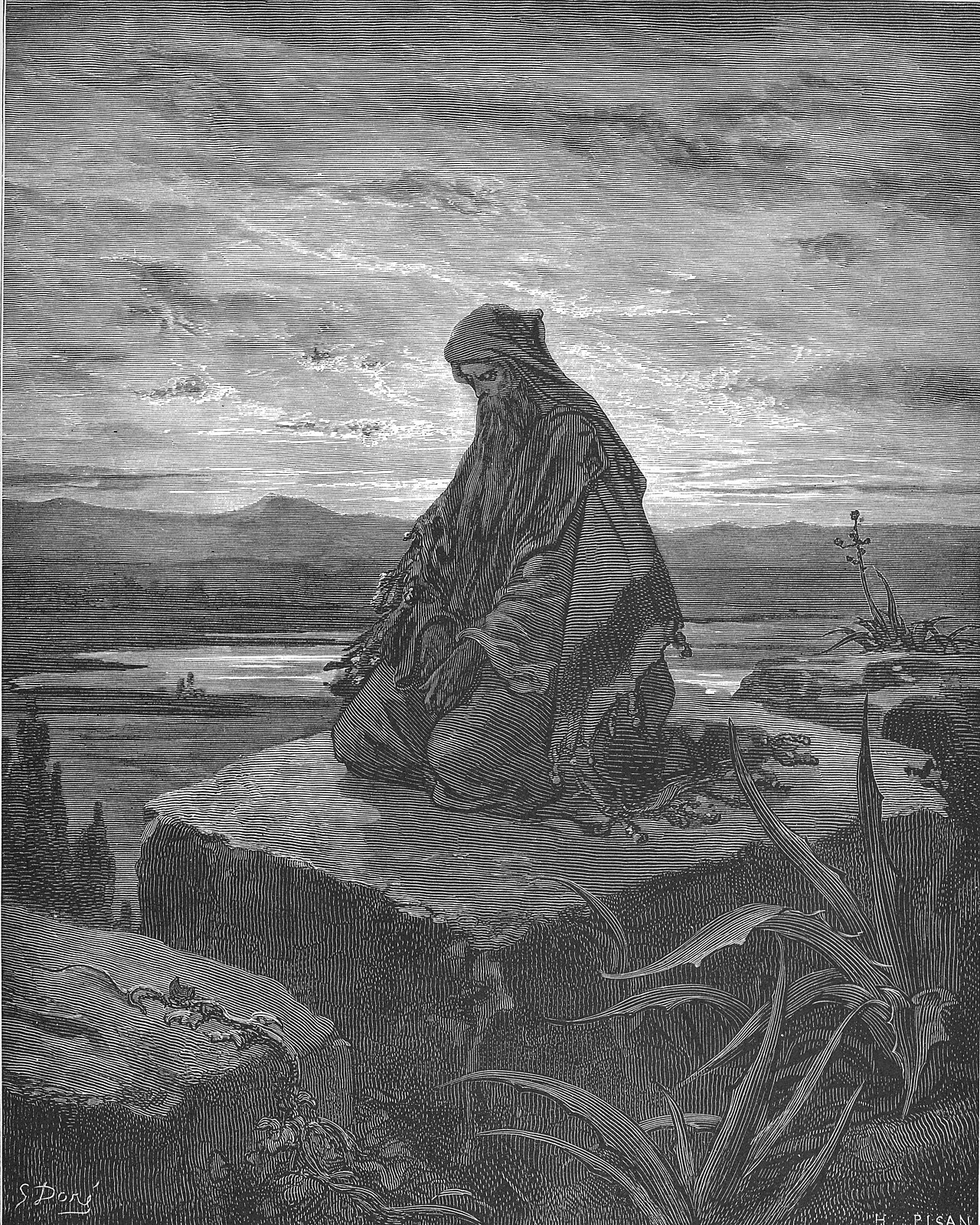
Isaiahchapter 40
31 verses · Isaiah · 8th century BC · The Prophets
A voice of one calling: “Prepare the way for the LORD in the wilderness; make a straight highway for our God in the desert.
Introduction
Isaiah, The Prophets, Isaiah Overview.
Isaiah son of Amoz spoke these words in Jerusalem, and they are addressed to a people he would not live to see, the Judeans carried away to Babylon a century later. Those hearers feared that the gods of their conquerors had beaten their own God, or that He had lost track of them. The chapter opens the second half of the book and answers that fear with a series of comparisons. Listen for the voices that call out one after another, and for the questions that set the LORD beside the nations, the idols and the stars. It ends on strength given to the tired.
Context
- Who
- Exiles who believed their God had been beaten by Babylon's
- What
- A message of comfort that sets the greatness of the LORD against the fear of an exiled people.
- Where
- Addressed to Jerusalem and to the Judean exiles in Babylon, with a road through the desert between them.
- When
- Spoken about 700 to 690 BC by the book's own reading, and addressed to the exile that began in 586 BC.
- Why
- To answer the complaint that God had forgotten His people, by showing that the Creator of the stars also carries the weak.
Historical context
From here the book speaks to people in exile as though they are standing in front of the prophet. Because of that, and because Cyrus is named a few chapters on, most critical scholars propose a second author writing in the 500s BC and often a third for the closing chapters. The position held here is the traditional one: Isaiah, writing in advance, exactly as he says a prophet should. Two facts are worth knowing on either view. Isaiah's God stakes his claim on being the one who tells the future before it happens, which he argues out in chapter 41. And the oldest complete copy of the book we possess, the Great Isaiah Scroll from the caves at Qumran, copied around 125 BC, runs from chapter 1 to chapter 66 as one continuous scroll, with no break, no seam, and no change of hand at chapter 40.
Show the rest of the historical context, 4 more paragraphs
The opening picture is a road gang. When a king traveled, crews went ahead to level the route, fill hollows, cut down high ground, and straighten the way, the great processional avenues of Babylon and Persia were built for exactly that. Isaiah has a voice crying in the wilderness to prepare that road, only the one arriving is the LORD himself, and every valley and mountain in the way is coming down.
The grass image is a specific weather event. When the sirocco blows in off the desert, green hillsides brown out in a day or two, the wind blows on it, the grass withers, the flower fades. That is the measurement Isaiah puts on all human strength, and against it he sets the one thing left standing: the word of our God shall stand forever.
The idol description is a workshop report. A craftsman casts the image, the goldsmith beats out gold plate to cover it, and silver chains are made to hold it. A man too poor for that chooses a wood that will not rot and hires a skilled workman to set it up so it will not topple over. The gods of the empire that conquered you have to be nailed down.
The last verses are astronomy and shepherding at once. He brings out the starry host by number and calls them all by name, and he gathers lambs in his arm and carries them in his chest, and gently leads those that are with young. A ewe near lambing cannot be driven at the flock's pace; a shepherd slows down for her.
Significance
The exiles' complaint is quoted: my way is hidden from the LORD, and my case is passed over by my God. They did not think he was cruel. They thought he had lost track of them.
Show the rest of the significance, 1 more paragraph
The answer runs through the whole chapter, he counts stars and carries lambs, and neither task tires him, and lands on the promise that those who wait on the LORD renew their strength, mount up with wings like eagles, run and not be weary, walk and not faint. Notice the order: flying, running, and then walking, which is the hardest of the three to keep doing.
This chapter in Jewish lifeWhat this chapter is in Jewish life and reading.
What is done
This chapter is read aloud in the synagogue twice in the year, in both the Ashkenazi and the Sephardi rites, as the site's table in src/lib/hebraic/readings.ts records it. Its first twenty-six verses, Isaiah 40:1 to 40:26, are the Haftarah of the portion Va'etchanan, which reads Deuteronomy 3:23 to 7:11. Its last verses open the Haftarah of the portion Lech-Lecha, which reads Genesis 12:1 to 17:27, and that reading runs from Isaiah 40:27 to 41:16.
How it is read
Rashi is quoted here from The Judaica Press complete Tanach with Rashi, translated by A. J. Rosenberg, which Sefaria reports as CC-BY, and Ibn Ezra from the Commentary of Ibn Ezra on Isaiah translated by M. Friedlander in 1873, which Sefaria reports as public domain. Rashi marks this chapter as a turning point in the book. He says that "from here to the end of the Book are words of consolations", and the section break separates them from the prophecies of retribution (Rashi on Isaiah 40:1:1). The ones told to comfort are the prophets (Rashi on Isaiah 40:1:1). The voice in the wilderness is the Holy Spirit calling for the way to Jerusalem (Rashi on Isaiah 40:3:1). The valleys raised and mountains lowered make an even road for the return (Rashi on Isaiah 40:4:1).
The herald of Zion at the ninth verse is feminine in the Hebrew, while the herald of chapter 52 is masculine. Rashi draws a teaching from the difference: "if they are worthy, he will be as swift as a male". If they are not, he will delay his steps until the end (Rashi on Isaiah 40:9:1). Ibn Ezra reads the word of the Lord that stands for ever with a note on the verb, which he takes as lasting and beyond frustration (Ibn Ezra on Isaiah 40:8:1).
The questions of the twelfth to fourteenth verses Rashi reads as an argument from power to promise. The One who measured the waters "surely He has the power to keep these promises" (Rashi on Isaiah 40:12:1). He took counsel with the prophets, as with Abraham in Genesis 18:17, and with none of the nations (Rashi on Isaiah 40:14:1). The corpus carries twenty-four commentary entries on this chapter, and they reach the twenty-fourth of its thirty-one verses, so the verses of the second Haftarah drawn from it stand without a gloss here.
What the rabbis say
The corpus carries forty rabbinic locators on this chapter and the text of none, so each is cited by ref here and none is quoted or paraphrased. On the first verse it holds Bereshit Rabbah 100:9 and Bereshit Rabbah 97:3. On the second verse it holds Bereshit Rabbah 80:7 and Bereshit Rabbati, Parashat Bereshit 4. On the third verse it holds Aggadat Bereshit 68:1 and Otzar Midrashim, Baraita of Samuel HaKatan 1:38. On the fourth verse it holds Bamidbar Rabbah 1:2 and Devarim Rabbah 4:11. On the fifth verse it holds Aggadat Bereshit 23:2 and Mekhilta DeRabbi Yishmael, Tractate Pischa 12:13.
On the sixth verse it holds Midrash Lekach Tov, Exodus 22:20:3 and Midrash Tehillim 146:2. On the seventh verse it holds Midrash Tehillim 138:1. On the eighth verse it holds Bamidbar Rabbah 16:3 and Bereshit Rabbah 53:3. On the ninth verse it holds Aggadat Bereshit 80:1 and Midrash Tanchuma Buber, Toldot 16:2. On the tenth verse it holds Midrash Tanchuma Buber, Ki Tisa 20:2 and Midrash Tanchuma Buber, Noach 12:2.
On the eleventh verse it holds Midrash Sekhel Tov, Bereshit 33:13:3 and Midrash Sekhel Tov, Bereshit 33:14:3. On the twelfth verse it holds Aggadat Bereshit 21:1 and Bamidbar Rabbah 2:17. On the thirteenth verse it holds Midrash Lekach Tov, Numbers 12:1:1 and Otzar Midrashim, Midrashim of Rabbi Akiba, Aleph Bet of Rabbi Akiba (Version 1) 19. On the fourteenth verse it holds Tanna DeBei Eliyahu Rabbah 31:1. On the fifteenth verse it holds Bereshit Rabbah 99:7.
On the sixteenth verse it holds Bamidbar Rabbah 12:3. On the seventeenth verse it holds Aggadat Bereshit 29:1. On the eighteenth verse it holds Midrash Lekach Tov, Exodus 20:2:14. On the twenty-second verse it holds Bamidbar Rabbah 12:11. On the twenty-third verse it holds Kohelet Rabbah 8:17:1.
On the twenty-fourth verse it holds Bamidbar Rabbah 20:13. On the twenty-fifth verse it holds Midrash Lekach Tov, Deuteronomy 4:12:1. On the twenty-sixth verse it holds Aggadat Bereshit 65:2. On the twenty-seventh verse it holds Aggadat Bereshit 62:1. On the twenty-eighth verse it holds Aggadat Bereshit 23:4.
On the twenty-ninth verse it holds Bereshit Rabbah 25:3. On the thirtieth verse it holds Otzar Midrashim, The Order of Arakim 1:7. On the thirty-first verse it holds Aggadat Bereshit 38:1. What each of them teaches is a saying of the rabbis, and it is reported as theirs wherever this site quotes one. The quotations wait on a fetch that carries the text.
Sources: Rashi, Rashi on Isaiah 40:1:1 to 40:24:1, The Judaica Press complete Tanach with Rashi, translated by A. J. Rosenberg, reported CC-BY; Ibn Ezra, Ibn Ezra on Isaiah 40:5:1 to 40:23:1, Commentary of Ibn Ezra on Isaiah, translated by M. Friedlander, 1873, reported public domain; The Sefaria corpus, scripts/data/sources/sefaria/isaiah/40.json, the 40 Talmud and Midrash locators of this chapter; The site's own files, src/lib/hebraic/readings.ts, the Haftarah of Lech-Lecha (both rites, Isaiah 40:27 to 41:16) and of Va'etchanan (both rites, Isaiah 40:1 to 40:26), and src/data/bible/chapter-verse-counts.json for the verse count.
The heads below are this chapter's scenes. The numbered points under each are its verses.
Comfort Ye My People: a Voice Crying in the Wilderness
Isaiah 40:1-2
The second half of the book opens with a double command, Comfort, comfort My people, given to heralds who are sent to Jerusalem. They proclaim that her forced labor has been completed, and Barnes gives the Hebrew word behind forced labor the sense of hard service now discharged.
Isaiah 40:1
“Comfort ye, comfort ye my people - This is the exordium, or the general subject of this and the following chapters. The commencement is abrupt, as often happens in Isaiah and the other prophets. The scene where this vision is laid is in Babylon; the time near the close of the captivity. The topic, or main subject of the consolation, is stated in the following verse - that that captivity was about to end, and that brighter and happier days were to succeed their calamities and their exile.”
her forced labor has been completed: Speak tenderly renders a Hebrew idiom that Jerome keeps word for word, speak to the heart of Jerusalem. Hosea 2:14 uses it of wooing. Jamieson, Fausset and Brown read the double through Messiah, the true Israel, who received suffering enough to answer for all her sins.
Isaiah 40:2
“Messiah is the antitypical Israel (compare Mt 2:15, with Ho 11:1). He indeed has "received" of sufferings amply more than enough to expiate "for our sins" (Ro 5:15, 17). Otherwise (cry unto her) "that she shall receive (blessings) of the Lord's hand double to the punishment of all her sins" (so "sin" is used, Zec 14:19, Margin) [LOWTH].”
Jamieson, Fausset & Brown · Commentary Critical and Explanatory on the Whole Bible (1871)reformed
1 more voice on this verse
Isaiah 40:2
“Double for all her sins “Blessings double to the punishment” - It does not seem reconcilable to our notions of the Divine justice, which always punishes less than our iniquities deserve, to suppose that God had punished the sins of the Jews in double proportion; and it is more agreeable to the tenor of this consolatory message to understand it as a promise of ample recompense for the effects of past displeasure, on the reconciliation of God to his returning people.”
Adam Clarke · Commentary on the Bible (1810-1826)evangelical
Isaiah 40:3-5
The herald's cry is applied by all four Gospels to John the Baptist, at Matthew 3:3, Mark 1:3, Luke 3:4 and John 1:23. Every valley shall be lifted up, the language of leveling a highway for a royal procession. Luke's quotation runs on into the promise that follows.
Isaiah 40:3
“The voice of him that crieth - Lowth and Noyes render this, ‘A voice crieth,’ and annex the phrase ‘in the wilderness’ to the latter part of the sentence: A voice crieth, ‘In the wilderness prepare ye the way of Yahweh.’ The Hebrew (קורא קול qôl qôrē') will bear this construction, though the Vulgate and the Septuagint render it as in our common version. The sense is not essentially different, though the parallelism seems to require the translation proposed by Lowth. The design is to state the source of consolation referred to in the previous verses.”
1 more voice on this verse
Isaiah 40:3
“Mal 4:5, 6 cannot have received its exhaustive fulfilment in John; the Jews always understood it of the literal Elijah. As there is another consummating advent of Messiah Himself, so perhaps there is to be of his forerunner Elias, who also was present at the transfiguration. the Lord--Hebrew, Jehovah; as this is applied to Jesus, He must be Jehovah (Mt 3:3).”
Jamieson, Fausset & Brown · Commentary Critical and Explanatory on the Whole Bible (1871)reformed
Cross references
Isaiah 40:3
- Quoted inJohn 1:23John replied in the words of Isaiah the prophet: “I am a voice of one calling in the wilderness, ‘Make straight the way for the Lord.’”
John the Baptist self-identifies: 'I am the voice of one crying in the wilderness'
- Quoted inLuke 3:4“as it is written in the book of the words of Isaiah the prophet: “A voice of one calling in the wilderness, ‘Prepare the way for the Lord, make straight paths for Him.”
'The voice of one crying in the wilderness' (extended through Isa 40:5, 'all flesh shall see')
- Quoted inMark 1:2As it is written in Isaiah the prophet: “Behold, I will send My messenger ahead of You, who will prepare Your way.”
kathos gegraptai heading Mark's whole Gospel (composite frame, w/ Mal 3:1), the formula placed at a book's very threshold
- Quoted inMark 1:3“A voice of one calling in the wilderness, ‘Prepare the way for the Lord, make straight paths for Him.’”
'The voice of one crying in the wilderness'
- Quoted inMatthew 3:3This is he who was spoken of through the prophet Isaiah: “A voice of one calling in the wilderness, ‘Prepare the way for the Lord, make straight paths for Him.’”
'voice of one crying in the wilderness' applied to John the Baptist
ConnectionsMatthew 3:3
Every valley shall be lifted up: Clarke doubts the old rendering crooked for the Hebrew word and, with the Syriac, takes it as a hill. That reading gives the Berean its uneven ground. Matthew Henry turns the picture to the heart, lifting the valleys of the downcast and bringing low the mountains and hills of pride.
Isaiah 40:4
Crooked - The word עקב akob is very generally rendered crooked: but this sense of the word seems not to be supported by any good authority. Ludolphus, Comment. ad Hist. Aethiop. p. 206, says “that in the Ethiopia language it signifies clivus, locus editus:” and so the Syriac Version renders it in this place, ערמא arama: Hebrew, ערמה aramah, tumulus, acervus. Thus the parallelism would be more perfect:” the hilly country shall be made level, and the precipices a smooth plain.”
Adam Clarke · Commentary on the Bible (1810-1826)evangelical
all humanity together will see it: Barnes reads the glory as His power and faithfulness. It was revealed first in bringing the exiles home from Babylon, and more fully when the Messiah came. Ambrose sees it in Christ, in whom all humanity together saw the glory of the Father shine through a man.
Isaiah 40:5
“He [Christ] was a reproach but at the same time also the majesty of the Lord, as it is written, "And the glory of the Lord shall be revealed, and all flesh together shall see the salvation of God." What had he lost if he had nothing less? He had neither comeliness nor beauty, but he had not ceased to be the power of God. He appeared a man, but the divine majesty and glory of the Father shone on earth.”
Ambrose of Milan · written before 397 · LETTER 27patristic
1 more voice on this verse
Isaiah 40:5
“And the glory of the Lord - The phrase here means evidently the majesty, power, or honor of Yahweh. He would display his power, and show himself to be a covenant-keeping God, by delivering his people from their bondage, and reconducting them to their own land. This glory and faithfulness would be shown in his delivering them from their captivity in Babylon; and it would be still more illustriously shown in his sending the Messiah to accomplish the deliverance of his people in later days. And all flesh - All human beings.”
All Flesh Is Grass; He Shall Feed His Flock Like a Shepherd
Isaiah 40:6-8
A voice says, Cry out, and the answer judges all human strength, All flesh is like grass. The grass withers when the breath of the LORD blows on them. Verse 8 answers that frailty, the word of our God stands forever, and Peter quotes the saying at 1 Peter 1:24-25.
Isaiah 40:6
“The voice saint Cry “A voice saith Proclaim” - To understand rightly this passage is a matter of importance; for it seems designed to give us the true key to the remaining part of Isaiah’s prophecies, the general subject of which is the restoration of the people and Church of God.”
Adam Clarke · Commentary on the Bible (1810-1826)evangelical
Cross references
Isaiah 40:6
- Quoted in1 Peter 1:24“For, “All flesh is like grass, and all its glory like the flowers of the field; the grass withers and the flowers fall,”
'All flesh is as grass... but the word of the Lord endureth for ever'
the breath of the LORD blows: The Hebrew ruach can mean wind, breath or spirit. Barnes argues for wind, the gust that passes over a field and leaves its grass to wither. People fade the same way when God takes away their strength and beauty.
Isaiah 40:7
“The grass withereth - Soon withers. Its beauty is soon gone. The flower fadeth - Soon fades; or fades when the wind of Yahweh passes over it. So is also with man. He loses his vigor, and dies at once when Yahweh takes away his strength and beauty. Because the spirit of the Lord bloweth upon it - This should be rendered, undoubtedly, ‘When the wind of Yahweh bloweth upon it.’ The word ‘spirit’ here does not suit the connection, and does not express the idea of the prophet.”
1 more voice on this verse
Isaiah 40:7
“Third, he shows the firmness of the divine word, indeed the people is grass: heaven and earth shall pass away: but my words shall not pass away (Luke 21:33).”
Thomas Aquinas · written before 1274 · Commentary on Isaiahpatristic
Barnes reads the word of God here as His promise to deliver the captives, firm through every change among the nations. The repeated line about the grass gives that promise its weight. Aquinas sets the verse beside Luke 21:33, where Christ says His words will outlast heaven and earth.
Isaiah 40:8
“The grass withereth ... - This is repeated from the former verse for the sake of emphasis, or strong confirmation. But the word of our God - The phrase ‘word of our God,’ refers either to his promise to be the protector and deliverer of his people in their captivity, or, in general, means that all his promises shall be firm and unchanging. Shall stand for ever - Amidst all revolutions among men, his promise shall be firm.”
Isaiah 40:9-11
Zion herself becomes the herald, sent up on a high mountain to say to the cities of Judah, Here is your God. Two images stand together, His arm establishes His rule, and at once He tends His flock like a shepherd. The arm that rules is the arm that carries.
Isaiah 40:9
“O Zion, that bringest good tidings - This is evidently the continuance of what the ‘voice’ said, or of the annunciation which was to give joy to an afflicted and oppressed people. There has been, however, much diversity of opinion in regard to the meaning of the passage. The margin renders it, ‘Thou that tellest good tidings to Zion,’ making Zion the receiver, and not the publisher of the message that was to convey joy. The Vulgate, in a similar way, renders it, ‘Ascend a high mountain, thou who bringest good tidings to Zion’ (qui evangelizas Zion).”
His arm establishes His rule: Cyril of Alexandria reads the arm as the authority of Christ, the divine strength He showed in power and dominion. Barnes takes the reward and recompense that come with Him as the reward He brings for His people. Revelation 22:12 takes up the same words for the returning Christ.
Isaiah 40:10
“For our Lord Jesus Christ showed himself to us having divine strength, and his arm with authority, that is, with power and dominion.”
Cyril of Alexandria · written before 444 · LETTER 1:31patristic
He gathers the lambs in His arms: The arm that rules in verse 10 now carries the lambs, and the Hebrew uses the same word for both acts. Barnes pictures lambs too young to walk, held close to the heart of the shepherd. Clement of Alexandria took the lambs as believers in their simplicity.
Isaiah 40:11
“IN the chapter before us our Savior is described as Jehovah God. He is spoken of as clothed with irresistible power: "He shall come with strong hand, and His arm shall rule for Him," but, as if to soften a glory far too bright for the weak eyes of the trembling, the Prophet introduces the delightful words of the text: "He shall feed His flock like a shepherd: He shall gather the lambs with His arm, and carry them in His bosom, and shall gently lead those that are with young." Here is Divinity!”
2 more voices on this verse
Isaiah 40:11
“And that He also calls us lambs, the Spirit by the mouth of Isaiah is an unimpeachable witness: "He will feed His flock like a shepherd, He will gather the lambs with His arm,"—using the figurative appellation of lambs, which are still more tender than sheep, to express simplicity.”
Clement of Alexandria · written before 215 · The Instructor Book 1patristic
Isaiah 40:11
“He shall feed his flock - In the previous verse, the fact had been asserted that God would come to subdue his foes, and to reward his people. In this verse, the mild and gentle character of his government over his people is predicted. It would not be that of a conqueror over vanquished subjects; but it would be mild and tender, like that of a shepherd who carries the lambs, which are unable to walk, in his own arms, and gently leads along the feeble and the delicate.”
Who Hath Measured the Waters in the Hollow of His Hand?
Isaiah 40:12-14
measured the waters in the hollow of his hand: A string of questions sets out the wisdom behind creation. Who has measured the waters in the hollow of his hand, marked off the heavens with the span of his hand? No one has directed the Spirit of the LORD, since the LORD consulted no one in ordering the world.
Isaiah 40:12
“Who would deny that God has made these things, who spoke through the Prophet, saying: 'Who has measured the waters in the hollow of His hand, and marked off the heavens with a span, enclosed the dust of the earth in a measure, and weighed the mountains in scales and the hills in a balance, who has directed the Spirit of the Lord, or who has been his counselor or instructed Him?' We also read elsewhere: Because it holds the circuit of the earth and has made the earth as nothing.”
Ambrose of Milan · written before 397 · The Six Days of Creation, Book 1, Chapter 3patristic
1 more voice on this verse
Isaiah 40:12
“Who hath measured - The object in this and the following verses to Isa 40:26, is to show the greatness, power, and majesty of God, by strong contrast with his creatures, and more especially with idols. Perhaps the prophet designed to meet and answer an implied objection: that the work of deliverance was so great that it could not be accomplished.”
directed the Spirit of the LORD: Barnes observes that the verb rendered directed is the one verse 12 uses for marking off the heavens. The One who measures is measured by no one, and the Septuagint that Jerome sets out reads, who has measured the Spirit of the Lord. Paul quotes the question at Romans 11:34.
Isaiah 40:13
“Who hath directed - This passage is quoted by Paul in Rom 11:34, and referred to by him in 1Co 2:16. The word rendered ‘directed’ here (תכן tikēn) is the same which is used in the previous verse, ‘and meted out heaven.’ The idea here is, ‘Who has fitted, or disposed the mind or spirit of Yahweh? What superior being has ordered, instructed, or disposed his understanding? Who has qualified him for the exercise of his wisdom, or for the formation and execution of his plans?’ The sense is, God is supreme.”
Cross references
Isaiah 40:13
- Quoted in1 Corinthians 2:16“For who has known the mind of the Lord, so as to instruct Him?” But we have the mind of Christ.
'Who hath known the mind of the Lord?' (the mind of Christ)
- Quoted inRomans 11:34“Who has known the mind of the Lord? Or who has been His counselor?”
'Who hath known the mind of the Lord?' (doxology)
who taught Him the paths of justice?: Barnes reads the paths of justice as the wisdom by which God orders creation and providence, so that all things keep their places. The verse names each stage of a pupil's schooling: counsel, light, teaching, knowledge and the way shown. The LORD had a teacher at none of them.
Isaiah 40:14
“With whom took he counsel - The sentiment of the former verse is repeated here, in order, probably, to make it more emphatic. In the path of judgment - The way of judging correctly and wisely; or the way of administering justice. It denotes here his boundless wisdom as it is seen in the various arrangements of his creation and providence, by which all things keep their places, and accomplish his vast designs.”
Isaiah 40:15-17
like a drop in a bucket: Against that wisdom the nations are set for scale, like a drop in a bucket and a speck of dust on the scales. All the nations are as nothing before Him, counted as nothingness and emptiness, and the Hebrew word for emptiness is used later of the idols.
Isaiah 40:15
“However, English Version, "isles" answers well to "mountains" (Isa 40:12), both alike being lifted up by the power of God; in fact, "isles" are mountains upheaved from the bed of the sea by volcanic agency; only that he seems here to have passed from unintelligent creatures (Isa 40:12) to intelligent, as nations and lands, that is, their inhabitants.”
Jamieson, Fausset & Brown · Commentary Critical and Explanatory on the Whole Bible (1871)reformed
Lebanon is not sufficient for fuel: Clarke hears an echo in Judith 16:16, where all sacrifice and fat are too little, and asks whether the prophet means no offering could atone. Jerome reads the verse as a step away from the rites of sacrifice. All the forests of Lebanon and its animals fall short.
Isaiah 40:16
“And Lebanon is not sufficient - The image is beautiful and uncommon. It has been imitated by an apocryphal writer, who however comes far short of the original: - “For all sacrifice is too little for a sweet savor unto thee: And all the fat is not sufficient for thy burnt-offering.” Judith 16:16. Does not the prophet mean here that all the burnt-offerings and sacrifices that could be offered were insufficient to atone for sin?”
Adam Clarke · Commentary on the Bible (1810-1826)evangelical
He regards them as nothingness and emptiness: Barnes points out that emptiness renders tohu, the word Genesis 1:2 uses for the formless earth before creation. Set beside the Creator, all the nations count as that unformed waste. Barnes calls the language hyperbole for their small weight before God.
Isaiah 40:17
“Are as nothing - This expresses literally what had been expressed by the beautiful and striking imagery above. Less than nothing - A strong hyperbolic expression denoting the utter insignificance of the nations as compared with God. Such expressions are common in the Scriptures. And vanity - Hebrew, תהו tôhû - ‘Emptiness;’ the word which in Gen 1:2 is rendered ‘without form.’”
Isaiah 40:18-20
To whom will you liken God?: The question turns to their gods, To whom will you liken God? The answer comes as a workshop scene, an idol that a craftsman casts. A poorer man seeks a skilled craftsman to set up an idol that will not topple, a rival to the God of verse 12.
Isaiah 40:18
“This passage, if not written (as BARNES thinks) so late as the idolatrous times of Manasseh, has at least a prospective warning reference to them and subsequent reigns; the result of the chastisement of Jewish idolatry in the Babylonish captivity was that thenceforth after the restoration the Jews never fell into it.”
Jamieson, Fausset & Brown · Commentary Critical and Explanatory on the Whole Bible (1871)reformed
a metalworker overlays with gold: Barnes observes that the Hebrew word for craftsman covers any worker in wood, stone or metal. Most idols were cast in metal by trade. The verse follows one image from the craftsman who casts it to the metalworker who overlays it with gold and fits its silver chains.
Isaiah 40:19
“The workman - The Hebrew word denotes an artificer of any kind, and is applied to one who engraved on wood or stone Exo 28:2; to a workman in iron, brass, stone, wood Exo 35:35; Deu 27:15; or an artisan, or artificer in general. It here refers manifestly to a man who worked in the metals of which idols were commonly made. Those idols were sometimes made of wood, sometimes of clay, but more frequently, as they are at present in India, of metal. It became, undoubtedly, a regular trade or business thus to make idol-gods.”
chooses wood that will not rot: Clarke draws a custom from the words bereft of an offering. The gold and silver were first given as an offering and then made into the god itself. A worshipper too poor for that gift chose hard wood and paid a craftsman to set it up so it would stand.
Isaiah 40:20
“Chooseth a tree that will not rot - For what? To make a god out of it! The rich we find made theirs of gold and silver; the poor man was obliged to put up with a wooden god! From the words “he that hath no oblation chooseth a tree,” we may learn that the gold and silver necessary to make the graven image was first dedicated, and then formed into a god! How stupid is idolatry! Strange that these people did not perceive that there could be no help in these molten and wooden idols!”
Adam Clarke · Commentary on the Bible (1810-1826)evangelical
Isaiah 40:21-22
Do you not know? Have you not heard?: The prophet turns to Israel with four questions meant to shame forgetfulness. The God described here sits enthroned above the circle of the earth, its dwellers like grasshoppers below. He stretches out the heavens like a curtain, and Delitzsch notes that the Hebrew word for circle is a geometric term.
Isaiah 40:21
“This is understood not only ever since the beginning of the world, but from and by the origin of the universe. It is founded upon the foundation of the earth. The invisible things of God are clearly seen from the creation of the world, Rom. i.”
Matthew Henry · Commentary on the Whole Bible (1707-1721)puritan
1 more voice on this verse
Isaiah 40:21
“Have ye not known? - This is evidently an address to the worshippers of idols, and either designed to be addressed to the Jews themselves in the times of Manasseh, when idolatry abounded, or to all idolaters. The prophet had in the previous verses shown the manner in which the idols were made, and the folly of regarding them as objects of worship. He now turns and addresses the worshippers of these idols, as being without excuse. They might have known that these were not the true God.”
He sits enthroned above the circle: Clarke explains the curtain from Shaw's Travels. Eastern houses stretched a veil across the court against the sun, and the heavens are spread out like that covering over the dwelling of God. Jerome sets every nation of the earth beside the grasshoppers and asks why earth and ash should boast.
Isaiah 40:22
“As a curtain “As a thin veil” - “It is usual in the summer season, and upon all occasions when a large company is to be received, to have the court sheltered from heat or inclemency of the weather by a velum, umbrella, or veil, as I shall call it; which being expanded on ropes from one side of the parapet wall to the other, may be folded or unfolded at pleasure. The psalmist seems to allude to some covering of this kind in that beautiful expression of spreading out the heavens like a curtain.” - Shaw’s Travels, p. 274.”
Adam Clarke · Commentary on the Bible (1810-1826)evangelical
2 more voices on this verse
Isaiah 40:22
“Therefore, it is enough to mention the qualities and substance of the heavens that we find in the writings of Isaiah, who expressed the nature of the celestial sphere in ordinary and familiar language, saying that God has made the heavens firm like smoke, not wanting to reveal its subtle and immaterial nature. And he also speaks of its appearance, saying that God has made the heavens like a vault, within which all things in the sea and on land are enclosed. It is similarly signified when it is read: Because the Lord has stretched out the heavens.”
Ambrose of Milan · written before 397 · The Six Days of Creation, Book 1, Chapter 6patristic
Isaiah 40:22
“It is he--rather, connected with last verse, "Have ye not known?"--have ye not understood Him that sitteth . . .? (Isa 40:26) [MAURER]. circle--applicable to the globular form of the earth, above which, and the vault of sky around it, He sits.”
Jamieson, Fausset & Brown · Commentary Critical and Explanatory on the Whole Bible (1871)reformed
Isaiah 40:23-24
He brings the princes to nothing: The same hand that measures creation reduces rulers, for He brings the princes to nothing. No sooner are they planted, than He blows on them and they wither. Then a whirlwind sweeps them away like stubble, rulers removed at a breath from the God who made them.
Isaiah 40:23
“That bringeth princes to nothing,.... The great men of the earth, kings, rulers, and nobles, these he brings to the dust; and all their counsels, schemes, and purposes, come to nothing; and their monarchies and kingdoms too in time. Where are now the Babylonish, Persian, and Grecian monarchies, and those great princes that formerly reigned in them? he maketh the judges of the earth as vanity; their decrees and decisions to stand for nothing, as "tohu" and "bohu", the first of which words is used here; so that they are no more regarded and attended to.”
No sooner are they planted: Jamieson, Fausset and Brown read the planted ones as rulers, pictured as tall trees at Psalm 37:35 and Daniel 4:10. Unsown seed is a royal line cut off (Nahum 1:14). Stems that never root send up no new shoots, so these princes wither and leave no heirs on the earth.
Isaiah 40:24
“And he shall also blow upon them “And if he but blow upon them” - The Septuagint, Syriac, Vulgate, and MS. Bodl., with another, have גם gam, only, without the conjunction ו vau, and.”
Adam Clarke · Commentary on the Bible (1810-1826)evangelical
1 more voice on this verse
Isaiah 40:24
“Often compared to tall trees (Ps 37:35; Da 4:10). not . . . sown--the seed, that is, race shall become extinct (Na 1:14). stock--not even shall any shoots spring up from the stump when the tree has been cut down: no descendants whatever (Job 14:7; see on Isa 11:1). and . . . also--so the Septuagint.”
Jamieson, Fausset & Brown · Commentary Critical and Explanatory on the Whole Bible (1871)reformed
Isaiah 40:25-26
The question returns in the mouth of the Holy One Himself, To whom will you liken Me, or who is My equal? The answer commanded is observation, to see the One who leads forth the starry host and calls each one by name. Not one of them is missing.
Isaiah 40:25
“God is one thing, and what belongs to God is another thing.… How will you employ in a comparison with God an object as your example, [such as a king] which fails in all the purposes that belong to a comparison? Why, when supreme power among kings cannot evidently be varied but only unique and singular, is an exception made in the case of him (of all others) who is King of kings, and (from the exceeding greatness of his power and the subjection of all other ranks to him) the very summit, as it were, of dominion?”
Tertullian · written before 220 · Against Marcion 1.4patristic
He calls each one by name: Jamieson, Fausset and Brown take each name as the attributes God gives a star of the host by His great power. Clarke records a rabbinic saying that a man able to lift his eyes, who neglects it, is unworthy to have his name mentioned. Psalm 147:4 repeats the thought.
Isaiah 40:26
“Left up your eyes on high - The rabbins say, He who is capable of meditating on the revolutions of the heavenly bodies, and does not meditate on them, is not worthy to have his name mentioned among men.”
Adam Clarke · Commentary on the Bible (1810-1826)evangelical
1 more voice on this verse
Isaiah 40:26
“In English Version the sense is, "He has endowed them with their peculiar attributes ('names') by the greatness of His might," and the power of His strength (the better rendering, instead of, "for that He is strong").”
Jamieson, Fausset & Brown · Commentary Critical and Explanatory on the Whole Bible (1871)reformed
They That Wait Shall Mount Up with Wings as Eagles
Isaiah 40:27-28
Jacob's complaint is quoted directly, My way is hidden from the LORD, the exile's sense that God has stopped watching. The answer repeats the questions of verse 21. The LORD is the everlasting God, the Creator of the ends of the earth, who will not grow tired or weary.
Isaiah 40:27
“Is hid - He takes no notice of my prayers and tears, and sufferings, but suffers mine enemies to abuse me at their pleasure. This complaint is uttered in the name of the people, being prophetically supposed to be in captivity. God has neglected to plead my cause, and to give judgment for me against mine enemies.”
John Wesley · Explanatory Notes upon the Old Testament (1765)evangelical
Creator of the ends of the earth: Athanasius turned this verse against the Arians, who said God made the Son and left the rest to Him, as if making things were toil. A Creator who will never grow tired needs no helper to spare Him the labor. The whole creation, he wrote, cries out against the claim.
Isaiah 40:28
If they shall assign the toil of making all things as the reason why God only made the Son, the whole creation will cry out against them as saying unworthy things of God; and Isaiah, too, who has said in Scripture, "The everlasting God, the Lord, the Creator of the ends of the earth, does not faint, neither is he weary: there is no searching of his understanding."
Athanasius of Alexandria · written before 373 · Discourses Against the Arians 2.17.25patristic
1 more voice on this verse
Isaiah 40:28
“There is no searching of his understanding “And that his understanding is unsearchable” - Twenty-four MSS., two editions, the Septuagint and Vulgate, read ואין veein, with the conjunction ו vau.”
Adam Clarke · Commentary on the Bible (1810-1826)evangelical
ConnectionsGenesis 21:33
Isaiah 40:29-31
He gives power to the faint: The chapter answers despair with power given away, for He gives power to the faint. Those who wait upon the LORD will renew their strength, and the promise descends in order. They will mount up with wings like eagles, then run and not grow weary, then walk and not faint.
Isaiah 40:29
“He giveth power to the faint - To his weak and feeble people. This is one of his attributes; and his people, therefore, should put their trust in him, and look to him for aid (compare 2Co 12:9). The design of this verse is to give consolation to the afflicted and down-trodden people in Babylon, by recalling to their minds the truth that it was one of the characteristics of God that he ministered strength to those who were conscious of their own feebleness, and who looked to him for support.”
Even youths grow tired and weary: The two verbs denied of the LORD in verse 28 are here given to the strongest of men. Barnes sets the most vigorous of the race against God to show whose power runs out. Aquinas cites 1 Samuel 2:9 on the failure of human might.
Isaiah 40:30
“Even the youths shall faint - The most vigorous young men, those in whom we expect manly strength, and who are best suited to endure hardy toil. They become weary by labor. Their powers are soon exhausted. The design here is, to contrast the most vigorous of the human race with God, and to show that while all their powers fail, the power of God is unexhausted and inexhaustible.”
1 more voice on this verse
Isaiah 40:30
“He shows the greatness of his strength by comparison to natural strength, which he shows failing first: youths shall faint, who are in the state of advancing; young men, who seem strong: no man shall prevail by his own strength (1 Sam 2:9).”
Thomas Aquinas · written before 1274 · Commentary on Isaiahpatristic
those who wait upon the LORD: Barnes reads the Hebrew for wait as waiting in expectation, the trust of weary captives who could look to the LORD alone. Jerome renders renew as change, a fresh strength put on as the old is spent. He links the eagles to Psalm 103:5, where youth is renewed.
Isaiah 40:31
Marcus Brown
It was only yesterday when I turned to the sky above and saw an eagle in flight. It was at 4:31 in the afternoon and this verse was brought to mind, a balm to restore my anxious heart to the posture of faithful endurance. Those who wait upon the Lord will surely be surprised on how long they are expected to guard their hearts. They will hold on to peace well past the point of their understanding. Those who wait upon the Lord will do so to the point of utter foolishness. It is the man who is firmly set upon the rock, that can lift his eyes to the heavens. And there, in a state of desperation, does the Lord send his messenger, and eagle.
It is the weak who needs his strength renewed. The man who aims to run his race, as the Apostle Paul encourages, is the one who can appreciate the necessity of the Spirit to renew him. Although we strive forward at a snails pace, Jesus will bear us upon His own body and not let us faint. Did the Father of Glory in his mercy see Christ walk up to the mountain of his death and appoint Joseph to come to his aid? If the Father showed this kindness to the man who bears all our sin, wont He do the same to you, who he has purchased and redeemed?
Isaiah 40:31
“But those that wait on the Lord, who make conscience of their duty to him, and by faith rely upon him and commit themselves to his guidance, shall find that God will not fail them. [1.] They shall have grace sufficient for them: They shall renew their strength as their work is renewed, as there is new occasion; they shall be anointed, and their lamps supplied, with fresh oil.”
Matthew Henry · Commentary on the Whole Bible (1707-1721)puritan
1 more voice on this verse
Isaiah 40:31
“But they that wait upon the Lord - The word rendered ‘wait upon’ here (from קוה qâvâh), denotes properly to wait, in the sense of expecting. The phrase, ‘to wait on Yahweh,’ means to wait for his help; that is, to trust in him, to put our hope or confidence in him. It is applicable to those who are in circumstances of danger or want, and who look to him for his merciful interposition. Here it properly refers to those who were suffering a long and grievous captivity in Babylon, and who had no prospect of deliverance but in him.”
Keep studying
Studies11
Words12
Sources for this chapter
The summary
Jamieson, Fausset & Brown, Commentary Critical and Explanatory; John Calvin, Commentaries; John Wesley, Notes on the Old Testament and Matthew Henry, Complete Commentary.
The exposition
Adam Clarke, Commentary on the Bible; Albert Barnes; Ambrose of Milan, LETTER 27; Athanasius of Alexandria, Discourses Against the Arians 2.17.25; Clement of Alexandria, The Instructor Book 1; Cyril of Alexandria, LETTER 1:31; Franz Delitzsch, Biblical Commentary on the Prophecies of Isaiah; Jamieson, Fausset & Brown, Commentary Critical and Explanatory on the Whole Bible; Jerome, Commentary on Isaiah; John Gill, Exposition of the Old Testament; Matthew Henry, Commentary on the Whole Bible and Thomas Aquinas, Commentary on Isaiah.
The writing
Marcus Brown wrote what stands in his name on this page.