
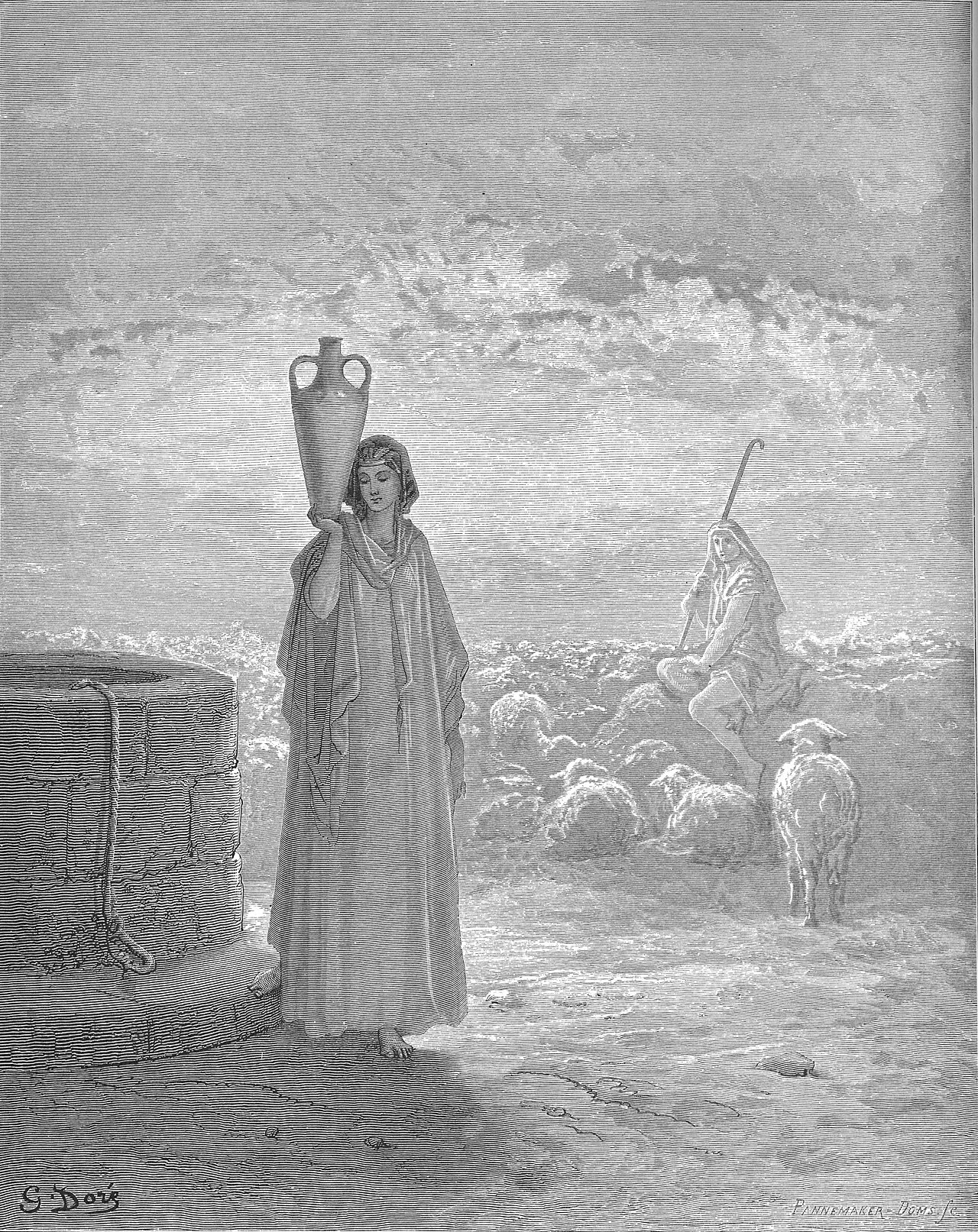
Genesischapter 29
35 verses · Moses, by tradition · 15th to 13th century BC · The Law
As soon as Jacob saw Rachel, the daughter of his mother’s brother Laban, with Laban’s sheep, he went up and rolled the stone away from the mouth of the well and watered his uncle’s sheep.
Introduction
Moses, by tradition, The Law, Genesis Overview.
Moses, by tradition, Narrative, The Law, The Isaac and Jacob cycle, Genesis Overview. Genesis was given to twelve tribes, and this chapter tells where the first four of them came from. Jacob arrives in his mother's country with nothing to pay a bride price, and he is dealing with a man as shrewd as himself. The first hearers knew the customs of the well, the marriage feast and the order in which daughters were married. Listen for the one line of complaint Jacob makes the morning after, and for the answer he gets. Listen too for the names Leah gives her sons, each one a short sentence.
Context
- Who
- Israel in the wilderness, twelve tribes hearing how the first four sons were born
- What
- A narrative of Jacob's arrival in Haran, his seven years of work for Rachel, Laban's substitution of Leah, and the birth of Leah's first four sons.
- Where
- Paddan-aram near Haran, a well in the fields and the household of Laban.
- When
- The patriarchal age, about 1929 to 1922 BC on the traditional dating for the first seven years of service.
- Why
- To show the deceiver deceived, and God seeing the unloved wife from whom Levi and Judah came.
Historical context
The chapter is Jacob's and Laban's, and Jacob arrives as a relative with no property, which sets every term that follows.
Show the rest of the historical context, 5 more paragraphs
The place is Haran in Paddan-aram, the country Abraham's servant had gone to for Rebekah at Genesis 24:10, and Laban is Rebekah's brother.
The occasion is a marriage contracted by a man with nothing to pay with. Seven years of labour is unusual only in its form, because a payment to the bride's family was ordinary and contracts of the period allow a man without capital to pay in service instead.
A first hearer understood the well. It is covered with a heavy stone and opened only when all the flocks have gathered, which was how shared water was rationed and kept from being drawn dry or fouled, and Jacob rolls it away by himself.
He also understood how the substitution at verse 23 was possible: a veiled bride, a night feast where the word behind feast is mishteh, a drinking feast, and a dark tent. Laban's answer, that the older daughter is married first, is a real regional custom and a hard thing to say to the man who had just taken his own older brother's place.
The names Leah gives her sons are short sentences of grief and hope, that the LORD has seen her affliction and heard that she is unloved. The fourth breaks the pattern, because with Judah she stops asking for anything and says she will praise the LORD.
Significance
Israel could not miss the justice of it. The man who had used an older brother's place against a father who could not see was answered in the dark with an older sister in a younger one's place.
Show the rest of the significance, 2 more paragraphs
They also heard where their tribal fathers came from. Reuben, Simeon, Levi and Judah were all born to the wife nobody had chosen, and the text says in its own voice that the LORD saw she was unloved and opened her womb.
For a people counting themselves by those names, that was the first thing they knew about four of them.
This chapter in Jewish lifeWhat this chapter is in Jewish life and reading.
What is done
A living Jewish custom is grounded in this chapter by one of its classical readers. Radak, commenting on the feast Laban made at the wedding, writes that the verse "comes to show the custom that was in the world, and still is today, to do a feast and celebration for weddings", the groom or the father of the bride or groom bearing the cost, and that from Laban's answer about fulfilling the week "the Sages instituted the Wedding Meal and 7 days of celebration after a wedding" (Radak on Genesis 29:22:1, the Sefaria Community Translation, CC0). The seven days of celebration after a Jewish wedding are still kept, and the corpus names this chapter as where the classical commentary anchors them.
How it is read
The commentators read the chapter as Jacob meeting his match in deceit. Rashi takes the lifting up of the feet at the first verse as gladness making the walk light, on the authority of Genesis Rabbah 70:8, and the rolling of the stone as a display of strength, done "as easily as one draws the stopper from the mouth of a bottle" (Rashi on Genesis 29:10:1, the Pentateuch with Rashi's commentary by M. Rosenbaum and A. M. Silbermann, 1929 to 1934, public domain, citing Bereishit Rabbah 70:12). He gives Jacob's weeping two causes from the same midrash, that he foresaw "by the Holy Spirit that she would not be buried with him in the cave of Machpelah", and that he had come empty-handed where Eliezer had come with ten laden camels (Rashi on Genesis 29:11:1). He reads Jacob's word that he is her father's brother as a warning as much as a fact, that if Laban means to deceive him then Jacob is his brother in deception, and if Laban is honest then Jacob is the son of the pious Rebekah (Rashi on Genesis 29:12:1). Leah's weeping at the seventeenth verse he traces to the common saying that "Rebekah has two sons, Laban has two daughters", the elder for the elder and the younger for the younger, on Genesis Rabbah 70:16. Radak stays with the plain narrative. He explains why Nahor rather than Bethuel is named, notes that Laban's two daughters are introduced early so that the reader can follow the bargain that comes later, and observes that Laban conceded that marriage inside the family was a good thing (Radak on Genesis 29:5:1, 29:16:1 and 29:19:1, translated by Eliyahu Munk, HaChut Hameshulash, CC-BY). On the night of the substitution he draws a rule of modesty out of the deception itself, that the dark is what made the exchange possible (Radak on Genesis 29:23:1). Ibn Ezra comments here at 29:4:1, 29:9:1 and 29:20:1, and the corpus holds no English of him under a licence permitting quotation, so he stands as a citation.
What the rabbis say
The corpus records forty rabbinic locators on this chapter, thirty-six of them Midrash and four Talmud. Bereshit Rabbah runs through the scene at the well and the marriages at 70:8, 70:9, 70:10, 70:11, 70:12, 70:14, 70:18, 70:19, 71:3 and 71:4, and Midrash Aggadah comments at Genesis 29:2:1, 29:3:1, 29:3:2, 29:4:1, 29:5:1, 29:5:2, 29:13:1 and 29:29:1. Aggadat Bereshit takes the chapter up at 42:1, 49:1, 49:3, 49:5 and 83:1, Bereshit Rabbati at Parashat Vayetze 10 and 15, and Midrash Lekach Tov at Genesis 29:7:1, 29:8:1, 29:15:1, 29:23:1, 29:26:1 and 29:28:1. Three of the four Talmud locators fall on one page, Bava Batra 123a, at its sections 14, 18 and 20, standing at the verses about the two sisters, the kinship and the giving of Rachel; the fourth is Avot DeRabbi Natan, Recension B 1:3 at the twenty-seventh verse. Rashi hands on his own sayings with their locators, among them Genesis Rabbah 70:8, 70:12, 70:13, 70:14, 70:16 and 70:17.
Sources: Radak, Radak on Genesis 29:22:1, the Sefaria Community Translation, CC0; Radak on Genesis 29:5:1, 29:16:1, 29:19:1, 29:23:1 and 29:24:1, translated by Eliyahu Munk, HaChut Hameshulash, CC-BY; Rashi, Rashi on Genesis 29:1:1, 29:2:1, 29:3:1, 29:6:1, 29:7:1, 29:8:1, 29:10:1, 29:11:1, 29:12:1, 29:13:1, 29:14:1, 29:15:1, 29:17:1, 29:18:1 and 29:21:1, the Pentateuch with Rashi's commentary by M. Rosenbaum and A. M. Silbermann, 1929 to 1934, public domain; Ibn Ezra, Ibn Ezra on Genesis 29:4:1, 29:9:1 and 29:20:1, cited only, no English version in the corpus under a licence permitting quotation; Midrash, Bereshit Rabbah 67:10, 70:8, 70:9, 70:10, 70:11, 70:12, 70:14, 70:18, 70:19, 71:3, 71:4 and 79:4; Midrash Aggadah, Genesis 29:2:1, 29:3:1, 29:3:2, 29:4:1, 29:5:1, 29:5:2, 29:13:1 and 29:29:1; Aggadat Bereshit 42:1, 49:1, 49:3, 49:5 and 83:1; Midrash Lekach Tov, Genesis 29:7:1, 29:8:1, 29:15:1, 29:23:1, 29:26:1 and 29:28:1; Bereshit Rabbati, Parashat Vayetze 10 and 15; Bamidbar Rabbah 20:19; Esther Rabbah 7:9; Mekhilta DeRabbi Yishmael, Tractate Pischa 16:12; Babylonian Talmud, Bava Batra 123a:14, 123a:18 and 123a:20; Avot DeRabbi Natan, Avot DeRabbi Natan, Recension B 1:3.
The heads below are this chapter's scenes. The numbered points under each are its verses.
Jacob Meets Rachel at the Well
Genesis 29:1-3
the land of the people of the east: Jacob stops at a well in a field among the people of the east. A large stone covers the mouth of it. The shepherds wait until every flock has gathered, then roll the stone away and water the sheep. He has just left one stone standing as a pillar at Bethel, and now another lies between him and the water.
Genesis 29:1
“Then Jacob went on his journey Moses now relates the arrival of Jacob in Mesopotamia, and the manner in which he was received by his uncle; and although the narration may seem superfluous, it yet contains nothing but what is useful to be known; for he commends the extraordinary strength of Jacob's faith, when he says, that he lifted up his feet to come into an unknown land.”
John Calvin · Commentaries (1554)reformed
near it lay three flocks of sheep: Adam Clarke reads the three flocks as belonging to three other owners, since Laban's flock was still on its way with Rachel. Matthew Henry gives reasons for the stone: water was scarce and owned, and a cover kept out the sun and spiteful hands and kept lambs from drowning. Water here was guarded.
Genesis 29:2
“The stone at the well's mouth, which is so often mentioned here, was either to secure their property in it (for water was scarce, it was not there usus communis aquarum--for every one's use ), or it was to save the well from receiving damage from the heat of the sun, or from any spiteful hand, or to prevent the lambs of the flock from being drowned in it.”
Matthew Henry · Commentary on the Whole Bible (1707-1721)puritan
1 more voice on this verse
Genesis 29:2
“Three flocks of sheep - צאן tson, small cattle, such as sheep, goats, etc.; See note on Gen 12:16. Sheep, in a healthy state, seldom drink in cold and comparatively cold countries: but it was probably different in hot climates. The three flocks, if flocks and not shepherds be meant, which were lying now at the well, did not belong to Laban, but to three other chiefs; for Laban’s flock was yet to come, under the care of Rachel, Gen 29:6.”
Adam Clarke · Commentary on the Bible (1810-1826)evangelical
roll away the stone from the mouth: Adam Clarke notes that the Samaritan text reads shepherds where the Hebrew reads flocks, a reading Houbigant defended here and at verse 8. Clarke argues that flocks cannot roll a stone. The Berean supplies the shepherds as the ones who roll it.
Genesis 29:3
“All the flocks - Instead of העדרים hadarim, flocks, the Samaritan reads haroim, shepherds; for which reading Houbigant strongly contends, as well in this verse as in Gen 29:8. It certainly cannot be said that all the flocks rolled the stone from the well’s mouth, and watered the sheep: and yet so it appears to read if we prefer the common Hebrew text to the Samaritan. It is probable that the same reading was originally that of the second verse also.”
Adam Clarke · Commentary on the Bible (1810-1826)evangelical
Genesis 29:4-6
Jacob asks the shepherds three questions and gets three short answers. The third answer comes with Rachel walking toward him. Laban is named here as the grandson of Nahor, Abraham's brother, reaching past his own father Bethuel. The reader met this Laban in chapter 24, running out to a stranger at the sight of gold.
Genesis 29:4
“My brethren, whence be ye? - The language of Laban and his family was Chaldee and not Hebrew; (see Gen 31:47); but from the names which Leah gave to her children we see that the two languages had many words in common, and therefore Jacob and the shepherds might understand each other with little difficulty. It is possible also that Jacob might have learned the Chaldee or Aramitish language from his mother, as this was his mother’s tongue.”
Adam Clarke · Commentary on the Bible (1810-1826)evangelical
John Gill explains why Jacob names Nahor. Haran was Nahor's city, Gill says, citing 24:10, and a grandson could be called by his grandfather's name. Gill adds that the shepherds knew Laban as a neighbour in their own city.
Genesis 29:5
“And he said unto them, know ye Laban the son of Nahor?.... He was the son of Bethuel, and grandson of Nahor; grandsons being called the sons of their grandfather; and Nahor might be more known than Bethuel, Haran being Nahor's city, Gen 24:10; and not Bethuel his mother's father, but Laban her brother is inquired after; perhaps Bethuel was dead, and Laban was the head of the family, and well known, and it was to him he was sent: and they said, we know him; perfectly well; he lives in our city, and is our neighbour.”
Adam Clarke gives Jacob's question as is there peace to him, with peace covering every kind of well-being. The shepherds answer yes and point to his daughter Rachel coming with his sheep. Clarke notes that Rachel means a ewe.
Genesis 29:7-8
Jacob tells working men their business on his first day in the country. They answer that every flock must gather first, and that the stone comes off the well before any sheep drink. Their rule says the stone waits for all of them. He is told plainly what moving it takes.
Genesis 29:7
“It is yet high day - The day is but about half run; neither is it time that the cattle should be gathered together - it is surely not time yet to put them into the folds; give them therefore water, and take them again to pasture.”
Adam Clarke · Commentary on the Bible (1810-1826)evangelical
The shepherds keep a rule of the well. Adam Clarke thinks the stone came off only when every flock with a right to the well had arrived, and that Laban's flock was the last. Rachel's arrival completes the count.
Genesis 29:8
“We cannot, until all the flocks be gathered together - It is a rule that the stone shall not be removed till all the shepherds and the flocks which have a right to this well be gathered together; then, and not before, we may water the sheep. See note on Gen 29:3.”
Adam Clarke · Commentary on the Bible (1810-1826)evangelical
1 more voice on this verse
Genesis 29:8
“11 And Jacob kissed Rachel, and lifted up his voice, and wept. 12 And Jacob told Rachel that he was her father's brother, and that he was Rebekah's son: and she ran and told her father.”
Matthew Henry · Commentary on the Whole Bible (1707-1721)puritan
Genesis 29:9-11
Rachel arrived with her father’s sheep: Rachel arrives with her father's sheep, and Jacob rolls the stone away by himself and waters Laban's flock. Then he kisses her and weeps aloud. Chapter 24 ran the same scene for his mother: a traveller reaches the family's country, stops at a well, a woman comes to draw, and she runs home with the news. Moses meets his wife at a well in Midian at Exodus 2:16 to 21.
Genesis 29:9
“Rachel came with her father’s sheep - So we find that young women were not kept concealed in the house till the time they were married, which is the common gloss put on עלמה almah, a virgin, one concealed. Nor was it beneath the dignity of the daughters of the most opulent chiefs to carry water from the well, as in the case of Rebekah; or tend sheep, as in the case of Rachel.”
Adam Clarke · Commentary on the Bible (1810-1826)evangelical
rolled the stone away from the mouth: Adam Clarke doubts that Jacob moved the stone alone and thinks he helped the shepherds once Laban's flock had come. The verse ties Rachel, the sheep and the flock to his mother's brother, three times over in the Hebrew. Kinship drives the scene.
Genesis 29:10
“Jacob went near, and rolled the stone - Probably the flock of Laban was the last of those which had a right to the well; that flock being now come, Jacob assisted the shepherds to roll off the stone, (for it is not likely he did it by himself), and so assisted his cousin, to whom he was as yet unknown, to water her flock.”
Adam Clarke · Commentary on the Bible (1810-1826)evangelical
Jacob kissed Rachel and wept aloud: , and Adam Clarke takes the tears as thanks to God for bringing him this far in safety. Cyril of Alexandria reads Rachel, the sheep of God, as a figure of the church among the nations. Jacob had fled from home.
Genesis 29:11
“Jacob kissed Rachel - A simple and pure method by which the primitive inhabitants of the earth testified their friendship to each other, first abused by hypocrites, who pretended affection while their vile hearts meditated terror, (see the case of Joab), and afterwards disgraced by refiners on morals, who, while they pretended to stumble at those innocent expressions of affection and friendship, were capable of committing the grossest acts of impurity. And lifted up his voice - It may be, in thanksgiving to God for the favor he had shown him, in conducting him thus far in peace and safety.”
Adam Clarke · Commentary on the Bible (1810-1826)evangelical
1 more voice on this verse
Genesis 29:11
In addition Rachel is interpreted as a "sheep of God." And some consider her to be with good reason a symbol of the church among the nations. She is also the sheep of Christ, mixed in the ancient folds, and finally received in the fold of the Savior. Therefore he said, "And other sheep I have, which are not of this fold, them also I must bring, and they shall hear my voice; and there shall be one fold, and one shepherd."
Cyril of Alexandria · written before 444 · GLAPHYRA ON GENESIS, 4.4patristic
Genesis 29:12-14
she ran and told her father: Jacob tells Rachel that he is Rebekah's son, a relative of her father. She runs and tells him. Laban runs out to meet him, embraces him, and brings him home. In chapter 24 Laban ran out to a servant who had ten camels and gold, and Jacob comes with nothing.
Genesis 29:12
“Jacob told Rachel, &c.--According to the practice of the East, the term "brother" is extended to remote degrees of relationship, as uncle, cousin, or nephew.”
Jamieson, Fausset & Brown · Commentary Critical and Explanatory on the Whole Bible (1871)reformed
he ran out to meet him: What Jacob told Laban goes unrecorded. Jamieson, Fausset and Brown note, on verse 12, that brother in Eastern speech covered any near kinsman, uncle, cousin or nephew. Laban's own greeting in verse 14 claims the same bond.
Genesis 29:13
“And it came to pass, when Laban heard the tidings of Jacob his sister's son,.... That there was such a man at the well, thus related to him, and what he had done there, had rolled away the stone, and watered his flock.”
The claim of shared flesh echoes Adam's words over Eve at 2:23. John Gill takes the month as a full month to the day and holds that Jacob spent it tending Laban's flocks and doing his work. The unpaid month sets up the wage question of verse 15.
Genesis 29:14
“And Laban said to him, surely thou art my bone and my flesh,.... Nearly allied in blood, being his sister's son: and he abode with him the space of a month; or "a month of days" (m), a full month to a day; all this while feeding his flocks, and doing whatsoever service he had for him to do. (m) חדש ימים "mensem dierum", Pagninus, Montanus, Drusius, Schmidt.”
Seven Years, and Seven More
Genesis 29:15-17
should you work for nothing?: Laban calls Jacob his relative and then asks him to name his own wages. The next verse gives the two daughters in birth order, Leah the older and Rachel the younger. Verse 17 says Leah had weak eyes and Rachel was shapely and beautiful. Birth order decides the rest of the chapter.
Genesis 29:15
“Because thou art my brother, etc. - Though thou art my nearest relative, yet I have no right to thy services without giving thee an adequate recompense. Jacob had passed a whole month in the family of Laban, in which he had undoubtedly rendered himself of considerable service. As Laban, who was of a very saving if not covetous disposition, saw that he was to be of great use to him in his secular concerns, he wished to secure his services, and therefore asks him what wages he wished to have.”
Adam Clarke · Commentary on the Bible (1810-1826)evangelical
2 more voices on this verse
Genesis 29:15
“Notice, I ask you, how when someone is helped by the hand from on high, everything goes favorably for him. "You shall not serve me for nothing," Laban says. "Tell me what your wages should be." In fact, this blessed man was acting out of love and was content simply to receive board and lodging and return him sincere thanks for it. But, since Jacob demonstrated great humility, Laban took the initiative in promising to pay him whatever wage he named.”
John Chrysostom · written before 407 · HOMILIES ON GENESIS 55.6patristic
Genesis 29:15
“His posterity are there reminded of it long afterwards, as an instance of the meanness of their origin: probably Rachel was young, and scarcely marriageable, when Jacob first came, which made him the more willing to stay for her till his seven years' service had expired.”
Matthew Henry · Commentary on the Whole Bible (1707-1721)puritan
the older was named Leah: John Gill gives Leah's name the sense of labour or weariness. The order of older and younger is the order Jacob himself upset when he took the firstborn's blessing from Esau. Laban will hold him to it at verse 26.
Genesis 29:16
“And Laban had two daughters,.... Grown up and marriageable: and the name of the elder was Leah; which signifies labour or weariness: and the name of the younger was Rachel; before mentioned, whom Jacob met with at the well, Gen 29:10; and whose name signifies a sheep, as before observed; see Gill on Gen 29:9.”
Leah had weak eyes: The Berean says Leah had weak eyes, and readers divide on the word. John Gill takes it as sore or watery eyes, while Adam Clarke reads soft and lovely eyes, her one beauty beside Rachel's shapely form. Gill notes that Onkelos gave it as beautiful.
Genesis 29:17
“Leah was tender eyed,.... Blear eyed, had a moisture in them, which made them red, and so she was not so agreeable to look at; though Onkelos renders the words,"the eyes of Leah were beautiful,''as if her beauty lay in her eyes, and nowhere else: but Rachel was beautiful and well favoured; in all parts, in the form of her countenance, in her shape and stature, and in her complexion, her hair black, her flesh white and ruddy, as Ben Melech observes.”
2 more voices on this verse
Genesis 29:17
“Leah was tender-eyed - רכות raccoth, soft, delicate, lovely. I believe the word means just the reverse of the signification generally given to it. The design of the inspired writer is to compare both the sisters together, that the balance may appear to be greatly in favor of Rachel. The chief recommendation of Leah was her soft and beautiful eyes; but Rachel was יפת תאר yephath toar, beautiful in her shape, person, mien, and gait, and יפת מראה yephath mareh, beautiful in her countenance.”
Adam Clarke · Commentary on the Bible (1810-1826)evangelical
Genesis 29:17
“Leah tender-eyed--that is, soft blue eyes--thought a blemish. Rachel beautiful and well-favored--that is, comely and handsome in form. The latter was Jacob's choice.”
Jamieson, Fausset & Brown · Commentary Critical and Explanatory on the Whole Bible (1871)reformed
Genesis 29:18-20
Jacob names the daughter twice over, by her name and by her birth order. He has no herds for a bride price, so he offers seven years of his own labour. The years seemed but a few days to him, out of love for Rachel. Laban's substitution follows in verse 23.
Genesis 29:18
“I will serve thee seven years for Rachel thy daughter--A proposal of marriage is made to the father without the daughter being consulted, and the match is effected by the suitor either bestowing costly presents on the family, or by giving cattle to the value the father sets upon his daughter, or else by giving personal services for a specified period.”
Jamieson, Fausset & Brown · Commentary Critical and Explanatory on the Whole Bible (1871)reformed
Laban's answer refers to her without her name. Jamieson, Fausset and Brown note that a proposal went to the father without the daughter being consulted, and the price was paid in gifts, cattle or years of service. Rachel herself says nothing in the chapter.
it seemed but a few days: Jacob served seven years for Rachel, yet his love made the years seem but a few days. Adam Clarke notes that a man gave a price for a wife in many ancient nations, and Jacob's price was his work. John Wesley applies the few days to those who love God.
Genesis 29:20
“And Jacob served seven years for Rachel - In ancient times it appears to have been a custom among all nations that men should give dowries for their wives; and in many countries this custom still prevails. When Shechem asked Dinah for wife, he said, Ask me never so much - dowry and gift, and I will give according as ye shall say unto me.”
Adam Clarke · Commentary on the Bible (1810-1826)evangelical
1 more voice on this verse
Genesis 29:20
“They seemed to him but a few days for the love he had to her - An age of work will be but as a few days to those that love God, and long for Christ's appearing.”
John Wesley · Explanatory Notes upon the Old Testament (1765)evangelical
Genesis 29:21-22
The seven years are counted out, and Jacob says his time is complete. He asks Laban for the wife he has paid for. Laban invites all the men of that place and prepares a feast. The word behind feast is mishteh, a drinking feast.
Genesis 29:21
“But an infamous fraud was practised on Jacob, and on his showing a righteous indignation, the usage of the country was pleaded in excuse. No plea of kindred should ever be allowed to come in opposition to the claim of justice. But this is often overlooked by the selfish mind of man, and fashion or custom rules instead of the will of God.”
Jamieson, Fausset & Brown · Commentary Critical and Explanatory on the Whole Bible (1871)reformed
1 more voice on this verse
Genesis 29:21
“My days are fulfilled - My seven years are now completed, let me have my wife, for whom I have given this service as a dowry.”
Adam Clarke · Commentary on the Bible (1810-1826)evangelical
invited all the men of that place: John Gill reads the guests as the chief men of Haran, gathered to make the marriage public and binding. Adam Clarke, on verse 27, thinks Laban then kept the week going partly to hide his fraud from the public eye. The whole town is at the wedding.
Genesis 29:22
“And Laban gathered together all the men of the place,.... Of the city of Haran, which may be understood of the chief and principal of them, to make the marriage of his daughter public and authentic: and made a feast; a marriage or marriage feast, as the Septuagint version, see Mat 22:2; which was usual, when a marriage was solemnized, expressive of joy on that account.”
1 more voice on this verse
Genesis 29:22
“Laban - made a feast - משתה mishteh signifies a feast of drinking. As marriage was a very solemn contract, there is much reason to believe that sacrifices were offered on the occasion, and libations poured out; and we know that on festival occasions a cup of wine was offered to every guest; and as this was drunk with particular ceremonies, the feast might derive its name from this circumstance, which was the most prominent and observable on such occasions.”
Adam Clarke · Commentary on the Bible (1810-1826)evangelical
Genesis 29:23-24
when evening came, Laban took his daughter Leah: Genesis gives the hour and nothing more. Adam Clarke fills in the veil and the dark chamber that held the substitution until morning. The man deceived here had gone in to a blind father wearing his brother's clothes. Laban gives his servant girl Zilpah to Leah in the same breath.
Genesis 29:23
“In the evening - he took Leah his daughter - As the bride was always veiled, and the bride chamber generally dark, or nearly so, and as Leah was brought to Jacob in the evening, the imposition here practiced might easily pass undetected by Jacob, till the ensuing day discovered the fraud.”
Adam Clarke · Commentary on the Bible (1810-1826)evangelical
his servant girl Zilpah: Adam Clarke holds that a maid given at marriage belonged to the bride, and the husband had no right over her. John Gill notes that Rebekah seems to have left home with several maids, while Leah receives one, the only portion Jacob had with her. The Targum, Gill reports, made Zilpah Laban's daughter by a concubine.
Genesis 29:24
“And Laban gave unto his daughter Leah Zilpah his maid, for an handmaid. It was usual to have many given them at this time, as Rebekah seems to have had, Gen 24:59; but Leah had but one, and this was all the portion Jacob had with her. The Targum of Jonathan is,"and Laban gave her Zilpah his daughter, whom his concubine bore unto him:''hence the Jews say (q), that the daughters of a man by his concubines are called maids. (q) Pirke Eliezer, c. 36.”
1 more voice on this verse
Genesis 29:24
“And Laban gave - Zilpah his maid - Slaves given in this way to a daughter on her marriage, were the peculiar property of the daughter; and over them the husband had neither right nor power.”
Adam Clarke · Commentary on the Bible (1810-1826)evangelical
Genesis 29:25-26
Jacob's protest, What have you done to me, is the rebuke Pharaoh gave Abraham at 12:18 and Abimelech gave Isaac at 26:10. Both times a king outside the family said it to a patriarch. Here a patriarch says it. Laban answers with a local custom, the older daughter married before the younger.
Genesis 29:25
“And it came to pass, that, in the morning, behold, it was Leah,.... The morning light discovered her, and her veil being off, her tender eyes showed who she was: it is much her voice had not betrayed her; but perhaps there might be a likeness of voice in her and her sister; or she might keep silence, and so not be discovered in that way; but to excuse her from sin is not easy, even the sin of adultery and incest.”
1 more voice on this verse
Genesis 29:25
“He had cheated his own father when he pretended to be Esau, and now his father-in-law cheated him. Herein, how unrighteous soever Laban was, the Lord was righteous; as Judges i. Even the righteous, if they take a false step, are sometimes thus recompensed on the earth.”
Matthew Henry · Commentary on the Whole Bible (1707-1721)puritan
Laban says it is not their custom to give the younger daughter before the older. Matthew Henry doubts any such custom existed and thinks Laban made it up to mock Jacob. Adam Clarke takes the custom as real.
Genesis 29:26
“It must not be so done in our country - It was an early custom to give daughters in marriage according to their seniority; and it is worthy of remark that the oldest people now existing, next to the Jews, I mean the Hindoos, have this not merely as a custom, but as a positive law; and they deem it criminal to give a younger daughter in marriage while an elder daughter remains unmarried.”
Adam Clarke · Commentary on the Bible (1810-1826)evangelical
1 more voice on this verse
Genesis 29:26
“We have reason to think there was no such custom of his country as he pretends; only he banters Jacob with it, and laughs at his mistake. Note, Those that can do wickedly and then think to turn it off with a jest, though they may deceive themselves and others, will find at last that God is not mocked.”
Matthew Henry · Commentary on the Whole Bible (1707-1721)puritan
Genesis 29:27-28
Finish this week’s celebration: Jerome reads the week as the marriage week, and the verses bear him out. Jacob finishes the week and is given Rachel, then serves the second seven years afterward. Both sisters are his inside a fortnight. Fourteen years of work are owed for the younger daughter.
Genesis 29:27
“Fulfill her week - The marriage feast, it appears, lasted seven days; it would not therefore have been proper to break off the solemnities to which all the men of the place had been invited, Gen 29:22, and probably Laban wished to keep his fraud from the public eye; therefore he informs Jacob that if he will fulfill the marriage week for Leah, he will give him Rachel at the end of it, on condition of his serving seven other years.”
Adam Clarke · Commentary on the Bible (1810-1826)evangelical
And Jacob did just that: Jacob finished the week and was given Rachel as his wife, so he now had two sisters as wives. Adam Clarke finds no blame on Jacob for it in that age, though it cost him years of their jealousy. Clarke notes such marriages were later judged unlawful.
Genesis 29:28
“And Jacob did so - and he gave him Rachel - It is perfectly plain that Jacob did not serve seven years more before he got Rachel to wife; but having spent a week with Leah, and in keeping the marriage feast, he then got Rachel, and served afterwards seven years for her. Connections of this kind are now called incestuous; but it appears they were allowable in those ancient times. In taking both sisters, it does not appear that any blame attached to Jacob, though in consequence of it he was vexed by their jealousies.”
Adam Clarke · Commentary on the Bible (1810-1826)evangelical
Genesis 29:29-30
Laban also gave his servant girl Bilhah: Bilhah goes to Rachel as Zilpah went to Leah. The two maidservants will bear Dan, Naphtali, Gad and Asher, four of the twelve tribes of Israel. Verse 30 says Jacob loved Rachel more than Leah. He works another seven years of service for her.
Genesis 29:29
“And Laban gave to Rachel his daughter, Bilhah his handmaid to be her maid. As he had given Leah an handmaid he gave Rachel another; and this in the Targum of Jonathan is said to be a daughter of Laban by a concubine also, as the former.”
he loved Rachel more than Leah: Jacob gave Laban seven more years of work for Rachel, whom he loved more than Leah. Jamieson, Fausset and Brown read the unloved of verse 31 by this measure, Leah loved less than she ought to have been. Her sons come next.
Genesis 29:30
“And he went in also unto Rachel,.... Cohabited with her as his wife: and he loved also Rachel more than Leah; she was his first love, and he retained the same love for her he ever had; as appears by his willingness to agree to the same condition of seven years' servitude more for her sake, and which he performed as follows: and served with him, yet seven other years; that is, Jacob served so many years with Laban after he had married his two daughters, and fulfilled the weeks of feasting for each of them.”
Leah's First Four Sons
the LORD saw that Leah was unloved: Unloved here carries the sense of loved less, which verse 30 has just said. The LORD sees it and opens Leah's womb, while Rachel stays barren. Sarah and Rebekah were barren before her. Rachel's womb opens at 30:22, after Leah has borne four sons.
Genesis 29:32-33
she named him Reuben: Reuben carries the sound of see, a son, and Simeon the sound of hearing. Leah names the LORD in both, saying He has seen her affliction and heard that she is unloved. Each name carries her hope that her husband will love her. Reuben is the firstborn of Israel, and 49:3 and 4 take the first place from him.
Genesis 29:32
“She called his name Reuben - ראובן reuben, literally, see ye or behold a son; for Jehovah hath looked upon, ראה raah, beheld, my affliction; behold then the consequence, I have got a son!”
Adam Clarke · Commentary on the Bible (1810-1826)evangelical
she named him Simeon: Simeon is later paired with Levi in the violence at Shechem in chapter 34, and Jacob's last words curse their anger together at 49:5 to 7. John Gill mentions a Jewish tradition that Leah bore her sons at seven months. He cites Pirke Eliezer for it.
Genesis 29:33
“And she conceived again, and bare a son,.... As soon as she well could. The Jews (x) have a notion, that Leah brought forth her sons at seven months' end: and said, because the Lord hath heard that I was hated; or less loved than her sister: he hath therefore given me this son also; to comfort her under the trial and exercise, and engage her husband's love the more unto her: and she called his name Simeon: which signifies "hearing", and answers to the reason of her having him as she concluded. (x) Pirke Eliezer, c. 36.”
1 more voice on this verse
Genesis 29:33
“She called his name Simeon - שמעון shimon, hearing; i.e., God had blessed her with another son, because he had heard that she was hated - loved less than Rachel was.”
Adam Clarke · Commentary on the Bible (1810-1826)evangelical
Genesis 29:34-35
Levi carries the sound of joined, and Leah names him out of her hope of being joined to her husband. Numbers 18:2 joins the tribe of Levi to the priests. With the fourth son she stops asking and says she will praise the LORD, and Judah carries the sound of praise. Jacob blesses Judah over three older brothers at 49:8 to 10, and that line runs to David and to Jesus.
Genesis 29:34
“Therefore was his name called Levi - לוי levi, joined; because she supposed that, in consequence of all these children, Jacob would become joined to her in as strong affection, at least, as he was to Rachel. From Levi sprang the tribe of Levites, who instead of the first-born, were joined unto the priests in the service of the sanctuary. See Num 18:2, Num 18:4.”
Adam Clarke · Commentary on the Bible (1810-1826)evangelical
Leah names her fourth son Judah and says this time she will praise the LORD. Jerome gives Judah the sense of confession, which he explains as thanks, as in the thanks Jesus gives the Father at Matthew 11:25. Matthew Henry ties the praise to Christ.
Genesis 29:35
“Now will I praise the Lord more and better than I have done. [2.] All our praises must centre in Christ, both as the matter of them and as the Mediator of them. He descended from him whose name was praise, for he is our praise. Is Christ formed in my heart?”
Matthew Henry · Commentary on the Whole Bible (1707-1721)puritan
How this psalm is built
The form: A betrothal narrative at a well that turns into an account of service and substitution, as Henry classes it.
The patterns in this chapter
| Device | What it does | Where to see it |
|---|---|---|
| The stone on the well | The chapter opens on a large stone covering the mouth of a well that takes every shepherd to move, and Jacob is told plainly what moving it takes. When Rachel arrives he rolls it away by himself. He had left a stone standing as a pillar at Bethel the chapter before.Matthew Henry, Commentary on the Whole Bible, 1710, on Genesis 29:1 to 3. | Genesis 29:2, Genesis 29:3, Genesis 29:8, Genesis 29:10 |
| The younger put in the older's place, and the older in the younger's | Jacob took the firstborn's blessing from a father who could not see. Laban gives him the firstborn daughter in a dark chamber and answers his protest with a local custom, that the older daughter marries first. Adam Clarke fills in the veil that held the substitution until morning.Adam Clarke, Commentary on the Bible, 1832, on Genesis 29:23 and 24. | Genesis 29:23, Genesis 29:25, Genesis 29:26 |
| What have you done to me | Jacob's protest at verse 25 is the rebuke Pharaoh gave Abraham at Genesis 12:18 and Abimelech gave Isaac at Genesis 26:10. Both earlier times a king outside the family said it to a patriarch, and here a patriarch says it inside the family. Laban says it back to Jacob at Genesis 31:26.Matthew Henry, Commentary on the Whole Bible, 1710, on Genesis 29:25 and 26. | Genesis 29:25 |
| Four sons named out of one woman's hope | Leah names Reuben for seeing, Simeon for hearing, Levi for being joined, and with the fourth she stops asking and names Judah for praise. The first three carry her hope that her husband will love her, and the fourth carries no request at all.Adam Clarke, Commentary on the Bible, 1832, on Genesis 29:32 to 35. | Genesis 29:32, Genesis 29:33, Genesis 29:34, Genesis 29:35 |
The historical value
9 more paragraphs on the patterns
The chapter records how a marriage was contracted where a man had no property. Jacob names his own wage at Laban's invitation and pays seven years of labour in place of a bride price, and each daughter is given with a maidservant, Zilpah to Leah and Bilhah to Rachel. Those two women bear Dan, Naphtali, Gad and Asher, four of the twelve tribes of Israel.
It also records the marriage week. Jerome reads the week of verse 27 as the marriage week, which is why Rachel can be given seven days after Leah and the second seven years served afterward. The word behind the feast at verse 22 is mishteh, a drinking feast, and Adam Clarke reads the dark chamber and the veil as what made the substitution possible.
The debated concept
Verse 31 says the LORD saw that Leah was unloved, and the Hebrew word is the ordinary word for hated. The question is whether it states a comparison or a condition. The reading Jamieson, Fausset and Brown give takes it as loved less, which is what verse 30 has just said in so many words. A second reading keeps the stronger sense and takes Leah's own names for her sons as the evidence, since three of the four carry her hope that her husband will love her. The text supports the comparison in verse 30 and the stronger sense in Leah's own mouth, and Genesis lets both stand.
Where the chapter reaches
What Genesis 29 carries into the rest of Scripture is Judah. Leah's fourth son is named for praise, Jacob blesses him over three older brothers at Genesis 49:8, and the line runs from there to David and to Jesus.
The chapter's other reach is Levi, whose name Leah gives out of her hope of being joined to her husband, and whose descendants carry the priesthood.
The divine connection
The one theological statement the chapter makes in its own voice is at verse 31, that the LORD saw. Nothing is said about Jacob's preference being approved or corrected. What is said is that the woman the household valued least is the one whose womb God opened, and that the son who carries the promise forward comes from her rather than from the wife Jacob worked fourteen years for. At the Evidence Standard the claim goes this far and stops there, because Genesis 29 states the fact and leaves the reader to read Genesis 49:8 for what it came to.
Keep studying
Places1
Sources for this chapter
The summary
Jamieson, Fausset & Brown, Commentary Critical and Explanatory; John Calvin, Commentaries; John Wesley, Notes on the Old Testament and Matthew Henry, Complete Commentary.
The context
Jamieson, Fausset & Brown, Commentary Critical and Explanatory on the Whole Bible and Matthew Henry, Commentary on the Whole Bible.
The form and classifications
Adam Clarke, Commentary on the Bible, 1832, on Genesis 29:9 to 11; John Calvin, Commentary on Genesis, 1554, on Genesis 29:31 to 35; John Gill, Exposition of the Old Testament, 1748 to 1763, on Genesis 29:15 to 17 and Matthew Henry, Commentary on the Whole Bible, 1710, on Genesis 29.
The exposition
Adam Clarke, Commentary on the Bible; Cyril of Alexandria, GLAPHYRA ON GENESIS, 4.4; Jamieson, Fausset & Brown, Commentary Critical and Explanatory on the Whole Bible; Jerome, Hebrew Questions on Genesis; John Calvin, Commentary on Genesis; John Gill, Exposition of the Old Testament; John Wesley, Explanatory Notes upon the Old Testament and Matthew Henry, Commentary on the Whole Bible.