
Genesis 29:9
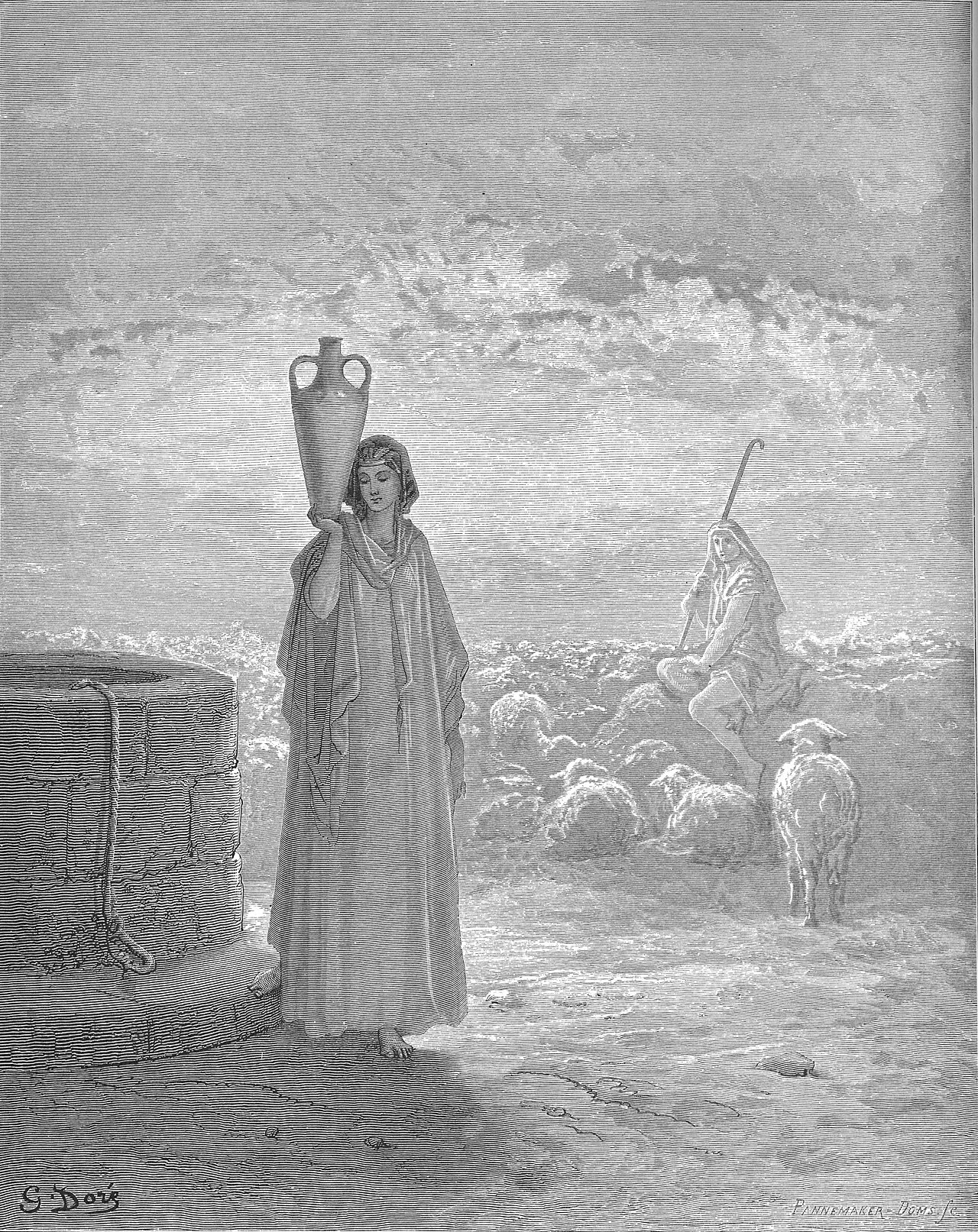
in Genesis 29While he was still speaking with them, Rachel arrived with her father’s sheep, for she was a shepherdess.
BSB
The same verse in ASV and KJV ▾
ASV
While he was yet speaking with them, Rachel came with her father’s sheep; for she kept them.
KJV
And while he yet spake with them, Rachel came with her father’s sheep: for she kept them.
⋯
This verse in Genesis 29
Commentary
7 notes on this verseRachel came with her father’s sheep - So we find that young women were not kept concealed in the house till the time they were married, which is the common gloss put on עלמה almah, a virgin, one concealed. Nor was it beneath the dignity of the daughters of the most opulent chiefs to carry water from the well, as in the case of Rebekah; or tend sheep, as in the case of Rachel.
This site's exposition
Rachel arrived with her father's sheep
on Genesis 29:9-11
Rachel arrives with her father's sheep, and Jacob rolls the stone away by himself and waters Laban's flock. Then he kisses her and weeps aloud. Chapter 24 ran the same scene for his mother: a traveller reaches the family's country, stops at a well, a woman comes to draw, and she runs home with the news. Moses meets his wife at a well in Midian at Exodus 2:16 to 21.
The record, by era
The Puritans and the Awakening4 voices
), that is, she took the care of them, having servants under her that were employed about them. Rachel's name signifies a sheep. Note, Honest useful labour is that which nobody needs be ashamed of, nor ought it to be a hindrance to any one's preferment.
quarantine:debris (2026-07-29) — leading-punctuation+unbalanced-parens
Thou art my bone and my flesh. Note, Those are hard-hearted indeed that are unkind to their relations, and that hide themselves from their own flesh, Isaiah lviii, 7. Because thou art my brother - That is, kinsman.
And while he yet spake with them,.... While Jacob was thus discoursing with the shepherds: Rachel came with her father's sheep; to water them at the well.
If we know how to value the happiness of heaven, the sufferings of this present time will be as nothing to us in comparison of it. An age of work will be but as a few days to those that love God and long for Christ's appearing.
The Nineteenth Century1 voice
A commentator
Jamieson, Fausset & Brown1802–1910
Commentary Critical and Explanatory on the Whole Bible (1871)
proposed
Watering them, which is done twice a day, is a work of time and labor, and Jacob rendered no small service in volunteering his aid to the young shepherdess. The interview was affecting, the reception welcome, and Jacob forgot all his toils in the society of his Mesopotamian relatives.
The words behind it
12 Hebrew wordsEvery Hebrew word of this verse in the order it stands, with what it means and the door to its own study. The last column counts the times a word stands in the whole Bible: the rarer the word, the more the places it appears belong together.
| Hebrew | Sound | Meaning | Word study | In the Bible |
|---|---|---|---|---|
| עוֹדֶ֖נּוּ | odenu | still [was] he | H5750 → | 490 times |
| מְדַבֵּ֣ר | medaber | speaking | H1696 → | 1141 times |
| עִמָּ֑ם | ʾimam | with them | H5973 → | 1050 times |
| וְרָחֵ֣ל׀ | verachel | and Rachel | H7354 → | 47 times |
| בָּ֗אָה | baah | she came | H935 → | 2568 times |
| עִם־ | ʾim- | with | H5973 → | 1050 times |
| הַצֹּאן֙ | hatzon | the sheep | H6629 → | 274 times |
| אֲשֶׁ֣ר | ʾasher | which | H834 → | 5497 times |
| לְאָבִ֔יהָ | leaviha | [belonged] to father her | H1 → | 1212 times |
| כִּ֥י | ki | for | H3588 → | 4482 times |
| רֹעָ֖ה | roah | [was] a shepherdess | H7462 → | 177 times |
| הִֽוא׃ | hi' | she | H1931 → | 1879 times |
עוֹדֶ֖נּוּstill [was] he
odenuH5750 →490 times
מְדַבֵּ֣רspeaking
medaberH1696 →1141 times
עִמָּ֑םwith them
ʾimamH5973 →1050 times
וְרָחֵ֣ל׀and Rachel
verachelH7354 →47 times
בָּ֗אָהshe came
baahH935 →2568 times
עִם־with
ʾim-H5973 →1050 times
הַצֹּאן֙the sheep
hatzonH6629 →274 times
אֲשֶׁ֣רwhich
ʾasherH834 →5497 times
לְאָבִ֔יהָ[belonged] to father her
leavihaH1 →1212 times
כִּ֥יfor
kiH3588 →4482 times
רֹעָ֖ה[was] a shepherdess
roahH7462 →177 times
הִֽוא׃she
hi'H1931 →1879 times
A shaded row is a word that stands 400 times or fewer in the Bible.
The walk
8 stopsEach card is a verse this one points to, and under it the verses that one points to in turn. Where several paths arrive at the same place, that place is listed first: the text keeps returning to it.
Through
Genesis 24:15Before the servant had finished praying, Rebekah came out with her jar on her shoulder. She was the daughter of Bethuel son of Milcah, the wife of Abraham’s brother Nahor.
it leads to
- Genesis 11:29
And Abram and Nahor took wives for themselves. Abram’s wife was named Sarai, and Nahor’s wife was named Milcah; she was the daughter of Haran, who was the father of both Milcah and Iscah.
- Genesis 24:45
And before I had finished praying in my heart, there was Rebekah coming out with her jar on her shoulder, and she went down to the spring and drew water. So I said to…
- Isaiah 65:24
Even before they call, I will answer, and while they are still speaking, I will hear.
- Daniel 9:20–23
While I was speaking, praying, confessing my sin and that of my people Israel, and presenting my petition before the LORD my God concerning His holy mountain—
- Psalms 65:2
O You who listen to prayer, all people will come to You.
- Genesis 11:29
Through
Exodus 2:21Moses agreed to stay with the man, and he gave his daughter Zipporah to Moses in marriage.
it leads to
- Hebrews 13:5
Keep your lives free from the love of money and be content with what you have, for God has said: “Never will I leave you, never will I forsake you.”
- Genesis 31:38–40
I have been with you for twenty years now. Your sheep and goats have not miscarried, nor have I eaten the rams of your flock.
- Exodus 18:2–6
After Moses had sent back his wife Zipporah, his father-in-law Jethro had received her,
- Hebrews 13:5
Where this verse is studied
On this page
About Genesis
Who and where
1 name in this verse with a page on the site.
This page draws on Adam Clarke, Commentary on the Bible; Jamieson, Fausset & Brown, Commentary Critical and Explanatory on the Whole Bible; John Gill, Exposition of the Old Testament (1748-1763); John Wesley, Explanatory Notes upon the Old Testament and Matthew Henry, Commentary on the Whole Bible.