
Genesischapter 19
38 verses · Moses, by tradition · 15th to 13th century BC · The Law
“Very well,” he answered, “I will grant this request as well, and will not demolish the town you indicate.
Introduction
Moses, by tradition, The Law, Genesis Overview.
Moses wrote this chapter, by tradition, for Israel in the wilderness, a people on their way to a land whose nations God was judging for wrongs of the same kind. It answers the pleading of the chapter before it. It moves from a city at night to a burned plain in the morning and then to a cave in the hills. Listen for how often the rescued family hesitates, and for the one line that says why they were saved at all. Listen also for two nations Israel would meet on its road east of the Jordan. Read it as judgment and mercy told in the same night.
Context
- Who
- Israel in the wilderness, on their way to a land God was clearing of what this chapter describes
- What
- A narrative of the judgment on Sodom and Gomorrah, the rescue of Lot's household, and the birth of Moab and Ammon.
- Where
- Sodom and its gateway, the road to the small town of Zoar in the plain of the Jordan, and a cave in the hills above it.
- When
- The patriarchal age on the night after the visit at Mamre, about 2067 BC on the traditional dating, a date the chapter itself does not give.
- Why
- To show that the Judge of all the earth does right in sparing the righteous and judging the wicked, and to give Israel the origin of two neighbouring peoples.
Historical context
The chapter belongs to Lot, Abraham's nephew, who by now is sitting in the gateway of Sodom. Genesis has moved him there in three steps: a tent pitched toward the city at Genesis 13:12, a house in it at Genesis 14:12, and a seat in its gate here.
Show the rest of the historical context, 6 more paragraphs
The time is the night and morning that follow the visit at Mamre, about 2067 BC on the traditional reckoning.
The places are exact. Sodom and Gomorrah stood on the plain by the Salt Sea, Zoar was a small town about two miles off by John Gill's reckoning, and the chapter ends in a cave in the hill country above the burned ground.
The occasion is the judgment announced in the previous chapter, carried out by the two messengers who went on toward the city while Abraham stayed behind.
A first hearer knew what the gateway was. It was the civic centre of a town, where elders sat to judge cases and witness contracts, which is why the crowd's sneer at verse 9 about a foreigner acting as a judge lands where it does.
He also knew that a host's duty to protect a guest under his roof was close to absolute in that culture, which is the background of Lot's offer at verse 8. Genesis reports the offer and adds no approval of it.
The country itself would have been familiar. The southern end of the Salt Sea sits on a geological rift and the ground there carries bitumen, sulphur and gas, and the same tar pits appear at Genesis 14:10 as the thing that beat five kings.
Significance
This was the standing example for Israel of a patience that ends, cited by the prophets and later by the apostles, and of God taking out the few who were His while it fell.
Show the rest of the significance, 1 more paragraph
It was also a map of the neighbours. Moab and Ammon, the two nations east of the Jordan that Israel would meet on the road and be forbidden to attack, began in the cave at the end of this chapter.
This chapter in Jewish lifeWhat this chapter is in Jewish life and reading.
What is done
This chapter is heard inside the fourth portion of the annual cycle, in the same sitting as the visit at the oaks and the binding of Isaac (src/lib/hebraic/readings.ts). The two angels at the gate, the destruction of the cities and the cave at Zoar are read without a break from the pleading of Abraham. The card above carries the portion and the prophetic reading set beside it.
How it is read
The corpus holds the English text of three comments on this chapter and the reference alone for twenty one more. Radak is quoted from the CC-BY translation of Eliyahu Munk, HaChut Hameshulash.
Radak reads the plea of Lot in the seventh verse as a plea made on the ground of neighbourhood. Lot calls the men of the city his brothers and his neighbours, and asks them to leave his guests alone for his sake (Radak on Genesis 19:7:1). On the thirteenth verse he reads the outcry as the cry of "the victims of the cruelties of the Sodomites". He treats the wording of that verse as a point of Hebrew grammar (Radak on Genesis 19:13:1). On the twenty third verse he holds that the destruction began the moment Lot was inside Zoar, and that the angel acted on the word of God (Radak on Genesis 19:23:1).
Rashi comments on nineteen verses of this chapter, and the corpus holds the text of none of them, because the licence Sefaria reports for that English version keeps it out. They run from Rashi on Genesis 19:1:1 on the angels at the gate to Rashi on Genesis 19:24:1 on the overthrow. Ibn Ezra stands on the sixth verse at Ibn Ezra on Genesis 19:6:1, and Sforno on the tenth at Sforno on Genesis 19:10:1.
What the rabbis say
The corpus records forty places where the Midrash and the Talmud cite this chapter, thirty three under Midrash and seven under Talmud. It carries the locator for each one with no text, so the references stand here and the sayings are read at the source.
Bereshit Rabbah reads the chapter through from the gate to the cave. It reads the first verse at 49:14, the second at 50:4, the sixth at 45:6, the ninth at 50:7 and the tenth at 50:8. It reads the twelfth verse at 26:5, the thirteenth at 50:9, the twenty second at 50:12 and the twenty fifth at 51:4. It reads the thirtieth verse at 51:7, the thirty first at 51:8, the thirty second at 41:7, the thirty sixth at 45:4 and the thirty seventh at 51:11.
Aggadat Bereshit reads the sixteenth verse at 31:3, the seventeenth at 25:2, the twenty third at 25:1, the twenty fourth at 1:1 and the twenty seventh at 34:1. Bamidbar Rabbah reads the fifth verse at 20:22, the eighth at 10:5, the eleventh at 9:18, the twenty first at 11:7 and the twenty ninth at 20:19. Midrash Sekhel Tov reads the seventh and thirty fourth verses at the locators of the same names, and Bereshit Rabbati reads the nineteenth at Parashat Vayera 41.
The Talmud is cited at Bava Metzia 86b:20 on the first verse and 87a:1 on the third, which sets the welcome Lot gave beside the welcome Abraham gave in the chapter before. It is cited at Bava Batra 91b:10 on the fifteenth verse and at Berakhot 54b:8 on the pillar of salt. The Jerusalem Talmud reads the twenty eighth verse at Maaser Sheni 5:5:8. Avot DeRabbi Natan reads the thirty third verse at 34:5, and its second recension reads the thirty fifth at 37:10.
Sources: Radak, Radak on Genesis 19:7:1, 19:13:1 and 19:23:1, in HaChut Hameshulash, translated by Eliyahu Munk, CC-BY, about 1200; Rashi, Ibn Ezra and Sforno, their twenty one comments on Genesis 19, cited by reference; the licence Sefaria reports for the English versions keeps the text out of the corpus; The Midrash and the Talmud, the forty locators on Genesis 19 in scripts/data/sources/sefaria/genesis/19.json; MannaFest, the annual cycle table at src/lib/hebraic/readings.ts, 2026.
The heads below are this chapter's scenes. The numbered points under each are its verses.
Angels at Lot's Door
Genesis 19:1-2
Lot was sitting in the gateway of the city: Three men came to Abraham and two arrived at Sodom. Lot is sitting in the gateway, the place where a city's elders sat and cases were judged. Genesis has moved him in three steps, a tent pitched toward Sodom at 13:12, a house in Sodom at 14:12, and a seat in its gate here. He offers his house, and they answer that they will spend the night in the square.
Genesis 19:1
“Lot was not inside Sodom "but at the gate." I might have said, just as Abraham was sitting outside his tent, out of hospitality, even at an inconvenient time (for it was the middle of the day) on the lookout for travelers, so his relative and the imitator of his morality "was sitting at the gate" ready to invite those passing through the land, even though evening had now come. For he surely knew the impiety of the Sodomites and that there was no rest for the stranger in that place.”
Origen of Alexandria · written before 253 · SELECTIONS ON GENESISpatristic
1 more voice on this verseWhat preachers and commentators have said about this verse, in their own words.
Genesis 19:1
“For (as we have seen) one of the messengers held the principal place, as being superior to the others in dignity. Now, although Christ was always the Mediator, yet, because he manifested himself more obscurely to Lot than he did to Abraham, the two angels only came to Sodom.”
John Calvin · Commentaries (1554)reformed
Lot's offer repeats Abraham's courtesies, feet washed and a night's lodging. Adam Clarke reads the refusal as the angels keeping to the part of travellers, who knew the city and preferred its open square to a house. Lot's pressing wins them over in the next verse.
Genesis 19:2
“Nay; but we will abide in the street - Instead of לא lo, nay, some MSS. have לו lo, to him; “And they said unto him, for we lodge in the street.” where, nevertheless, the negation is understood. Knowing the disposition of the inhabitants, and appearing in the mere character of travelers, they preferred the open street to any house; but as Lot pressed them vehemently, and they knew him to be a righteous man, not yet willing to make themselves known, they consented to take shelter under his hospitable roof.”
Adam Clarke · Commentary on the Bible (1810-1826)evangelical
1 more voice on this verse
Genesis 19:2
“Therefore the angels act, as if it were safe to sleep on the highway; and thus conceal their knowledge of the abandoned wickedness of the whole people. For if the gates of cities are shut, to prevent the incursions of wild beasts and of enemies; how wrong and absurd it is that they who are within should be exposed to still more grievous dangers?”
John Calvin · Commentaries (1554)reformed
Lot insisted so strongly: Lot pressed them until they came in, and he baked unleavened bread. This is the first unleavened bread in Scripture. The night that follows carries what Israel will keep at Passover, unleavened bread eaten in a house, one household spared while a city is judged, and a family sent out in haste before morning. Genesis records the meal and says nothing of Passover.
Genesis 19:3
“And he pressed upon them greatly - Partly because he would by no means have them to expose themselves to the perils of lodging in the streets of Sodom, and partly because he was desirous of their converse.”
John Wesley · Explanatory Notes upon the Old Testament (1765)evangelical
Genesis 19:4-5
all the men of the city of Sodom: Abraham had stopped asking at ten righteous. The verse gives the count another way, all the men of the city, both young and old. The demand made at the door is what the outcry of chapter 18 was about. The whole city surrounds the one house in it that had taken a stranger in.
Genesis 19:4
“But before they lay down, the men of the city, both young and old, all the people to the last man, surrounded the house; and they called to Lot and said to him: Where are the men who came to you tonight?”
Bede · written before 735 · Commentary on Genesis (Hexaemeron)patristic
1 more voice on this verse
Genesis 19:4
“Note, When the disease of sin has become epidemical, it is fatal to any place, Isa. i. That they had arrived at the highest pitch of wickedness; they were sinners before the Lord exceedingly ( ch. xiii. It was the most unnatural and abominable wickedness that they were now set upon, a sin that still bears their name, and is called Sodomy.”
Matthew Henry · Commentary on the Whole Bible (1707-1721)puritan
Adam Clarke reads the demand at the door as the proof of the outcry the LORD had heard against the city in 18:20. He adds that the crime is too vile to describe. The text names it plainly and says no more.
Genesis 19:5
“Where are the men which came in to thee, etc. - This account justifies the character given of this depraved people in the preceding chapter, Gen 18:20, and in Gen 23:13. As their crime was the deepest disgrace to human nature, so it is too bad to be described; in the sacred text it is sufficiently marked; and the iniquity which, from these most abominable wretches, has been called Sodomy, is punished in our country with death.”
Adam Clarke · Commentary on the Bible (1810-1826)evangelical
Genesis 19:6-8
shutting the door behind him: Lot goes out to them and shuts the door behind him. He offers the crowd his two daughters and asks them to leave the men under his roof alone. Genesis records the words and adds no comment, the way it records the rest of his story. The same scene runs again at Gibeah in Judges 19.
Genesis 19:6
“And Lot went out at the door unto them,.... At the door of his house: and shut the door after him; the door of the passage to his house, the courtyard door, for another word is here used; unless the one was properly the door, and the other a hatch: however, this precaution of shutting it was used to prevent the men of Sodom rushing in, and taking away the men by violence; and that Lot might have some opportunity of trying what he could do by arguments, to prevail upon them to desist from their attempt.”
Lot calls the crowd his brothers and names the act a wicked thing. Two verses later the same men call him a foreigner. Adam Clarke read Lot's seat in the gate as a sign of office, and it bought him no standing with the crowd.
under the protection of: Lot sets his two daughters below the protection of his roof. Adam Clarke says that only the sacred weight the eastern nations gave to hospitality could excuse the offer. A man who took a stranger under his roof was bound to defend him even at the cost of his own life.
Genesis 19:8
“Behold now, I have two daughters - Nothing but that sacred light in which the rights of hospitality were regarded among the eastern nations, could either justify or palliate this proposal of Lot. A man who had taken a stranger under his care and protection, was bound to defend him even at the expense of his own life.”
Adam Clarke · Commentary on the Bible (1810-1826)evangelical
2 more voices on this verse
Genesis 19:8
“I have two daughters - This was unadvisedly and unjustifiably offered. It is true, of two evils we must chose the less, but of two sins we must chose neither, nor ever do evil that good may come of it.”
John Wesley · Explanatory Notes upon the Old Testament (1765)evangelical
Genesis 19:8
“He reasoned with them, pleaded the laws of hospitality and the protection of his house which his guests were entitled to; but he might as well have offered reason to a roaring lion and a raging bear as to these head-strong sinners, who were governed only by lust and passion.”
Matthew Henry · Commentary on the Whole Bible (1707-1721)puritan
Genesis 19:9-11
The mob calls him a foreigner, after years in the city and a seat in its gateway. The men inside reached out, pulled him in, and shut the door. They struck the crowd at the entrance with blindness. The Hebrew word is rare, and it appears once more when Elisha prays it down on the Aramean army at 2 Kings 6:18.
Genesis 19:9
“And he will needs be a judge - So his sitting in the gate is perhaps a farther proof of his being there in a magisterial capacity, as some have supposed.”
Adam Clarke · Commentary on the Bible (1810-1826)evangelical
1 more voice on this verse
Genesis 19:9
“If reproofs remedy not, there is no remedy. That nothing less than the power of an angel could save a good man out of their wicked hands. It was now past dispute what Sodom's character was and what course must be taken with it, and therefore the angels immediately give a specimen of what they further intended.”
Matthew Henry · Commentary on the Whole Bible (1707-1721)puritan
pulled Lot into the house: The guests Lot tried to shield now shield him. Matthew Henry notes that angels are sent to keep those who put themselves in danger by doing good. The same hands that pull him in will lead him out at dawn.
Genesis 19:10
“Lot was solicitous to protect them, and now they take effectual care for his safety, in return for his kindness. Note further, Angels are employed for the special preservation of those that expose themselves to danger by well-doing. The saints, at death, are pulled like Lot into a house of perfect safety, and the door shut for ever against those that pursue them.”
Matthew Henry · Commentary on the Whole Bible (1707-1721)puritan
wearied themselves trying to find the door: Adam Clarke gives two readings of the blindness. The angels either took away or confused the men's sight, or they brought a darkness so deep that no one could find Lot's door. Either way the crowd kept groping for the door until it tired.
Genesis 19:11
“And they smote the men - with blindness - This has been understood two ways: 1. The angels, by the power which God had given them, deprived these wicked men of a proper and regular use of their sight, so as either totally to deprive them of it, or render it so confused that they could no longer distinguish objects; or, 2. They caused such a deep darkness to take place, that they could not find Lot’s door.”
Adam Clarke · Commentary on the Bible (1810-1826)evangelical
2 more voices on this verse
Genesis 19:11
“And they smote the men that were at the door of the house with blindness, both small and great,.... with "blindnesses" (n); with extreme blindness, with blindness both of eye and heart, as Aben Ezra interprets it; and indeed had they not been given up to a judicial blindness and hardness of heart, such a stroke upon them might have convinced them that their ways were evil, and their works not right, and that by them they had incurred the displeasure of God, and would desisted from their enterprise; but, on the contrary, they went on with it, and sought…”
Genesis 19:11
“This was designed, (1.) To put an end to their attempt, and disable them from pursuing it. Justly were those struck blind who had been deaf to reason.”
Matthew Henry · Commentary on the Whole Bible (1707-1721)puritan
Flee, and Do Not Look Back
Genesis 19:12-14
The angels ask for sons, daughters, sons-in-law and anyone in the city who belongs to him. Lot spoke to the sons-in-law and they thought he was joking. The Hebrew behind that joking is built on the root that gives Isaac his name. Sarah laughed on the same root one chapter earlier.
Genesis 19:12
“THE angelic messengers of mercy were not only earnest to bring Lot out of the city, but in their great kindness they reminded him of an important matter which, in the alarm of the tumult without and in the surprise of their fearful tidings, he might possibly have forgotten. They suggested to his distracted heart a loving care for his relatives and friends. His wife and his two daughters were already with him in the house, but he had two sons-in-law to whom his daughters were espoused, if not married.”
2 more voices on this verse
Genesis 19:12
“Hast thou here any besides? son-in-law - Here there appears to be but one meant, as the word חתן chathan is in the singular number; but in Gen 19:14 the word is plural, חתיו chathanaiv, his sons-in-law. There were only two in number; as we do not hear that Lot had more than two daughters: and these seem not to have been actually married to those daughters, but only betrothed, as is evident from what Lot says, Gen 19:8; for they had not known man, but were the spouses elect of those who are here called his sons-in-law.”
Adam Clarke · Commentary on the Bible (1810-1826)evangelical
Genesis 19:12
“Hast thou here any besides? . . . we will destroy this place--Apostolic authority has declared Lot was "a righteous man" (2Pe 2:8), at bottom good, though he contented himself with lamenting the sins that he saw, instead of acting on his own convictions, and withdrawing himself and family from such a sink of corruption.”
Jamieson, Fausset & Brown · Commentary Critical and Explanatory on the Whole Bible (1871)reformed
the outcry to the LORD against its people: The angels give Lot the reason, the outcry that was named to Abraham at Mamre. Matthew Henry notes that the same angels who deliver God's people also carry out His judgment on sinners. The inquiry of 18:21 has ended in a verdict.
Genesis 19:13
“Note, The holy angels are ministers of God's wrath for the destruction of sinners, as well as of his mercy for the preservation and deliverance of his people. In this sense, the good angels become evil angels, Ps. lxxviii.”
Matthew Henry · Commentary on the Whole Bible (1707-1721)puritan
1 more voice on this verse
Genesis 19:13
“However, how do we account for the fact that the Savior himself has brought to mind that all who spurned the gospel were worse?”
Salvian the Presbyter · written before 500 · THE GOVERNANCE OF GOD 4.9patristic
pledged in marriage to his daughters: John Gill puts this errand about midnight. He records Aben Ezra and Jarchi, who held that Lot had two other daughters already married in the city who perished. The words pledged in marriage point instead to the two daughters at home, still to be married.
Genesis 19:14
“And Lot went out,.... From his house, after the men of Sodom were gone from it, and before the morning, very probably about midnight: and spake unto his sons in law, which married his daughters: according to Aben Ezra, he had two other daughters that perished in Sodom, which he gathers from Gen 19:15, "which are here", as if he had some elsewhere; and so Jarchi says, he had two daughters married in the city.”
1 more voice on this verse
Genesis 19:14
“Those who lived a merry life, and made a jest of everything, made a jest of this warning, and so they perished in the overthrow. Thus many who are warned of the misery and danger they are in by sin make a light matter of it, and think their ministers do but jest with them; such will perish with their blood upon their own heads.”
Matthew Henry · Commentary on the Whole Bible (1707-1721)puritan
Genesis 19:15-17
At daybreak the angels hurried Lot along: The angels hurried him at daybreak and he hesitated. They take him by the hand, with his wife and his two daughters, and lead the four out of the city. The reason the verse gives is the LORD's compassion for them. Peter calls him righteous Lot at 2 Peter 2:7.
Genesis 19:15
“Let us flee like Lot, who feared the crimes of the people of Sodom more than their punishments. A holy man surely, he chose to shut his house to the men of Sodom and flee the contagion of their offenses. When he dwelt with them, he did not come to know them, for he did not know their outrages and turned away from their disgraces. When he fled, he did not look back on them, for he did not desire to associate with them.”
Ambrose of Milan · written before 397 · FLIGHT FROM THE WORLD 9.55-56patristic
2 more voices on this verse
Genesis 19:15
“The kindly interest the angels took in the preservation of Lot is beautifully displayed. But he "lingered." Was it from sorrow at the prospect of losing all his property, the acquisition of many years? Or was it that his benevolent heart was paralyzed by thoughts of the awful crisis?”
Jamieson, Fausset & Brown · Commentary Critical and Explanatory on the Whole Bible (1871)reformed
Genesis 19:15
“His daughters that were married perished with their unbelieving husbands; but those that continued with him were preserved with him.”
Matthew Henry · Commentary on the Whole Bible (1707-1721)puritan
when Lot hesitated: Adam Clarke guesses that Lot lingered pleading with the rest of his family to come. The angels pulled the four away by force. Clarke holds that they would have perished in their lingering as the sons-in-law perished in their scorn.
Genesis 19:16
“While he lingered - Probably in affectionate though useless entreaties to prevail on the remaining parts of his family to escape from the destruction that was now descending; laid hold upon his hand - pulled them away by mere force, the Lord being merciful; else they had been left to perish in their lingering, as the others were in their gainsaying.”
Adam Clarke · Commentary on the Bible (1810-1826)evangelical
2 more voices on this verse
Genesis 19:16
“Herein it is said, The Lord was merciful to him; otherwise he might justly have left him to perish, since he was so loth to depart. Note, (1.) The salvation of the most righteous men must be attributed to God's mercy, not to their own merit.”
Matthew Henry · Commentary on the Whole Bible (1707-1721)puritan
Genesis 19:16
“EVEN as Lot lingered in Sodom, awakened sinners are apt to tarry long in their sin and unbelief. Some few are suddenly brought to Christ, and, like Saul of Tarsus, within a few hours enjoy complete Gospel liberty. But many others are unwise children and tarry long in the place of danger, loitering where they ought to hasten and wasting time which they should diligently redeem. It is angelic work to quicken those who linger.”
Do not look back: Three orders come at once: run, keep your eyes forward, and keep moving across the plain. Adam Clarke reads every word as urgent. The plain was to burn with the cities, so a halt anywhere on it would be fatal.
Genesis 19:17
“When they had brought them forth, etc. - Every word here is emphatic, Escape for thy Life; thou art in the most imminent danger of perishing; thy life and thy soul are both at stake. Look not behind thee - thou hast but barely time enough to escape from the judgment that is now descending; no lingering, or thou art lost! one look back may prove fatal to thee, and God commands thee to avoid it. Neither stay thou in all the plain, because God will destroy that as well as the city.”
Adam Clarke · Commentary on the Bible (1810-1826)evangelical
2 more voices on this verse
Genesis 19:17
“Such as these are the commands given to those who through grace are delivered out of a sinful state. [1.] Return not to sin and Satan, for that is looking back to Sodom. [2.] Rest not in self and the world, for that is staying in the plain. And, [3.] Reach towards Christ and heaven, for that is escaping to the mountain, short of which we must not take up.”
Matthew Henry · Commentary on the Whole Bible (1707-1721)puritan
Genesis 19:17
“THE Lord Himself said to Lot, "Escape for your life," although the command was sent by one of His chosen messengers. God has messengers, nowadays, and He still sends by them short, sharp, urgent, stimulating messages like this, "Escape for your life." This message was sent in love. God loved Lot and, therefore, He would save him from the impending doom of Sodom. I doubt not that this message of love was spoken by the messenger in very solemn tones.”
Charles Spurgeon · written before 1892 · The Metropolitan Tabernacle Pulpit, Sermon No. 2400: “Number 2400—or, "Escape for Your Life!"” (lightly modernized text, CCEL edition)Particular Baptist
Genesis 19:18-22
Lot is told to flee to the mountains and asks for a nearer town. The request is granted. The name Zoar comes out of his own plea that it is a small place. The angel can do nothing until Lot can reach the town, so the judgment waits on one man.
Genesis 19:18
“It seems that now, after the exodus from Sodom, the conversation is no longer with angels but with the Lord. For when one leaves the territory of evil he will find God conversing with him, and he will have the courage and confidence to ask for whatever he wishes.”
Cyril of Alexandria · written before 444 · CATENA ON GENESIS 3.1139patristic
run to the mountains: Lot says the disaster will overtake him before he can reach the mountains, and he will die. Adam Clarke answers that God gives no command His creatures cannot fulfil, and he excuses Lot by the hurry of the hour. Lot settles in those mountains at verse 30.
Genesis 19:19
“I cannot escape to the mountain - He saw the destruction so near, that he imagined he should not have time sufficient to reach the mountain before it arrived. He did not consider that God could give no command to his creatures that it would be impossible for them to fulfill; but the hurry and perturbation of his mind will at once account for and excuse this gross oversight.”
Adam Clarke · Commentary on the Bible (1810-1826)evangelical
it is a small place: Lot asks twice for the town on the ground that it is small. Adam Clarke offers two readings: Lot may have wanted it for his own, or he may have thought a small town less wicked than Sodom and less ripe for judgment. Clarke leans toward the second.
Genesis 19:20
“It is a little one - Probably Lot wished to have it for an inheritance, and therefore pleaded its being a little one, that his request might be the more readily granted. Or he might suppose, that being a little city, it was less depraved than Sodom and Gomorrah, and therefore not so ripe for punishment; which was probably the case.”
Adam Clarke · Commentary on the Bible (1810-1826)evangelical
grant this request as well: The small town Lot asked for is spared. Jamieson, Fausset and Brown read the answer two ways at once: the prayer of faith availed, and Lot would learn from it that plain obedience had been the safer road.
Genesis 19:21
“See, I have accepted thee concerning this . . . also--His request was granted him, the prayer of faith availed, and to convince him, from his own experience, that it would have been best and safest at once to follow implicitly the divine directions.”
Jamieson, Fausset & Brown · Commentary Critical and Explanatory on the Whole Bible (1871)reformed
1 more voice on this verse
Genesis 19:21
“See, I have accepted thee - How prevalent is prayer with God! Far from refusing to grant a reasonable petition, he shows himself as if under embarrassment to deny any.”
Adam Clarke · Commentary on the Bible (1810-1826)evangelical
That is why the town was called Zoar: Adam Clarke reads the angel's words as proof of Abraham's question at Mamre, that the Judge of all the earth will do right. Zoar means little. Its older name was Bela, the name it carries among the five kings of 14:2.
Genesis 19:22
“I cannot do any thing till thou be come thither - So these heavenly messengers had the strictest commission to take care of Lot and his family; and even the purposes of Divine justice could not be accomplished on the rebellious, till this righteous man and his family had escaped from the place. A proof of Abraham’s assertion, The Judge of all the earth will do right. The name of the city was called Zoar - צוער Tsoar, Little, its former name being Bela.”
Adam Clarke · Commentary on the Bible (1810-1826)evangelical
2 more voices on this verse
Genesis 19:22
“Great is the loving kindness of God. He who is all-powerful says, "I can do nothing until you arrive there." He accommodates even the weakness of his servant and tolerates his delay.”
Cyril of Alexandria · written before 444 · CATENA ON GENESIS 3.1144patristic
Genesis 19:22
“I cannot do any thing till thou be come thither - The very presence of good men in a place helps to keep off judgments. See what care God takes for the preservation of his people!”
John Wesley · Explanatory Notes upon the Old Testament (1765)evangelical
Fire, Brimstone, and a Pillar of Salt
Genesis 19:23-24
by the time the sun had risen over the land: The fire falls in full daylight, with the sun already risen over the land. Sulfur and fire come down on Sodom and Gomorrah out of the heavens. Sulfur enters the Bible in this verse and becomes the word for judgment on to the last book of Scripture. Gill notes the LORD named twice.
Genesis 19:23
“THE destruction of Sodom was, undoubtedly, a literal fact. And the record of it in Genesis is as true a piece of history as any event that is recorded by Tacitus or Josephus. But it was also intended to be a great parabolic lesson to us—a lesson in the shape of a parable—by which we might receive both instruction and blessing. The Old Testament is a great Book of texts and the New Testament contains the sermons upon them.”
Charles Spurgeon · written before 1892 · The Metropolitan Tabernacle Pulpit, Sermon No. 2642: “The Flight to Zoar” (lightly modernized text, CCEL edition)Particular Baptist
The LORD is named twice in the verse. Many early fathers read the second name as the Father and the first as the Son raining sulfur on Sodom and Gomorrah. Adam Clarke grants the doctrine from other passages and holds that this verse does not plainly teach it.
Genesis 19:24
“The Lord rained - brimstone and fire from the Lord - As all judgment is committed to the Son of God, many of the primitive fathers and several modern divines have supposed that the words ויהוה vaihovah and מאת יהוה meeth Yehovah imply, Jehovah the Son raining brimstone and fire from Jehovah the Father; and that this place affords no mean proof of the proper Divinity of our blessed Redeemer. It may be so; but though the point is sufficiently established elsewhere, it does not appear to me to be plainly indicated here.”
Adam Clarke · Commentary on the Bible (1810-1826)evangelical
1 more voice on this verse
Genesis 19:24
“Then the Lord rained - from the Lord - God the Son, from God the Father, for the Father has committed all judgment to the Son. He that is the saviour will be the destroyer of those that reject the salvation.”
John Wesley · Explanatory Notes upon the Old Testament (1765)evangelical
Genesis 19:25-26
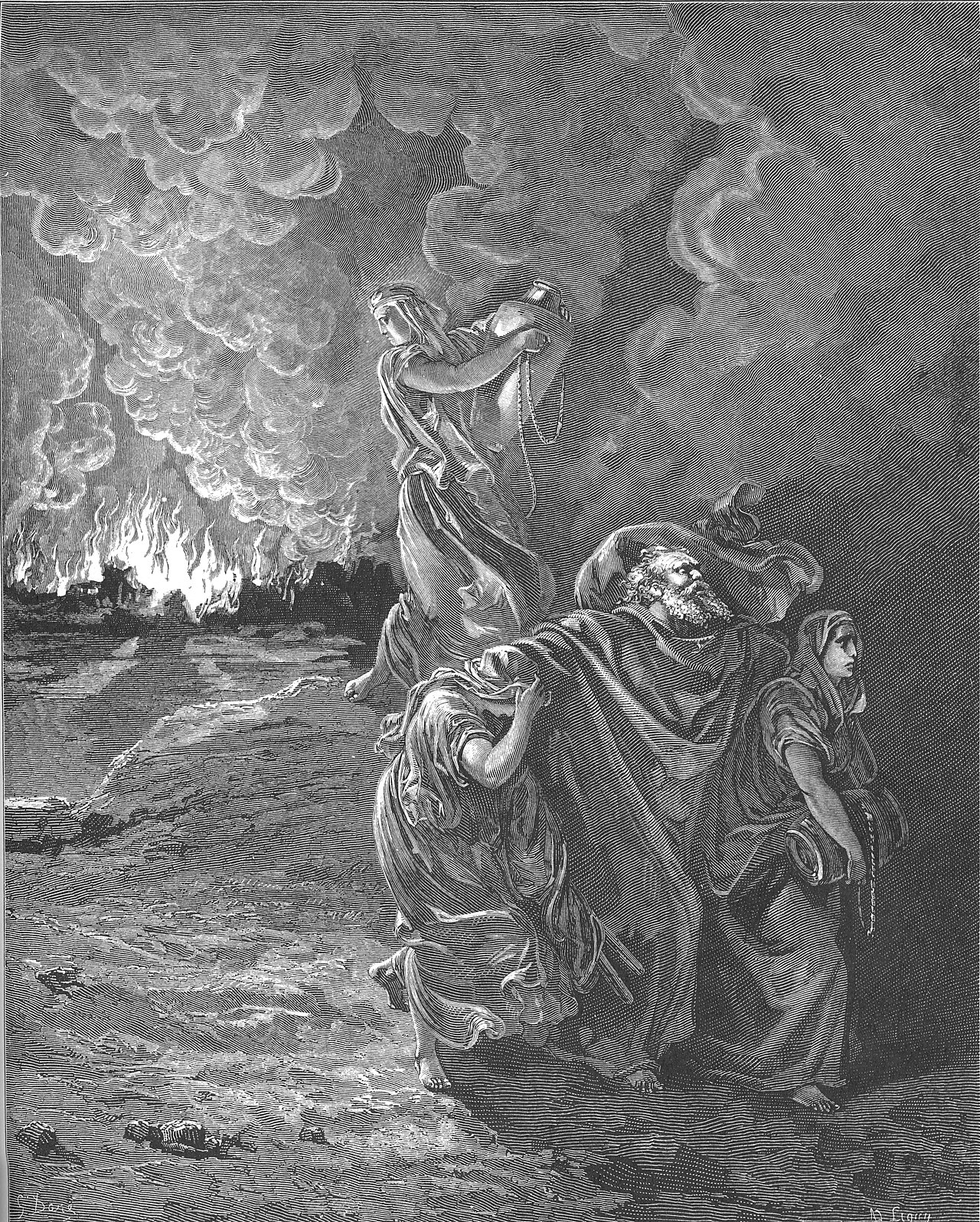
He destroyed these cities and the entire plain: The cities, the entire plain, the inhabitants and everything that grew on the ground go together. Isaiah, Jeremiah, Amos and Zephaniah name it later and expect their hearers to know it. Lot's wife looked back and became a pillar of salt, in one sentence. Jesus gives her three words at Luke 17:32, remember Lot's wife.
Genesis 19:25
“And he overthrew those cities, and all the plain - This forms what is called the lake Asphaltites, Dead Sea, or Salt Sea, which, according to the most authentic accounts, is about seventy miles in length, and eighteen in breadth. The most strange and incredible tales are told by many of the ancients, and by many of the moderns, concerning the place where these cities stood.”
Adam Clarke · Commentary on the Bible (1810-1826)evangelical
1 more voice on this verse
Genesis 19:25
"The plain which is now covered by the Salt or Dead Sea shows in the great difference of level between the bottoms of the northern and southern ends of the lake--the latter being thirteen feet and the former thirteen hundred--that the southern end was of recent formation, and submerged at the time of the fall of the cities" [LYNCH].
Jamieson, Fausset & Brown · Commentary Critical and Explanatory on the Whole Bible (1871)reformed
a pillar of salt: Adam Clarke sets aside the many old tales about how the change happened and keeps to what the text says. She was walking behind her husband, and she looked back against the command of verse 17. Scripture says little more.
Genesis 19:26
“She became a pillar of salt - The vast variety of opinions, both ancient and modern, on the crime of Lot’s wife, her change, and the manner in which that change was effected, are in many cases as unsatisfactory as they are ridiculous. On this point the sacred Scripture says little. God had commanded Lot and his family not to look behind them; the wife of Lot disobeyed this command; she looked back from behind him - Lot, her husband, and she became a pillar of salt.”
Adam Clarke · Commentary on the Bible (1810-1826)evangelical
4 more voices on this verse
Genesis 19:26
“But let us return to Lot, who, fleeing the destruction of Sodom with his wife and daughters after he had received the command from the angels to not look back, was proceeding to Zoar. But his wife became negligent of the command. "She looked back"; she violated the imposed law; "she became a little statue of salt." Do we think there was so much evil in this transgression, that the woman, because she looked behind her, incurred the destruction that she appeared to be fleeing by divine favor?”
Origen of Alexandria · written before 253 · HOMILIES ON GENESIS 5.2patristic
Genesis 19:26
“As by the example of Sodom the wicked are warned to turn from their wickedness, so by the example of Lot's wife the righteous are warned not to turn from their righteousness. The sin of Lot's wife: She looked back from behind him. This seemed a small thing, but we are sure, by the punishment of it, that it was a great sin, and exceedingly sinful.”
Matthew Henry · Commentary on the Whole Bible (1707-1721)puritan
Genesis 19:26
“But whether it was from irresistible curiosity or perturbation of feeling, or that she was about to return to save something, his wife lingered, and while thus disobeying the parting counsel, "to look not back, nor stay in all the plain" [Ge 19:17], the torrent of liquid lava enveloped her so that she became the victim of her supine indolence or sinful rashness.”
Jamieson, Fausset & Brown · Commentary Critical and Explanatory on the Whole Bible (1871)reformed
Genesis 19:26
“Probably she hankered after her house and goods in Sodom, and was loath to leave them. Christ intimates this to be her sin, Luke xvii, 31, 32, she too much regarded her stuff. And her looking back spoke an inclination to go back; and therefore our saviour uses it as a warning against apostasy from our Christian profession.”
John Wesley · Explanatory Notes upon the Old Testament (1765)evangelical
Genesis 19:27-28
the place where he had stood before the LORD: Abraham went back early the next morning to the spot where he had stood before the LORD. From there he looked out over Sodom and Gomorrah and the whole plain, and saw smoke going up from the land like a furnace. Exodus 19:18 uses the same figure of Sinai. Genesis gives him the sight and no word with it.
Genesis 19:27
“EARLY in the morning Abraham sought that favored spot where but yesterday God had been pleased to manifest Himself and where he had been favored with a season of extraordinary communion. Where should the Believer go, but to that choice place, dear to his heart, where he has communed with the Lord?— It is a high privilege, the highest which mortals can enjoy, to talk with God, to plead with Him, to use arguments and to prevail. Such Divine Grace had Abraham found. No marvel that he goes back to the place where God had thus drawn near to him.”
2 more voices on this verse
Genesis 19:27
“Note, When we have prayed we must look after our prayers, and observe the success of them. We must direct our prayer as a letter, and then look up for an answer, direct our prayer as an arrow, and then look up to see whether it reach the mark, Ps. v. 3 . Our enquiries after news must be in expectation of an answer to our prayers.”
Matthew Henry · Commentary on the Whole Bible (1707-1721)puritan
Genesis 19:27
“Abraham gat up early in the morning - Anxious to know what was the effect of the prayers which he had offered to God the preceding day; what must have been his astonishment when he found that all these cities, with the plain which resembled the garden of the Lord, Gen 13:10, burnt up, and the smoke ascending like the smoke of a furnace, and was thereby assured that even God himself could not discover ten righteous persons in four whole cities!”
Adam Clarke · Commentary on the Bible (1810-1826)evangelical
like smoke from a furnace: Matthew Henry sets the smoke of Sodom and Gomorrah beside the smoke of Babylon in Revelation 19. He holds that those who pleaded hardest for sinners will glorify God when the judgment falls. Abraham had pleaded for these cities.
Genesis 19:28
“Thus the saints, when they see the smoke of Babylon's torment rising up for ever (like Sodom's here), will say again and again, Alleluia, Rev. xix. Those that have, in the day of grace, most earnestly interceded for sinners, will, in the day of judgment, be content to see them perish, and will glorify God in their destruction.”
Matthew Henry · Commentary on the Whole Bible (1707-1721)puritan
1 more voice on this verse
Genesis 19:28
“And he looked toward Sodom - Not as Lot's wife did, tacitly reflecting upon the divine severity, but humbly adoring it, and acquiescing in it. Here is God's favourable regard to Abraham, ver. 29.”
John Wesley · Explanatory Notes upon the Old Testament (1765)evangelical
He remembered Abraham: The verse credits the rescue to God, who remembered Abraham. Lot was brought out of the catastrophe, and the cities where he lived were destroyed. Genesis uses this word of God acting on a promise, as when He remembered Noah at 8:1 and Rachel at 30:22. The intercession of chapter 18 is answered here.
Genesis 19:29
“God remembered Abraham - Though he did not descend lower than ten righteous persons, (see Gen 18:32), yet the Lord had respect to the spirit of his petitions, and spared all those who could be called righteous, and for Abraham’s sake offered salvation to all the family of Lot, though neither his sons-in-law elect nor his own wife ultimately profited by it. The former ridiculed the warning; and the latter, though led out by the hands of the angel, yet by breaking the command of God perished with the other gainsayers.”
Adam Clarke · Commentary on the Bible (1810-1826)evangelical
1 more voice on this verse
Genesis 19:29
“He remembered Abraham, and, for his sake, sent Lot out of the overthrow. God will certainly give an answer of peace to the prayer of faith, in his own way and time; though, for a while, it seem to be forgotten, yet, sooner or later, it will appear to be remembered.”
Matthew Henry · Commentary on the Whole Bible (1707-1721)puritan
Lot's Daughters in the Cave
Lot left Zoar and settled in the mountains he had asked to avoid. He was afraid to stay in Zoar, and the text gives no other reason. The man who chose the plain of the Jordan at 13:11 ends in a cave with two daughters. Genesis reports the move and stops.
Genesis 19:30
“Lot went up out of Zoar - From seeing the universal desolation that had fallen upon the land, and that the fire was still continuing its depredations, he feared to dwell in Zoar, lest that also should be consumed, and then went to those very mountains to which God had ordered him at first to make his escape. Foolish man is ever preferring his own wisdom to that of his Maker.”
Adam Clarke · Commentary on the Bible (1810-1826)evangelical
1 more voice on this verse
Genesis 19:30
“He feared to dwell in Zoar - Here is the great trouble and distress that Lot was brought into after his deliverance, ver. 29. He was frightened out of Zoar, durst not dwell there, either because he was conscious to himself that it was a refuge of his own chusing, and that therein he had foolishly prescribed to God, and therefore could not but distrust his safety in it.”
John Wesley · Explanatory Notes upon the Old Testament (1765)evangelical
Genesis 19:31-33
The older daughter says no man is left in the land for them. They get him drunk with wine, and the firstborn goes in that night. Noah's story after the flood runs the same way, wine, a father shamed by his children, and nations born out of it. Genesis sets the account down and passes no sentence on it.
Genesis 19:31
“Our father is old - And consequently not likely to re-marry; and there is not a man in the earth - none left, according to their opinion in all the land of Canaan, of their own family and kindred; and they might think it unlawful to match with others, such as the inhabitants of Zoar, who they knew had been devoted to destruction as well as those of Sodom and Gomorrah, and were only saved at the earnest request of their father; and probably while they lived among them they found them ripe enough for punishment, and therefore would have…”
Adam Clarke · Commentary on the Bible (1810-1826)evangelical
1 more voice on this verse
Genesis 19:31
“The great sin that Lot and his daughters were guilty of, when they were in this desolate place. His daughters laid a very wicked plot to bring him to sin; and theirs was, doubtless, the greater guilt.”
Matthew Henry · Commentary on the Whole Bible (1707-1721)puritan
Adam Clarke supposes the wine came from provisions carried out of Zoar. He reads the daughters' plan more favourably than most interpreters, as an effort to keep their father's family alive. The older sister lays the plan.
Genesis 19:32
“Come, let us make our father drink wine - On their flight from Zoar it is probable they had brought with them certain provisions to serve them for the time being, and the wine here mentioned among the rest. After considering all that has been said to criminate both Lot and his daughters in this business, I cannot help thinking that the transaction itself will bear a more favorable construction than that which has been generally put on it.”
Adam Clarke · Commentary on the Bible (1810-1826)evangelical
not aware when she lay down: Lot knew nothing of her coming or going that night. Adam Clarke builds his defence of Lot on this clause, since a father drunk with wine and not aware of the act was not drawn by his own desire. The same words return for the younger daughter at verse 35.
Genesis 19:33
“And he perceived not when she lay down, nor when, etc. - That is, he did not perceive the time she came to his bed, nor the time she quitted it; consequently did not know who it was that had lain with him. In this transaction Lot appears to me to be in many respects excusable. 1. He had no accurate knowledge of what took place either on the first or second night, therefore he cannot be supposed to have been drawn away by his own lust, and enticed.”
Adam Clarke · Commentary on the Bible (1810-1826)evangelical
2 more voices on this verse
Genesis 19:33
“After these things now that well-known story is related in which it is written that Lot's daughters cunningly lay with their father by stealth. In this matter I do not know if anyone can so excuse Lot as to free him from sin. Nor again do I think he should be so accused that he ought to become party to such serious incest. For I do not find him to have plotted against or to have violently snatched away the chastity of his daughters but rather to have been the victim of a plot and cunningly ensnared.”
Origen of Alexandria · written before 253 · HOMILIES ON GENESIS 5.3patristic
Genesis 19:33
“No mountain, on this side the holy hill above, can set us out of the reach of Satan's fiery darts. (2.) The peril of drunkenness. It is not only a great sin itself, but it is the inlet of many sins; it may prove the inlet of the worst and most unnatural sins, which may be a perpetual wound and dishonour.”
Matthew Henry · Commentary on the Whole Bible (1707-1721)puritan
Genesis 19:34-36
I slept with my father last night: The second night is planned in daylight by the sister who went in first. They say they want to preserve their father's line. One chapter earlier God promised a son to a woman past the age of childbearing. Both daughters became pregnant by their father.
the younger daughter went in: Again that night the younger daughter took her turn. John Gill counts it an aggravation of Lot's sin that he was overtaken a second night, when he ought to have been on his guard. Adam Clarke excuses him on the ground that he knew nothing.
Genesis 19:35
“And they made their father drink wine that night also,.... Until he was drunk; which is an aggravation of his sin, that he should be overtaken a second time, and that so soon as the next night, when he ought to have been upon his guard, knowing how he had fallen into it the night before: and the younger arose and lay with him; arose from her own bed, and went to her father's, and lay down by him: and he perceived not when she lay down, nor when she arose; See Gill on Gen 19:33.”
became pregnant by their father: Irenaeus held that Lot, acting without will or knowledge, worked out a figure of things to come. Genesis gives the result in a single line. From these two pregnancies come two peoples on Israel's eastern border.
Genesis 19:36
For Lot, not acting under the impulse of his own will, nor at the prompting of carnal concupiscence, nor having any knowledge or thought of anything of the kind, did [in fact] work out a type [of future events]. As says the Scripture: "And that night the elder went in and lay with her father; and Lot knew not when she lay down, nor when she arose." And the same thing took place in the case of the younger: "And he knew not," it is said, "when she slept with him, nor when she arose."
Irenaeus · written before 202 · Irenaeus Against Heresies Book 4patristic
Genesis 19:37-38
gave birth to a son and named him Moab: Moab and Ammon begin here, and both nations fight Israel for centuries. Deuteronomy 23:3 shuts a Moabite or an Ammonite out of the assembly of the LORD to the tenth generation. The two names are read as from the father and as son of his kindred. Ruth the Moabitess comes out of this line into David's.
Genesis 19:37
“And the firstborn bare a son, and called his name Moab,.... As if it was "Meab", from the father, as Aben Ezra, and so Josephus, that is, which she had by her father; and she was so far from being ashamed that it might be known in time to come, she gave him this name. Hillerus (w) makes it to be a compound of אב and מובא, and to signify "going into", or "lying with a father", which still more notoriously points to her own action.”
1 more voice on this verse
Genesis 19:37
“But I know that some, so far as the story pertains to a spiritual interpretation, have referred Lot to the person of the Lord and his daughters to the two Testaments. But I do not know if anyone freely accepts these views who knows what the Scripture says about the Ammonites and Moabites who descend from Lot's race.”
Origen of Alexandria · written before 253 · HOMILIES ON GENESIS 5.5patristic
she named him Ben-ammi: Adam Clarke renders Ben-ammi as son of one's own people. He takes both names as support for his view that the daughters meant only to keep the family alive, and he notes they never repeated the act. The Ammonites of the narrator's day trace back to this birth.
Genesis 19:38
“Ben-ammi - בן עמי Ben-ammi, the son of my people. Both these names seem to justify the view taken of this subject above, viz., that it was merely to preserve the family that the daughters of Lot made use of the above expedient; and hence we do not find that they ever attempted to repeat it, which, had it been done for any other purpose, they certainly would not have failed to do. On this subject Origen, in his fifth homily on Genesis, has these remarkable words: Ubi hic libidinis culpa, ubi incesti criminis arguitur?”
Adam Clarke · Commentary on the Bible (1810-1826)evangelical
How this psalm is built
The form: A piece of history, the destruction of Sodom set down as a literal fact and as true a record as any event in the book, as Spurgeon classes it.
The patterns in this chapter
| Device | What it does | Where to see it |
|---|---|---|
| The door, opened, shut and lost | The door carries the first half of the chapter. Lot goes out to the crowd and shuts it behind him at verse 6, the men inside pull him back through it and shut it at verse 10, and the crowd struck with blindness wearies itself trying to find it at verse 11. John Gill notices that two different Hebrew words are used, and takes one for the house door and the other for the door of the courtyard passage.John Gill, Exposition of the Old Testament, 1748 to 1763, on Genesis 19:6. | Genesis 19:6, Genesis 19:9, Genesis 19:10, Genesis 19:11 |
| Zoar, the little place | Lot asks for a nearer town and makes its smallness his argument twice in one verse. Adam Clarke gives the name as Tsoar, little, and records that the town had been called Bela before this. The name the place carries afterwards is the word out of Lot's own plea.Adam Clarke, Commentary on the Bible, 1832, on Genesis 19:22. | Genesis 19:20, Genesis 19:22 |
| What the fire took, listed in one breath | Verse 25 names four things together: the cities, the entire plain, all the inhabitants of the cities, and everything that grew on the ground. Adam Clarke reads the overthrow as forming what is now the Salt Sea, and John Wesley reports the lake as about thirty miles long and ten broad, with no living creature in it. The list is the measure of how complete the judgment was.Adam Clarke, Commentary on the Bible, 1832, on Genesis 19:25. | Genesis 19:25 |
| They hurried him, and he lingered | The angels hurry Lot at verse 15 and tell him to hurry again at verse 22, and between the two the text says he hesitated. John Wesley sets the contrast plainly, that Lot did not treat the warning as a joke as his sons in law had, and still did not make the haste the case required. Matthew Henry reads the hand that took his as the mercy the verse itself names.John Wesley, Explanatory Notes upon the Old Testament, 1765, on Genesis 19:16. | Genesis 19:15, Genesis 19:16, Genesis 19:22 |
The New Testament's use
11 more paragraphs on the patterns
The chapter is used three ways in the New Testament. Peter calls Lot righteous at 2 Peter 2:7 and 8, which is the verdict Jamieson, Fausset and Brown work from. Jesus gives Lot's wife three words at Luke 17:32, remember Lot's wife, and John Wesley reads the saying as a warning against turning back from a Christian profession. Matthew Henry sets the smoke of verse 28 beside the smoke of Babylon's torment in Revelation 19.
The unleavened bread of verse 3 is the first in Scripture, and the night carries a shape Israel will keep at Passover: unleavened bread eaten in a house, one household spared while a city is judged, and a family sent out in haste before morning. Genesis records the meal and says nothing about Passover, and the connection is left where the text leaves it.
The debated concept
The chapter carries three long arguments.
The first is what the blindness of verse 11 was. Adam Clarke sets out the two ways it has been understood: that the angels deprived the men of the regular use of their sight, or that they caused a deep darkness to fall so that the men could not find Lot's door. The rare Hebrew word returns when Elisha prays it down on the Aramean army at 2 Kings 6:18, which is the other place a reader can test it against.
The second is Lot's wife. Adam Clarke says the variety of opinions on her crime, her change and the manner of it are in many cases as unsatisfactory as they are ridiculous, and holds that Scripture says little: she was commanded not to look back, she looked back, and she became a pillar of salt. Jamieson, Fausset and Brown offer three possible motives, curiosity, distress of feeling, or a wish to return and save something, and read the end as the liquid mass overtaking her where she lingered. John Wesley holds that she hankered after her house and goods, and reads Luke 17:31 and 32 as Christ's own account of her sin. Matthew Henry takes the smallness of the act as the point, that a thing which seems small is shown great by its punishment.
The third is the double naming of the LORD at verse 24. Adam Clarke reports that many of the primitive fathers and several modern divines took the wording to mean Jehovah the Son raining fire from Jehovah the Father, and read the verse as a proof of the Divinity of Christ. Clarke allows that the doctrine is established elsewhere and says it does not appear to him to be plainly indicated here. John Wesley takes the same reading Clarke declines, God the Son from God the Father, on the ground that the Father has committed all judgment to the Son.
The cave at the end of the chapter is argued over as well. Adam Clarke reads the two names, Moab and Ben-ammi, as evidence that the daughters acted to preserve the family line, and notes that they never repeated it, which he takes as telling. He cites Origen's fifth homily on Genesis on the same question. Genesis itself passes no sentence, and Matthew Henry supplies one, reading the episode as the sin of Lot and his daughters and as a warning about wine.
The divine connection
The chapter answers the argument of Genesis 18 without repeating it. Abraham had stopped at ten righteous, and verse 4 gives the count another way, all the men of the city, both young and old. The terms he settled were never met, and verse 29 says what happened instead: God remembered Abraham, and brought Lot out. Adam Clarke reads that as the Lord having respect to the spirit of Abraham's petition though the petition itself stopped short.
The verb in verse 29 is the one Genesis uses of God acting on a promise. He remembered Noah at Genesis 8:1 and Rachel at Genesis 30:22, and each time a rescue follows. The rescue here is credited to a man who was not in the city and had already gone home.
Keep studying
Words12
Subjects1
Sources for this chapter
The summary
Jamieson, Fausset & Brown, Commentary Critical and Explanatory; John Calvin, Commentaries; John Wesley, Notes on the Old Testament and Matthew Henry, Complete Commentary.
The form and classifications
Charles Spurgeon; Jamieson, Fausset and Brown, Commentary Critical and Explanatory on the Whole Bible, 1871, on Genesis 19:12 and Matthew Henry, Commentary on the Whole Bible, 1710, on Genesis 19:4.
The exposition
Adam Clarke, Commentary on the Bible; Irenaeus, Against Heresies; Jamieson, Fausset & Brown, Commentary Critical and Explanatory on the Whole Bible; Jerome, Hebrew Questions on Genesis; John Calvin, Commentary on Genesis; John Gill, Exposition of the Old Testament and Matthew Henry, Commentary on the Whole Bible.