
2 Kingschapter 9
37 verses · Jeremiah, by tradition · 6th century BC · History
Key verse
And when thou comest thither, look out there Jehu the son of Jehoshaphat the son of Nimshi, and go in, and make him arise up from among his brethren, and carry him to an inner chamber;
It stands in A flask of oil poured out in an inner chamber, verses 1 to 13.
The chapter
Chapter summary
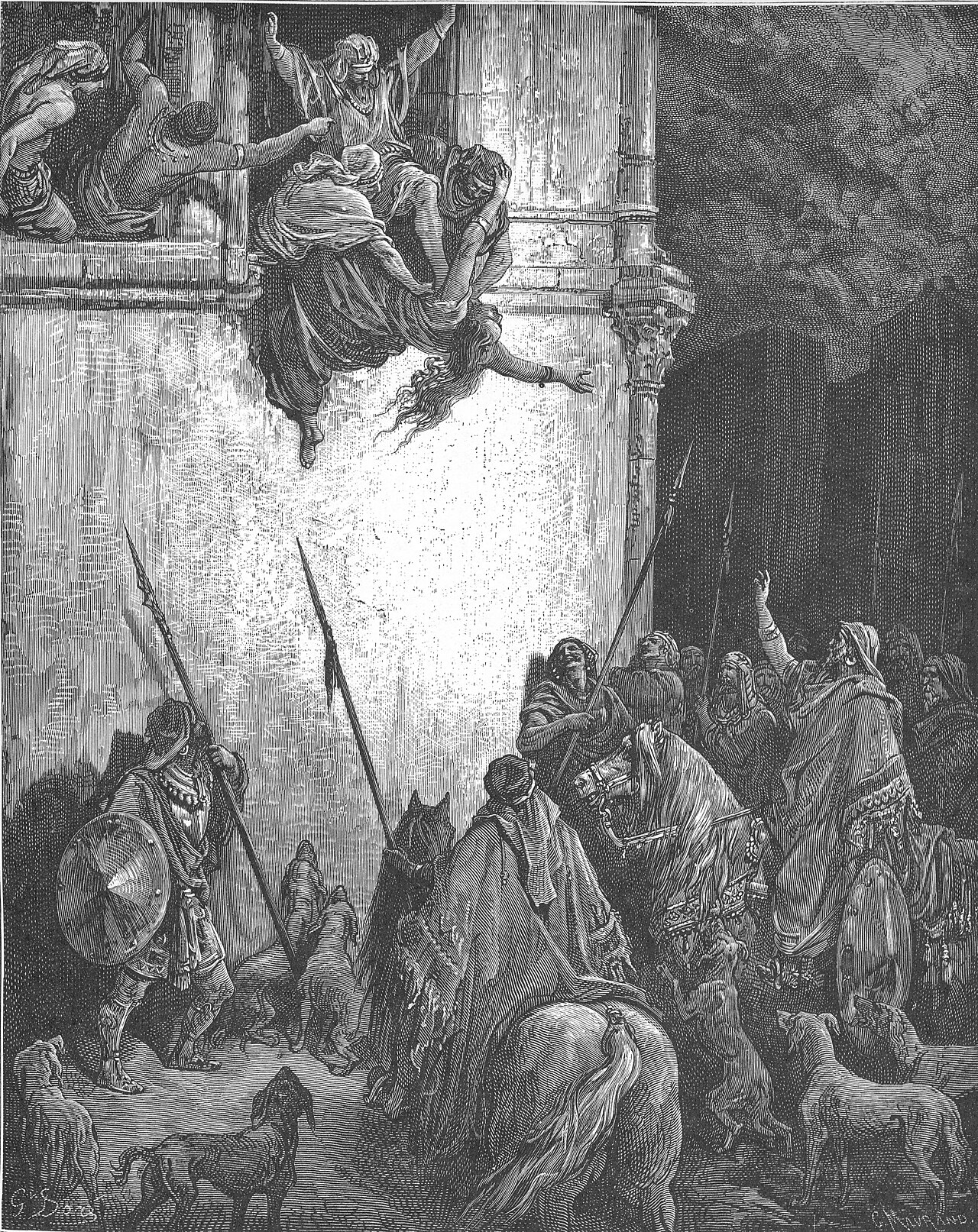
Elisha sends a young prophet to anoint Jehu in an inner chamber at Ramoth-gilead and then flee, judgment on the house of Ahab, to avenge the blood of the prophets. The captains spread their garments under him on the bare steps and blow the trumpet. Then the ride the watchman recognizes: 'the driving is like the driving of Jehu the son of Nimshi; for he driveth furiously.' Joram turns to flee crying treachery, is shot between the arms, and is cast into the portion of Naboth the Jezreelite, exactly as Elijah said. Jezebel paints her eyes and meets him at the window ('Is it peace, thou Zimri, thy master's murderer?') and the dogs eat her.
Context
History · Jeremiah · 2 Kings overview
The world of this chapter
- Who
- Israelites who had waited a generation for the sentence on Ahab's house to fall
- Where
- The army camp at Ramoth-gilead, and the royal residence at Jezreel
- When
- The revolution of Jehu. 841 BC
Historical context
The chapter belongs to Jehu, a commander of the army holding the border post at Ramoth-gilead, and to an unnamed young prophet sent by Elisha. The year is 841 BC, which the Assyrian record fixes at the other end by the tribute Jehu paid in the same year.
The places are an army camp in Gilead and the royal residence at Jezreel, about forty-five miles apart. The occasion is a wounded king recovering at Jezreel while his army stands at the border.
A first hearer knew what an anointing was and what it cost. Oil came in a flask and was poured on the head with the commission spoken over the man. Doing it in the back room of an army camp, by a messenger who then runs for his life, is a measure of the danger.
The officers' answer is the recognised ritual of acclamation. Clothing laid on the bare steps under a man's feet made a throne dais out of a stairway, and the ram's horn published it.
A first hearer also knew the ground. The plot named twice in this chapter is Naboth's field, taken by false witness in Ahab's day, and the meeting between the two kings and Jehu falls on it.
Jezebel painting her eyes with kohl and dressing her hair is a queen meeting her death in full royal presentation, and her greeting names Zimri, the usurper who lasted seven days. Later in the same year Jehu appears in Assyrian art on the Black Obelisk of Shalmaneser III, kneeling with tribute. It is the closest thing that survives to a contemporary portrait of a ruler named in the Bible.
Significance
The first hearers heard Elijah's sentence come back word for word, spoken by the man carrying it out. Nothing had been forgotten in the years since the vineyard.
The chapter is also a warning about the instrument. Jehu is doing what God commanded. The deceit, the speed and the relish of it are what make a later prophet call the blood of Jezreel a charge against Jehu's own house at Hosea 1:4.
Where the chapter sits
2 Kings 9 falls in Elijah's ascension; Elisha's ministry (chapters 1–13). Elijah taken up by whirlwind; double portion; widow's oil; the Shunammite's son raised; Naaman healed; siege of Samaria broken; Elisha dies and his bones raise a man.
After it: Northern kingdom's fall, chapters 14–17.
The whole shape of 2 Kings→The structure of this chapter
The heads below are this chapter's scenes. The numbered points under each are its verses.
A flask of oil poured out in an inner chamber
Gird up thy loins: Elisha does not go to Ramoth-gilead himself but sends one of the sons of the prophets, keeping the danger from the older man and giving the younger one a task suited to his strength. The flask of oil comes with sealed instructions, pour, declare, then flee before anyone can ask a question, a coronation meant to happen and be gone before the army around Jehu can react. Jewish tradition names the messenger Jonah the son of Amittai, a reading Gill records without pressing it as certain.
2 Kings 9:1
“And Elisha the prophet called one of the children of the prophets,.... Who the Jews generally say (k) was Jonah the son of Amittai: and said, gird up thy loins; his loose and long garments about his loins, for quicker dispatch in travelling: and take this box of oil in thine hand; for an use after directed to: and go to Ramothgilead; where Joram had left his army with his captains, to keep the city from the Syrians. (k) Seder Olam Rabba, c. 18. p. 47.”
2 more voices on this verseWhat preachers and commentators have said about this verse, in their own words.
2 Kings 9:1
“Box - Rather, “flask,” or “vial” 1Sa 10:1. Oil and ointment were commonly kept in open-mouthed jars, vases, or bottles made of glass, alabaster, or earthen-ware. Many such vessels have been found both in Egypt and Assyria. The “oil” was the holy oil, compounded after the receipt given in Exodus Exo 30:23-25.”
2 Kings 9:1
“Ramoth-gilead--a city of great importance to the Hebrew people, east of Jordan, as a fortress of defense against the Syrians. Jehoram had regained it (2Ki 8:29). But the Israelitish army was still encamped there, under the command of Jehu.”
Jamieson, Fausset & Brown· Commentary Critical and Explanatory on the Whole Bible (1871)reformed
2 Kings 9:2
“His being suddenly animated for the service would be proof sufficient of his being anointed to it. There needed no other proof. The thing signified was the best evidence of the sign. [2.] To do it expeditiously.”
Matthew Henry· Commentary on the Whole Bible (1707-1721)puritan
2 Kings 9:3
“I have anointed thee king over Israel--This was only a part of the message; the full announcement of which is given (2Ki 9:7-10). flee, and tarry not--for fear of being surprised and overtaken by the spies or servants of the court.”
Jamieson, Fausset & Brown· Commentary Critical and Explanatory on the Whole Bible (1871)reformed
1 more voice on this verse
2 Kings 9:3
“Flee, and tarry not - The probable object of these directions was at once to prevent questioning, and to render the whole thing more striking.”
even the young man the prophet: The narrator repeats the description, even the young man the prophet, twice in one sentence, as if underlining how small a figure carries this errand into a camp of captains. Pulled apart from his brethren into an inner chamber, Jehu is anointed with the same covenant phrase attached to David's own people, king over the people of the Lord, even over Israel, a title that still calls this apostate kingdom the Lord's own after years of Baal worship. Gill notes that no Loammi had yet been pronounced over them; the calf worship had not cancelled the claim.
2 Kings 9:4
“The young man the prophet - This should be translated, The servant of the prophet; that is, the servant which Elisha now had in place of Gehazi.”
Adam Clarke· Commentary on the Bible (1810-1826)evangelical
2 Kings 9:5
“Perhaps Jehu had some intimation of his business; and therefore, that he might not seem too forward to catch at the honour, he asked, To which of all us? that it might not be said afterwards he got it by speaking first, but they might all be satisfied he was indeed the person designed.”
Matthew Henry· Commentary on the Whole Bible (1707-1721)puritan
1 more voice on this verse
2 Kings 9:5
“The chief officers - the generals - were assembled together in Jehu’s quarters, perhaps holding a council of war. The place of assembly seems to have been the great court. Hence, Jehu “went into the house” 2Ki 9:6 entered, that is, one of the rooms opening into the court.”
2 Kings 9:6
“And he arose, and went into the house,.... Into the inner chamber in it: and he poured the oil on his head, and said unto him, thus saith the Lord God of Israel, I have anointed thee king over the people of the Lord, even over Israel; for though they were fallen into idolatry, and from the pure worship of God, yet the Lord had still a right unto them, and as yet he had not wrote a "Loammi" Hos 1:9 upon them; and there were many among them which had not bowed the knee to Baal.”
1 more voice on this verse
2 Kings 9:6
“King over the people of the Lord - This pointed out to Jehu that he was to rule that people according to God’s law; and consequently, that he was to restore the pure worship of the Most High in Israel.”
Adam Clarke· Commentary on the Bible (1810-1826)evangelical
shalt smite the house of Ahab: The commission names the charge precisely: not the calf worship first raised against Jeroboam, but the blood of the Lord's prophets and servants, shed at Jezebel's hand. The sentence on Ahab's house borrows the exact extermination formula already used against Jeroboam's house and Baasha's, him that pisseth against the wall, and him that is shut up and left, so a reader of Kings recognizes a third dynasty condemned by the same words. The last line names what this book has been waiting to happen, the dogs eating Jezebel in Jezreel, and the young prophet is gone before the door shuts behind him.
2 Kings 9:7
“Thou shalt smite the house of Ahab - For their most cruel murders they have forfeited their own lives, according to that immutable law, “He that sheddeth man’s blood by man shall his blood be shed.” This and the two following verses contain the commission which Jehu received from the Lord against the bloody house of Ahab.”
Adam Clarke· Commentary on the Bible (1810-1826)evangelical
1 more voice on this verse
2 Kings 9:7
“That they were idolaters was bad enough, and merited all that was brought upon them; yet that is not mentioned here, but the controversy God has with them is for their being persecutors, not so much their throwing down God's altars as their slaying his prophets with the sword.”
Matthew Henry· Commentary on the Whole Bible (1707-1721)puritan
2 Kings 9:8
“For the whole house of Ahab shall perish,.... Be cut off by death, and that in a violent manner, not one should escape: and I will cut off from Ahab him that pisseth against the wall, and him that is shut up and left in Israel; of these phrases; see Gill on 1Ki 14:10, 1Ki 21:21.”
2 Kings 9:9
“And I will make the house of Ahab, The same is threatened; see Gill on 1Ki 21:22.”
2 Kings 9:10
“The whole stock of royal blood was little enough, and too little, to atone for the blood of the prophets, the saints and martyrs, which, in God's account, is of great price.”
Matthew Henry· Commentary on the Whole Bible (1707-1721)puritan
wherefore came this mad fellow: The captains call the messenger this mad fellow, the contempt Scripture elsewhere aims at ecstatic prophets, and Jehu answers only, ye know the man, and his communication, letting them draw their own conclusion. Once he repeats the anointing word plainly, the captains do not deliberate; they strip their own cloaks onto the stairs for a throne and blow trumpets, an acclamation as sudden as the anointing itself. Wesley reads their haste as evidence the army was already ripe for Joram's fall.
2 Kings 9:11
This mad fellow - The captains, seeing his excited look, his strange action, and his extreme haste, call him (as soldiers would) “this wild fellow.”
2 Kings 9:12
“They said, It is false - Or, as the Chaldee has it, Thou liest. Or, perhaps, it might be thus understood, “We know he has said nothing but folly and lies, nevertheless, let us hear what he has said.”
Adam Clarke· Commentary on the Bible (1810-1826)evangelical
1 more voice on this verse
2 Kings 9:12
“He knew not but some of them either out of loyalty to Joram or envy of him, might oppose him, and go near to crush his interest in its infancy; but he relied on the divine appointment, and was not afraid to own it, knowing whom he had trusted: he that raised him would stand by him.”
Matthew Henry· Commentary on the Whole Bible (1707-1721)puritan
2 Kings 9:13
“Took every man his garment, and put it under him - The outer cloak of the Jews was a sort of large shawl or blanket, which might well serve for a carpet of state. Such a carpet is commonly represented on the seat of an Assyrian throne in the Nineveh sculptures. The stairs rose against the walI of the house from the pavement of the court to the level of the upper story, or of the roof.”
1 more voice on this verse
2 Kings 9:13
“The popularity of Jehu with the army thus favored the designs of Providence in procuring his immediate and enthusiastic proclamation as king, and the top of the stairs was taken as a most convenient substitute for a throne. Joram had kept Ramoth-gilead--rather, "was keeping," guarding, or besieging it, with the greater part of the military force of Israel.”
Jamieson, Fausset & Brown· Commentary Critical and Explanatory on the Whole Bible (1871)reformed
Driving furiously: an arrow through Joram in Naboth's field
conspired against Joram: The narrator breaks the action to explain what a reader already half knows from the previous chapter, that Joram had held Ramoth-gilead against Hazael and been carried home wounded, leaving Jehu in command at the border. Jehu's first order as king is not a march but a seal on the city, let none go forth nor escape, so that the news reaches Jezreel only in his own chariot. The conspiracy's whole advantage is the silence he buys with that one instruction.
2 Kings 9:14
“Joram had kept Ramoth-gilead - The confederate armies appear to have taken this city; but they were obliged to watch their conquests, as they perceived that Hazael was determined to retake it if possible.”
Adam Clarke· Commentary on the Bible (1810-1826)evangelical
1 more voice on this verse
2 Kings 9:14
“There he was fighting for the king his master, but received orders from a higher king to fight against him. It does not appear that Jehu aimed at the government, or that he ever thought of it, but the commission given him was a perfect surprise to him.”
Matthew Henry· Commentary on the Whole Bible (1707-1721)puritan
2 Kings 9:15
“But King Joram was returned to be healed in Jezreel,.... As is recorded, 2Ki 8:29 and here repeated for the reason above given: and Jehu said, if it be your minds; to engage one and all, and heartily, in this conspiracy, and to make me king: then let none go forth nor escape out of the city, to go to tell it in Jezreel; that so Joram might be surprised unawares, and have no opportunity either of fleeing or of preparing for his defence.”
was come down to see Joram: Jehu rides for Jezreel in the state of a king already, and the text sets Judah's king beside Israel's without comment, Ahaziah come down to visit his wounded uncle. Two kings of two houses, bound by marriage into the one house now under sentence, are gathered in the same place on the same day. Neither man in Jezreel yet knows that Ramoth-gilead has changed hands.
2 Kings 9:16
“So Jehu rode in a chariot,.... In great pomp and majesty as a king: and went to Jezreel: set forward on a march thither with his captains, and part of his army at least, from Ramothgilead; which, according to Bunting (n), was twenty four miles: for Jordan lay there; to be cured of his wounds, as before observed: and Ahaziah king of Judah was come down to see Joram; see 2Ki 8:29. (n) Travels, &c. p. 166.”
1 more voice on this verse
2 Kings 9:16
“Jehu - went to Jezreel; for Joram lay there - From the preceding verse we learn, that Joram had been wounded in his attack on Ramoth-gilead, and had gone to Jezreel to be cured; and neither he nor Ahaziah knew any thing of the conspiracy in Ramoth-gilead, because Jehu and his captains took care to prevent any person from leaving the city; so that the two kings at Jezreel knew nothing of what had taken place.”
Adam Clarke· Commentary on the Bible (1810-1826)evangelical
a watchman on the tower: A watchman posted on the tower reads the approach and sends first one horseman, then a second, and Jehu answers each the same way, what hast thou to do with peace, turn thee behind me, folding the king's own messengers into his advancing company. The watchman's final report turns on one detail rather than any message, the driving is like the driving of Jehu the son of Nimshi, for he driveth furiously, a description Clarke calls almost proverbial for the man. The reader learns Jehu's identity from his chariot before Joram does.
2 Kings 9:17
“A watchman on the tower - These watchmen, fixed on elevated places and generally within hearing of each other, served as a kind of telegraphs, to communicate intelligence through the whole country. But, in some cases, it appears that the intelligence was conveyed by a horseman to the next stage, as in the case before us. At this time, when the armies were at Ramoth-gilead, they were, no doubt, doubly watchful to observe the state of the country, and to notice every movement. See on 2Sa 13:34 (note).”
Adam Clarke· Commentary on the Bible (1810-1826)evangelical
1 more voice on this verse
2 Kings 9:17
“A report was made to Joram in his palace below. A messenger on horseback was quickly despatched down into the plain to meet the ambiguous host and to question the object of their approach. "Is it peace?" We may safely assume that this messenger would meet Jehu at the distance of three miles or more.”
Jamieson, Fausset & Brown· Commentary Critical and Explanatory on the Whole Bible (1871)reformed
2 Kings 9:18
What hast thou to do with peace? - “What is it to thee whether there be peace or war? Join my company, and fall into the rear.”
Adam Clarke· Commentary on the Bible (1810-1826)evangelical
2 Kings 9:19
“Then he sent out a second on horseback, which came to them, and said,.... The same as the first messenger did, and had the same answer, and was bid to do the same as in the preceding verse.”
2 Kings 9:20
“He driveth furiously - Jehu was a bold, daring, prompt, and precipitate general. In his various military operations he had established his character; and now it was almost proverbial.”
Adam Clarke· Commentary on the Bible (1810-1826)evangelical
in the portion of Naboth: Joram and Ahaziah ride out together and meet Jehu in the portion of Naboth the Jezreelite, the exact ground Ahab took by false witness and murder in the chapter where Elijah once stood on this same soil to condemn him. Wesley calls the coincidence of ground itself a kind of preaching, the circumstances of providence making the punishment answer the sin as face answers face in a glass. Nothing in the text says the location was chosen on purpose; the narrator simply names it and lets a reader who remembers that earlier chapter supply the rest.
2 Kings 9:21
“Make ready - literally, (as in margin) “Blind,” i. e., “Harness the horses to the chariot.” The king had no suspicion of Jehu’s treason. Probably he imagined that he was bringing him important news from the seat of war. Ahaziah’s accompanying him is significant of the close friendship which united the uncle and the nephew.”
1 more voice on this verse
2 Kings 9:21
“Portion of Naboth - The very sight of that ground was enough to make Jehu triumph and Joram tremble. The circumstances of events are sometimes so ordered by Divine providence, as to make the punishment answer the sin, as face answers face in a glass.”
John Wesley· Explanatory Notes upon the Old Testament (1765)evangelical
the whoredoms of thy mother: Joram's question, is it peace, gets an answer aimed past him at his mother: what peace, so long as the whoredoms of thy mother Jezebel and her witchcrafts are so many. Wesley observes that Jehu names her sins rather than Joram's own, because hers were the more notorious and the real cause of the judgment he has come to carry out. Joram turns to flee with one word for his nephew, treachery, the first he has understood of what has already happened at Ramoth-gilead.
2 Kings 9:22
“What peace, so long as the whoredoms - Though the words whoredom, adultery, and fornication, are frequently used to express idolatry, and false religion, in general; yet here they may be safely taken in their common and most obvious sense, as there is much reason to believe that Jezebel was the patroness and supporter of a very impure system of religion; and to this Jehu might refer, rather than to the calf-worship, to which himself was most favourably disposed.”
Adam Clarke· Commentary on the Bible (1810-1826)evangelical
1 more voice on this verse
2 Kings 9:22
“He mentions not Joram's, but his mother's sins; because they were more notorious and infamous: and because they were the principal cause why God inflicted, and he was come to execute these judgments. The way of sin can never be the way of peace.”
John Wesley· Explanatory Notes upon the Old Testament (1765)evangelical
2 Kings 9:23
“And Joram turned his hand, and fled,.... Taking hold of the horses' reins with it to turn them, or by the motion of it directing the charioteer to turn them back towards Jezreel, whither he fled: and said to Ahaziah, there is treachery, O Ahaziah; a conspiracy formed, and rebellion raised by the captains, at the head of which he supposed Jehu was.”
smote Jehoram between his arms: Jehu draws his bow with full strength and the arrow finds Joram between his arms, read by the bench as between the shoulders since the king had already turned his chariot to run. One shot ends the reign in a single verse, the same abruptness with which the anointing in the inner chamber began it. The house of Ahab loses its king on the ground his father stole.
2 Kings 9:24
“Drew a bow with his full strength - The marginal reading is correct: He filled his hand with a bow. That is, “He immediately took up his bow, set his arrow, and let fly.” This is the only meaning of the passage. Between his arms - That is, between his shoulders; for he was now turned, and was flying from Jehu.”
Adam Clarke· Commentary on the Bible (1810-1826)evangelical
the Lord laid this burden: Jehu tells his own captain Bidkar to remember riding behind Ahab on this very road when the Lord laid this burden upon him, and orders Joram thrown into Naboth's field rather than given a king's burial. Verse twenty-six adds a detail the earlier chapter never states outright, the blood of his sons alongside Naboth's own, which Clarke reads as evidence that Jezebel's plot to secure the vineyard permanently must have removed any heir who could reclaim it. The command closes with its own citation, according to the word of the Lord, naming the debt as paid where it was incurred.
2 Kings 9:25
“Rode together after Ahab - The Assyrian sculptures make it probable that Josephus was right in interpreting this “rode side by side behind Ahab in his chariot.” The Assyrian monarchs, when they go out to war, are frequently attended hy two guards, who stand behind them in the same chariot. Burden - Compare the use of the same word in Isaiah (Isa 13:1; Isa 15:1, etc.), and in Lamentations Lam 2:14, for a denunciation of woe.”
1 more voice on this verse
2 Kings 9:25
“For this the house of Ahab must be reckoned with; and that very piece of ground which he, with so much pride and pleasure, had made himself master of at the expense of the guilt of innocent blood, now became the theatre on which his son's dead body lay exposed a spectacle to the world. Thus the Lord is known by the judgment which he executeth.”
Matthew Henry· Commentary on the Whole Bible (1707-1721)puritan
2 Kings 9:26
“The blood of Naboth, and the blood of his sons - We are not informed in 1 Kings 21 that any of Naboth’s family was slain but himself: but as the object both of Ahab and Jezebel was to have Naboth’s vineyard entirely, and for ever, it is not likely that they would leave any of his posterity, who might at a future time reclaim it as their inheritance. Again, to secure this point, Jezebel had Naboth convicted of treason and atheism; in order that his whole family might be involved in his ruin.”
Adam Clarke· Commentary on the Bible (1810-1826)evangelical
Ahaziah shot at the ascent of Gur
by the way of the garden house: Ahaziah runs for Judah and is overtaken on the road near Ibleam, dying at Megiddo, a death Chronicles fills out with more detail than Kings gives here. Jehu still permits the body to be carried to Jerusalem and buried with his fathers in the city of David, a courtesy Gill traces to Ahaziah's descent from Jehoshaphat rather than any mercy toward the house of Ahab he had married into. Judah's throne, unlike Israel's, still has a David to be buried beside.
2 Kings 9:27
“By the way of the garden-house - Or “by the way of Beth-Gan,” which has been conjectured to be another name for En-Gannim, “the spring of the gardens.” Both are considered identical with Ginaea, the modern Jenin, which lies due south of Jezreeh The road from Jezreel (Zerin) to Jenin passes at first along the plain of Esdraelon, but after a while begins to rise over the Samaritan hills. Here probably was “the ascent of Gur, by Ibleam,” which may have occupied the site of the modern Jelama. Whether the soldiers attacked him there or not is uncertain.”
2 more voices on this verse
2 Kings 9:27
“He died - The history is briefly and imperfectly described here, and the defects supplied in (the book of Chronicles, is great part written for that end, to supply things omitted in the book of Kings) out of both it may be thus compleated: he fled first to Megiddo, and thence to Samaria, where he was caught, and thence brought to Jehu, and by his sentence was put to death at Megiddo.”
John Wesley· Explanatory Notes upon the Old Testament (1765)evangelical
2 Kings 9:27
“Ahaziah--was grandnephew to King Joram, and great-grandson to King Ahab. Ibleam--near Megiddo, in the tribe of Issachar (Jos 17:11; Jud 1:27); and Gur was an adjoining hill.”
Jamieson, Fausset & Brown· Commentary Critical and Explanatory on the Whole Bible (1871)reformed
2 Kings 9:28
“And his servants carried him in a chariot to Jerusalem,.... With the leave of Jehu, because he was the grandson of Jehoshaphat, a sincere worshipper of God, 2Ch 22:9, and buried him in his sepulchre with his fathers in the city of David; see 1Ki 22:50.”
the eleventh year of Joram: The chapter dates Ahaziah's accession to Joram's eleventh year, where the previous chapter had given the twelfth, and the bench reads the two verses together rather than against each other. Barnes and Gill both take it as two ways of counting the same short reign, a co-regency year with his father counted once as eleventh and once as twelfth depending on which king anchors the count. Both readings stand on the same two verses.
2 Kings 9:29
“In the eleventh year - The twelfth according to 2Ki 8:25. The discrepancy may be best explained from two ways of reckoning the accession of Ahaziah, who is likely to have been regent for his father during at least one year. See 2Ch 21:19.”
Painted eyes at a window, and dogs in the portion of Jezreel
she painted her face: Jezebel meets her death exactly as report reaches her, taking time to paint her eyes and dress her hair before she looks out the window, a queen staging her last appearance on her own terms. Her taunt reaches for the one precedent that fits, had Zimri peace, who slew his master, naming the captain who took Elah's throne by murder and burned in it seven days later. Gill reads the question as daring Jehu to remember how briefly a usurper's crown lasts.
2 Kings 9:30
“She painted her face, and tired her head - She endeavored to improve the appearance of her complexion by paint, and the general effect of her countenance by a tiara or turban head-dress. Jonathan, the Chaldee Targumist, so often quoted, translates this וכחלת בצדידא עינהא vechachalath bitsdida eynaha: “She stained her eyes with stibium or antimony.” This is a custom in Astatic countries to the present day. From a late traveler in Persia, I borrow the following account: - “The Persians differ as much from us in their notions of beauty as they do in those of taste.”
Adam Clarke· Commentary on the Bible (1810-1826)evangelical
1 more voice on this verse
2 Kings 9:30
“Jezebel painted her face--literally, "her eyes," according to a custom universal in the East among women, of staining the eyelids with a black powder made of pulverized antimony, or lead ore mixed with oil, and applied with a small brush on the border, so that by this dark ligament on the edge, the largeness as well as the luster of the eye itself was thought to be increased.”
Jamieson, Fausset & Brown· Commentary Critical and Explanatory on the Whole Bible (1871)reformed
2 Kings 9:31
“And as Jehu entered in at the gate,.... Either of the city of Jezreel, or of the king's palace: she said, had Zimri peace, who slew his master? Elah the son of Baasha king of Israel; no, he had not; he reigned but seven days, and, being besieged, burnt the king's house over him, and died, 1Ki 16:10, suggesting that the like would be his fate, who had slain his master Joram; or the words may be rendered, "O Zimri, the slayer of his master"; calling Jehu so, because of his likeness to Zimri.”
1 more voice on this verse
2 Kings 9:31
“Had Zimri peace, who slew his master? - Jarchi paraphrases this place thus: “If thou hast slain thy master, it is no new thing; for Zimri also slew Elah, the son of Baasha;” which words were rather intended to conciliate than to provoke. But the words are understood by most of the versions thus: Health to Zimri, the slayer of his master!”
Adam Clarke· Commentary on the Bible (1810-1826)evangelical
Who is on my side?: Jehu answers her window with a question of his own, who is on my side, close to the psalmist's own appeal against evildoers, and two or three eunuchs inside Jezebel's household choose him over her without hesitation. At his order they throw her down, and the horses that trample her afterward finish what the fall began. The men who owed her service that morning are the men who end her life by noon.
2 Kings 9:32
“And the Psalmist ( Ps. xciv. 16 ), Who will rise up for me against the evil-doers? Note, When reformation-work is set on foot, it is time to ask, "Who sides with it?" III.”
Matthew Henry· Commentary on the Whole Bible (1707-1721)puritan
2 Kings 9:33
“However it was, thus she was most shamefully put to death, dashed against the wall and the pavement, and then trodden on by the horses, which were all besmeared with her blood and brains. See the end of pride and cruelty, and say, The Lord is righteous. The very dogs completing her shame and ruin, according to the prophecy.”
Matthew Henry· Commentary on the Whole Bible (1707-1721)puritan
for she is a king’s daughter: Jehu eats and drinks first, then orders Jezebel's body buried, calling her a king's daughter, since she came to Israel as the daughter of the king of Tyre before she was ever Ahab's queen. The men sent to bury her find only the skull, the feet, and the palms of her hands, the dogs of Jezreel having already done what royal blood could not prevent. Clarke calls the fulfillment literal down to the detail, the same dogs named against her by name in the earlier chapter.
2 Kings 9:34
“She is a king’s daughter - Jezebel was certainly a woman of a very high lineage. She was daughter of the king of Tyre; wife of Ahab, king of Israel; mother of Joram, king of Israel; mother-in-law of Joram, king of Judah; and grandmother of Ahaziah, king of Judah.”
Adam Clarke· Commentary on the Bible (1810-1826)evangelical
2 Kings 9:35
“And they went to bury her,.... The servants of Jehu, according to his orders and instructions: but they found no more of her than the scull, and the feet, and the palms of her hands; the flesh, and even all the rest of her bones, being devoured by dogs, so that there was scarce anything of her to be buried, as in 2Ki 9:10, something similar to this happened to Ascletarion, a mathematician, as related by Suetonius (o). (o) In Vita Domitian. c. 15.”
1 more voice on this verse
2 Kings 9:35
“The skull - the feet, and the palms of her hands - The dogs did not eat those parts, say Jarchi and Kimchi, because in her festal dances she danced like a dog, on her hands and feet, wantonly moving her head. What other meaning these rabbins had, I do not inquire. She was, no doubt, guilty of the foulest actions, and was almost too bad to be belied. How literally was the prediction delivered in the preceding book, (1Ki 21:23, The dogs shall eat Jezebel, by the wall of Jezreel), fulfilled!”
Adam Clarke· Commentary on the Bible (1810-1826)evangelical
by his servant Elijah the Tishbite: Jehu names the word and the man who spoke it, this is the word of the Lord, which he spake by his servant Elijah the Tishbite, closing a sentence Elijah first pronounced at Naboth's vineyard and the narrator had already echoed once at Ahab's own death. The formula runs through three condemned houses in this book, Jeroboam's, Baasha's, and now Ahab's, and here alone the text spells out that not even a grave will hold Jezebel's name, so that they shall not say, this is Jezebel. Revelation 2:20 later carries that same name out of Jezreel entirely and gives it to a teacher inside a church at Thyatira, the same seduction under a borrowed title.
2 Kings 9:36
“This is the word of the Lord--(See 1Ki 21:23). Jehu's statement, however, was not a literal but a paraphrased quotation of Elijah's prophecy.”
Jamieson, Fausset & Brown· Commentary Critical and Explanatory on the Whole Bible (1871)reformed
2 Kings 9:37
“And the carcass of Jezebel shall be as dung - As it was not buried under the earth, but was eaten by the dogs, this saying was also literally fulfilled. They shall not say, This is Jezebel - As she could not be buried, she could have no funeral monument. Though so great a woman by her birth, connections, and alliances, she had not the honor of a tomb! There was not even a solitary stone to say, Here lies Jezebel! not even a mound of earth to designate the place of her sepulture!”
Adam Clarke· Commentary on the Bible (1810-1826)evangelical
Keep studying
On this page
Studies3
On this book
Sources for this chapter
The summary
Jamieson, Fausset & Brown, Commentary Critical and Explanatory; John Wesley, Notes on the Old Testament and Matthew Henry, Complete Commentary.
The exposition
Adam Clarke, Commentary on the Bible; Albert Barnes, Notes on the Old Testament; Jamieson, Fausset & Brown, Commentary Critical and Explanatory on the Whole Bible; John Gill, Exposition of the Old Testament; John Wesley, Explanatory Notes upon the Old Testament and Matthew Henry, Commentary on the Whole Bible.