
2 Kings 9:22
in 2 Kings 9When Joram saw Jehu, he asked, “Have you come in peace, Jehu?” “How can there be peace,” he replied, “as long as the idolatry and witchcraft of your mother Jezebel abound?”
BSB
The same verse in ASV and KJV ▾
ASV
And it came to pass, when Joram saw Jehu, that he said, Is it peace, Jehu? And he answered, What peace, so long as the whoredoms of thy mother Jezebel and her witchcrafts are so many?
KJV
And it came to pass, when Joram saw Jehu, that he said, Is it peace, Jehu? And he answered, What peace, so long as the whoredoms of thy mother Jezebel and her witchcrafts are so many?
⋯
This verse in 2 Kings 9
Commentary
9 notes on this verseWhat peace, so long as the whoredoms - Though the words whoredom, adultery, and fornication, are frequently used to express idolatry, and false religion, in general; yet here they may be safely taken in their common and most obvious sense, as there is much reason to believe that Jezebel was the patroness and supporter of a very impure system of religion; and to this Jehu might refer, rather than to the calf-worship, to which himself was most favourably disposed.
This site's exposition
the whoredoms of thy mother
on 2 Kings 9:22-23
Joram's question, is it peace, gets an answer aimed past him at his mother: what peace, so long as the whoredoms of thy mother Jezebel and her witchcrafts are so many. Wesley observes that Jehu names her sins rather than Joram's own, because hers were the more notorious and the real cause of the judgment he has come to carry out. Joram turns to flee with one word for his nephew, treachery, the first he has understood of what has already happened at Ramoth-gilead.
The record, by era
The Church Fathers1 voice
So he went out with a group of select men. But he met Joram, king of Israel, in the course of his journey, and little later Ahaziah, king of Judah. He was able to defeat them after the first attack and killed them both.
The Puritans and the Awakening4 voices
He mentions not Joram's, but his mother's sins; because they were more notorious and infamous: and because they were the principal cause why God inflicted, and he was come to execute these judgments. The way of sin can never be the way of peace.
Note, It is no new thing for those that are doing God's work to be looked upon as out of the way of peace. Active reformers, faithful reprovers, are threatened with trouble; but let them be in nothing terrified, Phil. i. (3.) She quoted a precedent, to deter him from the prosecution of this enterprise: " Had Zimri peace?
quarantine:debris (2026-07-29) — odd-straight-quotes
And it came to pass, when Joram saw, Jehu, that he said, is it peace, Jehu?....
Jezebel daring the judgment. She heard that Jehu had slain her son, and slain him for her whoredoms and witchcrafts, and thrown his dead body into the portion of Naboth, according to the word of the Lord, and that he was now coming to Jezreel, where she could not but expect herself to fall next a sacrifice to his revenging sword.
2 more voices on this verse
The Nineteenth Century2 voices
A commentator
Jamieson, Fausset & Brown1802–1910
Commentary Critical and Explanatory on the Whole Bible (1871)
A report was made to Joram in his palace below. A messenger on horseback was quickly despatched down into the plain to meet the ambiguous host and to question the object of their approach. "Is it peace?" We may safely assume that this messenger would meet Jehu at the distance of three miles or more.
A commentator
Albert Barnes1798–1870
Notes, Explanatory and Practical, on the Old and New Testaments (1832-1869)
proposed
Joram had asked the usual question, “Is it peace?” - meaning simply, “Is all well?” In Jehu’s reply, by “whoredoms” we are probably to understand “idolatries,” acts of spiritual unfaithfulness; by “witchcrafts,” dealings with the Baal prophets and oracles. Compare 2Ki 1:2 note.
The words behind it
17 Hebrew wordsEvery Hebrew word of this verse in the order it stands, with what it means and the door to its own study. The last column counts the times a word stands in the whole Bible: the rarer the word, the more the places it appears belong together.
| Hebrew | Sound | Meaning | Word study | In the Bible |
|---|---|---|---|---|
| וַיְהִ֗י | vayhi | and it was | H1961 → | 3559 times |
| כִּרְא֤וֹת | kirot | when saw | H7200 → | 1300 times |
| יְהוֹרָם֙ | yehoram | Jehoram | H3088 → | 29 times |
| אֶת־ | ʾet- | <obj.> | H853 → | 10935 times |
| יֵה֔וּא | yehu' | Jehu | H3058 → | 58 times |
| וַיֹּ֖אמֶר | vaiyomer | and he said | H559 → | 5305 times |
| הֲשָׁל֣וֹם | hashalom | ¿ peace | H7965 → | 236 times |
| יֵה֑וּא | yehu' | O Jehu | H3058 → | 58 times |
| וַיֹּ֙אמֶר֙ | vaiyomer | and he said | H559 → | 5305 times |
| מָ֣ה | mah | what? | H4100 → | 752 times |
| הַשָּׁל֔וֹם | hashalom | [is] <the> peace | H7965 → | 236 times |
| עַד־ | ʾad- | until | H5704 → | 1261 times |
| זְנוּנֵ֞י | zenunei | [the] prostitutions of | H2183 → | |
| אִיזֶ֧בֶל | ʾizevel | Jezebel | H348 → | 22 times |
| אִמְּךָ֛ | ʾimekha | mother your | H517 → | 220 times |
| וּכְשָׁפֶ֖יהָ | ukheshafeiha | and sorceries her | H3785 → | |
| הָרַבִּֽים׃ | harabim | <the> many | H7227 → | 454 times |
וַיְהִ֗יand it was
vayhiH1961 →3559 times
כִּרְא֤וֹתwhen saw
kirotH7200 →1300 times
יְהוֹרָם֙Jehoram
yehoramH3088 →29 times
אֶת־<obj.>
ʾet-H853 →10935 times
יֵה֔וּאJehu
yehu'H3058 →58 times
וַיֹּ֖אמֶרand he said
vaiyomerH559 →5305 times
הֲשָׁל֣וֹם¿ peace
hashalomH7965 →236 times
יֵה֑וּאO Jehu
yehu'H3058 →58 times
וַיֹּ֙אמֶר֙and he said
vaiyomerH559 →5305 times
מָ֣הwhat?
mahH4100 →752 times
הַשָּׁל֔וֹם[is] <the> peace
hashalomH7965 →236 times
עַד־until
ʾad-H5704 →1261 times
זְנוּנֵ֞י[the] prostitutions of
zenuneiH2183 →
אִיזֶ֧בֶלJezebel
ʾizevelH348 →22 times
אִמְּךָ֛mother your
ʾimekhaH517 →220 times
וּכְשָׁפֶ֖יהָand sorceries her
ukheshafeihaH3785 →
הָרַבִּֽים׃<the> many
harabimH7227 →454 times
A shaded row is a word that stands 400 times or fewer in the Bible.
The walk
8 stopsEach card is a verse this one points to, and under it the verses that one points to in turn. Where several paths arrive at the same place, that place is listed first: the text keeps returning to it.
Through
Nahum 3:4because of the many harlotries of the harlot, the seductive mistress of sorcery, who betrays nations by her prostitution and clans by her witchcraft.
it leads to
- Isaiah 47:9
These two things will overtake you in a moment, in a single day: loss of children, and widowhood. They will come upon you in full measure, in spite of your many sorceries and the…
- Isaiah 47:12–13
So take your stand with your spells and with your many sorceries, with which you have wearied yourself from your youth. Perhaps you will succeed; perhaps you will inspire terror!
- Revelation 18:23
The light of a lamp will never shine in you again, and the voices of a bride and bridegroom will never call out in you again. For your merchants were the great ones of…
- Revelation 17:1–5
Then one of the seven angels with the seven bowls came and said to me, “Come, I will show you the punishment of the great prostitute, who sits on many waters.
- Ezekiel 16:25–29
At the head of every street you built your lofty shrines and degraded your beauty. With increasing promiscuity, you spread your legs to all who passed by.
- Isaiah 47:9
Through
2 Chronicles 21:13but you have walked in the ways of the kings of Israel and have caused Judah and the people of Jerusalem to prostitute themselves, just as the house of Ahab prostituted itself. You have…
it leads to
- 2 Chronicles 21:4
When Jehoram had established himself over his father’s kingdom, he strengthened himself by putting to the sword all his brothers along with some of the princes of Israel.
- 2 Chronicles 21:11
Jehoram had also built high places on the hills of Judah; he had caused the people of Jerusalem to prostitute themselves and had led Judah astray.
- 1 Kings 16:30–33
However, Ahab son of Omri did evil in the sight of the LORD, more than all who were before him.
- 2 Chronicles 21:4
Where this verse is studied
On this page
About 2 Kings
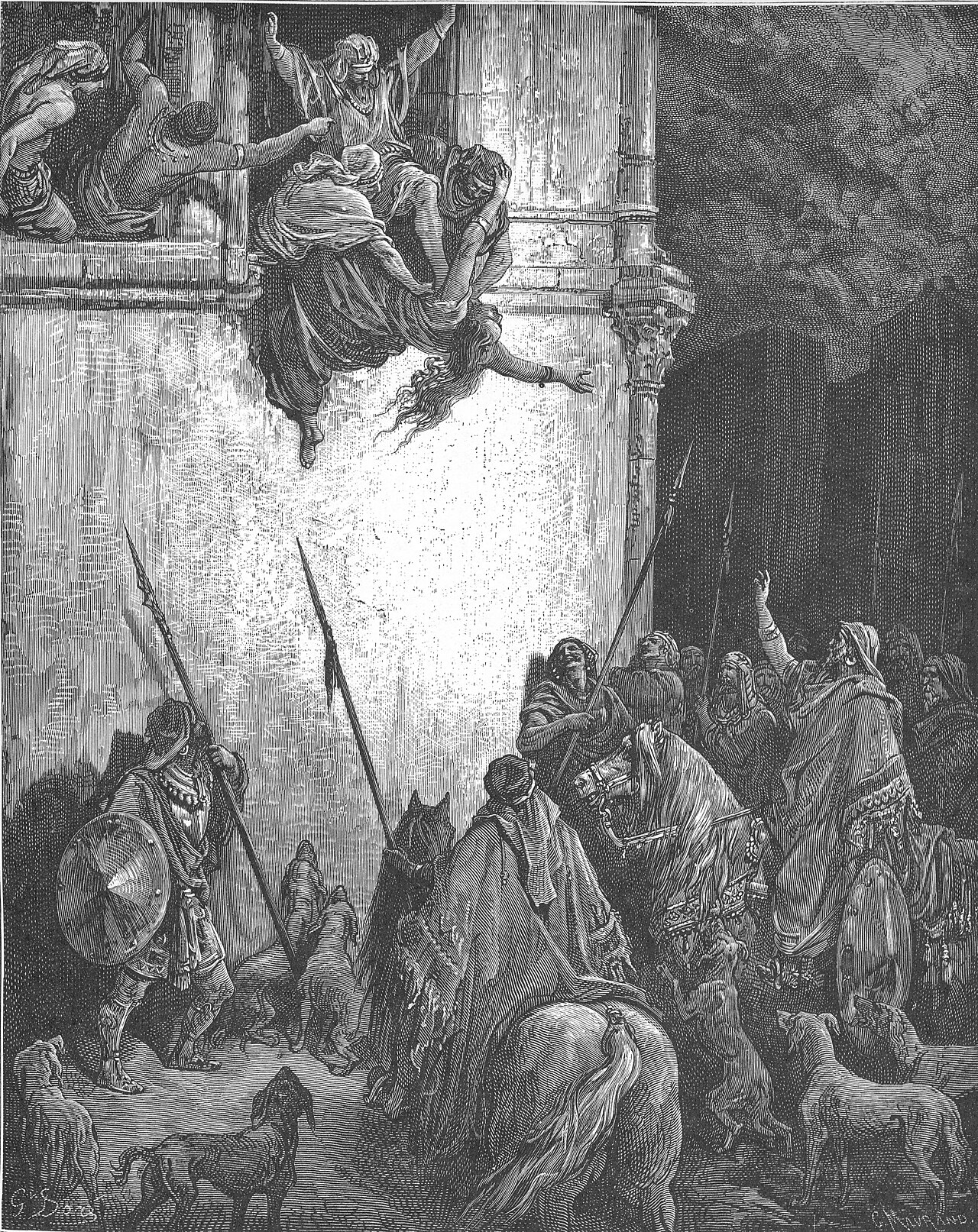
Who and where
2 names in this verse with a page on the site.
- PersonDivided kingdomJezebelSidonian princess and Ahab's queen who institutionalized Baal worship in Israel, ordered Elijah's death after Carmel, and engineer…
- PersonDivided kingdomJehuThe furious-driving commander anointed at Elisha's order who purged the house of Ahab and Baal from Israel — zealous for the LORD,…
This page draws on Adam Clarke, Commentary on the Bible; Albert Barnes, Notes, Explanatory and Practical, on the Old and New Testaments (1832-1869); Ephrem the Syrian, ON THE SECOND BOOK OF KINGS 9:1-24; Jamieson, Fausset & Brown, Commentary Critical and Explanatory on the Whole Bible; John Gill, Exposition of the Old Testament (1748-1763); John Wesley, Explanatory Notes upon the Old Testament and Matthew Henry, Commentary on the Whole Bible.