
2 Kings 9:33
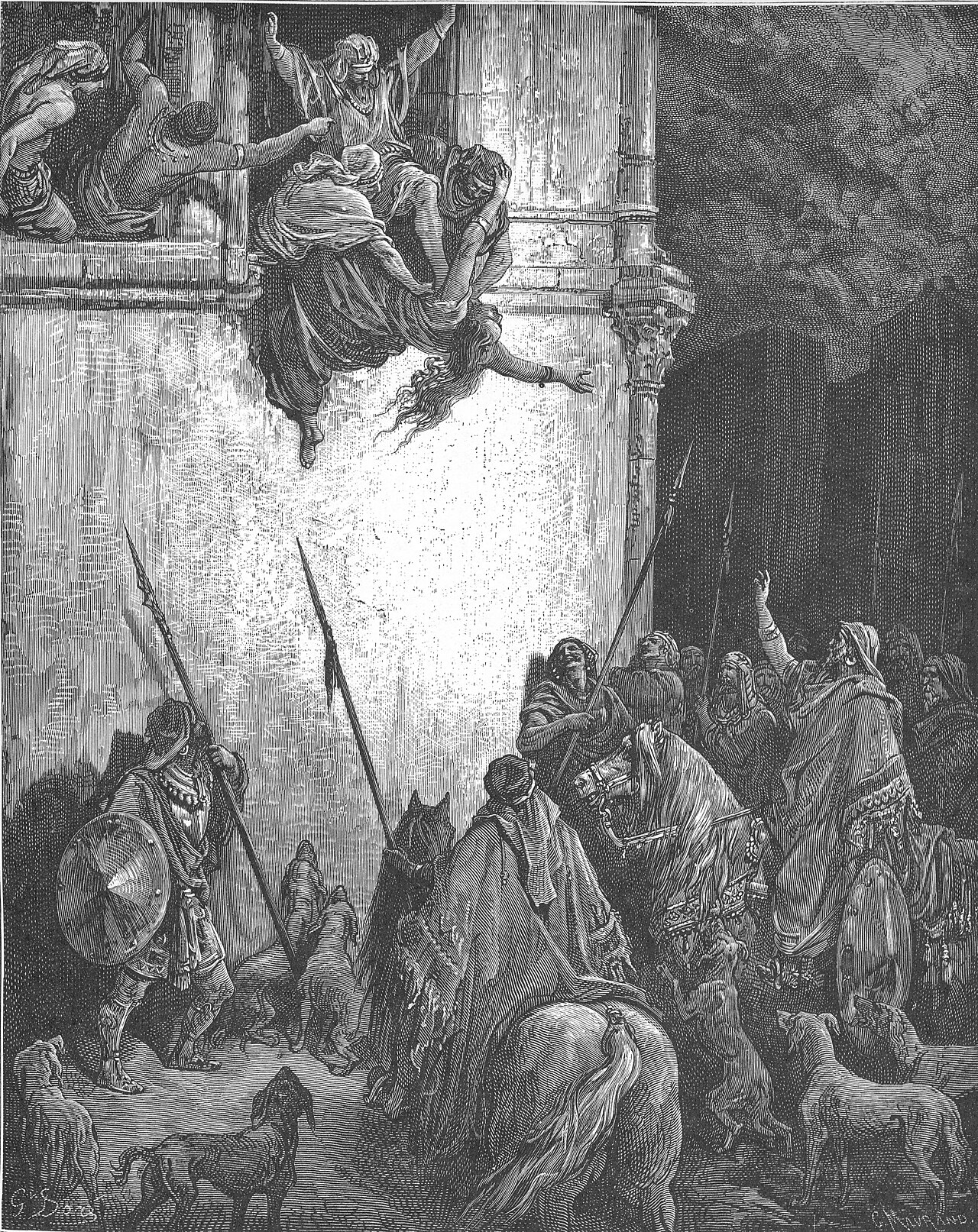
in 2 Kings 9“Throw her down!” yelled Jehu. So they threw her down, and her blood splattered on the wall and on the horses as they trampled her underfoot.
BSB
The same verse in ASV and KJV ▾
ASV
And he said, Throw her down. So they threw her down; and some of her blood was sprinkled on the wall, and on the horses: and he trod her under foot.
KJV
And he said, Throw her down. So they threw her down: and some of her blood was sprinkled on the wall, and on the horses: and he trode her under foot.
⋯
This verse in 2 Kings 9
Commentary
7 notes on this verseHowever it was, thus she was most shamefully put to death, dashed against the wall and the pavement, and then trodden on by the horses, which were all besmeared with her blood and brains. See the end of pride and cruelty, and say, The Lord is righteous. The very dogs completing her shame and ruin, according to the prophecy.
This site's exposition
Who is on my side
on 2 Kings 9:32-33
Jehu answers her window with a question of his own, who is on my side, close to the psalmist's own appeal against evildoers, and two or three eunuchs inside Jezebel's household choose him over her without hesitation. At his order they throw her down, and the horses that trample her afterward finish what the fall began. The men who owed her service that morning are the men who end her life by noon.
This site's exposition
Throw her down!
Jezebel dies under the horses of the man she had just taunted. Matthew Henry read her death as the end that pride and cruelty come to, and drew from it that the LORD is righteous. Henry saw the dogs complete her shame, as the prophecy had said.
The record, by era
The Church Fathers1 voice
Jehu, who had seen the woman who had spoken to him and had recognized her to be Jezebel, ordered the eunuchs who were beside her to throw her out of the window, and they immediately threw her with force and spattered the wall with her …
The Puritans and the Awakening2 voices
7 And thou shalt smite the house of Ahab thy master, that I may avenge the blood of my servants the prophets, and the blood of all the servants of the L ORD , at the hand of Jezebel.
quarantine:scripture (2026-07-29) — scripture-overlap:95%@v7
And he said, throw her down,....
The Nineteenth Century1 voice
So they threw her down - What a terrible death! She was already, by the fall, almost dashed to pieces; and the brutal Jehu trampled her already mangled body under his horse’s feet!
The words behind it
10 Hebrew wordsEvery Hebrew word of this verse in the order it stands, with what it means and the door to its own study. The last column counts the times a word stands in the whole Bible: the rarer the word, the more the places it appears belong together.
| Hebrew | Sound | Meaning | Word study | In the Bible |
|---|---|---|---|---|
| וַיֹּ֥אמֶר | vaiyomer | and he said | H559 → | 5305 times |
| שִׁמְט֖וּהָ | shimtuh | let fall her | H8058 → | |
| וַֽיִּשְׁמְט֑וּהָ | vaiyishmetuha | and they let fall her | H8058 → | |
| וַיִּ֨ז | vaiyiz | and it spattered | H5137 → | |
| מִדָּמָ֧הּ | midamah | some of blood her | H1818 → | 360 times |
| אֶל־ | ʾel- | to | H413 → | 5510 times |
| הַקִּ֛יר | hakir | the wall | H7023 → | 75 times |
| וְאֶל־ | veel- | and to | H413 → | 5510 times |
| הַסּוּסִ֖ים | hasusim | the horses | H5483 → | 140 times |
| וַֽיִּרְמְסֶֽנָּה׃ | vaiyirmesenah | and he trampled her | H7429 → | 19 times |
וַיֹּ֥אמֶרand he said
vaiyomerH559 →5305 times
שִׁמְט֖וּהָlet fall her
shimtuhH8058 →
וַֽיִּשְׁמְט֑וּהָand they let fall her
vaiyishmetuhaH8058 →
וַיִּ֨זand it spattered
vaiyizH5137 →
מִדָּמָ֧הּsome of blood her
midamahH1818 →360 times
אֶל־to
ʾel-H413 →5510 times
הַקִּ֛ירthe wall
hakirH7023 →75 times
וְאֶל־and to
veel-H413 →5510 times
הַסּוּסִ֖יםthe horses
hasusimH5483 →140 times
וַֽיִּרְמְסֶֽנָּה׃and he trampled her
vaiyirmesenahH7429 →19 times
A shaded row is a word that stands 400 times or fewer in the Bible.
The walk
8 stopsEach card is a verse this one points to, and under it the verses that one points to in turn. Where several paths arrive at the same place, that place is listed first: the text keeps returning to it.
Through
Hebrews 10:29How much more severely do you think one deserves to be punished who has trampled on the Son of God, profaned the blood of the covenant that sanctified him, and insulted the Spirit of…
it leads to
- Ephesians 4:30
And do not grieve the Holy Spirit of God, in whom you were sealed for the day of redemption.
- Hebrews 6:6
and then have fallen away—to be restored to repentance, because they themselves are crucifying the Son of God all over again and subjecting Him to open shame.
- Isaiah 63:10
But they rebelled and grieved His Holy Spirit. So He turned and became their enemy, and He Himself fought against them.
- 1 Corinthians 11:27
Therefore, whoever eats the bread or drinks the cup of the Lord in an unworthy manner will be guilty of sinning against the body and blood of the Lord.
- Luke 12:10
And everyone who speaks a word against the Son of Man will be forgiven, but whoever blasphemes against the Holy Spirit will not be forgiven.
- Ephesians 4:30
Through
Micah 7:10Then my enemy will see and will be covered with shame—she who said to me, “Where is the LORD your God?” My eyes will see her; at that time she will be trampled like…
it leads to
- Zechariah 10:5
They will be like mighty men in battle, trampling the enemy in the mire of the streets. They will fight because the LORD is with them, and they will put the horsemen to shame.
- Jeremiah 50:33–34
This is what the LORD of Hosts says: “The sons of Israel are oppressed, and the sons of Judah as well. All their captors hold them fast, refusing to release them.
- Psalms 42:10
Like the crushing of my bones, my enemies taunt me, while they say to me all day long, “Where is your God?”
- Zechariah 10:5
Where this verse is studied
On this page
About 2 Kings
Who and where
1 name in this verse with a page on the site.
This page draws on Adam Clarke, Commentary on the Bible; Ephrem the Syrian, ON THE SECOND BOOK OF KINGS 9:32; John Gill, Exposition of the Old Testament (1748-1763) and Matthew Henry, Commentary on the Whole Bible.