
2 Kings 9:35
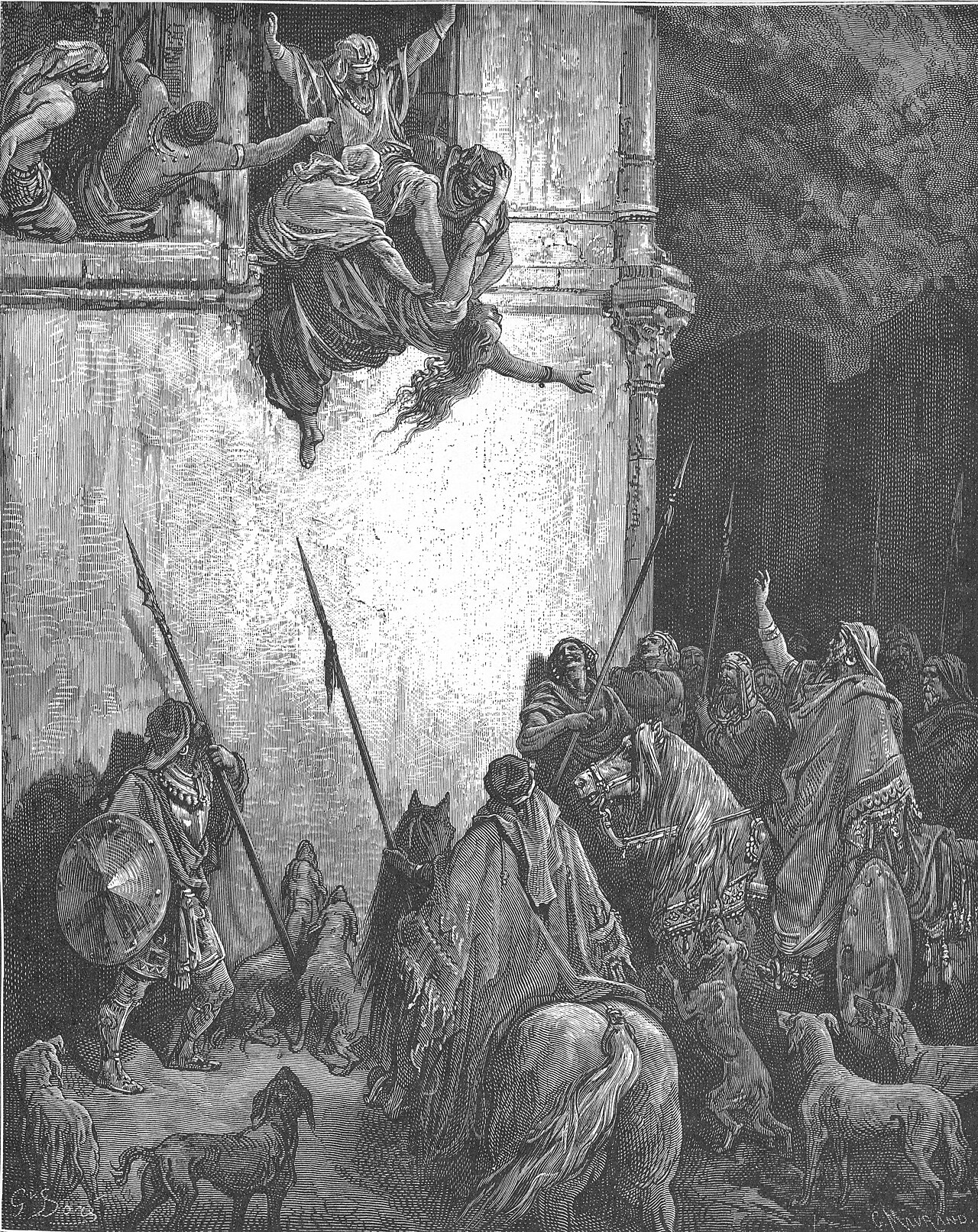
in 2 Kings 9But when they went out to bury her, they found nothing but her skull, her feet, and the palms of her hands.
BSB
The same verse in ASV and KJV ▾
ASV
And they went to bury her; but they found no more of her than the skull, and the feet, and the palms of her hands.
KJV
And they went to bury her: but they found no more of her than the skull, and the feet, and the palms of her hands.
⋯
This verse in 2 Kings 9
Commentary
6 notes on this verseAnd they went to bury her,.... The servants of Jehu, according to his orders and instructions: but they found no more of her than the scull, and the feet, and the palms of her hands; the flesh, and even all the rest of her bones, being devoured by dogs, so that there was scarce anything of her to be buried, as in 2Ki 9:10, something similar to this happened to Ascletarion, a mathematician, as related by Suetonius (o). (o) In Vita Domitian. c. 15.
This site's exposition
for she was the daughter of a king
on 2 Kings 9:34-35
Jehu eats and drinks first, then orders Jezebel's body buried, for she was the daughter of a king. The men sent to bury her found nothing but her skull, her feet, and the palms of her hands. The dogs of Jezreel had done what royal blood could not prevent.
This site's exposition
her skull, her feet
The dogs had left three parts of Jezebel. Adam Clarke records the rabbis Jarchi and Kimchi, who tied those remains to her festal dancing on hands and feet. John Gill set beside it a like end that Suetonius records of Ascletarion, a mathematician, in his Life of Domitian.
The record, by era
The Church Fathers1 voice
Jehu, who had seen the woman who had spoken to him and had recognized her to be Jezebel, ordered the eunuchs who were beside her to throw her out of the window, and they immediately threw her with force and spattered the wall with her …
The Puritans and the Awakening1 voice
7 And thou shalt smite the house of Ahab thy master, that I may avenge the blood of my servants the prophets, and the blood of all the servants of the L ORD , at the hand of Jezebel.
quarantine:scripture (2026-07-29) — scripture-overlap:95%@v7
The Nineteenth Century1 voice
The skull - the feet, and the palms of her hands - The dogs did not eat those parts, say Jarchi and Kimchi, because in her festal dances she danced like a dog, on her hands and feet, wantonly moving her head. What other meaning these rabbins had, I do not inquire. She was, no doubt, guilty of the foulest actions, and was almost too bad to be belied. How literally was the prediction delivered in the preceding book, (1Ki 21:23, The dogs shall eat Jezebel, by the wall of Jezreel), fulfilled!
The words behind it
11 Hebrew wordsEvery Hebrew word of this verse in the order it stands, with what it means and the door to its own study. The last column counts the times a word stands in the whole Bible: the rarer the word, the more the places it appears belong together.
| Hebrew | Sound | Meaning | Word study | In the Bible |
|---|---|---|---|---|
| וַיֵּלְכ֖וּ | vaiyelekhu | and they went | H1980 → | 1546 times |
| לְקָבְרָ֑הּ | lekaverah | to bury her | H6912 → | 133 times |
| וְלֹא־ | velo'- | and not | H3808 → | 5168 times |
| מָ֣צְאוּ | matzeu | they found | H4672 → | 455 times |
| בָ֗הּ | vah | in her | ||
| כִּ֧י | ki | that | H3588 → | 4482 times |
| אִם־ | ʾim- | except | H518 → | 1069 times |
| הַגֻּלְגֹּ֛לֶת | hagulgolet | the skull | H1538 → | |
| וְהָרַגְלַ֖יִם | veharaglayim | and the feet | H7272 → | 247 times |
| וְכַפּ֥וֹת | vekhapot | and [the] palms of | H3709 → | 192 times |
| הַיָּדָֽיִם׃ | haiyadayim | the hands | H3027 → | 1618 times |
וַיֵּלְכ֖וּand they went
vaiyelekhuH1980 →1546 times
לְקָבְרָ֑הּto bury her
lekaverahH6912 →133 times
וְלֹא־and not
velo'-H3808 →5168 times
מָ֣צְאוּthey found
matzeuH4672 →455 times
בָ֗הּin her
vah
כִּ֧יthat
kiH3588 →4482 times
אִם־except
ʾim-H518 →1069 times
הַגֻּלְגֹּ֛לֶתthe skull
hagulgoletH1538 →
וְהָרַגְלַ֖יִםand the feet
veharaglayimH7272 →247 times
וְכַפּ֥וֹתand [the] palms of
vekhapotH3709 →192 times
הַיָּדָֽיִם׃the hands
haiyadayimH3027 →1618 times
A shaded row is a word that stands 400 times or fewer in the Bible.
The walk
8 stopsEach card is a verse this one points to, and under it the verses that one points to in turn. Where several paths arrive at the same place, that place is listed first: the text keeps returning to it.
Through
Acts 12:23Immediately, because Herod did not give glory to God, an angel of the Lord struck him down, and he was eaten by worms and died.
it leads to
- Acts 10:25–26
As Peter was about to enter, Cornelius met him and fell at his feet to worship him.
- Psalms 115:1
Not to us, O LORD, not to us, but to Your name be the glory, because of Your loving devotion, because of Your faithfulness.
- 2 Thessalonians 2:4
He will oppose and exalt himself above every so-called god or object of worship. So he will seat himself in the temple of God, proclaiming himself to be God.
- Acts 14:14–15
But when the apostles Barnabas and Paul found out about this, they tore their clothes and rushed into the crowd, shouting,
- 1 Samuel 25:38
About ten days later, the LORD struck Nabal dead.
- Acts 10:25–26
Through
Ecclesiastes 6:3A man may father a hundred children and live for many years; yet no matter how long he lives, if he is unsatisfied with his prosperity and does not even receive a proper burial,…
it leads to
- Job 3:16
Or why was I not hidden like a stillborn child, like an infant who never sees daylight?
- Job 3:16
Through
Jeremiah 22:19He will be buried like a donkey, dragged away and thrown outside the gates of Jerusalem.
it leads to
- Jeremiah 36:30
Therefore this is what the LORD says about Jehoiakim king of Judah: He will have no one to sit on David’s throne, and his body will be thrown out and exposed to heat by…
- Jeremiah 36:30
Through
Job 31:3Does not disaster come to the unjust and calamity to the workers of iniquity?
it leads to
- Job 21:30
Indeed, the evil man is spared from the day of calamity, delivered from the day of wrath.
- Job 21:30
Where this verse is studied
On this page
About 2 Kings
This page draws on Adam Clarke, Commentary on the Bible; Ephrem the Syrian, ON THE SECOND BOOK OF KINGS 9:32; John Gill, Exposition of the Old Testament (1748-1763); John Gill, Exposition of the Old Testament and Matthew Henry, Commentary on the Whole Bible.