
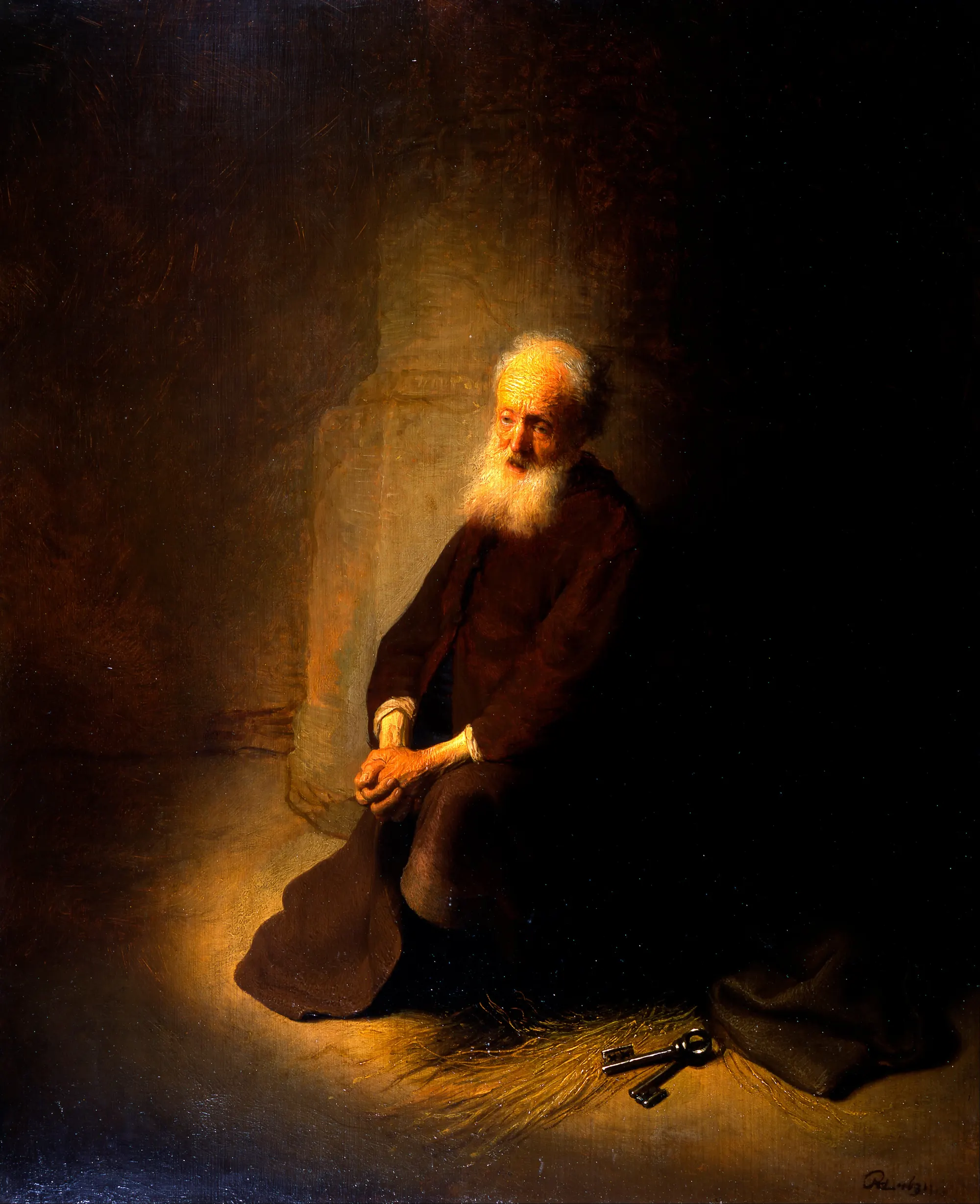
1 Peterchapter 2
25 verses · Peter · AD 62 to 64 · The general letters
you also, like living stones, are being built into a spiritual house to be a holy priesthood, offering spiritual sacrifices acceptable to God through Jesus Christ.
Introduction
Peter, The general letters, 1 Peter Overview.
Peter wrote this chapter to believers who had no temple, no priesthood of their own and little standing in their towns. Many were slaves in pagan households, and all of them lived under a Roman emperor who did not share their faith. The chapter moves from what the church is before God to how it behaves before neighbours, rulers and masters. Listen for the stones, the priests and the building, all drawn from Israel's worship. Listen also for the example of Christ that closes the chapter. Read it as a charter for a people who look powerless.
Context
- Who
- Believers with no temple of their own, many of them household slaves
- What
- Teaching on the church as God's house and people, followed by instructions for living under rulers and masters, with Christ's suffering as the pattern.
- Where
- Written from Babylon, most likely Rome, to churches in Pontus, Galatia, Cappadocia, Asia and Bithynia.
- When
- About AD 62 to 64, under the emperor Nero and before his persecution of the church.
- Why
- To give slandered believers their true standing before God and to show them how to answer slander with good conduct and patient suffering.
Historical context
Building in stone was skilled, visible work. Blocks were quarried, dressed, and tested, and the cornerstone set the line for every course above it, get it wrong and the whole wall runs crooked. Stones that would not fit the line were thrown aside by the builders as rejects.
Show the rest of the historical context, 3 more paragraphs
Calling the readers a priesthood was a startling move. In their world a priesthood meant a building, an altar, a hereditary family, and animals. Peter gives them a house made of people, sacrifices made of conduct and praise, and priesthood for everybody in the room including the slaves.
The instruction to honor the emperor was written while Nero ruled. It sits inside a sentence that also says to fear God, the honor given to Caesar is real and it is not worship, and putting them in the same line drew the boundary.
Household slaves are addressed directly, which almost no ancient writer did. The reference to being beaten for doing right was not hypothetical; a master could beat a slave legally and at will, and a slave who had joined a foreign religion was an obvious target.
Significance
For congregations with no building, no priest, and no sacrifices, being told they were the building, the priesthood, and the offering answered the accusation that they were not a real religion at all.
Show the rest of the significance, 1 more paragraph
For slaves being struck for their faith, the chapter's answer is the one thing that could carry them: he suffered without threatening back, and left them a pattern to walk in.
The heads below are this chapter's scenes. The numbered points under each are its verses.
Living Stones Built on the Stone Men Rejected
1 Peter 2:1-3
Rid yourselves, therefore, of all malice: Five vices are put off, malice, deceit, hypocrisy, envy, and slander, each a wrong done inside the community. The newborn of 1:23 are to crave pure spiritual milk, and verse 3 borrows Psalm 34:8, a psalm the letter quotes at 3:10 to 12.
1 Peter 2:1
“Wherefore laying aside - On the word rendered laying aside, see Rom 13:12; Eph 4:22, Eph 4:25; Col 3:8. The allusion is to putting off clothes; and the meaning is, that we are to cast off these things entirely; that is, we are no longer to practice them. The word “wherefore” (οὖν oun) refers to the reasonings in the first chapter. In view of the considerations stated there, we should renounce all evil. All malice - All “evil,” (κακίαν kakian.)”
crave pure spiritual milk: Those born again through the living word of 1:23 should crave the word as newborn babies crave milk. John Wesley takes the milk as the word of God, pure and without deceit. By it they grow up in their salvation.
1 Peter 2:2
“Desire - Always, as earnestly as new born babes do, chap. i, 3. The milk of the word - That word of God which nourishes the soul as milk does the body, and which is sincere, pure from all guile, so that none are deceived who cleave to it. That you may grow thereby - In faith, love, holiness, unto the full stature of Christ.”
John Wesley · Explanatory Notes upon the New Testament (1755)evangelical
3 more voices on this verse
1 Peter 2:2
“As new-born babes - In the preceding chapter, 1Pe 1:23, the apostle states that they had been born again; and as the new-born infant desires that aliment which nature has provided for it, so they, being born again - born from above, should as earnestly require that heavenly nourishment which is suited to their new nature; and this the apostle calls the sincere milk of the word, το λογικον αδολον γαλα, or, as some translate, the rational unadulterated milk; i.e.”
Adam Clarke · Commentary on the Bible (1810-1826)evangelical
1 Peter 2:2
“The Word Himself, then, the beloved One, and our nourisher, hath shed His own blood for us, to save humanity; and by Him, we, believing on God, flee to the Word, "the care-soothing breast" of the Father. And He alone, as is befitting, supplies us children with the milk of love, and those only are truly blessed who suck this breast.”
Clement of Alexandria · written before 215 · The Instructor Book 1patristic
1 Peter 2:2
“The end to which growth leads is perfected salvation. "Growth is the measure of the fulness of that, not only rescue from destruction, but positive blessedness, which is implied in salvation" [ALFORD]. thereby--Greek, "in it"; fed on it; in its strength (Ac 11:14).”
Jamieson, Fausset & Brown · Commentary Critical and Explanatory on the Whole Bible (1871)reformed
tasted that the Lord is good: Charles Spurgeon notes that Peter draws these words from Psalm 34:8. A first taste of the goodness of the Lord makes a believer crave more of Him. The Lord of the psalm is here Christ, the living stone of verse 4.
1 Peter 2:3
“Peter alludes to Ps 34:8. The first "tastes" of God's goodness are afterwards followed by fuller and happier experiences. A taste whets the appetite [BENGEL]. gracious--Greek, "good," benignant, kind; as God is revealed to us in Christ, "the Lord" (1Pe 2:4), we who are born again ought so to be good and kind to the brethren (1Pe 1:22).”
Jamieson, Fausset & Brown · Commentary Critical and Explanatory on the Whole Bible (1871)reformed
4 more voices on this verse
1 Peter 2:3
“Our Lord Jesus Christ is very gracious to his people. He is in himself infinitely good; he is very kind, free, and merciful to miserable sinners; he is pitiful and good to the undeserving; he has in him a fulness of grace. The graciousness of our Redeemer is best discovered by an experimental taste of it.”
Matthew Henry · Commentary on the Whole Bible (1707-1721)puritan
1 Peter 2:3
“True knowledge, then, consists in the understanding of Christ, which Paul terms the wisdom of God hidden in a mystery, which "the natural man receiveth not," the doctrine of the cross; of which if any man "taste," he will not accede to the disputations and quibbles of proud and puffed-up men, who go into matters of which they have no perception. For the truth is unsophisticated; and "the word is nigh thee, in thy mouth and in thy heart," as the same apostle declares, being easy of comprehension to those who are obedient.”
Irenaeus · written before 202 · Fragments from the Lost Writings of Irenaeuspatristic
1 Peter 2:3
“If so be ye have tasted that the Lord is gracious - Or rather, as Doddridge renders it, “Since you have tasted that the Lord is gracious.” The apostle did not mean to express any doubt on the subject, but to state that, since they had had an experimental acquaintance with the grace of God, they should desire to increase more and more in the knowledge and love of him. On the use of the word “taste,” see the notes at Heb 6:4.”
1 Peter 2:3
“I THINK there can be very little doubt that Peter is here quoting from Psalm 34:8: "O taste and see that the LORD is good." As I read you the chapter just now, I could not help observing the constant traces of Old Testament language. It endears Peter to us when we see how he prizes the ancient Word of the Lord and, at the same time, it puts honor upon the Old Testament itself when we see the Holy Spirit in the New thus quoting from the Old.”
1 Peter 2:4-5
the living stone: Christ is the living stone, rejected by men but chosen and precious in God’s sight, and believers become living stones in a spiritual house. The whole church is named a holy priesthood, the first of the Exodus 19:5 to 6 titles that verse 9 gathers.
1 Peter 2:4
“To whom coming, as unto a living stone - This is a reference to Isa 28:16: Behold, I lay in Zion for a foundation a stone, a tried stone, a precious corner stone, a sure foundation.”
Adam Clarke · Commentary on the Bible (1810-1826)evangelical
3 more voices on this verse
1 Peter 2:4
“And we saw Him, and He had not attractiveness or grace; but His mien was unhonoured, deficient in comparison of the sons of men," "a man set in the plague, and knowing how to bear infirmity: "to wit as having been set by the Father "for a stone of offence," and "made a little lower" by Him "than angels," He pronounces Himself "a worm, and not a man, an ignominy of man, and the refuse of the People.”
Tertullian · written before 220 · An Answer to the Jewspatristic
1 Peter 2:4
“There is a wonderful beauty and energy in these expressions, which describe Christ as a spiritual foundation, solid, firm, durable; and believers as a building erected upon it, in preference to that temple which the Jews accounted their highest glory. And St. Peter speaking of him thus, shows he did not judge himself, but Christ, to be the rock on which the church was built.”
John Wesley · Explanatory Notes upon the New Testament (1755)evangelical
1 Peter 2:4
“AT the outset I call your special attention to the connection of the two verses. "To whom coming, as unto a living stone...you also, as living stones, are built up." Or, "To whom coming...are built up...an holy priesthood." Everywhere throughout Scripture the connection between the saints and their Head is perpetually mentioned. "In Christ" is the very symbol of New Testament writers.”
like living stones: Albert Barnes notes that the word means living, the same word used of Christ the living stone in verse 4. Every believer becomes part of one house and one priesthood, and Charles Spurgeon stresses that Peter speaks of every saint. John Wesley counts body and soul among the sacrifices.
1 Peter 2:5
“Are built up - In union with each other. A spiritual house - Being spiritual yourselves, and an habitation of God through the Spirit. An holy priesthood - Consecrated to God, and "holy as he is holy." To offer up - Your souls and bodies, with all your thoughts, words, and actions, as spiritual sacrifices to God.”
John Wesley · Explanatory Notes upon the New Testament (1755)evangelical
3 more voices on this verse
1 Peter 2:5
IN this Epistle Peter is speaking of the scattered saints in all parts of the world and, taught by the Holy Spirit, he says of them that they were "an holy priesthood." He is not talking about ministers! He is not speaking of a certain number of men who have passed through many grades of office and are, thereby, qualified to wear robes of a certain color— he is speaking of every Believer and he calls every saint a member of "an holy priesthood!"
Charles Spurgeon · written before 1892 · The Metropolitan Tabernacle Pulpit, Sermon No. 3266: “The Priesthood of Believers” (lightly modernized text, CCEL edition)Particular Baptist
1 Peter 2:5
For David had been appointed a priest by God, although Saul persecuted him. For all the righteous possess the sacerdotal rank. And all the apostles of the Lord are priests, who do inherit here neither lands nor houses, but serve God and the altar continually. Of whom Moses also says in Deuteronomy, when blessing Levi, "Who said unto his father and to his mother, I have not known thee; neither did he acknowledge his brethren, and he disinherited his own sons: he kept Thy commandments, and observed Thy covenant."
Irenaeus · written before 202 · Against Heresies Book IVpatristic
1 Peter 2:5
“Ye also, as lively stones - Greek, “living stones.” The word should have been so rendered. The word lively with us now has a different meaning from living, and denotes “active, quick, sprightly.” The Greek word is the same as that used in the previous verse, and rendered living. The meaning is, that the materials of which the temple here referred to was composed, were living materials throughout. The foundation is a living foundation, and all the superstructure is compassed of living materials.”
1 Peter 2:6-8
a chosen and precious cornerstone: Three stone texts are joined: Isaiah 28:16's chosen and precious cornerstone, Psalm 118:22's stone the builders rejected, and Isaiah 8:14's stone of stumbling. The one stone is precious to those who believe and a stumbling block to those who disobey the word.
1 Peter 2:6
“Wherefore also--The oldest manuscripts read, "Because that." The statement above is so "because it is contained in Scripture." Behold--calling attention to the glorious announcement of His eternal counsel. elect--so also believers (1Pe 2:9, "chosen," Greek, "elect generation"). precious--in Hebrew, Isa 28:16, "a corner-stone of preciousness." See on Isa 28:16.”
Jamieson, Fausset & Brown · Commentary Critical and Explanatory on the Whole Bible (1871)reformed
3 more voices on this verse
1 Peter 2:6
“Peter calls our Lord Jesus Christ a chosen and precious stone, fashioned by the glory and splendor of divinity. He calls it the cornerstone, because through one faith it binds together in unity the two peoples, Israel and the Gentiles.”
Cyril of Alexandria · written before 444 · CATENApatristic
1 Peter 2:6
“The apostle is recommending the Christian church and constitution to these dispersed Jews. It was natural for them to object that the Christian church had no such glorious temple, nor such a numerous priesthood; but its dispensation was mean, the services and sacrifices of it having nothing of the pomp and grandeur which the Jewish dispensation had.”
Matthew Henry · Commentary on the Whole Bible (1707-1721)puritan
1 Peter 2:6
“Behold, I lay in Sion - This intimates that the foundation of the Christian Church should be laid at Jerusalem; and there it was laid, for there Christ suffered, and there the preaching of the Gospel commenced. A chief corner stone - This is the same as the foundation stone; and it is called here the chief corner stone because it is laid in the foundation, at an angle of the building where its two sides form the ground work of a side and end wall.”
Adam Clarke · Commentary on the Bible (1810-1826)evangelical
Cross references
1 Peter 2:6
- QuotingIsaiah 28:16“So this is what the Lord GOD says: “See, I lay a stone in Zion, a tested stone, a precious cornerstone, a sure foundation; the one who believes will never be shaken.”
'Behold, I lay in Sion a chief corner stone' ('it is contained in the scripture')
this stone is precious: To those who believe, Christ the stone is precious. To those who do not believe, the rejected stone has become the cornerstone they stumble over. Charles Spurgeon observes that Jesus divides every company into those who believe and those who disobey.
1 Peter 2:7
“Unto you therefore which believe - Christians are often called simply “believers,” because faith in the Saviour is one of the prominent characteristics by which they are distinguished from their fellow-men. It sufficiently describes any man, to say that he is a believer in the Lord Jesus. He is precious - Margin, “an honor.” That is, according to the margin, it is an honor to believe on him, and should be so regarded. This is true, but it is very doubtful whether this is the idea of Peter.”
2 more voices on this verse
1 Peter 2:7
“On the opposite effects of the same Gospel on different classes, compare Joh 9:39; 2Co 2:15, 16. precious--Greek, "THE preciousness" (1Pe 2:6). To you believers belongs the preciousness of Christ just mentioned. disobedient--to the faith, and so disobedient in practice. the stone which . . . head of . . . corner-- (Ps 118:22).”
Jamieson, Fausset & Brown · Commentary Critical and Explanatory on the Whole Bible (1871)reformed
1 Peter 2:7
“So it always is where Jesus comes—He divides the company into Believers and unbelievers—the obedient and the disobedient. But why are unbelievers, here, called disobedient? Is faith a matter of law and because a man does not believe, does he therefore disobey? How can it be otherwise? Is it not a natural duty for every man to believe that which is true? Let the very least among us judge in so simple a matter!”
Cross references
1 Peter 2:7
- QuotingPsalms 118:22“The stone the builders rejected has become the cornerstone.”
'The stone which the builders disallowed... head of the corner'
ConnectionsPsalms 118:22
The stone precious to believers is a stone of stumbling to those who do not believe. Their stumbling comes from disobedience to the word. Jamieson, Fausset and Brown read the appointing as God acting less directly, and Theophylact holds that their own disobedience is the cause.
1 Peter 2:8
“A stone of stumbling - Because in him all Jews and Gentiles who believe are united; and because the latter were admitted into the Church, and called by the Gospel to enjoy the same privileges which the Jews, as the peculiar people of God, had enjoyed for two thousand years before; therefore they rejected the Christian religion, they would have no partakers with themselves in the salvation of God. This was the true cause why the Jews rejected the Gospel; and they rejected Christ because he did not come as a secular prince.”
Adam Clarke · Commentary on the Bible (1810-1826)evangelical
2 more voices on this verse
1 Peter 2:8
“They could not be brought to seek justification by faith, but as it were by the works of the law; for they stumbled at that stumbling-stone, Rom. ix. (2.) The same blessed Jesus who is the author of salvation to some is to others the occasion of their sin and destruction. He is set for the rising and fall of many in Israel.”
Matthew Henry · Commentary on the Whole Bible (1707-1721)puritan
1 Peter 2:8
"Were appointed," Greek, "set," answers to "I lay," Greek, "set," 1Pe 2:6. God, in the active, is said to appoint Christ and the elect (directly). Unbelievers, in the passive, are said to be appointed (God acting less directly in the appointment of the sinner's awful course) [BENGEL].
Jamieson, Fausset & Brown · Commentary Critical and Explanatory on the Whole Bible (1871)reformed
Cross references
1 Peter 2:8
- QuotingIsaiah 8:14“And He will be a sanctuary—but to both houses of Israel a stone of stumbling and a rock of offense, to the dwellers of Jerusalem a trap and a snare.”
'A stone of stumbling, and a rock of offence'
1 Peter 2:9-10
But you are a chosen people: Israel's titles from Exodus 19:5 to 6 are given to a church that includes Gentiles: a chosen people, a royal priesthood, a holy nation. Verse 10 echoes Hosea's not my people, as Paul does at Romans 9:25 to 26, and Romans 11:29 keeps Israel's own calling irrevocable.
1 Peter 2:9
“But ye are a chosen generation - In contradistinction from those who, by their disobedience, had rejected the Saviour as the foundation of hope. The people of God are often represented as his chosen or elected people. See the notes at 1Pe 1:2. A royal priesthood - See the notes at 1Pe 2:5. The meaning of this is, probably, that they “at once bore the dignity of kings, and the sanctity of priests” - Doddridge.”
4 more voices on this verse
1 Peter 2:9
“Learn, [1.] All true Christians are a chosen generation; they all make one family, a sort and species of people distinct from the common world, of another spirit, principle, and practice, which they could never be if they were not chosen in Christ to be such, and sanctified by his Spirit. [2.] All the true servants of Christ are a royal priesthood.”
Matthew Henry · Commentary on the Whole Bible (1707-1721)puritan
1 Peter 2:9
“For you are translated from your former vain and tedious mode of life and have contemned the lifeless idols, and despised the demons, which are in darkness, and have run to the "true light," [John 1:9] and by it have "known the one and only true God and Father," [John 17:3] and so are owned to be heirs of His kingdom.”
Apostolic Constitutions · written before 380 · Apostolic Constitutions (Book V), Section 3, XVIpatristic
1 Peter 2:9
“EVERYTHING about a true Christian is marvelous. He is a marvel to himself and a marvel to all who are around him. Mere professors—man-made Christians—people who have made themselves Christians by their own free will apart from the Spirit of God, have nothing marvelous about them. You can make professors of that sort by the score and you can see them dissolve by the score, for what man made, man can unmake! And what is merely natural has its season, like the leaves on the trees and, by-and-by, it withers away because its time to fade has come.”
Charles Spurgeon · written before 1892 · The Metropolitan Tabernacle Pulpit, Sermon No. 2765: “Marvelous Light” (lightly modernized text, CCEL edition)Particular Baptist
1 Peter 2:9
“But ye are a chosen generation,.... Or "kindred"; the phrase is to be seen in the Septuagint, on Isa 43:20, to which, and the following verse, the apostle refers here, and in another part of this text.”
Cross references
1 Peter 2:9
- QuotingExodus 19:6And unto Me you shall be a kingdom of priests and a holy nation.’ These are the words that you are to speak to the Israelites.”
'A royal priesthood, an holy nation' (church as new Israel, w/ Isa 43:20-21)
ConnectionsExodus 19:6
Once you were not a people: The lines echo Hosea 1 and 2, where God renames a rejected people as His own. Adam Clarke and Bede take them as proof that the readers were mostly Gentiles. Mercy has made strangers into one people.
1 Peter 2:10
“But what is the "people" which was ignorant of God, but ours, who in days bygone knew not God? and who, in the hearing of the ear, gave heed to Him, but we, who, forsaking idols, have been converted to God?”
Tertullian · written before 220 · An Answer to the Jewspatristic
1 more voice on this verse
1 Peter 2:10
“Which in time past were not a people - This is a quotation from Hos 1:9, Hos 1:10; Hos 2:23, where the calling of the Gentiles, by the preaching of the Gospel, is foretold. From this it is evident, that the people to whom the apostle now addresses himself had been Gentiles, covered with ignorance and superstition, and now had obtained mercy by the preaching of the Gospel of Christ.”
Adam Clarke · Commentary on the Bible (1810-1826)evangelical
Sojourners Living Well Among the Nations
1 Peter 2:11-12
as foreigners and exiles: The appeal rests on who the readers are, foreigners and exiles, and the first battle is inward: desires of the flesh, as in Galatians 5:17. Outward conduct then answers slander, so watchers may see your good deeds and glorify God.
1 Peter 2:11
“Not only the gross appetites which we have in common with the brutes, but all the thoughts of the unrenewed mind. which--Greek, "the which," that is, inasmuch as being such as "war." &c. Not only do they impede, but they assail [BENGEL]. the soul--that is, against the regenerated soul; such as were those now addressed. The regenerated soul is besieged by sinful lusts.”
Jamieson, Fausset & Brown · Commentary Critical and Explanatory on the Whole Bible (1871)reformed
1 more voice on this verse
1 Peter 2:11
“Dearly beloved, I beseech you strangers and pilgrims - On the word rendered “strangers,” (παροίκους paroikous,) see the notes at Eph 2:19, where it is rendered “foreigners.” It means, properly, one dwelling near, neighboring; then a by-dweller, a sojourner, one without the rights of citizenship, as distinguished from a citizen; and it means here that Christians are not properly citizens of this world, but that their citizenship is in heaven, and that they are here mere sojourners.”
Conduct yourselves with such honor among the Gentiles: Adam Clarke explains that the Gentiles often slandered Christians as evildoers, confusing them with rebels. The answer Peter gives is conduct: honor among the Gentiles and good deeds they can see. On the day God visits, the slanderers may glorify Him.
1 Peter 2:12
“Stand fast, therefore, in these things, and follow the example of the Lord, being firm and unchangeable in the faith, loving the brotherhood, and being attached to one another, joined together in the truth, exhibiting the meekness of the Lord in your intercourse with one another, and despising no one. When you can do good, defer it not, because "alms delivers from death." Be all of you subject one to another, "having your conduct blameless among the Gentiles," that ye may both receive praise for your good works, and the Lord may not be blasphemed through you.”
Polycarp of Smyrna · written before 155 · Epistle to the Philippians 10patristic
2 more voices on this verse
1 Peter 2:12
“Having your conversation honest - Living in such a manner among the Gentiles, in whose country ye sojourn, as becomes the Gospel which ye profess. That whereas they speak against you as evil doers - In all the heathen countries, in the first age of the Church, the Christians and the Jews were confounded together; and as the latter mere everywhere exceedingly troublesome and seditious, the Christians shared in their blame, and suffered no small measure of obloquy and persecution on this very account.”
Adam Clarke · Commentary on the Bible (1810-1826)evangelical
1 Peter 2:12
“The same Greek verb occurs in a similar sense in 1Pe 3:2. "Other men narrowly look at (so the Greek implies) the actions of the righteous" [BENGEL]. TERTULLIAN contrasts the early Christians and the heathen: these delighted in the bloody gladiatorial spectacles of the amphitheater, whereas a Christian was excommunicated if he went to it at all.”
Jamieson, Fausset & Brown · Commentary Critical and Explanatory on the Whole Bible (1871)reformed
1 Peter 2:13-14
Submit yourselves for the Lord’s sake: Churches under Nero are told to submit for the Lord’s sake to every human institution, as Paul teaches at Romans 13:1 to 7. The ground is the Lord, and Peter's own stand before the council in Acts 5:29 sets its limit.
1 Peter 2:13
“Submit yourselves to every ordinance of man - Greek, “to every creation of man,” (ἀνθρωπίνῃ κτίσει anthrōpinē ktisei The meaning is, to every institution or appointment of man; to wit, of those who are in authority, or who are appointed to administer government. The laws, institutes, and appointments of such a government may be spoken of as the creation of man; that is, as what man makes. Of course, what is here said must be understood with the limitation everywhere implied, that what is ordained by those in authority is not contrary to the law of God.”
2 more voices on this verse
1 Peter 2:13
“Then he goes on also to show how he wishes you to be subject to the powers, bidding you pay "tribute to whom tribute is due, custom to whom custom," that is, the things which are Caesar's to Caesar, and the things which are God's to God; but man is the property of God alone.”
Tertullian · written before 220 · Scorpiacepatristic
1 Peter 2:13
“But lest they should think themselves so ennobled by faith as to be raised above subordination to human authorities, he tells them to submit themselves for the sake of Christ, who desires you to be subject, and who once was subject to earthly rulers Himself, though having all things subject to Him, and whose honor is at stake in you as His earthly representatives.”
Jamieson, Fausset & Brown · Commentary Critical and Explanatory on the Whole Bible (1871)reformed
governors as those sent by him: Adam Clarke takes the king of verse 13 as the Roman emperor and the governors as those he sent into the provinces. Their office was to punish those who do wrong and praise those who do right. Bede notes that Peter describes the office itself.
1 Peter 2:14
“Or unto governors - By king as supreme, the Roman emperor is meant; and by governors, ἡγεμοσιν, are meant, leaders, governors, presidents, proconsuls, and other chief magistrates, sent by him into the provinces dependent on the Roman empire. For the punishment of evil doers - This was the object of their mission; they were to punish delinquents, and encourage and protect the virtuous.”
Adam Clarke · Commentary on the Bible (1810-1826)evangelical
1 more voice on this verse
1 Peter 2:14
“Although bad kings often oppress the good, yet that is scarcely ever done by public authority (and it is of what is done by public authority that Peter speaks), save under the mask of right.”
Jamieson, Fausset & Brown · Commentary Critical and Explanatory on the Whole Bible (1871)reformed
1 Peter 2:15-17
silence the ignorance of foolish men: Slander is answered by conduct: by doing good you should silence the ignorance of foolish men. Freedom is lived as servants of God, and four short commands order every relationship: Love the brotherhood of believers, fear God, honor the king.
1 Peter 2:15
“For so is the will of God - That is, it is in accordance with the divine will that in this way you should put them to silence. That with well doing - By a life of uprightness and benevolence. Ye may put to silence the ignorance of foolish men - See the notes at Tit 2:8. The reference here is to men who brought charges against Christians, by accusing them of being inimical to the government, or insubordinate, or guilty of crimes.”
1 more voice on this verse
1 Peter 2:15
“Their ignorance should move the believer's pity, not his anger. They judge of things which they are incapable of judging through unbelief (compare 1Pe 2:12). Maintain such a walk that they shall have no charge against you, except touching your faith; and so their minds shall be favorably disposed towards Christianity.”
Jamieson, Fausset & Brown · Commentary Critical and Explanatory on the Whole Bible (1871)reformed
Live in freedom: Freedom in Christ is the ground of the submission Peter has just urged. Jamieson, Fausset and Brown call believers the Lord's freemen, whose good conduct is the fruit of that freedom. Hilary of Arles warns against faith worn as a mask.
1 Peter 2:16
“As free - The Jews pretended that they were a free people, and owed allegiance to God alone; hence they were continually rebelling against the Roman government, to which God had subjected them because of their rebellion against him: thus they used their liberty for a cloak of maliciousness - for a pretext of rebellion, and by it endeavored to vindicate their seditious and rebellious conduct.”
Adam Clarke · Commentary on the Bible (1810-1826)evangelical
1 more voice on this verse
1 Peter 2:16
“As free--as "the Lord's freemen," connected with 1Pe 2:15, doing well as being free. "Well-doing" (1Pe 2:15) is the natural fruit of being freemen of Christ, made free by "the truth" from the bondage of sin. Duty is enforced on us to guard against licentiousness, but the way in which it is to be fulfilled, is by love and the holy instincts of Christian liberty.”
Jamieson, Fausset & Brown · Commentary Critical and Explanatory on the Whole Bible (1871)reformed
Love the brotherhood of believers: Four commands sum up the passage. Honor is owed to all, love to fellow believers, fear to God and honor to the king. Theophylact observes that fear is given to God and honor to the king; a king who commands what God forbids is not to be obeyed.
1 Peter 2:17
“Christ has dignified our humanity by assuming it; therefore we should not dishonor, but be considerate to and honor our common humanity, even in the very humblest. The first "honor" is in the Greek aorist imperative, implying, "In every case render promptly every man's due" [ALFORD]. The second is in the present tense, implying, Habitually and continually honor the king.”
Jamieson, Fausset & Brown · Commentary Critical and Explanatory on the Whole Bible (1871)reformed
He Left Us Steps to Follow in Suffering
1 Peter 2:18-20
Servants, submit yourselves to your masters: Household slaves are told to submit even to those who are unreasonable, regulating a real institution as Ephesians 6:5 to 9 does. A beating for doing wrong earns no credit. Suffering for doing good, borne by one conscious of God, is commendable before God.
1 Peter 2:18
“Servants, be subject - See the notes on Eph 6:5; Col 3:22 (note); and Tit 2:9 (note). With all fear - With all submission and reverence. The good and gentle - Those who are ever just in their commands, never requiring more work than is necessary or proper, and always allowing sufficient food and sufficient time. The froward - Σκολιοις· The crooked, perverse, unreasonable morose, and austere. Your time belongs to your master; obey him in every thing that is not sinful; if he employs you about unreasonable or foolish things, let him answer for it.”
Adam Clarke · Commentary on the Bible (1810-1826)evangelical
2 more voices on this verse
1 Peter 2:18
“For as it is enjoined on them, "to be subject to their masters with all fear, not only to the good and gentle, but also to the froward," as Peter says; so fairness, and forbearance, and kindness, are what well becomes the masters.”
Clement of Alexandria · written before 215 · The Instructor Book 3patristic
1 Peter 2:18
“Servants--Greek, "household servants": not here the Greek for "slaves." Probably including freedmen still remaining in their master's house. Masters were not commonly Christians: he therefore mentions only the duties of the servants.”
Jamieson, Fausset & Brown · Commentary Critical and Explanatory on the Whole Bible (1871)reformed
conscious of God: Albert Barnes notes that the Greek for commended is the word grace, meaning a thing God regards with favour. Jamieson, Fausset and Brown render the phrase as a sense of God that weighs more than the regard of men. Hilary of Arles points to Christ, who suffered unjustly first.
1 Peter 2:19
“You will be approved by God if you suffer unjustly, because you know that that is exactly what he did.”
Hilary of Arles · written before 449 · Introductory Commentary on 1 Peterpatristic
2 more voices on this verse
1 Peter 2:19
“For this is thank-worthy - Margin, “thank.” Greek, “This is grace,” (χάρις charis). Doddridge renders the expression, “This is graceful indeed.” Various interpretations of this expression have been proposed; but the meaning evidently is, that it is acceptable to God, (see 1Pe 2:20, “this is acceptable to God” - χάρις παρὰ Θεῷ charis para Theō;) that is, this will be regarded by him with favor. It does not mean that it was worthy of thanks, or that God would thank them for doing it, (compare Luk 17:9-10;) but that such conduct would meet with his approbation.”
1 Peter 2:19
A course out of the common, and especially praiseworthy in the eyes of God: not as Rome interprets, earning merit, and so a work of supererogation (compare 1Pe 2:20). for conscience toward God--literally, "consciousness of God": from a conscientious regard to God, more than to men. endure--Greek, "patiently bear up under": as a superimposed burden [ALFORD]. grief--Greek, "griefs."
Jamieson, Fausset & Brown · Commentary Critical and Explanatory on the Whole Bible (1871)reformed
suffer for doing good: Adam Clarke notes that servants who became Christians were often beaten for refusing to join the idol worship of their masters. Enduring a beating for doing wrong earns no credit. Bede says that servants who suffer for doing good follow the Lord.
1 Peter 2:20
“To whom would He have rather made known the veiled import of His own language, than to him to whom He disclosed the likeness of His own glory-to Peter, John, and James, and afterwards to Paul, to whom He granted participation in (the joys of) paradise too, prior to his martyrdom? Or do they also write differently from what they think-teachers using deceit, not truth? Addressing the Christians of Pontus, Peter, at all events, says, "How great indeed is the glory, if ye suffer patiently, without being punished as evildoers!”
Tertullian · written before 220 · Scorpiacepatristic
1 more voice on this verse
1 Peter 2:20
“For what glory is it - It appears from this that the poor Christians, and especially those who had been converted to Christianity while in a state of slavery, were often grievously abused, they were buffeted because they were Christians, and because they would not join with their masters in idolatrous worship.”
Adam Clarke · Commentary on the Bible (1810-1826)evangelical
For to this you were called: The servants' case becomes every believer's calling, because Christ suffered, leaving you an example. The word, hupogrammos, is a child's writing copy traced stroke by stroke, and verses 22 to 25 trace the path from Isaiah 53.
1 Peter 2:21
“For even hereunto were ye called - Such a spirit is required by the very nature of your Christian vocation; you were called into the church in order that you might evince it. See the notes at 1Th 3:3. Because Christ also suffered for us - Margin, “some read, for you.” The latest editions of the Greek Testament adopt the reading “for you.” The sense, however, is not essentially varied.”
3 more voices on this verse
1 Peter 2:21
“Let us then continually persevere in our hope, and the earnest of our righteousness, which is Jesus Christ, "who bore our sins in His own body on the tree," "who did no sin, neither was guile found in His mouth," but endured all things for us, that we might live in Him. Let us then be imitators of His patience; and if we suffer for His name's sake, let us glorify Him. For He has set us this example in Himself, and we have believed that such is the case.”
Polycarp of Smyrna · written before 155 · Epistle to the Philippians 8patristic
1 Peter 2:21
“For even hereunto were ye called,.... Both to well doing, of which none but those who are called with an holy and effectual calling are capable; and which they are fitted for, and are under obligation to perform, and to suffer for so doing, which they must always expect, and to patience in suffering for it, which highly becomes them.”
1 Peter 2:21
“Christ is an example to servants, even as He was once in "the form of a servant." called--with a heavenly calling, though slaves. for us--His dying for us is the highest exemplification of "doing well" (1Pe 2:20). Ye must patiently suffer, being innocent, as Christ also innocently suffered (not for Himself, but for us).”
Jamieson, Fausset & Brown · Commentary Critical and Explanatory on the Whole Bible (1871)reformed
Verse 22 quotes Isaiah 53:9, setting the Servant's sinless life beside His suffering. He committed no sin covers His conduct and no deceit was found in His mouth His speech, the example a servant unjustly accused could follow.
1 Peter 2:22
“Who did no sin - He suffered, but not on account of any evil he had either done or said. In deed and word he was immaculate, and yet he was exposed to suffering; expect the same, and when it comes bear it in the same spirit. It is very likely that the apostle mentions guile, because those who do wrong generally strive to screen themselves by prevarication and lies. These words appear to be a quotation from Isa 53:9.”
Adam Clarke · Commentary on the Bible (1810-1826)evangelical
1 more voice on this verse
1 Peter 2:22
“Illustrating Christ's well-doing (1Pe 2:20) though suffering. did--Greek aorist. "Never in a single instance did" [ALFORD]. Quoted from Isa 53:9, end, Septuagint. neither--nor yet: not even [ALFORD].”
Jamieson, Fausset & Brown · Commentary Critical and Explanatory on the Whole Bible (1871)reformed
Cross references
1 Peter 2:22
- QuotingIsaiah 53:9“He was assigned a grave with the wicked, and with a rich man in His death, although He had done no violence, nor was any deceit in His mouth.”
'Who did no sin, neither was guile found in his mouth' (Christ's example in suffering)
ConnectionsIsaiah 53:9
When they heaped abuse on Him: Christ met abuse without retaliation or threats, and the ground follows: He entrusted Himself to Him who judges justly. The verb, paradidomi, hands the case to a higher court, the path verse 19 set before servants who suffer unjustly.
1 Peter 2:23
“Servants are apt to "answer again" (Tit 2:9). Threats of divine judgment against oppressors are often used by those who have no other arms, as for instance, slaves. Christ, who as Lord could have threatened with truth, never did so. committed himself--or His cause, as man in His suffering.”
Jamieson, Fausset & Brown · Commentary Critical and Explanatory on the Whole Bible (1871)reformed
3 more voices on this verse
1 Peter 2:23
“In all these instances the example of Christ is peculiarly adapted to the state of servants, who easily slide either into sin or guile, reviling their fellowservants, or threatening them, the natural result of anger without power. He committed himself to him that judgeth righteously - The only solid ground of patience in affliction.”
John Wesley · Explanatory Notes upon the New Testament (1755)evangelical
1 Peter 2:23
“Who, when he was reviled, reviled not again - He did not use harsh and opprobrious words in return for those which he received: (1) He was reviled. He was accused of being a seditious man; spoken of as a deceiver; charged with being in league with Beelzebub, the “prince of the devils” and condemned as a blasphemer against God.”
1 Peter 2:23
“Learn, [1.] Our Blessed Redeemer was perfectly holy, and so free from sin that no temptation, no provocation whatsoever, could extort from him so much as the least sinful or indecent word. [2.] Provocations to sin can never justify the commission of it.”
Matthew Henry · Commentary on the Whole Bible (1707-1721)puritan
He Himself bore our sins: Christ bore our sins in His body on the tree, the tree recalling the curse of Deuteronomy 21:23. By His stripes you are healed quotes Isaiah 53:5, healing from sin and, with Matthew 8:16 to 17, of the body.
1 Peter 2:24
“That we being dead to sin - Wholly delivered both from the guilt and power of it: indeed, without an atonement first made for the guilt, we could never have been delivered from the power. Might live to righteousness - Which is one only. The sins we had committed, and he bore, were manifold.”
John Wesley · Explanatory Notes upon the New Testament (1755)evangelical
4 more voices on this verse
1 Peter 2:24
“Who his own self - Not another in his place, as some anciently supposed, because they thought it impossible that the Christ should suffer. Bare our sins in his own body - Bore the punishment due to our sins. In no other sense could Christ bear them. To say that they were so imputed to him as if they had been his own, and that the Father beheld him as blackened with imputed sin, is monstrous, if not blasphemous.”
Adam Clarke · Commentary on the Bible (1810-1826)evangelical
1 Peter 2:24
“Christ was bruised and crucified as an expiatory sacrifice, and by his stripes we are healed. Learn, First, Jesus Christ bore the sins of all his people, and expiated them by his death upon the cross.”
Matthew Henry · Commentary on the Whole Bible (1707-1721)puritan
1 Peter 2:24
“So the same Greek means in 1Pe 2:5. our sins--In offering or presenting in sacrifice (as the Greek for "bare" implies) His body, Christ offered in it the guilt of our sins upon the cross, as upon the altar of God, that it might be expiated in Him, and so taken away from us.”
Jamieson, Fausset & Brown · Commentary Critical and Explanatory on the Whole Bible (1871)reformed
1 Peter 2:24
“Who his own self bare our sins,.... As was typified by the high priest bearing the sins of the holy things of the people of Israel, when he went into the most holy place, and by the scape goat bearing the iniquities of all the people unto a land not inhabited, and as was foretold by the Prophet Isaiah. The apostle here explains the nature and end of Christ's sufferings, which were to make atonement for sins, and which was done by bearing them.”
ConnectionsGalatians 3:13, Isaiah 53:5
Verse 25 closes the line of Isaiah 53:6, you were like sheep going astray. Christ is the Shepherd and Overseer of your souls, overseer being episkopos, the office the letter gives the elders at 5:1 under the Chief Shepherd.
1 Peter 2:25
“For ye were as sheep going astray - Here also is an allusion to Isa 53:6, “All we like sheep have gone astray.” See the notes at that verse. The figure is plain. We were like a flock without a shepherd. We had wandered far away from the true fold, and were following our own paths. We were without a protector, and were exposed to every kind of danger. This aptly and forcibly expresses the condition of the whole race before God recovers people by the plan of salvation.”
2 more voices on this verse
1 Peter 2:25
“Learn, [1.] Sinners, before their conversion, are always going astray; their life is a continued error. [2.] Jesus Christ is the supreme shepherd and bishop of souls, who is always resident with his flock, and watchful over them. [3.] Those that expect the love and care of this universal pastor must return to him, must die unto sin, and live unto righteousness.”
Matthew Henry · Commentary on the Whole Bible (1707-1721)puritan
1 Peter 2:25
“Shepherd and Bishop--The designation of the pastors and elders of the Church belongs in its fullest sense to the great Head of the Church, "the good Shepherd." As the "bishop" oversees (as the Greek term means), so "the eyes of the Lord are over the righteous" (1Pe 3:12).”
Jamieson, Fausset & Brown · Commentary Critical and Explanatory on the Whole Bible (1871)reformed
ConnectionsIsaiah 53:6
How this psalm is built
The form: The church described as a spiritual house and a people, then the letter's household instructions, opened by an appeal to the readers as foreigners and exiles at verse 11, as Ohrid classes it.
The patterns in this chapter
| Device | What it does | Where to see it |
|---|---|---|
| The stone texts | Three Scriptures on a stone stand together: Isaiah 28:16 at verse 6, Psalm 118:22 at verse 7 and Isaiah 8:14 at verse 8. The word stone stands six times in the Berean text of verses 4 to 8. Jamieson, Fausset and Brown name the psalm at verse 7, and Cyril of Alexandria reads the cornerstone as binding Israel and the Gentiles into one.Jamieson, Fausset & Brown, Commentary Critical and Explanatory on the Whole Bible, on 1 Peter 2:6 and 2:7. | 1 Peter 2:6, 1 Peter 2:7, 1 Peter 2:8 |
| Israel's titles given to the church | Verse 9 gives the readers four names: a chosen people, a royal priesthood, a holy nation and a people for God's own possession. John Gill traces the phrase chosen people to the Greek of Isaiah 43:20, and Adam Clarke traces verse 10 to Hosea 1:9 and 10 and 2:23.John Gill, Exposition of the New Testament, on 1 Peter 2:9. | 1 Peter 2:9, 1 Peter 2:10 |
| The Servant song of Isaiah 53 | Verses 22 to 25 draw on Isaiah 53 for the sinless Servant, the sins He bore, the wounds that heal and the sheep that went astray. Albert Barnes names Isaiah 53:6 at verse 25, and Eusebius of Caesarea reads the wounds of verse 24 as the scourging Christ endured.Albert Barnes, Notes, Explanatory and Practical, on 1 Peter 2:25. | 1 Peter 2:22, 1 Peter 2:24, 1 Peter 2:25 |
Stones and a house
8 more paragraphs on the patterns
The chapter builds one picture from verse 4 to verse 10. Christ is the living stone, the readers are living stones, and together they are a spiritual house with a holy priesthood. Albert Barnes notes that the word rendered living is the same in verses 4 and 5 (Notes, Explanatory and Practical, on 1 Peter 2:5). Charles Spurgeon stresses that the priesthood belongs to every believer (The Metropolitan Tabernacle Pulpit, Sermon No. 3266).
The debated reading: appointed to stumble
Verse 8 says those who stumble were appointed to it. Jamieson, Fausset and Brown, citing Bengel, note that God is said to appoint Christ and the elect in the active voice. Unbelievers are said to be appointed in the passive, with God acting less directly (Commentary Critical and Explanatory, on 1 Peter 2:8).
Theophylact of Ohrid holds that God, who desires all people to be saved, is never a cause of ruin. The unbelievers made themselves vessels of it (Commentary on 1 Peter, on 1 Peter 2:7). Matthew Henry reads the same Christ as salvation to some and the occasion of stumbling to others (Commentary on the Whole Bible, on 1 Peter 2:8).
Where the household instructions begin
Verse 11 turns from what the church is to how it lives. Submission is asked to every human authority at verse 13, of servants at verse 18, and of wives at 3:1. Theophylact notes that teachers of the faith append moral teaching to doctrine, and that Peter does so here (Commentary on 1 Peter, on 1 Peter 2:11).
What the chapter hands forward
The example of the suffering Christ at verses 21 to 25 returns at 3:18 and 4:1. The Shepherd and Overseer of verse 25 is named the Chief Shepherd at 5:4.
Keep studying
Studies27
- Trees: Eden, Cross, New Jerusalem
- Aaron
- An Eye for an Eye in the Law of Moses
- Elders and Deacons
- You Are Good, and You Do What Is Good
- Hanged on a tree
Show the next 6 titles
- Be Holy, Because I Am Holy
- Daniel's Open Window
- The Words Chesed and Chrestotes
- The Gentleness of Christ
- The Words Rachamim, Chesed and Eleos
- Not My People becomes My People
Show the next 6 titles
Places1
Words12
Sources for this chapter
The summary
Jamieson, Fausset & Brown, Commentary Critical and Explanatory; John Calvin, Commentaries; John Wesley, Explanatory Notes Upon the New Testament and Matthew Henry, Complete Commentary.
The context
Albert Barnes, Notes on the Book of Isaiah; Charles Spurgeon, The Treasury of David on Psalm 118; Franz Delitzsch, Biblical Commentary on the Prophecies of Isaiah; John Wesley, Explanatory Notes upon the New Testament and Matthew Henry, Commentary on the Whole Bible.
The form and classifications
Theophylact of Ohrid, Commentary on 1 Peter, on 1 Peter 2:11.
The exposition
Adam Clarke, Commentary on the Bible; Albert Barnes; Bede, Commentary on the Catholic Epistles; Charles Spurgeon; Hilary of Arles, Introductory Commentary on 1 Peter; Jamieson, Fausset & Brown, Commentary Critical and Explanatory on the Whole Bible; John Calvin, Commentary on the Catholic Epistles; John Gill, Exposition of the New Testament; John Wesley, Explanatory Notes upon the New Testament; Matthew Henry, Commentary on the Whole Bible and Theophylact of Ohrid, Commentary on 1 Peter.