
Leviticus 19:2 · Subject · Featured Study
Be holy, because I am holy
A command of the laws given at Mount Sinai, spoken to the whole congregation of Israel and again to its priests.
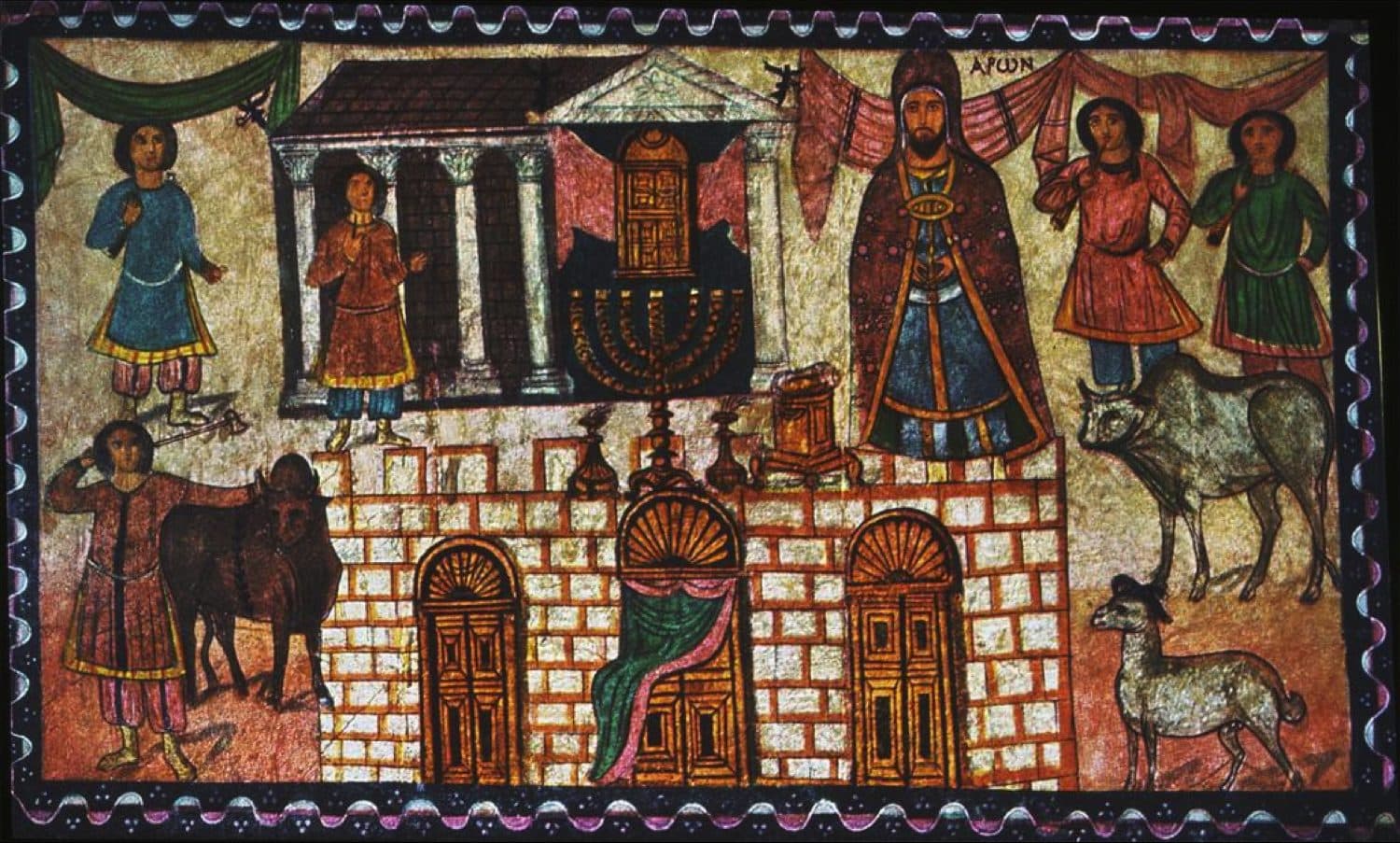
Painter unknown, The Consecration of the Tabernacle, wall painting of the Dura-Europos synagogue, third century. Public domain.
THE ARTWORKThe painter set Aaron the priest beside the sanctuary, its lampstand and its altar, with the animals for the offerings. Leviticus gives its laws of holiness to the people who camped around that sanctuary.
God gives one command to all Israel in Leviticus and gives it with a reason: be holy, because I am holy.
Summary
In Leviticus God tells Israel five times to be holy because He is holy, and Peter gives the same command to the church.
- Leviticus gives the command at 11:44, 11:45, 19:2, 20:7 and 20:26.
- Each time a reason follows: who God is, the rescue from Egypt, or His setting Israel apart.
- God calls Himself the LORD who sanctifies His people at 20:8 and 22:32.
- Peter quotes the command in 1 Peter 1:16 to believers scattered through five provinces of Asia Minor.
The Command and Its Reasons
Leviticus 11, 19 and 20, in the order the book gives them
The command first stands in the law of clean and unclean animals. God gives His own name as the reason, and the next words forbid the creatures that crawl on the ground.
Verse 45 gives a second reason. The LORD brought Israel up out of Egypt to be their God.
Leviticus 19 opens with the command spoken to the whole congregation of Israel. The chapter that follows asks respect for mother and father, keeping the Sabbath, and love of neighbour.
At 20:7 the reason is the covenant name, I am the LORD your God. The fifth giving closes chapter 20, and its reason is God's choice of Israel to be His own.
Chapter 21 gives the same word to the priests. They must be holy because they present the food of their God, and Israel is to regard each priest as holy because the LORD who sets them apart is holy.
For I am the LORD your God; consecrate yourselves, therefore, and be holy, because I am holy. You must not defile yourselves by any creature that crawls along the ground.The first giving.
For I am the LORD, who brought you up out of the land of Egypt so that I would be your God; therefore be holy, because I am holy.The second giving.
“Speak to the whole congregation of Israel and tell them: Be holy because I, the LORD your God, am holy.The third giving, to the whole congregation.
Consecrate yourselves, therefore, and be holy, because I am the LORD your God.The fourth giving.
You are to be holy to Me because I, the LORD, am holy, and I have set you apart from the nations to be My own.The fifth giving.
You are to regard him as holy, since he presents the food of your God. He shall be holy to you, because I the LORD am holy—I who set you apart.The command to the priests.
Where the Command Stands
Six verses in two books
| Book | Verse | The reason given | Its setting |
|---|---|---|---|
| Leviticus | 11:44 | I am the LORD your God; I am holy | The creatures that crawl on the ground |
| Leviticus | 11:45 | I brought you up out of Egypt; I am holy | The close of the food laws |
| Leviticus | 19:2 | I, the LORD your God, am holy | The laws for the whole congregation |
| Leviticus | 20:7 | I am the LORD your God | The laws against Molech and the mediums |
| Leviticus | 20:26 | I am holy; I set you apart from the nations | Clean and unclean animals |
| 1 Peter | 1:16 | It is written; the One who called you is holy | Hope set on the grace of Christ |
- Book
- Leviticus
- Verse
- 11:44
- The reason given
- I am the LORD your God; I am holy
- Its setting
- The creatures that crawl on the ground
- Book
- Leviticus
- Verse
- 11:45
- The reason given
- I brought you up out of Egypt; I am holy
- Its setting
- The close of the food laws
- Book
- Leviticus
- Verse
- 19:2
- The reason given
- I, the LORD your God, am holy
- Its setting
- The laws for the whole congregation
- Book
- Leviticus
- Verse
- 20:7
- The reason given
- I am the LORD your God
- Its setting
- The laws against Molech and the mediums
- Book
- Leviticus
- Verse
- 20:26
- The reason given
- I am holy; I set you apart from the nations
- Its setting
- Clean and unclean animals
- Book
- 1 Peter
- Verse
- 1:16
- The reason given
- It is written; the One who called you is holy
- Its setting
- Hope set on the grace of Christ
Set Apart from the Nations
Leviticus 20:22-26, the words set apart used twice over
The close of chapter 20 ties the people to the animals. God says He has set Israel apart from the peoples, and Israel is to keep the clean animals apart from the unclean.
So the food laws taught Israel at every meal that God had made it a people of its own.
Israel is told to consecrate itself, and God names Himself the LORD who sanctifies Israel at 20:8 and again at 22:32, where His holy name and the rescue from Egypt stand in one sentence.
But I have told you that you will inherit their land, since I will give it to you as an inheritance—a land flowing with milk and honey. I am the LORD your God, who has set you apart from the peoples. You are therefore to distinguish between clean and unclean animals and birds. Do not become contaminated by any animal or bird, or by anything that crawls on the ground; I have set these apart as unclean for you.God sets Israel apart, and Israel sets the unclean animals apart.
And you shall keep My statutes and practice them. I am the LORD who sanctifies you.The LORD who sanctifies.
You must not profane My holy name. I must be acknowledged as holy among the Israelites. I am the LORD who sanctifies you, who brought you out of the land of Egypt to be your God. I am the LORD.”His holy name and the rescue from Egypt.
The Hebrew of the command
At 11:44 and 20:7 consecrate yourselves is one Hebrew verb in the reflexive stem, so Israel is told to make itself holy.
At 20:8 the same root stands as a participle in the stem that makes a thing holy, in the words the LORD who sanctifies you.
At 11:45 who brought you up is a participle of the verb to go up, the word for the exodus.
In 20:24-26 the verb badal, to set apart, stands four times. God sets Israel apart from the peoples at 20:24 and 20:26, and Israel sets the clean animals apart from the unclean twice in 20:25.
The Greek of 1 Peter 1:16
The SBL Greek New Testament reads hagioi esesthe, hoti ego hagios, you shall be holy, because I am holy.
The Robinson-Pierpont text reads ginesthe, become holy, and adds eimi, I am, after holy.
Sinai and the Churches of Asia
Where Leviticus was given and where 1 Peter was sent
Leviticus ends by naming where its commands were given.
At Sinai God had already called Israel a holy nation and a kingdom of priests.
Rashi, the medieval Jewish commentator, says in his commentary on Leviticus that chapter 19 was read to the full assembly because most of the Torah's teaching depends on it.
First Peter goes to believers scattered through Pontus, Galatia, Cappadocia, Asia and Bithynia. Peter writes that they were sanctified by the Spirit and sprinkled by the blood of Jesus Christ.
These are the commandments that the LORD gave to Moses for the Israelites on Mount Sinai.The book's last verse.
And unto Me you shall be a kingdom of priests and a holy nation.’ These are the words that you are to speak to the Israelites.”The calling at Sinai, before the laws of Leviticus.
Peter, an apostle of Jesus Christ, To the elect who are exiles of the Dispersion throughout Pontus, Galatia, Cappadocia, Asia, and Bithynia, chosen according to the foreknowledge of God the Father and sanctified by the Spirit for obedience to Jesus Christ and sprinkling by His blood: Grace and peace be yours in abundance.The five provinces of the letter.
Peter's letter and his death
Peter closes the letter with greetings from the church in Babylon.
The church in Babylon, chosen together with you, sends you greetings, as does my son Mark.The place the letter was sent from.
Eusebius of Caesarea records in the fourth century that Nero put the apostles to death, Paul beheaded in Rome and Peter crucified there.
The date of the exodus
First Kings counts four hundred and eighty years from the exodus to the fourth year of Solomon. Eugene Merrill in Kingdom of Priests reads the number as years and puts the departure near 1446 BC, as do Bryant Wood and Gleason Archer.
In the four hundred and eightieth year after the Israelites had come out of the land of Egypt, in the month of Ziv, the second month of the fourth year of Solomon’s reign over Israel, he began to build the house of the LORD.The four hundred and eighty years.
Exodus 1:11 names Rameses as a store city Israel built. Kenneth Kitchen in On the Reliability of the Old Testament and James Hoffmeier in Israel in Egypt place the exodus in the reign of Rameses II, near 1260 BC.
So the Egyptians appointed taskmasters over the Israelites to oppress them with forced labor. As a result, they built Pithom and Rameses as store cities for Pharaoh.The store cities Pithom and Rameses.
What the Text Leaves Unsaid
Questions Leviticus and 1 Peter leave open
Leviticus gives no definition of holiness in a sentence. The reader learns it from the laws that follow the command.
The text never sets the holiness of Israel equal to the holiness of God. God is holy, and Israel is holy to Him.
Peter names no verse when he writes that it is written. The words match the command as Leviticus gives it in chapters 11 and 19.
Leviticus gives no account of where the word holy comes from.
Peter and the Command
1 Peter 1:13-19, the command read after the cross
Peter quotes the command to believers who once lived in the passions of their former ignorance. He gives it the same order Leviticus gives it, the rescue first and the command after.
The rescue Peter names is the blood of Christ. He was the lamb without blemish, and His blood redeemed them from the empty way of life of their fathers.
Peter then calls the church what Sinai called Israel, a holy nation and a royal priesthood.
But just as He who called you is holy, so be holy in all you do, for it is written: “Be holy, because I am holy.”The command quoted from Leviticus, with the God who called them as the reason.
For you know that it was not with perishable things such as silver or gold that you were redeemed from the empty way of life you inherited from your forefathers, but with the precious blood of Christ, a lamb without blemish or spot.The ransom that grounds the command for the church.
But you are a chosen people, a royal priesthood, a holy nation, a people for God’s own possession, to proclaim the virtues of Him who called you out of darkness into His marvelous light.Peter's words to the church.
Voices on the Command
Four commentators of the eighteenth and nineteenth centuries
Matthew Henry counts three reasons in Peter's words: the grace of the call, the command written in Scripture, and God's own example.
And yet it is required in strong terms, and enforced by three reasons, taken from the grace of God in calling us,--from his command, it is written, --and from his example. Be you holy, for I am holy. Learn, (1.) The grace of God in calling a sinner is a powerful engagement to holiness.
Matthew Henry · Commentary on the Whole Bible · on 1 Peter 1:15-16Puritan
Wesley reads the LORD who sanctifies as the God who separates His people and gives them grace to keep His statutes.
Who sanctify you - Who separate you from all nations, and from their impurities and idolatries, to be a peculiar people to myself; and who give you my grace to keep my statutes.
John Wesley · Explanatory Notes upon the Old Testament · on Leviticus 20:8Evangelical
Jamieson, Fausset and Brown add that the God who gives the command also gives the power to obey it.
As I am the fountain of holiness, being holy in My essence, be ye therefore zealous to be partakers of holiness, that ye may be as I also am [DIDYMUS]. God is essentially holy: the creature is holy in so far as it is sanctified by God. God, in giving the command, is willing to give also the power to obey it, namely, through the sanctifying of the Spirit (1Pe 1:2).
Jamieson, Fausset & Brown · Commentary Critical and Explanatory on the Whole Bible · on 1 Peter 1:16Reformed
Albert Barnes notes that the command was given first to Israel and is given with equal right to Christians, the people of God.
Because it is written, Be ye holy; for I am holy - Lev 11:44. This command was addressed at first to the Israelites, but it is with equal propriety addressed to Christians, as the professed people of God. The foundation of the command is, that they professed to be his people, and that as his people they ought to be like their God. Compare Mic 4:5. It is a great truth, that people everywhere will imitate the God whom they worship. They will form their character in accordance with his. They will regard what he does as right.
Albert Barnes · Notes, Explanatory and Practical, on the Old and New Testaments (1832-1869) · on 1 Peter 1:16Evangelical
What Holiness Asks
Two questions readers answer in different ways
Separation or likeness to God
Some readers hear the command as a call to separation. Adam Clarke reads the first giving as keeping apart from all the people of the earth, and Rashi, in his commentary on Leviticus 20:7, reads sanctify yourselves as keeping aloof from all idolatry.
Ye shall - sanctify yourselves - Ye shall keep yourselves separate from all the people of the earth, that ye may be holy; for I am holy. And this was the grand design of God in all these prohibitions and commands; for these external sanctifications were only the emblems of the internal purity which the holiness of God requires here, and without which none can dwell with him in glory hereafter. See at the conclusion of this chapter. The contents of this chapter must furnish many profitable reflections to a pious mind.
Adam Clarke · Commentary on the Bible · on Leviticus 11:44Evangelical
Others hear a call to likeness. Bonaventure writes in his Collations on the Hexaemeron that in holiness the creature must resemble the Creator, and Jamieson, Fausset and Brown call God the grand model.
Literally, "But (rather) after the pattern of Him who hath called you (whose characteristic is that He is) holy, be (Greek, 'become') ye yourselves also holy." God is our grand model.
Jamieson, Fausset & Brown · Commentary Critical and Explanatory on the Whole Bible · on 1 Peter 1:15Reformed
The text carries both readings. Leviticus 20:26 names separation from the nations, and 1 Peter 1:15 names the holiness of the God who called.
The command and the food laws in the church
Charles Spurgeon, in his sermon The Clean and the Unclean, holds that the reason of the command stands and the food laws that carried it are fulfilled. Mark adds to the words of Jesus that all foods are clean, and Peter heard a voice tell him not to call impure what God has made clean.
because it does not enter his heart, but it goes into the stomach and then is eliminated.” (Thus all foods are clean.)Mark's note on the words of Jesus: all foods are clean.
The voice spoke to him a second time: “Do not call anything impure that God has made clean.”The voice Peter heard in his vision at Joppa.
THE MOSAIC LAW ATTACHED great importance to meats and drinks: the Christian religion attaches none. The apostle Peter was shown by the vision of a sheet let down from heaven, not only that all nations were now to receive the gospel message, but that all kinds of food were now clean, and that all the prohibitions which had formerly been laid upon them for legal purposes were now once for all withdrawn. A Christian may, if he pleases, put himself under restrictions as to these matters.
Charles Spurgeon · The Metropolitan Tabernacle Pulpit, Sermon No. 499: “The Clean and the Unclean” (lightly modernized text, CCEL edition) · on Leviticus 11:2-3
The objection to this reading comes from the text itself. The first giving joins the command to the crawling creatures in one verse, and 20:25-26 joins Israel's separation to the separation of the animals.
Books on the Command
Three works to read next, from 1765 to 1871
Explanatory Notes upon the Old Testament
John Wesley · 1765
Wesley comments on Leviticus verse by verse in short notes.
Commentary Critical and Explanatory on the Whole Bible
Robert Jamieson, A. R. Fausset and David Brown · 1871
The note on Peter's command reads the Greek as become holy and ties the command to the Spirit's work in 1:2.
The Clean and the Unclean, Sermon 499
Charles Spurgeon · 1863
Spurgeon preaches the food laws of Leviticus 11 to a church that keeps none of them.
Holy Because He Is Holy
The command rests on who God is and on what He has already done for the people He addresses.
So the text asks the reader to be holy in all conduct, because the God who called is holy, and to trust the LORD who makes His people holy.
Keep studying
Places2