
Colossians 2 · Subject · Featured Study
The Teaching Paul Answered at Colossae
What Colossians 2 tells of the teaching pressed on the church, with three readings of who taught it and the holders of each.
Paul calls the rules urged on the believers at Colossae a shadow, and he says the body that casts it belongs to Christ.
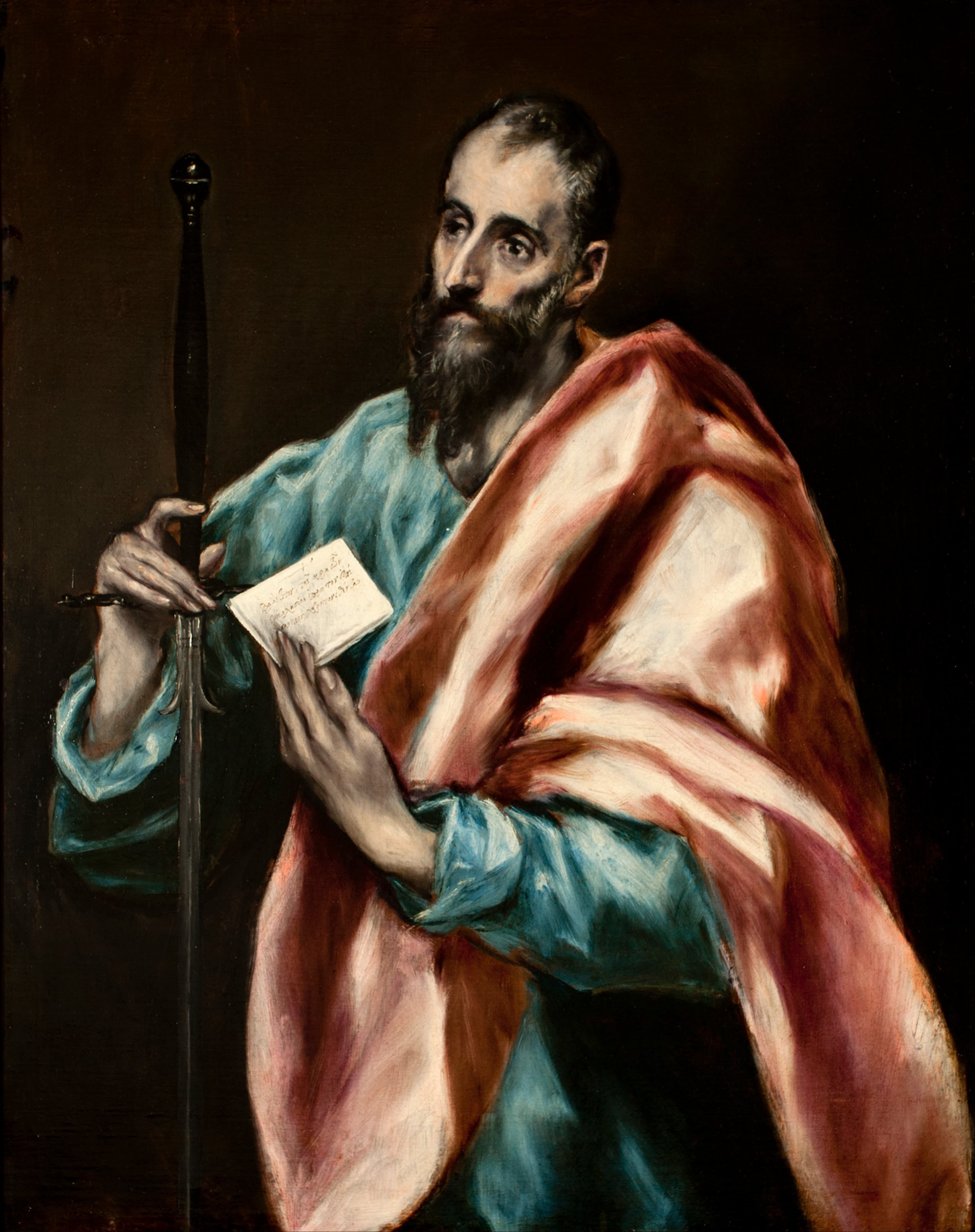
El Greco, Saint Paul, between 1610 and 1614, Museo del Greco, Toledo. Public domain, via Wikimedia Commons.
THE ARTWORKEl Greco painted Paul alone at three-quarter length, a sword at his side and a short letter open in his hand. The letter stands beside Colossians, which Paul wrote to a church that had not seen his face.
Summary
Colossians 2 describes the teaching at Colossae by its marks.
- Paul calls it philosophy and empty deception, based on human tradition and the spiritual forces of the world.
- Its teachers judged believers by food and drink and by a feast, a New Moon or a Sabbath.
- One of them delighted in false humility and the worship of angels and spoke of what he had seen, and the rules forbade handling, tasting and touching.
- Matthew Henry read it as Jewish teaching on the law, Tertullian as Greek philosophy, and Theophylact of Ohrid as a blend of the two.
What the Letter Says of the Teaching
Six passages of Colossians 2 give the teaching's marks, from verse 4 to verse 23.
I say this so that no one will deceive you by smooth rhetoric. For although I am absent from you in body, I am present with you in spirit, and I delight to see your orderly condition and firm faith in Christ.It is the chapter's first hint of the teaching, which came to the church as persuasive speech.
See to it that no one takes you captive through philosophy and empty deception, which are based on human tradition and the spiritual forces of the world rather than on Christ.It is the chapter's first open warning, and it names the teaching as philosophy and empty deception.
Therefore let no one judge you by what you eat or drink, or with regard to a feast, a New Moon, or a Sabbath. These are a shadow of the things to come, but the body that casts it belongs to Christ.It lists the five things by which the teachers judged believers and calls them a shadow.
Do not let anyone who delights in false humility and the worship of angels disqualify you with speculation about what he has seen. Such a person is puffed up without basis by his unspiritual mind. He has lost connection to the head, from whom the whole body, supported and knit together by its joints and ligaments, grows as God causes it to grow.It turns from the rules to the man who teaches them, and it traces his error to his break from Christ.
If you have died with Christ to the spiritual forces of the world, why, as though you still belonged to the world, do you submit to its regulations: “Do not handle, do not taste, do not touch!”? These will all perish with use, because they are based on human commands and teachings.Paul quotes the rules themselves and traces them to human commands.
Such restrictions indeed have an appearance of wisdom, with their self-prescribed worship, their false humility, and their harsh treatment of the body; but they are of no value against the indulgence of the flesh.It weighs the rules and finds them useless against the indulgence of the flesh.
The Marks and Two Readings
Three marks of the teaching, each read once as the law of Moses and once as Greek philosophy.
| Mark | Read as the law of Moses | Read as Greek philosophy |
|---|---|---|
| Philosophy and human tradition | The traditions the Jews depended on (Barnes) | The philosophy of the Greek schools (Tertullian) |
| Food and drink | The clean and unclean foods of the law (Clarke) | The Greek refusal to eat anything that had lived (Severian of Gabala) |
| Do not handle, do not taste, do not touch | The language of the Jewish teachers on food (Barnes) | Perhaps the customs of the Gentiles (Chrysostom) |
- Read as the law of Moses
- The traditions the Jews depended on (Barnes)
- Read as Greek philosophy
- The philosophy of the Greek schools (Tertullian)
- Mark
- Food and drink
- Read as the law of Moses
- The clean and unclean foods of the law (Clarke)
- Read as Greek philosophy
- The Greek refusal to eat anything that had lived (Severian of Gabala)
- Read as the law of Moses
- The language of the Jewish teachers on food (Barnes)
- Read as Greek philosophy
- Perhaps the customs of the Gentiles (Chrysostom)
Colossae and Its Neighbours
The man who taught the church, its two neighbour churches, its region and Paul's chains.
The church at Colossae learned the gospel from Epaphras, who was one of them. Paul writes that Epaphras goes to great pains for them and for those at Laodicea and Hierapolis.
Paul says he is struggling for the church at Colossae, for those at Laodicea and for all who have not met him face to face. He asks that the letter be read in the church of the Laodiceans as well.
Colossae stood in the Lycus Valley of Phrygia, and people from Phrygia were among the crowd in Jerusalem at Pentecost. Paul writes the letter in chains, and he signs its greeting in his own hand.
The Greek of the Warning
Eleven Greek words of Colossians 2 name the teaching and its rules, and seven of them stand nowhere else in the New Testament.
philosophia (G5385)Colossians 2:8
A noun the lexicon glosses as philosophy, used once in the New Testament, in Colossians 2:8.
stoicheion (G4747)Colossians 2:20
A noun the lexicon glosses as a principle, used seven times. The Berean renders it the spiritual forces of the world at Colossians 2:8 and Colossians 2:20, and the basic principles of the world at Galatians 4:3.
noumēnia (G3561)Colossians 2:16
A noun for the New Moon, used once in the New Testament, in Colossians 2:16.
skia (G4639)Colossians 2:17
A noun for a shadow, used seven times, which Colossians 2:17 sets against the body that casts it.
katabrabeuō (G2603)Colossians 2:18
A verb for an umpire's ruling against a contestant, used once, which the Berean renders disqualify.
thrēskeia (G2356)Colossians 2:18
A noun for religious worship, used four times, of the worship of angels in Colossians 2:18.
embateuō (G1687)Colossians 2:18
A verb the lexicon glosses as to investigate, used once, of the teacher's speculation about what he has seen.
dogmatizō (G1379)Colossians 2:20
A verb for laying down decrees, used once, in the question why believers submit to regulations.
ethelothrēskia (G1479)Colossians 2:23
A noun for a religion a man makes for himself, used once, which the Berean renders self-prescribed worship.
tapeinophrosynē (G5012)Colossians 2:23
A noun for lowliness of mind, used seven times, which the Berean renders false humility at Colossians 2:18 and Colossians 2:23 and humility at Colossians 3:12.
apheidia (G857)Colossians 2:23
A noun for unsparing severity, used once, of the harsh treatment of the body.
What the Text Leaves Unsaid
The letter leaves unanswered the teaching's name and teachers, its reach in the church, circumcision, the keeping of feasts and its visions.
The letter gives the teaching no name, and it never says who taught it, how many they were or where they came from. The word Gnostic appears nowhere in it.
Paul praises the church's orderly condition and firm faith, and he leaves unsaid whether anyone in the church had taken the teaching up.
Colossians 2 names circumcision as the circumcision performed by Christ, and the letter leaves unsaid whether the teachers demanded circumcision of the flesh.
The letter leaves unsaid whether believers should keep the feasts, New Moons and Sabbaths, and it speaks only to the judging of believers over them.
It leaves unsaid what the teacher claimed to have seen and what the worship of angels involved.
What Paul Sets Against It
Four passages answer marks of the teaching with Christ.
For in Christ all the fullness of the Deity dwells in bodily form. And you have been made complete in Christ, who is the head over every ruler and authority.It answers the philosophy and the spiritual forces of Colossians 2:8, since a believer who has Christ lacks nothing the teachers offer.
For in Him all things were created, things in heaven and on earth, visible and invisible, whether thrones or dominions or rulers or authorities. All things were created through Him and for Him.It answers the worship of angels, since thrones, dominions, rulers and authorities were all created through Christ and for Him.
And having disarmed the powers and authorities, He made a public spectacle of them, triumphing over them by the cross.It answers the spiritual forces of Colossians 2:8 and Colossians 2:20, since Christ disarmed the powers and authorities at the cross.
Therefore, since you have been raised with Christ, strive for the things above, where Christ is seated at the right hand of God. Set your minds on things above, not on earthly things.It answers the rules about food and touch, which concern earthly things, by setting the mind on Christ above.
Chrysostom on the Rules
John Chrysostom on Colossians 2:16 and Colossians 2:23, from his seventh homily on the letter.
“‘Let no man therefore judge you in meat, or in drink, or in respect of a feast day, or a new moon, or a sabbath day.’ Seest thou how he depreciates them? If ye have obtained such things, he saith, why make yourselves accountable for these petty matters? And he makes light of them, saying, ‘or in the part of a feast day,’ for in truth they did not retain the whole of the former rule, ‘or a new moon, or a sabbath day.’ He said not, ‘Do not then observe them,’ but, ‘let no man judge you.’ He showed that they were transgressing, and undoing, but he brought his charge against others. Endure not those that judge you, he saith, nay, not so much as this either, but he argues with those persons, almost stopping their mouths, and saying, Ye ought not to judge. But he would not have reflected on these. He said not ‘in clean and unclean,’ nor yet ‘in feasts of Tabernacles, and unleavened bread, and Pentecost,’ but ‘in part of a feast’: for they ventured not to keep the whole; and if they did observe it, yet not so as to celebrate the feast. ‘In part,’ he saith, showing that the greater part is done away. For even if they did keep sabbath, they did not do so with precision.”
John Chrysostom · Homily on Colossians 7 · on Colossians 2:16Patristic
“‘Which things have indeed a show of wisdom in will worship, and humility, and severity to the body; but are not of any value against the indulgence of the flesh.’ ‘Show,’ he saith; not power, not truth. So that even though they have a show of wisdom, let us turn away from them. For he may seem to be a religious person, and modest, and to have a contempt for the body. ‘Not of any value against the indulgence of the flesh.’ For God hath given it honor, but they use it not with honor. Thus, when it is a doctrine, he knows how to call it honor. They dishonor the flesh, he says, depriving it, and stripping it of its liberty, not giving leave to rule it with its will. God hath honored the flesh.”
John Chrysostom · Homily on Colossians 7 · on Colossians 2:23Patristic
Who Taught It?
Three readings of the teaching, each with its holders and the strongest objection, and the readings of two of its phrases.
Jewish teachers pressing the law of MosesMatthew Henry and Thomas Aquinas · Protestant and medieval commentary
“Those who pin their faith on other men's sleeves, and walk in the way of the world, have turned away from following after Christ. The deceivers were especially the Jewish teachers, who endeavoured to keep up the law of Moses in conjunction with the gospel of Christ, but really in competition with it and contradiction to it.”
Matthew Henry · Commentary on the Whole Bible · on Colossians 2:8Puritan
Thomas Aquinas, in his Commentary on Colossians, reads Colossians 2:16 as freeing believers from the ceremonial commands of the law.
The strongest objection is that the law of Moses commands no worship of angels and no visions, and Tertullian says Paul does not attack Moses in these verses.
“But when he blames those who alleged visions of angels as their authority for saying that men must abstain from meats-‘you must not touch, you must not taste’-in a voluntary humility, (at the same time) ‘vainly puffed up in the fleshly mind, and not holding the Head,’ (the apostle) does not in these terms attack the law or Moses, as if it was at the suggestion of superstitious angels that he had enacted his prohibition of sundry aliments.”
Tertullian · Against Marcion Book V · on Colossians 2:18Patristic
Greek philosophyTertullian · Patristic commentary
“Writing to the Colossians, he says, ‘See that no one beguile you through philosophy and vain deceit, after the tradition of men, and contrary to the wisdom of the Holy Ghost.’ He had been at Athens, and had in his interviews (with its philosophers) become acquainted with that human wisdom which pretends to know the truth, whilst it only corrupts it, and is itself divided into its own manifold heresies, by the variety of its mutually repugnant sects.”
Tertullian · The Prescription Against Heretics · on Colossians 2:8Patristic
The strongest objection is that a feast, a New Moon and a Sabbath belong to Israel's calendar.
A blend of Jewish and Greek teachingTheophylact of Ohrid, Adam Clarke, John Wesley and Albert Barnes · Byzantine and Protestant commentary
Theophylact of Ohrid, in his Commentary on Colossians, counts the rule on food mainly Jewish and the rule on days Greek. Clarke, in his Commentary on the Bible of 1832, reads the philosophy as the philosophizing of Jewish and Gentile teachers alike, and Wesley, in his Explanatory Notes of 1755, as philosophy blended with Christianity.
Barnes, in his Notes, Explanatory and Practical, finds two dangers that Paul is not careful to distinguish, Greek philosophy and Jewish opinions, and he adds that the oriental or Gnostic philosophy perhaps prevailed there too.
The strongest objection is that the letter speaks of one teacher in Colossians 2:18 and never of two parties.
What the worship of angels wasColossians 2:18 · John Chrysostom and Severian of Gabala
“‘Let no man rob you of your prize by a voluntary humility and worshiping of the Angels, dwelling in the things which he hath not seen, vainly puffed up by his fleshly mind.’ When he had filled them with anger through saying, ‘adjudge away from you,’ then he begins; ‘being a voluntary,’ he saith, ‘in humility and worshiping of Angels, intruding into things he hath not seen, vainly puffed up by his fleshly mind.’ How ‘in humility,’ or how ‘puffed up’? He shows that the whole arose out of vainglory. But what is on the whole the drift of what is said? There are some who maintain that we must be brought near by Angels, not by Christ, that were too great a thing for us. Therefore it is that he turns over and over again what has been done by Christ, ‘through the Blood of His Cross’; on this account he says that ‘He suffered for us’; that ‘He loved us.’ And besides in this very same thing, moreover, they were elevated afresh. And he said not ‘introduction by,’ but ‘worshiping of’ Angels. ‘Intruding into things he hath not seen.’ For he hath not seen Angels, and yet is affected as though he had. Therefore he saith, ‘Puffed up by his fleshly mind vainly,’ not about any true fact. About this doctrine, he is puffed up, and puts forward a show of humility. By his carnal mind, not spiritual; his reasoning is of man.”
John Chrysostom · Homily on Colossians 7 · on Colossians 2:18Patristic
Severian of Gabala gives the same reading of the teachers, that since God is too far above any service a man can render, propitiation was said to come through His angels.
What the spiritual forces of the world areColossians 2:8 and Colossians 2:20 · four readings
Chrysostom takes the elements of the world to be the sun and the moon, by which the days were kept, and he sets the verse beside Galatians 4:9.
Tertullian, in Against Marcion, reads them as worldly learning.
“When, again, he warns them to ‘beware of subtle words and philosophy,’ as being ‘a vain deceit,’ such as is ‘after the rudiments of the world’ (not understanding thereby the mundane fabric of sky and earth, but worldly learning, and ‘the tradition of men,’ subtle in their speech and their philosophy), it would be tedious, and the proper subject of a separate work, to show how in this sentence (of the apostle's) all heresies are condemned, on the ground of their consisting of the resources of subtle speech and the rules of philosophy.”
Tertullian · Against Marcion Book V · on Colossians 2:8Patristic
Clarke reads them as the rites of the Jewish religion, the first letters of the alphabet from which Christianity was composed. Jamieson, Fausset and Brown cite Neander for the reading that they are what is earthly, carnal and outward.
Books on the Teaching
Three works that read Colossians 2, each with a free door.
Homilies on Colossians
John Chrysostom · 407
Chrysostom gives his sixth and seventh homilies to Colossians 2:8 to 23, phrase by phrase.
Read Homily 7 at Historical ChristianAgainst Marcion
Tertullian · 220
Its fifth book reads the letters of Paul against Marcion, and Colossians 2:8 to 22 among them.
Read Book 5 at Historical ChristianCommentary on the Bible
Adam Clarke · 1832
Its notes on Colossians 2 give the Greek words of the warning and a parallel from the Talmud for the rules of verse 21.
Read Colossians 2 at StudyLightComplete in Christ
The chapter's answer to the teaching is Christ, in whom are hidden all the treasures of wisdom and knowledge, and in whom the believer has been made complete.
The chapter asks the reader, having received Christ Jesus as Lord, to continue to walk in Him, rooted and built up in Him. It asks the reader to keep the connection to the head, from whom the whole body grows as God causes it to grow.
Keep studying
Read it1
Places3
Symbols1