
Jonah 3:8
in Jonah 3Furthermore, let both man and beast be covered with sackcloth, and have everyone call out earnestly to God. Let each one turn from his evil ways and from the violence in his hands.
BSB
The same verse in ASV and KJV ▾
ASV
but let them be covered with sackcloth, both man and beast, and let them cry mightily unto God: yea, let them turn every one from his evil way, and from the violence that is in his hands.
KJV
But let man and beast be covered with sackcloth, and cry mightily unto God: yea, let them turn every one from his evil way, and from the violence that is in their hands.
⋯
This verse in Jonah 3
Commentary
12 notes on this verseLet man and beast be covered - This was done that every object which they beheld might deepen the impression already made, and cause them to mourn after a godly sort. Virgil tells us that the mourning for the death of Julius Caesar was so general, that the cattle neither ate nor drank: - Non ulli pastos illis egere diebus Frigida, Daphni, boves ad flumina: nulla neque amnem Libavit quadrupes, nec graminis attigit herbam. Ecl. 5:24. “The swains forgot their sheep, nor near the brink Of running waters brought their herds to drink.
This site's exposition
Let neither man nor beast, herd nor flock, taste any thing
on Jonah 3:7-9
Let neither man nor beast, herd nor flock, taste any thing extends the fast even to the city's animals, a detail without parallel elsewhere in Scripture that the commentators read as eastern custom rather than an invented flourish, since classical writers record similar mourning practices among other Near Eastern peoples. The decree goes past ritual, commanding that man and beast cry mightily unto God and that every one turn from his evil way and from the violence that is in their hands, naming violence specifically as the sin Nineveh must abandon. The king's own uncertainty, who can tell if God will turn and repent, and turn away from his fierce anger, that we perish not, asks for mercy without presuming it, and Henry and Pusey both read this as the humility the book commends against Jonah's own presumption that he already knew how God would act.
The record, by era
The Church Fathers3 voices
Recall that Daniel, passionate man though he was, spent many days fasting. He received as recompense an awesome vision so that he tamed the fury of the lions and turned them into the mildest of sheep, not by changing their nature but by diverting their purpose without loss of their ferocity. The Ninevites too made use of the remedy of fasting and won from the Lord a reprieve. Animals as well as human beings were included in the fast, so that all living things would abstain from evil practices. This total response won the favor of the Lord of all.
"For word came unto the king of Nineveh, and he arose from his throne, and he laid his robe from him, and covered him with sackcloth, and sat in ashes.
A commentator
John CassianThe Twelve Books on the Institutes of the Coenobia, Book 1, Chapter 2 · Written before 435.
proposed
Nor, indeed, ought this to influence us as a precedent for our daily life, that Joram, the wicked king of Israel, when surrounded by bands of his foes, rent his clothes, and is said to have had sackcloth inside them; or that the Ninevites, in order to mitigate the sentence of God, which had been pronounced against them by the prophet, were clothed in rough sackcloth.
The Medieval Church2 voices
Coarseness of attire is sometimes a sign of sorrow: wherefore those who are in sorrow want to wear coarser clothes, just as on the other hand in times of festivity and joy they wear finer clothes. Just as a man's mind is uplifted by fine …
A commentator
BonaventureDisputed Questions on Evangelical Perfection, Question 1 · Written in the 13th century.
proposed
On Jonah 3, upon the text: Let men and beasts be covered with sackcloth: the Gloss says: "Behold, the king of Nineveh rises from his throne; he exchanges purple for sackcloth, ointments for mud, clean things for filth." But this is to abase oneself in …
5 more voices on this verse
The Puritans and the Awakening3 voices
And beast - Their horses and camels, both which they adorned with rich and costly clothing, they must now in testimony of an hearty repentance, clothe with sackcloth; the clothing of beasts must witness for men. The violence - Oppression and rapine. In their hands - Which are practiced by them.
But let man and beast be covered with sackcloth,....
In prayer we must cry mightily, with a fixedness of thought, firmness of faith, and fervour of pious and devout affections. By crying mightily we wrestle with God; we take hold of him; and we are concerned to do so when he is not only departing from us as a friend, but coming forth against us as an enemy. It therefore concerns us in prayer to stir up all that is within us.
The Nineteenth Century2 voices
A commentator
Jamieson, Fausset & Brown1802–1910
Commentary Critical and Explanatory on the Whole Bible (1871)
proposed
cry . . . turn--Prayer without reformation is a mockery of God (Ps 66:18; Prayer, on the other hand, must precede true reformation, as we cannot turn to God from our evil way unless God first turns us (Jer 31:18, 19).
quarantine:debris (2026-07-29) — starts-lowercase+unbalanced-parens
A commentator
Albert Barnes1798–1870
Notes, Explanatory and Practical, on the Old and New Testaments (1832-1869)
proposed
Let man and beast be covered with sackcloth - The gorgeous caparisons of horses, mules and camels was part of Eastern magnificence. Who knows not how man’s pride is fed by the sleekness of his stud, their “well-appointed” trappings? Man, in his luxury and pride, would have everything reflect his glory, and minister to pomp. Self-humiliation would have everything reflect its lowliness. Sorrow would have everything answer to its sorrow. People think it strange that the horses at Nineveh were covered with sackcloth, and forget how, at the funerals of the rich, black horses are chosen and are clothed with black velvet. And cry unto God mightily - , “with might which conquereth judgment.” A faint prayer does not express a strong desire, nor obtain what it does not strongly ask for, as having only half a heart. And let them turn, every man from his evil way - Isa 59:6. “See what removed that inevitable wrath. Did fasting and sackcloth alone? No, but the change of the whole life. How does this appear? From the prophet’s word itself. For he who spake of the wrath of God and of their fast, himself mentions the reconciliation and its cause. “And God saw their works.” What works? that they fasted? that they put on sackcloth? He passes by these, and says, “that every one turned from his evil ways, and God repented of the evil which He had said that He would do unto them.” Seest thou, that not the fast plucked them from the peril, but the change of life made God propitious to these pagan. I say this, not that we should dishonor, but that we may honor fasting. For the honor of a fast is not in abstinence from food, but in avoidance of sin. So that tie who limiteth fasting to the abstinence from food only, he it is, who above all dishonoreth it. Fastest thou? Show it me by its works. ‘What works?’ askest thou? […]
The words behind it
16 Hebrew wordsEvery Hebrew word of this verse in the order it stands, with what it means and the door to its own study. The last column counts the times a word stands in the whole Bible: the rarer the word, the more the places it appears belong together.
| Hebrew | Sound | Meaning | Word study | In the Bible |
|---|---|---|---|---|
| וְיִתְכַּסּ֣וּ | veyitkasu | and they may cover themselves | H3680 → | |
| שַׂקִּ֗ים | sakim | sackcloth<s> | H8242 → | 49 times |
| הָֽאָדָם֙ | haadam | the people | H120 → | 551 times |
| וְהַבְּהֵמָ֔ה | vehabehemah | and the livestock | H929 → | 190 times |
| וְיִקְרְא֥וּ | veyikreu | and let them call out | H7121 → | 733 times |
| אֶל־ | ʾel- | to | H413 → | 5510 times |
| אֱלֹהִ֖ים | ʾelohim | God | H430 → | 2601 times |
| בְּחָזְקָ֑ה | bechazekah | with strength | H2394 → | |
| וְיָשֻׁ֗בוּ | veyashuvu | and let them turn back | H7725 → | 1056 times |
| אִ֚ישׁ | ʾish | everyone | H376 → | 1663 times |
| מִדַּרְכּ֣וֹ | midarko | from way his | H1870 → | |
| הָֽרָעָ֔ה | haraah | <the> evil | H7451 → | 662 times |
| וּמִן־ | umin- | and from | H4480 → | 1188 times |
| הֶחָמָ֖ס | hechamas | the violence | H2555 → | |
| אֲשֶׁ֥ר | ʾasher | which | H834 → | 5497 times |
| בְּכַפֵּיהֶֽם׃ | bekhapeihem | [is] in palms their | H3709 → |
וְיִתְכַּסּ֣וּand they may cover themselves
veyitkasuH3680 →
שַׂקִּ֗יםsackcloth<s>
sakimH8242 →49 times
הָֽאָדָם֙the people
haadamH120 →551 times
וְהַבְּהֵמָ֔הand the livestock
vehabehemahH929 →190 times
וְיִקְרְא֥וּand let them call out
veyikreuH7121 →733 times
אֶל־to
ʾel-H413 →5510 times
אֱלֹהִ֖יםGod
ʾelohimH430 →2601 times
בְּחָזְקָ֑הwith strength
bechazekahH2394 →
וְיָשֻׁ֗בוּand let them turn back
veyashuvuH7725 →1056 times
אִ֚ישׁeveryone
ʾishH376 →1663 times
מִדַּרְכּ֣וֹfrom way his
midarkoH1870 →
הָֽרָעָ֔ה<the> evil
haraahH7451 →662 times
וּמִן־and from
umin-H4480 →1188 times
הֶחָמָ֖סthe violence
hechamasH2555 →
אֲשֶׁ֥רwhich
ʾasherH834 →5497 times
בְּכַפֵּיהֶֽם׃[is] in palms their
bekhapeihemH3709 →
A shaded row is a word that stands 400 times or fewer in the Bible.
The walk
8 stopsEach card is a verse this one points to, and under it the verses that one points to in turn. Where several paths arrive at the same place, that place is listed first: the text keeps returning to it.
Through
Acts 3:19Repent, then, and turn back, so that your sins may be wiped away,
it leads to
- Isaiah 44:22
I have blotted out your transgressions like a cloud, and your sins like a mist. Return to Me, for I have redeemed you.
- Acts 2:38
Peter replied, “Repent and be baptized, every one of you, in the name of Jesus Christ for the forgiveness of your sins, and you will receive the gift of the Holy Spirit.
- Isaiah 43:25
I, yes I, am He who blots out your transgressions for My own sake and remembers your sins no more.
- Isaiah 1:16–20
Wash and cleanse yourselves. Remove your evil deeds from My sight. Stop doing evil!
- Matthew 13:15
For this people’s heart has grown callous; they hardly hear with their ears, and they have closed their eyes. Otherwise they might see with their eyes, hear with their ears, understand with their hearts,…
- Isaiah 44:22
Through
Jonah 1:6The captain approached him and said, “How can you sleep? Get up and call upon your God. Perhaps this God will consider us, so that we may not perish.”
it leads to
- Psalms 107:28–29
Then they cried out to the LORD in their trouble, and He brought them out of their distress.
- Jonah 3:9
Who knows? God may turn and relent; He may turn from His fierce anger, so that we will not perish.”
- 2 Samuel 12:22
David answered, “While the child was alive, I fasted and wept, for I said, ‘Who knows? The LORD may be gracious to me and let him live.’
- Psalms 107:28–29
Where this verse is studied
About Jonah
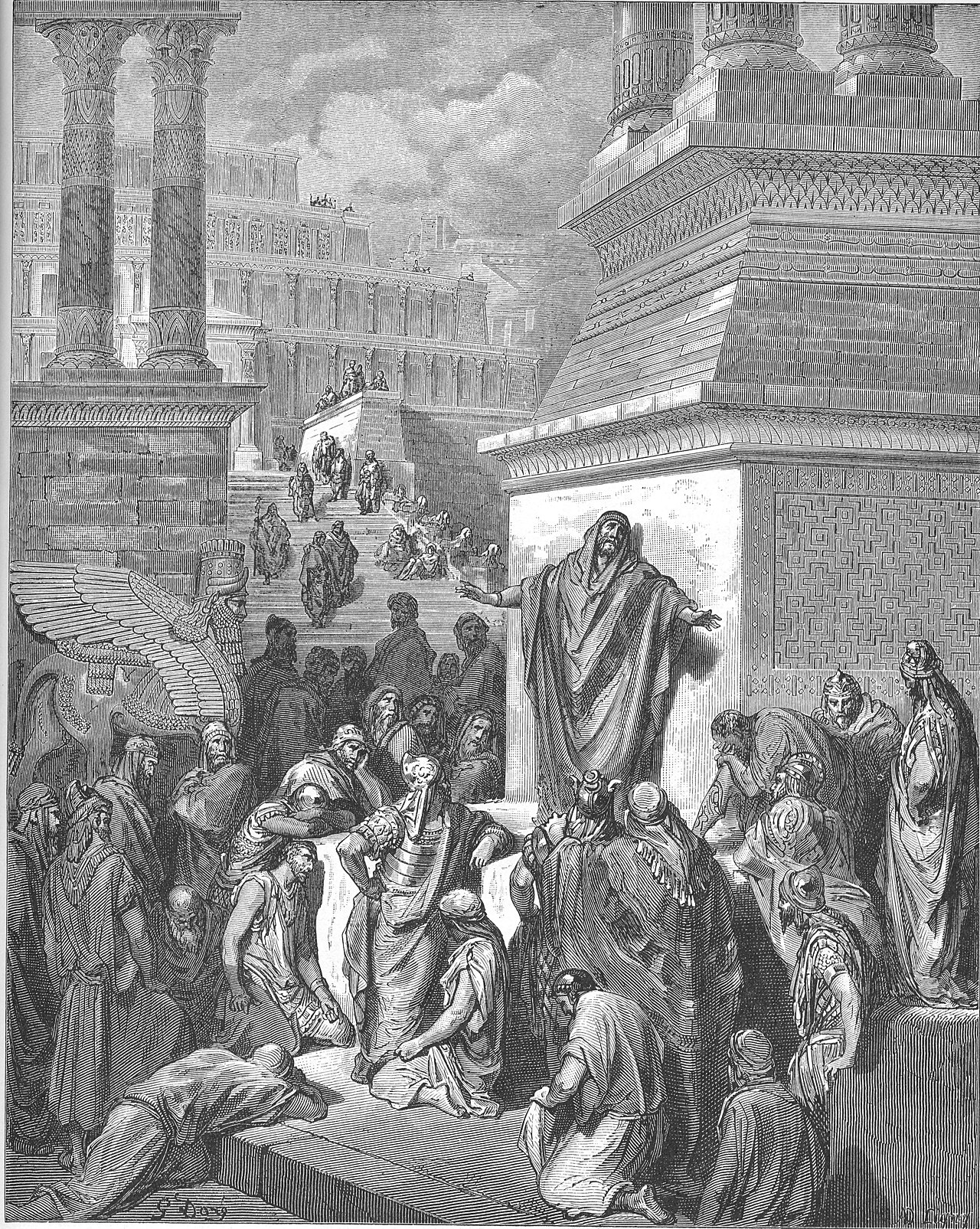
This page draws on 12 works. Open the list of works
This page draws on Adam Clarke, Commentary on the Bible; Albert Barnes, Notes, Explanatory and Practical, on the Old and New Testaments (1832-1869); Bonaventure, Disputed Questions on Evangelical Perfection, Question 1; Edward Bouverie Pusey, The Minor Prophets: A Commentary; Jamieson, Fausset & Brown, Commentary Critical and Explanatory on the Whole Bible; Jerome, Commentary on Jonah, Chapter 3; John Cassian, The Twelve Books on the Institutes of the Coenobia, Book 1, Chapter 2; John Chrysostom, HOMILIES ON GENESIS 1:7; John Gill, Exposition of the Old Testament (1748-1763); John Wesley, Explanatory Notes upon the Old Testament; Matthew Henry, Commentary on the Whole Bible and Thomas Aquinas, Commentary (church-history corpus).