
2 Kings 6:30
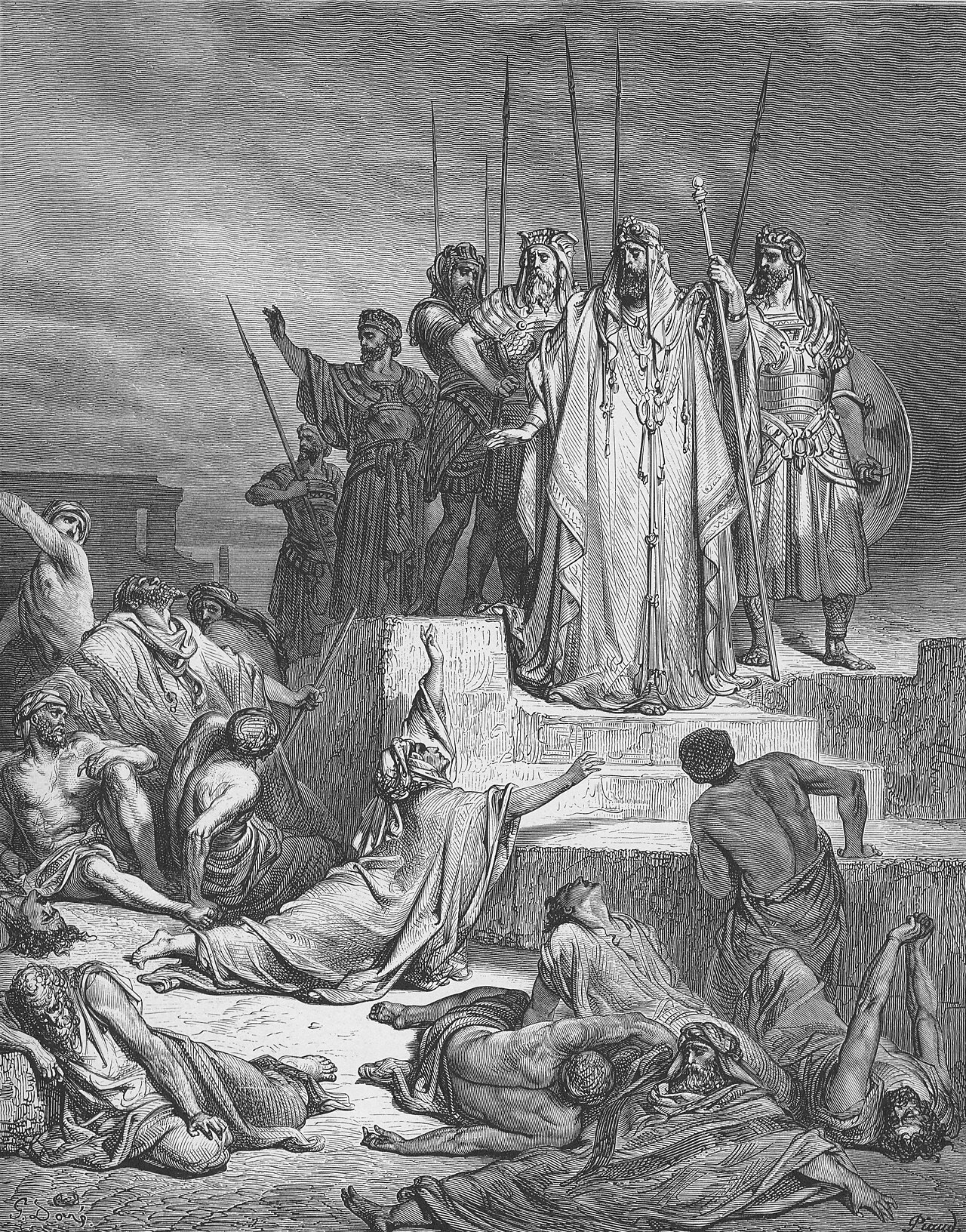
in 2 Kings 6When the king heard the words of the woman, he tore his clothes. And as he passed by on the wall, the people saw the sackcloth under his clothes next to his skin.
BSB
The same verse in ASV and KJV ▾
ASV
And it came to pass, when the king heard the words of the woman, that he rent his clothes (now he was passing by upon the wall); and the people looked, and, behold, he had sackcloth within upon his flesh.
KJV
And it came to pass, when the king heard the words of the woman, that he rent his clothes; and he passed by upon the wall, and the people looked, and, behold, he had sackcloth within upon his flesh.
⋯
This verse in 2 Kings 6
Commentary
8 notes on this verseA commentator
Albert Barnes1798–1870
Notes, Explanatory and Practical, on the Old and New Testaments (1832-1869)
Sackcloth - Jehoram hoped perhaps to avert Yahweh’s anger, as his father had done 1Ki 21:29. But there was no spirit of self-humiliation, or of true pentitence in his heart 2Ki 5:7. See the next verse.
This site's exposition
he rent his clothes
The king tears his royal robe in public grief, and underneath it the people see sackcloth already worn against his own skin, a penitential garment put on before this one horror ever reached his ears. The hidden sackcloth says the king already knew the city's condition was covenant judgment even while he kept looking for someone else to blame. What he does next shows which way that blame is about to fall.
The record, by era
The Church Fathers1 voice
"Some time later King Ben-hadad of Aram mustered his entire army; he marched against Samaria and laid siege to it." This is that Ben-hadad who had been condemned to death by God; and Ahab had received the order to execute him. But he spared his …
The Puritans and the Awakening3 voices
), as one heartily concerned for the misery of his people, and that it was not in his power to help them; but he did not lament his own iniquity, nor the iniquity of his people, which was the procuring cause of the calamity; he was not sensible that his ways and his doings had procured this to himself; this is his wickedness, for it is bitter.
quarantine:debris (2026-07-29) — leading-punctuation+unbalanced-parens
And it came to pass, when the king heard the words of the woman, that he rent his clothes,.... At the horror of the fact reported, and through grief that his people were brought into such distress through famine: and he passed by upon the wall; returning to his palace: and the people looked, and, behold, he had sackcloth upon his flesh; which, in token of humiliation for averting the calamities he was under, he had put there before, and now was seen through the rending of his clothes.
Concerning the sons of the prophets, and their condition and character. The college here spoken of seems to be that at Gilgal, for there Elisha was ( ch. iv. 38 ), and it was near Jordan; and, probably, wherever Elisha resided as many as could of the sons of the prophets flocked to him for the advantage of his instructions, counsels, and prayers.
The Nineteenth Century1 voice
A commentator
Jamieson, Fausset & Brown1802–1910
Commentary Critical and Explanatory on the Whole Bible (1871)
proposed
It is more than doubtful, however, if he was truly humbled on account of his own and the nation's sins; otherwise he would not have vowed vengeance on the prophet's life.
1 more voice on this verse
The Nineteenth Century1 voice
He had sackcloth within upon his flesh - The king was in deep mourning for the distresses of the people.
The words behind it
20 Hebrew wordsEvery Hebrew word of this verse in the order it stands, with what it means and the door to its own study. The last column counts the times a word stands in the whole Bible: the rarer the word, the more the places it appears belong together.
| Hebrew | Sound | Meaning | Word study | In the Bible |
|---|---|---|---|---|
| וַיְהִי֩ | vayhi | and it was | H1961 → | 3559 times |
| כִשְׁמֹ֨עַ | khishmoa' | when heard | H8085 → | 1159 times |
| הַמֶּ֜לֶךְ | hamelekh | the king | H4428 → | 2525 times |
| אֶת־ | ʾet- | <obj.> | H853 → | 10935 times |
| דִּבְרֵ֤י | divrei | [the] words of | H1697 → | 1440 times |
| הָֽאִשָּׁה֙ | haishah | the woman | H802 → | 781 times |
| וַיִּקְרַ֣ע | vaiyikra' | and he tore | H7167 → | 63 times |
| אֶת־ | ʾet- | <obj.> | H853 → | 10935 times |
| בְּגָדָ֔יו | begadav | clothes his | H899 → | 217 times |
| וְה֖וּא | vehu' | and he | H1931 → | 1879 times |
| עֹבֵ֣ר | ʾover | [was] passing by | H5674 → | 556 times |
| עַל־ | ʾal- | on | H5921 → | 5755 times |
| הַחֹמָ֑ה | hachomah | the wall | H2346 → | 133 times |
| וַיַּ֣רְא | vaiyar' | and it saw | H7200 → | 1300 times |
| הָעָ֔ם | haam | the people | H5971 → | 1873 times |
| וְהִנֵּ֥ה | vehineh | and there! | H2009 → | 843 times |
| הַשַּׂ֛ק | hasak | <the> sackcloth | H8242 → | 49 times |
| עַל־ | ʾal- | [was] on | H5921 → | 5755 times |
| בְּשָׂר֖וֹ | besaro | flesh his | H1320 → | 270 times |
| מִבָּֽיִת׃ | mibayit | from inside | H1004 → | 2046 times |
וַיְהִי֩and it was
vayhiH1961 →3559 times
כִשְׁמֹ֨עַwhen heard
khishmoa'H8085 →1159 times
הַמֶּ֜לֶךְthe king
hamelekhH4428 →2525 times
אֶת־<obj.>
ʾet-H853 →10935 times
דִּבְרֵ֤י[the] words of
divreiH1697 →1440 times
הָֽאִשָּׁה֙the woman
haishahH802 →781 times
וַיִּקְרַ֣עand he tore
vaiyikra'H7167 →63 times
אֶת־<obj.>
ʾet-H853 →10935 times
בְּגָדָ֔יוclothes his
begadavH899 →217 times
וְה֖וּאand he
vehu'H1931 →1879 times
עֹבֵ֣ר[was] passing by
ʾoverH5674 →556 times
עַל־on
ʾal-H5921 →5755 times
הַחֹמָ֑הthe wall
hachomahH2346 →133 times
וַיַּ֣רְאand it saw
vaiyar'H7200 →1300 times
הָעָ֔םthe people
haamH5971 →1873 times
וְהִנֵּ֥הand there!
vehinehH2009 →843 times
הַשַּׂ֛ק<the> sackcloth
hasakH8242 →49 times
עַל־[was] on
ʾal-H5921 →5755 times
בְּשָׂר֖וֹflesh his
besaroH1320 →270 times
מִבָּֽיִת׃from inside
mibayitH1004 →2046 times
A shaded row is a word that stands 400 times or fewer in the Bible.
The walk
8 stopsEach card is a verse this one points to, and under it the verses that one points to in turn. Where several paths arrive at the same place, that place is listed first: the text keeps returning to it.
Through
1 Kings 21:27When Ahab heard these words, he tore his clothes, put on sackcloth, and fasted. He lay down in sackcloth and walked around meekly.
it leads to
- Genesis 37:34
Then Jacob tore his clothes, put sackcloth around his waist, and mourned for his son many days.
Reached by 2 separate paths from here.
- 2 Samuel 3:31
Then David ordered Joab and all the people with him, “Tear your clothes, put on sackcloth, and mourn before Abner.” And King David himself walked behind the funeral bier.
- Genesis 37:34
Through
2 Kings 5:7When the king of Israel read the letter, he tore his clothes and asked, “Am I God, killing and giving life, that this man expects me to cure a leper? Surely you can see…
it leads to
- 1 Samuel 2:6
The LORD brings death and gives life; He brings down to Sheol and raises up.
- 1 Kings 20:7
Then the king of Israel summoned all the elders of the land and said, “Please take note and see that this man is looking for trouble, for when he demanded my wives, my children,…
- Genesis 30:2
Jacob became angry with Rachel and said, “Am I in the place of God, who has withheld children from you?”
- Deuteronomy 32:39
See now that I am He; there is no God besides Me. I bring death and I give life; I wound and I heal, and there is no one who can deliver from My…
- 1 Samuel 2:6
Through
2 Kings 19:1On hearing this report, King Hezekiah tore his clothes, put on sackcloth, and entered the house of the LORD.
it leads to
- 1 Kings 21:27
When Ahab heard these words, he tore his clothes, put on sackcloth, and fasted. He lay down in sackcloth and walked around meekly.
- 2 Kings 18:37
Then Hilkiah’s son Eliakim the palace administrator, Shebna the scribe, and Asaph’s son Joah the recorder came to Hezekiah with their clothes torn, and they relayed to him the words of the Rabshakeh.
- 1 Kings 21:27
Where this verse is studied
On this page
About 2 Kings
This page draws on Adam Clarke, Commentary on the Bible; Albert Barnes, Notes, Explanatory and Practical, on the Old and New Testaments (1832-1869); Ephrem the Syrian, ON THE SECOND BOOK OF KINGS 6:24; F. W. Farrar, The Second Book of Kings (Expositor's Bible); Jamieson, Fausset & Brown, Commentary Critical and Explanatory on the Whole Bible; John Gill, Exposition of the Old Testament; John Gill, Exposition of the Old Testament (1748-1763) and Matthew Henry, Commentary on the Whole Bible.