
Ruth 1:3
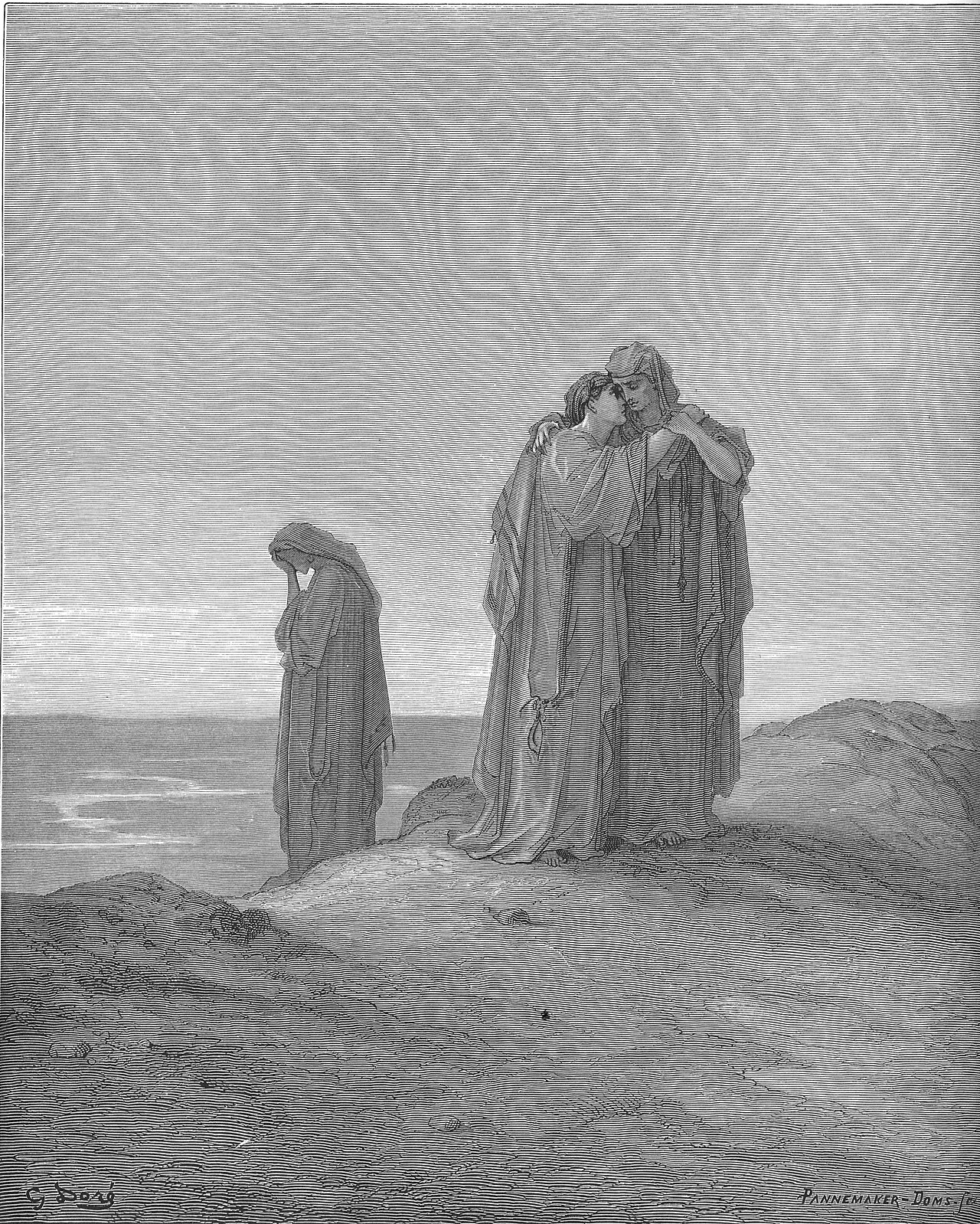
in Ruth 1Then Naomi’s husband Elimelech died, and she was left with her two sons,
BSB
The same verse in ASV and KJV ▾
ASV
And Elimelech, Naomi’s husband, died; and she was left, and her two sons.
KJV
And Elimelech Naomi’s husband died; and she was left, and her two sons.
⋯
This verse in Ruth 1
Commentary
5 notes on this verseThis site's exposition
Elimelech Naomi's husband died
on Ruth 1:3-5
Three men die in three verses and the text gives no cause for any of them. The sons marry Moabite women, which the law discouraged and did not forbid outright in the way Deuteronomy 7:3 forbids the seven nations. Verse 5 leaves the sentence standing on the woman rather than the men, the woman was left of her two sons and her husband, which is the position the rest of the book answers.
The record, by era
The Church Fathers2 voices
Therefore, if we acknowledge that Thamar is described in the genealogies on account of a mystery in the Lord's generations, we must also certainly not consider Ruth to be overlooked for the same reason: about whom the holy Apostle seems to have had an understanding, when he foresaw through the Spirit that the calling of the Gentiles was to be celebrated by the Gospel, saying that the Law is not made for the just, but for the unjust (1 Timothy 1:9). For how did Ruth, being a foreigner, marry a Jew? And by what reasoning did the evangelist think that the mention of a union should be made in the birth of Christ, which was forbidden by the series of laws? Therefore, did the Savior not originate from a legitimate generation (Deut. XXIII, 3)? It seems to be contrary unless we adhere to the apostolic belief, for the law was not established for the righteous, but for the unrighteous. And since she is a foreigner and a Moabite (especially since the law of Moses prohibited these marriages, and the Moabites were excluded from the Church; for it is written: Moabites shall not enter the Church of the Lord even to the third and fourth generation, and forever), how then did she enter into the Church if not because she was holy and blameless in her conduct, above the law? For if the Law was given to the impious and sinners, certainly Ruth, who surpassed the definition of the Law, and entered into the Church, and became an Israelite, and deserved to be counted among the greater ones of the Lord's family, because of the choice of her mind and not her body, is a great example for us, because in her the figure of our entrance into the Church of the Lord, who are gathered from the nations, preceded. […]
You call to mind Blaesilla's companionship, her conversation and her endearing ways; and you cannot endure the thought that you have lost them all. I pardon you the tears of a mother, but I ask you to restrain your grief. When I think of the parent, I cannot blame you for weeping, but when I think of the Christian and the recluse, the mother disappears from my view. Your wound is still fresh, and any touch of mine, however gentle, is more likely to inflame than to heal it.
The Puritans and the Awakening1 voice
And Elimelech, Naomi's husband, died,....
The Nineteenth Century1 voice
Elimelech - died - Probably a short time after his arrival in Moab.
The words behind it
8 Hebrew wordsEvery Hebrew word of this verse in the order it stands, with what it means and the door to its own study. The last column counts the times a word stands in the whole Bible: the rarer the word, the more the places it appears belong together.
| Hebrew | Sound | Meaning | Word study | In the Bible |
|---|---|---|---|---|
| וַיָּ֥מָת | vaiyamot | and he died | H4191 → | 839 times |
| אֱלִימֶ֖לֶךְ | ʾelimelekh | Elimelech | H458 → | 6 times |
| אִ֣ישׁ | ʾish | [the] husband of | H376 → | 1663 times |
| נָעֳמִ֑י | noomi | Naomi | H5281 → | 21 times |
| וַתִּשָּׁאֵ֥ר | vatishaer | and she was left | H7604 → | |
| הִ֖יא | hi' | she | H1931 → | 1879 times |
| וּשְׁנֵ֥י | ushenei | and [the] two | H8147 → | 768 times |
| בָנֶֽיהָ׃ | vaneiha | sons her | H1121 → | 4930 times |
וַיָּ֥מָתand he died
vaiyamotH4191 →839 times
אֱלִימֶ֖לֶךְElimelech
ʾelimelekhH458 →6 times
אִ֣ישׁ[the] husband of
ʾishH376 →1663 times
נָעֳמִ֑יNaomi
noomiH5281 →21 times
וַתִּשָּׁאֵ֥רand she was left
vatishaerH7604 →
הִ֖יאshe
hi'H1931 →1879 times
וּשְׁנֵ֥יand [the] two
usheneiH8147 →768 times
בָנֶֽיהָ׃sons her
vaneihaH1121 →4930 times
A shaded row is a word that stands 400 times or fewer in the Bible.
The walk
8 stopsEach card is a verse this one points to, and under it the verses that one points to in turn. Where several paths arrive at the same place, that place is listed first: the text keeps returning to it.
Through
Psalms 34:19Many are the afflictions of the righteous, but the LORD delivers him from them all.
it leads to
- Psalms 34:17
The righteous cry out, and the LORD hears; He delivers them from all their troubles.
- 1 Peter 4:12–13
Beloved, do not be surprised at the fiery trial that has come upon you, as though something strange were happening to you.
- Psalms 34:6
This poor man called out, and the LORD heard him; He saved him from all his troubles.
- 2 Corinthians 4:17
For our light and momentary affliction is producing for us an eternal weight of glory that is far beyond comparison.
- John 16:33
I have told you these things so that in Me you may have peace. In the world you will have tribulation. But take courage; I have overcome the world!”
- Psalms 34:17
Through
Hebrews 12:6For the Lord disciplines the one He loves, and He chastises every son He receives.”
it leads to
- Revelation 3:19
Those I love, I rebuke and discipline. Therefore be earnest and repent.
- Proverbs 3:12
for the LORD disciplines the one He loves, as does a father the son in whom he delights.
- Psalms 119:75
I know, O LORD, that Your judgments are righteous, and that in faithfulness You have afflicted me.
- Revelation 3:19
Where this verse is studied
On this page
Studies3
On this verse
On this chapter
About Ruth
This page draws on Adam Clarke, Commentary on the Bible; Ambrose of Milan, Commentary on Luke; Jerome, LETTER 39.5; John Gill, Exposition of the Old Testament; John Gill, Exposition of the Old Testament (1748-1763) and Keil and Delitzsch, Biblical Commentary on the Old Testament: Joshua, Judges, Ruth.