
Ruth 1:14
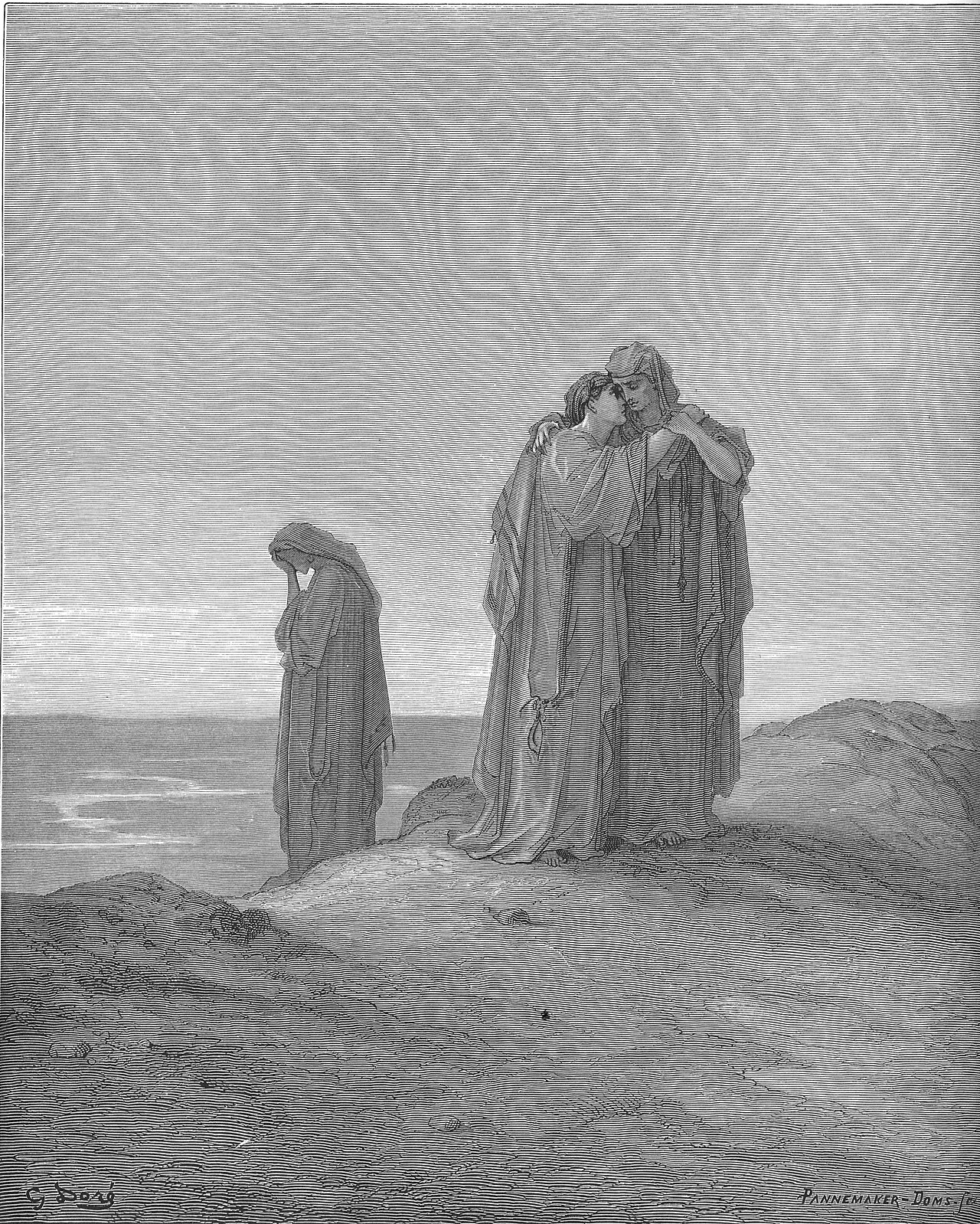
in Ruth 1Again they wept aloud, and Orpah kissed her mother-in-law goodbye, but Ruth clung to her.
BSB
The same verse in ASV and KJV ▾
ASV
And they lifted up their voice, and wept again: and Orpah kissed her mother-in-law, but Ruth clave unto her.
KJV
And they lifted up their voice, and wept again: and Orpah kissed her mother in law; but Ruth clave unto her.
⋯
This verse in Ruth 1
Commentary
6 notes on this verseAnd Orpah kissed her mother-in-law - The Septuagint add, Και επεστρεψεν εις τον λαον αυτης, And returned to her own people. The Vulgate, Syrian, and Arabic, are to the same purpose.
This site's exposition
they lifted up their voice, and wept again
on Ruth 1:14-15
Orpah kissed and Ruth clave, and the verb behind clave is the one Genesis 2:24 uses of a man cleaving to his wife. Orpah does nothing wrong: she does what Naomi told her twice to do, and the text never blames her. Naomi's last argument names what is actually at stake, thy sister in law is gone back unto her people, and unto her gods, so the choice being put to Ruth is a choice of God before it is a choice of country.
The record, by era
The Church Fathers1 voice
Next pass with eager eyes to Ruth, who with one short book separates eras—the end of the period of the judges and the beginning of Samuel. It seems a short account, but it depicts the symbolism of the great conflict when the two sisters separate …
The Puritans and the Awakening2 voices
And they lifted up their voice, and wept again,....
Thus many have a value and affection for Christ, and yet come short of salvation by him, because they cannot find in their hearts to forsake other things for him. They love him and yet leave him, because they do not love him enough, but love other things better. Thus the young man that went away from Christ went away sorrowful, Matt. xix.
The Nineteenth Century1 voice
A commentator
Albert Barnes1798–1870
Notes, Explanatory and Practical, on the Old and New Testaments (1832-1869)
proposed
The kiss at parting as well as at meeting is the customary friendly and respectful salutation in the East. The difference between mere kindness of manner and self-sacrificing love is most vividly depicted in the words and conduct of the two women. Ruth’s determination is stedfast to cast in her lot with the people of the Lord (compare the marginal references and Mat 15:22-28).
How the passage was read
What the Jewish commentators add
On the verses either side of this one
Would you wait for them. This is a question posed in wonder, “Would you perhaps wait for them until they grew up?” 17 The feminine form of them [להן] is used, because Naomi was hinting that perhaps she would bear daughters instead of sons, so why wait for “them”?
1 more on this passage, in their own words ▾
See, your sister-in-law has gone back. In this [word], the accent is at the beginning [on the first syllable] under the shin, because it is in the past tense. [But,] “and in the morning she would return,” 22 Megillas Esther:14.
This section is reception history: how the passage was read and kept in the Jewish tradition. Where a reading parts from an essential of the Christian faith, the section says so at that point.
Texts and citation data: Sefaria; each excerpt follows its version’s licence. 4 further sources are cited on this chapter that carry no English text this site may quote or only restate the verse.
The words behind it
10 Hebrew wordsEvery Hebrew word of this verse in the order it stands, with what it means and the door to its own study. The last column counts the times a word stands in the whole Bible: the rarer the word, the more the places it appears belong together.
| Hebrew | Sound | Meaning | Word study | In the Bible |
|---|---|---|---|---|
| וַתִּשֶּׂ֣נָה | vatisenah | and they raised | H5375 → | 656 times |
| קוֹלָ֔ן | kolan | voice their | H6963 → | |
| וַתִּבְכֶּ֖ינָה | vativkeinah | and they wept | H1058 → | |
| ע֑וֹד | od | again | H5750 → | |
| וַתִּשַּׁ֤ק | vatishak | and she kissed | H5401 → | |
| עָרְפָּה֙ | ʾarepah | Orpah | H6204 → | |
| לַחֲמוֹתָ֔הּ | lachamotah | <to> mother-in-law her | H2545 → | 11 times |
| וְר֖וּת | verut | and Ruth | H7327 → | 12 times |
| דָּ֥בְקָה | davekah | she clung | H1692 → | 54 times |
| בָּֽהּ׃ | bah | to her |
וַתִּשֶּׂ֣נָהand they raised
vatisenahH5375 →656 times
קוֹלָ֔ןvoice their
kolanH6963 →
וַתִּבְכֶּ֖ינָהand they wept
vativkeinahH1058 →
ע֑וֹדagain
odH5750 →
וַתִּשַּׁ֤קand she kissed
vatishakH5401 →
עָרְפָּה֙Orpah
ʾarepahH6204 →
לַחֲמוֹתָ֔הּ<to> mother-in-law her
lachamotahH2545 →11 times
וְר֖וּתand Ruth
verutH7327 →12 times
דָּ֥בְקָהshe clung
davekahH1692 →54 times
בָּֽהּ׃to her
bah
A shaded row is a word that stands 400 times or fewer in the Bible.
The walk
8 stopsEach card is a verse this one points to, and under it the verses that one points to in turn. Where several paths arrive at the same place, that place is listed first: the text keeps returning to it.
Through
Matthew 16:24Then Jesus told His disciples, “If anyone wants to come after Me, he must deny himself and take up his cross and follow Me.
it leads to
- Matthew 10:38
and anyone who does not take up his cross and follow Me is not worthy of Me.
- Luke 14:27
And whoever does not carry his cross and follow Me cannot be My disciple.
- 1 Peter 4:1–2
Therefore, since Christ suffered in His body, arm yourselves with the same resolve, because anyone who has suffered in his body is done with sin.
- Luke 9:23–27
Then Jesus said to all of them, “If anyone wants to come after Me, he must deny himself and take up his cross daily and follow Me.
- Mark 10:21
Jesus looked at him, loved him, and said to him, “There is one thing you lack: Go, sell everything you own and give to the poor, and you will have treasure in heaven. Then…
- Matthew 10:38
Through
Proverbs 18:24A man of many companions may come to ruin, but there is a friend who stays closer than a brother.
it leads to
- Proverbs 17:17
A friend loves at all times, and a brother is born for adversity.
- John 15:13–15
Greater love has no one than this, that he lay down his life for his friends.
- Proverbs 17:17
Through
Matthew 10:37Anyone who loves his father or mother more than Me is not worthy of Me; anyone who loves his son or daughter more than Me is not worthy of Me;
it leads to
- Luke 14:26
“If anyone comes to Me and does not hate his father and mother and wife and children and brothers and sisters—yes, even his own life—he cannot be My disciple.
- Luke 14:26
Where this verse is studied
On this page
Studies3
On this verse
On this chapter
About Ruth
Who and where
1 name in this verse with a page on the site.
This page draws on Adam Clarke, Commentary on the Bible; Albert Barnes, Notes, Explanatory and Practical, on the Old and New Testaments (1832-1869); John Gill, Exposition of the Old Testament (1748-1763); Keil and Delitzsch, Biblical Commentary on the Old Testament: Joshua, Judges, Ruth; Matthew Henry, Commentary on the Whole Bible and Paulinus of Nola, POEMS 27.511.