
2 Samuel 12:17
in 2 Samuel 12The elders of his household stood beside him to help him up from the ground, but he was unwilling and would not eat anything with them.
BSB
The same verse in ASV and KJV ▾
ASV
And the elders of his house arose, and stood beside him, to raise him up from the earth: but he would not, neither did he eat bread with them.
KJV
And the elders of his house arose, and went to him, to raise him up from the earth: but he would not, neither did he eat bread with them.
⋯
This verse in 2 Samuel 12
Commentary
6 notes on this verseElders - The chief officers of his kingdom and household. He would not - This excessive mourning did not proceed simply from the fear of the loss of the child; but from a deep sense of his sin, and the divine displeasure manifested herein.
This site's exposition
the Lord struck the child
on 2 Samuel 12:15-17
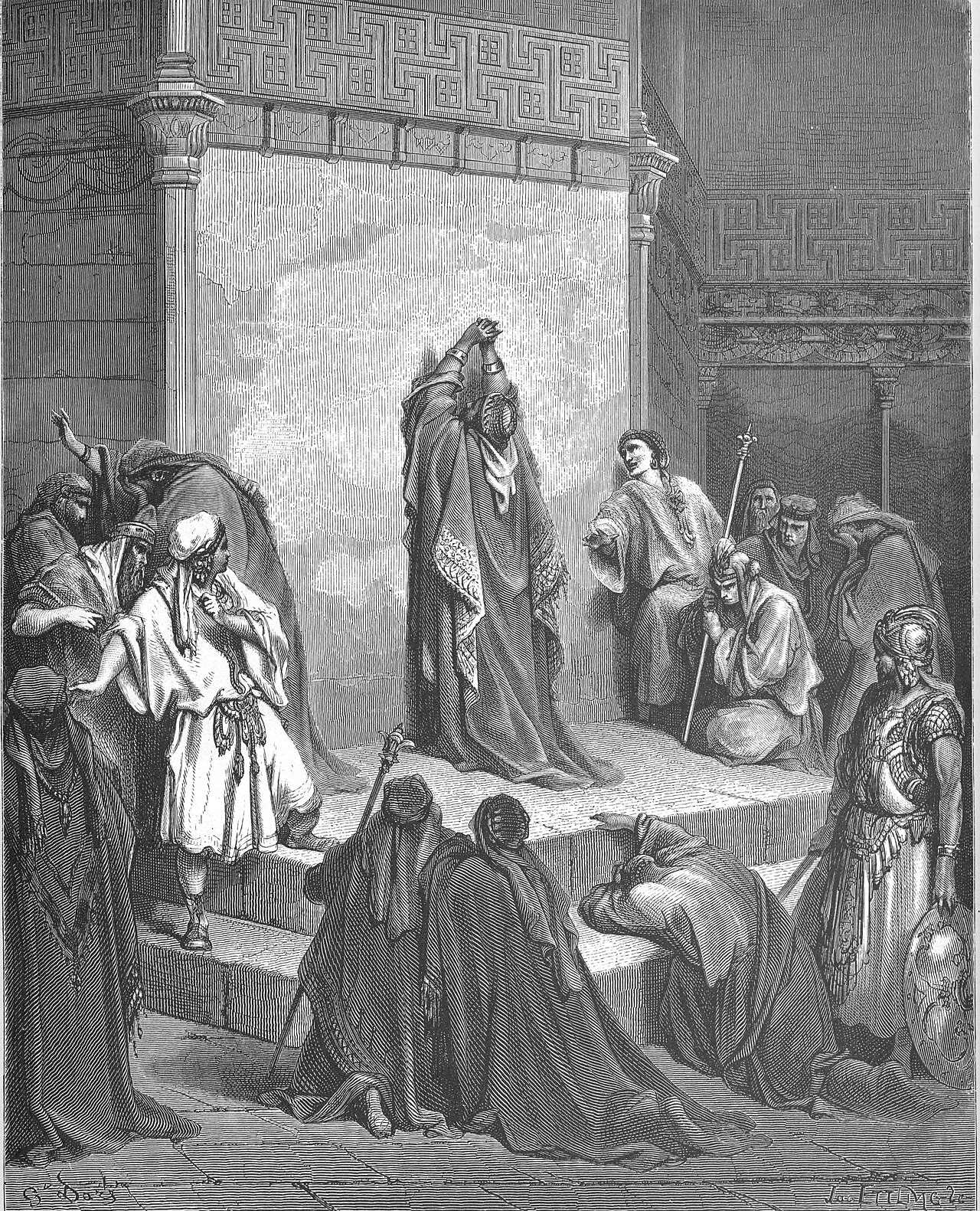
The Lord struck the child in the next clause after Nathan departs, and the sickness that follows is the sentence of verse fourteen already at work. David fasts, lies all night on the earth, and refuses to be raised up by the elders of his own house, a mourning so total that his own household cannot reach him. John Wesley reads the intensity as proof the king was not grieving a possible loss so much as carrying the weight of his own sin before the God who had just named it. The scene stands beside the parable's ewe lamb that lay in the poor man's bosom, another life bound up in a father's love and now under sentence.
This site's exposition
The elders of his household stood beside him
John Wesley identifies the elders as the chief officers of the kingdom and the household. John Gill notes that these princes of the court usually sat at the king's table. That evening David refused to eat with them.
The record, by era
The Church Fathers1 voice
How particularly difficult it is to atone for the evil deed of handing over the name of the Lord to the blasphemy of the heathen, we are instructed by the example of the most blessed David who, because of the intercession of his acts of …
The Puritans and the Awakening2 voices
Nathan had told him that certainly the child should die; yet, while it is in the reach of prayer, he earnestly intercedes with God for it, chiefly (as we may suppose) that its soul might be safe and happy in another world, and that his sin might not come against the child, and that it might not fare the worse for that in the future state.
And the elders of his house arose, and went to him, to raise him up from the earth,.... To persuade him to rise up, and sit upon a seat, and go to bed, after having taken some food; these were some of the chief officers at court, and had the management of the affairs of his household: but he would not; they could not persuade him to it: neither did he eat bread with them; that evening, as he had used to do; they being the princes of his court, who were wont to sit at table with him.
How the passage was read
What the Jewish commentators add
On the verses either side of this one
And came to repose and lied on the ground. And came [back] to the house and reposed at night lying on the ground.
This section is reception history: how the passage was read and kept in the Jewish tradition. Where a reading parts from an essential of the Christian faith, the section says so at that point.
Texts and citation data: Sefaria; each excerpt follows its version’s licence. 6 further sources are cited on this chapter that carry no English text this site may quote or only restate the verse.
The words behind it
13 Hebrew wordsEvery Hebrew word of this verse in the order it stands, with what it means and the door to its own study. The last column counts the times a word stands in the whole Bible: the rarer the word, the more the places it appears belong together.
| Hebrew | Sound | Meaning | Word study | In the Bible |
|---|---|---|---|---|
| וַיָּקֻ֜מוּ | vaiyakumu | and they stood | H6965 → | 628 times |
| זִקְנֵ֤י | ziknei | [the] elders of | H2205 → | 178 times |
| בֵיתוֹ֙ | veito | house his | H1004 → | 2046 times |
| עָלָ֔יו | ʾalav | with him | H5921 → | 5755 times |
| לַהֲקִימ֖וֹ | lahakimo | to raise him | H6965 → | 628 times |
| מִן־ | min- | from | H4480 → | 1188 times |
| הָאָ֑רֶץ | haaretz | the ground | H776 → | 2504 times |
| וְלֹ֣א | velo' | and not | H3808 → | 5168 times |
| אָבָ֔ה | ʾavah | he was willing | H14 → | 54 times |
| וְלֹֽא־ | velo'- | and not | H3808 → | 5168 times |
| בָרָ֥א | vara' | he ate | H1254 → | |
| אִתָּ֖ם | ʾitam | with them | H854 → | 929 times |
| לָֽחֶם׃ | lachem | food | H3899 → | 298 times |
וַיָּקֻ֜מוּand they stood
vaiyakumuH6965 →628 times
זִקְנֵ֤י[the] elders of
zikneiH2205 →178 times
בֵיתוֹ֙house his
veitoH1004 →2046 times
עָלָ֔יוwith him
ʾalavH5921 →5755 times
לַהֲקִימ֖וֹto raise him
lahakimoH6965 →628 times
מִן־from
min-H4480 →1188 times
הָאָ֑רֶץthe ground
haaretzH776 →2504 times
וְלֹ֣אand not
velo'H3808 →5168 times
אָבָ֔הhe was willing
ʾavahH14 →54 times
וְלֹֽא־and not
velo'-H3808 →5168 times
בָרָ֥אhe ate
vara'H1254 →
אִתָּ֖םwith them
ʾitamH854 →929 times
לָֽחֶם׃food
lachemH3899 →298 times
A shaded row is a word that stands 400 times or fewer in the Bible.
The walk
8 stopsEach card is a verse this one points to, and under it the verses that one points to in turn. Where several paths arrive at the same place, that place is listed first: the text keeps returning to it.
Through
2 Samuel 3:35Then all the people came and urged David to eat something while it was still day, but David took an oath, saying, “May God punish me, and ever so severely, if I taste bread…
it leads to
- 2 Samuel 1:12
They mourned and wept and fasted until evening for Saul and his son Jonathan, and for the people of the LORD and the house of Israel, because they had fallen by the sword.
- Jeremiah 16:7
No food will be offered to comfort those who mourn the dead; not even a cup of consolation will be given for the loss of a father or mother.
- Ruth 1:17
Where you die, I will die, and there I will be buried. May the LORD punish me, and ever so severely, if anything but death separates you and me.”
- Ezekiel 24:17
Groan quietly; do not mourn for the dead. Put on your turban and strap your sandals on your feet; do not cover your lips or eat the bread of mourners.”
- Judges 20:26
Then the Israelites, all the people, went up to Bethel, where they sat weeping before the LORD. That day they fasted until evening and presented burnt offerings and peace offerings to the LORD.
- 2 Samuel 1:12
Through
1 Samuel 28:23Saul refused, saying, “I will not eat.” But his servants joined the woman in urging him, and he heeded their voice. He got up from the ground and sat on the bed.
it leads to
- 1 Kings 21:4
So Ahab went to his palace, sullen and angry because Naboth the Jezreelite had told him, “I will not give you the inheritance of my fathers.” He lay down on his bed, turned his…
- 2 Kings 4:8
One day Elisha went to Shunem, and a prominent woman who lived there persuaded him to have a meal. So whenever he would pass by, he would stop there to eat.
- Proverbs 25:20
Like one who removes a garment on a cold day or vinegar poured on a wound is one who sings songs to a heavy heart.
- 1 Kings 21:4
Where this verse is studied
About 2 Samuel
This page draws on John Gill, Exposition of the Old Testament; John Gill, Exposition of the Old Testament (1748-1763); John Wesley, Explanatory Notes upon the Old Testament; Matthew Henry, Commentary on the Whole Bible and Salvian the Presbyter, THE GOVERNANCE OF GOD 4.18.