
2 Samuel 12:16
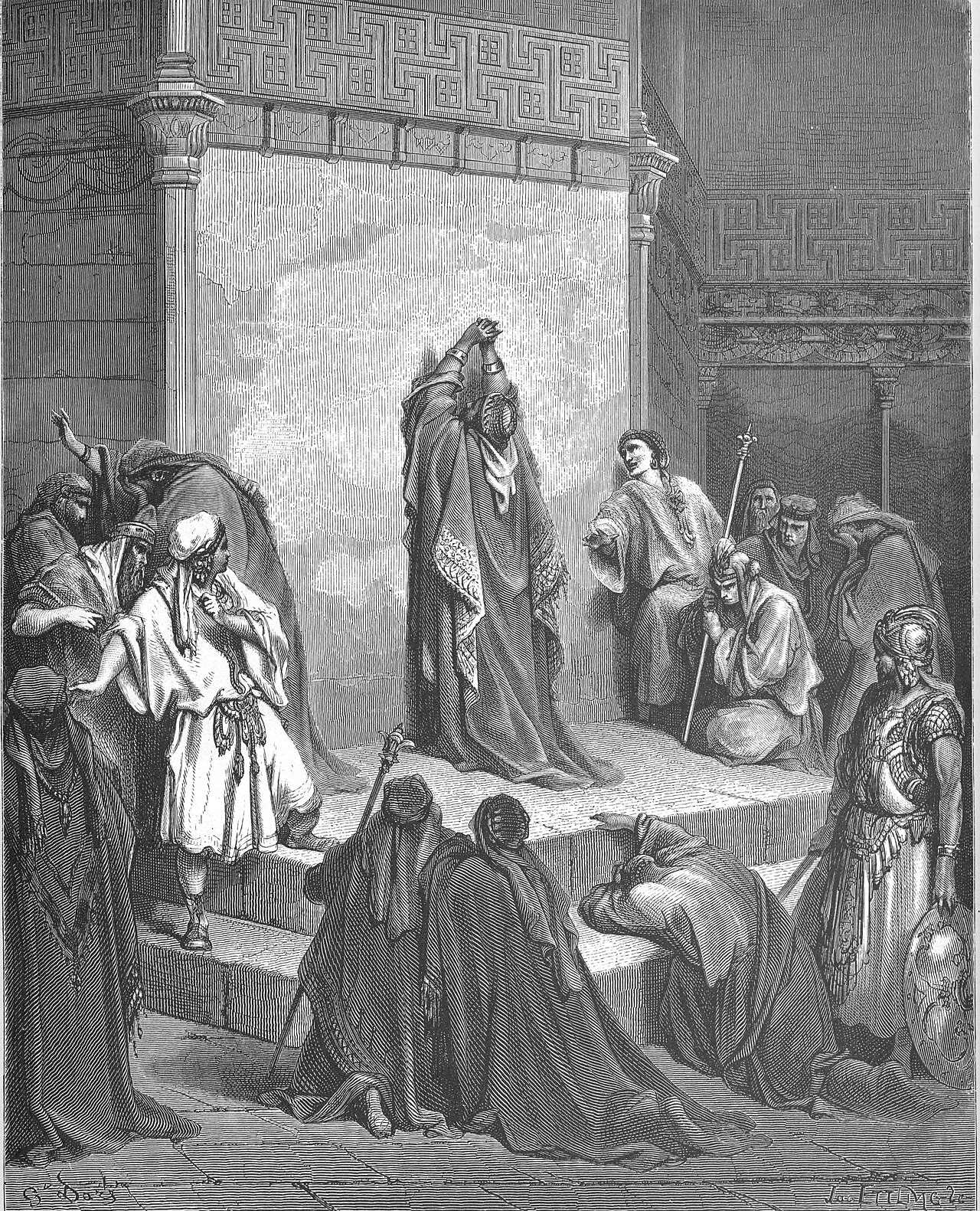
in 2 Samuel 12David pleaded with God for the boy. He fasted and went into his house and spent the night lying in sackcloth on the ground.
BSB
The same verse in ASV and KJV ▾
ASV
David therefore besought God for the child; and David fasted, and went in, and lay all night upon the earth.
KJV
David therefore besought God for the child; and David fasted, and went in, and lay all night upon the earth.
⋯
This verse in 2 Samuel 12
Commentary
8 notes on this verseDavid - besought God for the child - How could he do so, after the solemn assurance that he had from God that the child should die? The justice of God absolutely required that the penalty of the law should be exacted; either the father or the son shall die. This could not be reversed.
This site's exposition
the Lord struck the child
on 2 Samuel 12:15-17
The Lord struck the child in the next clause after Nathan departs, and the sickness that follows is the sentence of verse fourteen already at work. David fasts, lies all night on the earth, and refuses to be raised up by the elders of his own house, a mourning so total that his own household cannot reach him. John Wesley reads the intensity as proof the king was not grieving a possible loss so much as carrying the weight of his own sin before the God who had just named it. The scene stands beside the parable's ewe lamb that lay in the poor man's bosom, another life bound up in a father's love and now under sentence.
This site's exposition
David pleaded with God for the boy
Albert Barnes notes that the death of an infant in a royal harem usually weighed little on an Eastern king. David's grief marks his tender nature and his love for Bathsheba. Barnes reads the ground as the floor of his private chamber.
The record, by era
The Church Fathers2 voices
How particularly difficult it is to atone for the evil deed of handing over the name of the Lord to the blasphemy of the heathen, we are instructed by the example of the most blessed David who, because of the intercession of his acts of …
And I say not this to overturn fasting, (God forbid!) but to exhort you that with fasting ye do that which is better than fasting, the abstaining from all evil. David also sinned. Let us see then how he too repented. Three days he sat on ashes. But this he did not for the sin's sake, but for the child's, being as yet stupefied with that affliction. But the sin by other means did he wipe away, by humbleness, contrition of heart, compunction of soul, by falling into the like no more, by remembering it always, by bearing thankfully every thing that befalls him, by sparing those that grieve him, by forbearing to requite those who conspire against him; yea, even preventing those who desire to do this. For instance, when Shimei was bespattering him with reproaches without number and the captain who was with him was greatly indignant, he said, "Let him curse me, for the Lord hath bidden him:" for he had a contrite and humbled heart, and it was this especially which wiped away his sins. For this is confession, this is repentance.
The Puritans and the Awakening2 voices
Nathan had told him that certainly the child should die; yet, while it is in the reach of prayer, he earnestly intercedes with God for it, chiefly (as we may suppose) that its soul might be safe and happy in another world, and that his sin might not come against the child, and that it might not fare the worse for that in the future state.
David therefore besought God for the child,....
The Nineteenth Century1 voice
A commentator
Albert Barnes1798–1870
Notes, Explanatory and Practical, on the Old and New Testaments (1832-1869)
proposed
The death of the infant child of one of the numerous harem of an Oriental monarch would in general be a matter of little moment to the father. The deep feeling shown by David on this occasion is both an indication of his affectionate and tender nature, and also a proof of the strength of his passion for Bath-sheba. He went into his most private chamber, his closet Mat 6:6, and “lay upon the earth” 2Sa 13:31, rather “the ground,” meaning the floor of his chamber as opposed to his couch.
How the passage was read
What the Jewish commentators add
And came to repose and lied on the ground. And came [back] to the house and reposed at night lying on the ground.
This section is reception history: how the passage was read and kept in the Jewish tradition. Where a reading parts from an essential of the Christian faith, the section says so at that point.
Texts and citation data: Sefaria; each excerpt follows its version’s licence. 6 further sources are cited on this chapter that carry no English text this site may quote or only restate the verse.
The words behind it
14 Hebrew wordsEvery Hebrew word of this verse in the order it stands, with what it means and the door to its own study. The last column counts the times a word stands in the whole Bible: the rarer the word, the more the places it appears belong together.
| Hebrew | Sound | Meaning | Word study | In the Bible |
|---|---|---|---|---|
| וַיְבַקֵּ֥שׁ | vayvakesh | and he sought | H1245 → | 225 times |
| דָּוִ֛ד | david | David | H1732 → | 999 times |
| אֶת־ | ʾet- | <obj.> | H853 → | 10935 times |
| הָאֱלֹהִ֖ים | haelohim | <the> God | H430 → | 2601 times |
| בְּעַ֣ד | bead | for | H1157 → | 105 times |
| הַנָּ֑עַר | hanaar | the lad | H5288 → | 239 times |
| וַיָּ֤צָם | vaiyatzom | and he fasted | H6684 → | 21 times |
| דָּוִד֙ | david | David | H1732 → | 999 times |
| צ֔וֹם | tzom | a fast | H6685 → | |
| וּבָ֥א | uva' | and he went | H935 → | 2568 times |
| וְלָ֖ן | velan | and he passed [the] night | H3885 → | 84 times |
| וְשָׁכַ֥ב | veshakhav | and he lay | H7901 → | 212 times |
| אָֽרְצָה׃ | ʾaretzah | [the] ground towards | H776 → | 2504 times |
| בַּשָּׂק | basak | in the sackcloth | H8242 → | 49 times |
וַיְבַקֵּ֥שׁand he sought
vayvakeshH1245 →225 times
דָּוִ֛דDavid
davidH1732 →999 times
אֶת־<obj.>
ʾet-H853 →10935 times
הָאֱלֹהִ֖ים<the> God
haelohimH430 →2601 times
בְּעַ֣דfor
beadH1157 →105 times
הַנָּ֑עַרthe lad
hanaarH5288 →239 times
וַיָּ֤צָםand he fasted
vaiyatzomH6684 →21 times
דָּוִד֙David
davidH1732 →999 times
צ֔וֹםa fast
tzomH6685 →
וּבָ֥אand he went
uva'H935 →2568 times
וְלָ֖ןand he passed [the] night
velanH3885 →84 times
וְשָׁכַ֥בand he lay
veshakhavH7901 →212 times
אָֽרְצָה׃[the] ground towards
ʾaretzahH776 →2504 times
בַּשָּׂקin the sackcloth
basakH8242 →49 times
A shaded row is a word that stands 400 times or fewer in the Bible.
The walk
8 stopsEach card is a verse this one points to, and under it the verses that one points to in turn. Where several paths arrive at the same place, that place is listed first: the text keeps returning to it.
Through
Psalms 50:15Call upon Me in the day of trouble; I will deliver you, and you will honor Me.”
it leads to
- Psalms 107:28
Then they cried out to the LORD in their trouble, and He brought them out of their distress.
- Psalms 91:15
When he calls out to Me, I will answer him; I will be with him in trouble. I will deliver him and honor him.
- Psalms 34:3–4
Magnify the LORD with me; let us exalt His name together.
- Zechariah 13:9
This third I will bring through the fire; I will refine them like silver and test them like gold. They will call on My name, and I will answer them. I will say, ‘They…
- Psalms 107:19
Then they cried out to the LORD in their trouble, and He saved them from their distress.
- Psalms 107:28
Through
Esther 4:16“Go and assemble all the Jews who can be found in Susa, and fast for me. Do not eat or drink for three days, night or day, and I and my maidens will fast…
it leads to
- Acts 20:24
But I consider my life of no value to me, if only I may finish my course and complete the ministry I have received from the Lord Jesus—the ministry of testifying to the good…
- 2 Chronicles 20:3
Jehoshaphat was alarmed and set his face to seek the LORD. And he proclaimed a fast throughout Judah.
- Joel 2:12–17
“Yet even now,” declares the LORD, “return to Me with all your heart, with fasting, weeping, and mourning.”
- Acts 20:24
Where this verse is studied
About 2 Samuel
Who and where
1 name in this verse with a page on the site.
This page draws on 9 works. Open the list of works
This page draws on Adam Clarke, Commentary on the Bible; Albert Barnes, Notes, Explanatory and Practical, on the Old and New Testaments; Albert Barnes, Notes, Explanatory and Practical, on the Old and New Testaments (1832-1869); John Chrysostom, HOMILIES ON 2 CORINTHIANS 4.6; John Gill, Exposition of the Old Testament; John Gill, Exposition of the Old Testament (1748-1763); John Wesley, Explanatory Notes upon the Old Testament; Matthew Henry, Commentary on the Whole Bible and Salvian the Presbyter, THE GOVERNANCE OF GOD 4.18.