
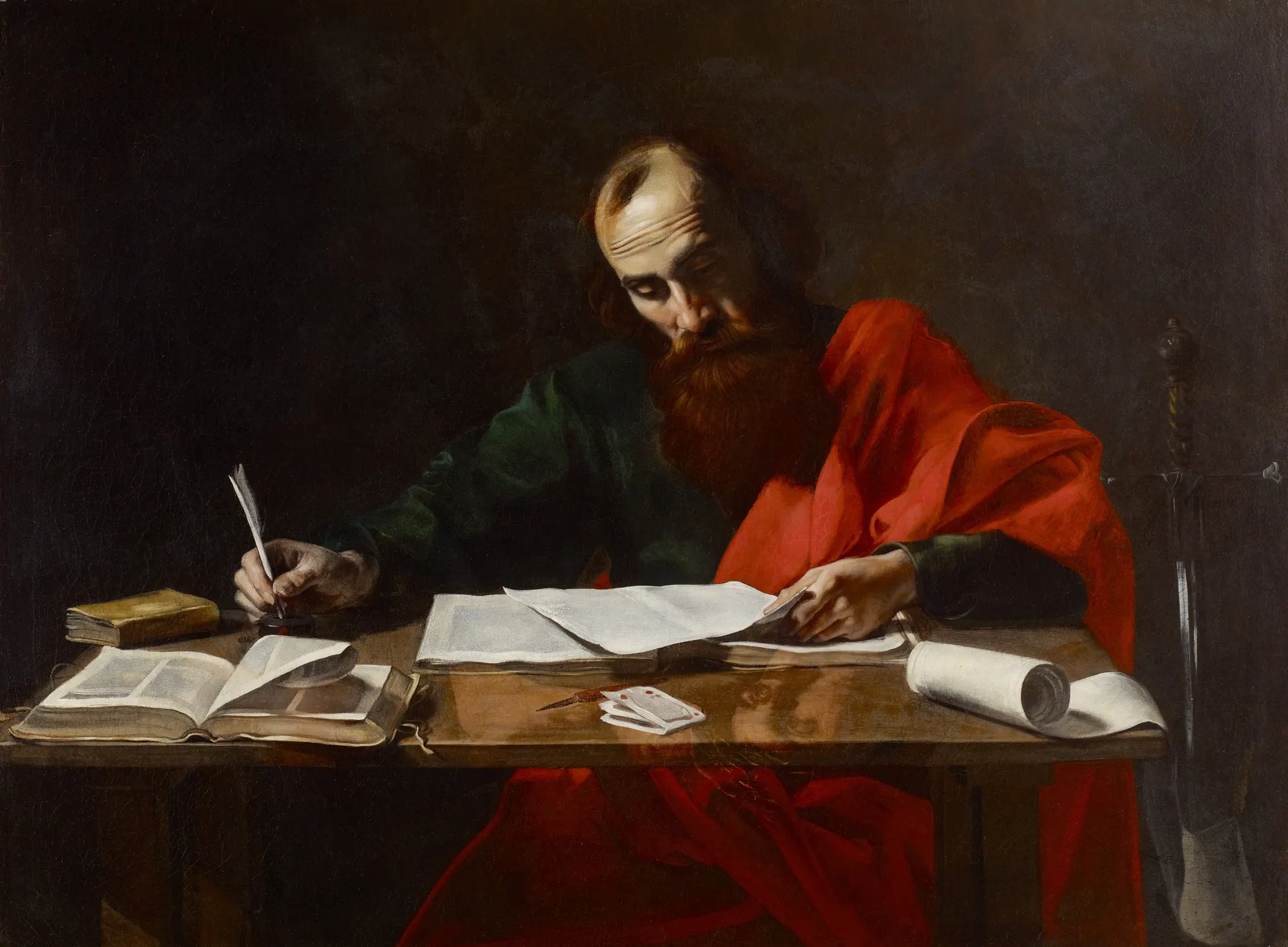
Romanschapter 16
27 verses · Paul · AD 56 or 57 · Paul's letters
The God of peace will soon crush Satan under your feet. The grace of our Lord Jesus Christ be with you.
Introduction
Paul, Paul's letters, Romans Overview.
This chapter is the last page of the letter, written at Corinth and carried to Rome by a woman from the harbor town nearby. It reads like the close of any letter between friends, and it is easy to hurry past. Slow down for the people. Listen for who is praised and for what, for the households named, and for the women whose work is counted. Listen too for one sharp warning set among the greetings. Then hear the long sentence of praise that ends the whole letter. The gospel reached Rome through people like these.
Context
- Who
- The specific people who made up the Roman churches, named, one by one.
- What
- The close of the letter, with a commendation of Phoebe, greetings to the believers at Rome by name, a warning against those who divide, greetings from Paul's companions and a closing doxology.
- Where
- Written at Corinth, where Gaius was Paul's host, and carried to Rome from Cenchrea, the harbor east of the city.
- When
- About AD 57 on the usual dating, during the three months Paul spent in Greece before carrying the collection to Jerusalem, a date probable to within a year or two.
- Why
- To introduce the woman carrying the letter, to bind Paul to a church he had not yet visited through the people they both knew, and to guard that church against division.
Historical context
Phoebe is commended first because she is carrying the letter. There was no postal service for private mail; letters travelled with someone going that way, and the carrier normally read it aloud to the recipients and answered questions about it. Paul calls her a servant of the church at Cenchreae, Corinth's eastern harbour, and a patron of many, a woman of standing whose money and household supported the work.
Show the rest of the historical context, 3 more paragraphs
Tertius names himself in one verse as the man writing the letter down. Long letters were dictated to a trained secretary, an amanuensis, who took them in shorthand and produced a fair copy. Papyrus, ink, and a professional's time made a letter this long an expensive object.
The names themselves are a social map. Many are typical slave and freedman names, several belong to households rather than individuals, and Paul greets those "of the household of Aristobulus" and "of Narcissus", meaning the slaves and dependants of a great house, not its owner. Prisca and Aquila are back in Rome after their exile, hosting a church in their home.
There was no church building anywhere in the world yet. These greetings sketch several separate congregations meeting in apartments and workshops across a city of perhaps a million people.
Significance
For the first hearers, this list was the letter's proof that its grand argument came down to actual people, women who worked hard in the Lord, relatives who had been in prison with Paul, a man whose mother had been a mother to him too.
Show the rest of the significance, 1 more paragraph
The one warning in the chapter fits that intimacy. Watch out for those who cause divisions by smooth talk and flattery, and avoid them. In small house churches, a persuasive newcomer could do enormous damage.
The heads below are this chapter's scenes. The numbered points under each are its verses.
Greet Phoebe, Prisca, and the Whole Roman Household
Romans 16:1-2
a servant of the church in Cenchrea: Paul commends Phoebe to the Roman church as a great help to many, Paul included. The word behind servant is diakonos, the term used for the office of deacon at Philippians 1:1 and 1 Timothy 3:8.
Romans 16:1
“I commend unto you Phebe our sister,.... This chapter chiefly consists of commendations and salutations of persons, and begins with the former. It was usual to give letters of commendation of a member of one church to those of another; see 2Co 3:1; The person who is here recommended was, as appears from the subscription of this epistle, if that may be depended on, the bearer of this letter, and is described by her name, Phebe; as she dwelt at Cenchrea, it is probable she was a Grecian, as is her name.”
3 more voices on this verseWhat preachers and commentators have said about this verse, in their own words.
Romans 16:1
“I commend - It was common then, as now, to bear letters of introduction to strangers, commending the person thus introduced to the favorable regards and attentions of those to whom the letters were addressed; 2Co 3:1; Act 18:27. This Epistle, with the apostle’s commendation, was designed thus to introduce its bearer to the Roman Christians. The mention of Phebe in this manner leaves it beyond a doubt that she was either the bearer of this Epistle, or accompanied those who bore it to Rome. The Epistle was therefore written, probably, at Corinth. (See Introduction.)”
Romans 16:1
“A servant - The Greek word is a deaconness. Of the church in Cenchrea - In the apostolic age, some grave and pious women were appointed deaconnesses in every church. It was their office, not to teach publicly, but to visit the sick, the women in particular, and to minister to them both in their temporal and spiritual necessities.”
John Wesley · Explanatory Notes upon the New Testament (1755)evangelical
Romans 16:1
“He gives a very good character of her. (1.) As a sister to Paul: Phebe our sister; not in nature, but in grace; not in affinity or consanguinity, but in pure Christianity: his own sister in the faith of Christ, loving Paul, and beloved of him, with a pure and chaste and spiritual love, as a sister; for there is neither male nor female, but all are one in Christ Jesus, Gal. iii.”
Matthew Henry · Commentary on the Whole Bible (1707-1721)puritan
she has been a great help to many people: Great help renders prostatis, a patron who took up the cause of others, as Barnes defines it. Theodoret thinks Phoebe welcomed Paul into her house at Corinth, and Clarke that she received the workers of the church who came to Cenchrea. Theophylact holds that she carried this letter.
Romans 16:2
“Succourer of many - One who probably entertained the apostles and preachers who came to minister at Cenchrea, and who was remarkable for entertaining strangers. See on Rom 12:8 (note).”
Adam Clarke · Commentary on the Bible (1810-1826)evangelical
Romans 16:3-5
Greet Prisca and Aquila: Prisca and Aquila head the list, and Acts 18 has them as tentmakers who left Italy when Claudius ordered the Jews out of Rome. They worked with Paul at Corinth and taught Apollos at Ephesus. They risked their lives, and a church met in their house.
Romans 16:3
“Greet Priscilla and Aquila - Salute; implying the apostle’s kind remembrance of them, and his wishes for their welfare. Priscilla - Priscilla was the wife of Aquila. They are mentioned in Act 18:2, Act 18:26; 1Co 16:19. Paul at first found them at Corinth. Aquila was a Jew, born in Pontus, who had resided at Rome, and who had left Rome, and come to Corinth, when Claudius expelled the Jews from Rome; see the notes at Act 18:2. It is probable that they were converted under the preaching of Paul.”
3 more voices on this verse
Romans 16:3
“It is a singular honor which he ascribes here to Prisca and Aquila, especially with regard to a woman. The modesty of the holy man does on this account more clearly shine forth; for he disdained not to have a woman as his associate in the work of the Lord; nor was he ashamed to confess this. She was the wife of Aquila, and Luke calls her Priscilla.”
John Calvin · Commentaries (1554)reformed
Romans 16:3
“He calls them his helpers in Christ Jesus, by private instructions and converse furthering the success of Paul's public preaching, one instance of which we have in their instructing Apollos, Acts xviii. Those are helpers to faithful ministers that lay out themselves in their families and among their neighbours to do good to souls.”
Matthew Henry · Commentary on the Whole Bible (1707-1721)puritan
Romans 16:3
“Salute Priscilla--The true reading here is "Prisca" (as in 2Ti 4:19), a contracted form of Priscilla, as "Silas" of "Silvanus." and Aquila my helpers--The wife is here named before the husband (as in Ac 18:18, and Ro 16:26, according to the true reading; also in 2Ti 4:19), probably as being the more prominent and helpful to the Church.”
Jamieson, Fausset & Brown · Commentary Critical and Explanatory on the Whole Bible (1871)reformed
who have risked their lives for me: Clarke says the event behind risked their lives is unknown. Jamieson, Fausset and Brown place it at Corinth or, more likely, at Ephesus. Calvin reads all the churches of the Gentiles as grateful for the life of their apostle.
Romans 16:4
“Who have for my life laid down their own necks - What transaction this refers to we know not; but it appears that these persons had, on some occasion, hazarded their own lives to save that of the apostle; and that the fact was known to all the Churches of God in that quarter, who felt themselves under the highest obligations to these pious persons, for the important service which they had thus rendered.”
Adam Clarke · Commentary on the Bible (1810-1826)evangelical
the church that meets at their house: Clarke notes that no church buildings yet existed, so the church in the house was the gathered believers. Chrysostom read Epenetus as the first convert of Achaia, and Clarke and Jamieson, Fausset and Brown hold that the manuscripts favour the province of Asia. The Berean text reads Asia.
Romans 16:5
“Salute my well beloved Epænetus, who is the first-fruits--that is, the first convert of Achaia unto Christ--The true reading here, as appears by the manuscripts, is, "the first-fruits of Asia unto Christ"--that is, Proconsular Asia (see Ac 16:6).”
Jamieson, Fausset & Brown · Commentary Critical and Explanatory on the Whole Bible (1871)reformed
3 more voices on this verse
Romans 16:5
“Perhaps there was a congregation of Christians that used to meet at their house at stated times; and then, no doubt, it was, like the house of Obed-Edom, blessed for the ark's sake. Others think that the church was no more than a religious, pious, well-governed family, that kept up the worship of God.”
Matthew Henry · Commentary on the Whole Bible (1707-1721)puritan
Romans 16:5
“Who is the first-fruit, etc. This is an allusion to the rites of the law; for as men are sanctified to God by faith, they who first offer themselves are fitly called the first-fruit. Whosoever then is called first in time to the faith, Paul allows him the prerogative of honor: yet he retains this eminence only when the end corresponds with the beginning.”
John Calvin · Commentaries (1554)reformed
Romans 16:5
“The church that is in their house - Aquila and Priscilla are mentioned Act 18:26 as having received “Apollos” into their family, to instruct him more perfectly. The church in their house is also mentioned 1Co 16:19. This may mean either the church that was accustomed to assemble for worship at their hospitable mansion; or it may mean their own family with their guests, regarded as a “church.” In those times Christians had no houses erected for public worship, and were therefore compelled to meet in their private dwellings.”
Romans 16:6-7
who has worked very hard for you: Mary is greeted for hard work done for the Roman church. Andronicus and Junia were Paul's countrymen and fellow prisoners, in Christ before he was. Junia is a woman's name, and Chrysostom called her worthy of the title apostle, here in its wider sense, a messenger sent out.
Romans 16:6
“Greet Mary, who bestowed much labor on us - Who this Mary was, or what the labor was which she bestowed upon the apostles, we know not. Her works, though hidden from man, are with God; and her name is recorded with honor in this book of life.”
Adam Clarke · Commentary on the Bible (1810-1826)evangelical
1 more voice on this verse
Romans 16:6
“Greet Mary, who has labored much among you. In this too he teaches that women also ought to labor for the churches of God. For they labor when they teach young women to be sober, to love their husbands, to bring up children, to be modest, chaste, good managers of the household, kind, subject to their own husbands, to receive guests with hospitality, to wash the feet of the saints, and to carry out in all chastity everything else that is written concerning the duties of women.”
Origen of Alexandria · written before 253 · Commentary on the Epistle to the Romanspatristic
They are outstanding among the apostles: Outstanding among the apostles is read two ways. Chrysostom and Origen count the pair among the apostles, while Clarke reads it as well known to the apostles. Matthew Henry takes Andronicus and Junia as husband and wife, and Aquinas reads Junia as a man's name, Junias.
Romans 16:7
“Greet Andronicus and Junia, my kinsmen and my fellow captives, who are noble among the apostles, who also were in Christ before me. It may indeed be that these were kinsmen of Paul according to the flesh, and believed before him, and were held to be noble among the apostles of Christ; concerning whom it is also possible to understand this, that perhaps they were among those seventy-two who were themselves also named apostles, and that for this reason he calls them noble among the apostles, and among those apostles who were before him.”
Origen of Alexandria · written before 253 · Commentary on the Epistle to the Romanspatristic
2 more voices on this verse
Romans 16:7
“And of course, if "Junia" is to be taken for a woman, this latter must be the meaning. who also were in Christ before me--The apostle writes as if he envied them this priority in the faith. And, indeed, if to be "in Christ" be the most enviable human condition, the earlier the date of this blessed translation, the greater the grace of it.”
Jamieson, Fausset & Brown · Commentary Critical and Explanatory on the Whole Bible (1871)reformed
Romans 16:7
“My kinsmen - In Rom 9:3, the apostle calls “all” the Jews “his kinsmen,” and it has been doubted whether he means anything more here than that they were “fellow Jews.” But as many others who were Jews are mentioned here without this appellation, and as he especially designates these persons, and Herodian Rom 16:11, it seems probable that they were remote relatives of the apostle.”
Romans 16:8-11
Greet Ampliatus: Five believers are greeted by name, among them Apelles, who is approved in Christ. The word is dokimos, tested and found sound. Greetings also go to believers in the households of Aristobulus and Narcissus, so the gospel had reached inside great houses.
Romans 16:8
“Greet Ampliatus my beloved in the Lord. Although he seems to ascribe to this man nothing outstanding above the rest by way of praise, nevertheless by this very fact, that he is beloved of Paul, he is rendered praiseworthy and worthy of greeting.”
Origen of Alexandria · written before 253 · Commentary on the Epistle to the Romanspatristic
2 more voices on this verse
Romans 16:8
“Amplias--a contracted form of "Ampliatus." my beloved in the Lord--an expression of dear Christian affection. Urbane--rather, "Urbanus." It is a man's name. our helper--"fellow labourer" in Christ.”
Jamieson, Fausset & Brown · Commentary Critical and Explanatory on the Whole Bible (1871)reformed
Romans 16:8
“Where the law of love is in the heart the law of kindness will be in the tongue. Endearing language should pass among Christians to express love, and to engage love. So he calls Amplias, beloved in the Lord, with true Christian love for Christ's sake; and Stachys, his beloved: a sign that Paul had been in the third heaven, he was so much made up of love.”
Matthew Henry · Commentary on the Whole Bible (1707-1721)puritan
Greet Urbanus, our fellow worker in Christ: Origen and Theodoret rank the two titles, and fellow worker is the higher one, since Urbanus had shared the preaching and the struggles of Paul. Stachys is called beloved, as Ampliatus was in verse 8. Chrysostom reads the higher title as containing the lower.
Romans 16:9
“Greet Urbanus my helper in Christ, and Stachys my beloved. He joins Stachys in the greeting, but he set Urbanus ahead in praises. For he calls the one a helper in Christ; but Stachys he named only as beloved to himself, just as he did Ampliatus. Now a helper of the Apostle in Christ is understood as nothing other than a partaker in the apostolic work.”
Origen of Alexandria · written before 253 · Commentary on the Epistle to the Romanspatristic
1 more voice on this verse
Romans 16:9
“Urbane, our helper - Who this Urbanus was we know not; what is here stated is, that he had been a fellow laborer with the apostles. Stachys, my beloved - One of my particular friends.”
Adam Clarke · Commentary on the Bible (1810-1826)evangelical
Greet Apelles, who is approved in Christ: Origen ties approved to tested character, and takes Apelles as a man proven by hardship in Christ. Jamieson, Fausset and Brown gather that Aristobulus himself was no believer. The household of Aristobulus held believers in the Lord.
Romans 16:10
“Greet those who are of the household of Aristobulus. Since nothing is idly either added or diminished in the letters of the Apostle, these who are either of the house or of the family of Aristobulus he names not without purpose neither beloved, nor approved, nor helpers in Christ; but perhaps because they had nothing of the sort in their merits, therefore he honored them with the title of greeting alone.”
Origen of Alexandria · written before 253 · Commentary on the Epistle to the Romanspatristic
3 more voices on this verse
Romans 16:10
“Apelles, approved in Christ - A man who, on different occasions, had given the highest proofs of the sincerity and depth of his religion. Some suppose that Apelles was the same with Apollos: whoever he was, he had given every demonstration of being a genuine Christian. Of Aristobulus’ household - It is doubted whether this person was converted, as the apostle does not salute him, but his household; or as the margin reads, his friends. He might have been a Roman of considerable distinction, who, though not converted himself, had Christians among his servants or his slaves.”
Adam Clarke · Commentary on the Bible (1810-1826)evangelical
Romans 16:10
“Salute Apelles approved in Christ,.... Origen was in doubt whether this was not the same person with Apollos the Alexandrian Jew, whom Aquila and Priscilla met with at Ephesus; but had he been intended, the apostle would doubtless have said more of him, he being so eminent and remarkable a preacher of the Gospel; though indeed the character here given is very considerable; besides, Apollos did not live at Rome, though it was not impossible he might be there at this time.”
Romans 16:10
“Salute Apelles approved--"the approved" in Christ--or, as we should say, "that tried Christian"; a noble commendation. Salute them which are of Aristobulus' household--It would seem, from what is said of Narcissus in Ro 16:11, that this Aristobulus himself had not been a Christian; but that the Christians of his household simply were meant; very possibly some of his slaves.”
Jamieson, Fausset & Brown · Commentary Critical and Explanatory on the Whole Bible (1871)reformed
Greet Herodion, my fellow countryman: Gill notes that the name Herodion comes from Herod. Origen observes that he is called a countryman with none of the praise given Andronicus and Junia. Matthew Henry records the view that Narcissus was the wealthy man of that name under Claudius.
Romans 16:11
“Herodion, my kinsman - Probably another converted Jew. See on Rom 16:7 (note). Of the household of Narcissus - Probably dead also, as we have supposed Aristobulus to have been at this time. Which are in the Lord - This might intimate that some of this family were not Christians; those only of that family that were converted to the Lord being saluted.”
Adam Clarke · Commentary on the Bible (1810-1826)evangelical
3 more voices on this verse
Romans 16:11
“Greet Herodion my kinsman. This man too, similarly to Andronicus and Junias, is called a kinsman of Paul; but he is named neither a fellow-captive as they were, nor noble among the apostles, among those who were in Christ before Paul. From which it must be understood that even among these whom Paul calls his kinsmen there is much difference, according to that reasoning, as I judge, which we attempted to open up above.”
Origen of Alexandria · written before 253 · Commentary on the Epistle to the Romanspatristic
Romans 16:11
“Those of the family of Aristobulus and Narcissus, who are in the Lord - It seems only part of their families were converted. Probably, some of them were not known to St. Paul by face, but only by character. Faith does not create moroseness, but courtesy, which even the gravity of an apostle did not hinder.”
John Wesley · Explanatory Notes upon the New Testament (1755)evangelical
Romans 16:11
“Aristobulus and Narcissus themselves, some think, were absent, or lately dead; others think they were unbelievers, and such as did not themselves embrace Christianity; so Pareus: and some think this Narcissus was the same with one of that name who is frequently mentioned in the life of Claudius, as a very rich man that had a great family, but was very wicked and mischievous.”
Matthew Henry · Commentary on the Whole Bible (1707-1721)puritan
Romans 16:12-13
Greet Tryphena and Tryphosa: Tryphena, Tryphosa and Persis are commended for hard labor in the Lord. Rufus is called chosen in the Lord, and his mother had been a mother to Paul as well. Mark 15:21 names a Rufus as the son of Simon of Cyrene, a link that rests on the name.
Romans 16:12
“Tryphena and Tryphosa - Two holy women, who it seems were assistants to the apostle in his work, probably by exhorting, visiting the sick, etc. Persis was another woman, who it seems excelled the preceding; for, of her it is said, she labored much in the Lord. We learn from this, that Christian women, as well as men, labored in the ministry of the word. In those times of simplicity all persons, whether men or women, who had received the knowledge of the truth, believed it to be their duty to propagate it to the uttermost of their power.”
Adam Clarke · Commentary on the Bible (1810-1826)evangelical
3 more voices on this verse
Romans 16:12
Greet Persis most dear, who has labored much in the Lord. This woman seems to be praised more than Tryphaena and Tryphosa, since indeed he says that those labored in the Lord, but that this one labored much in the Lord, to whom he added also "most dear."
Origen of Alexandria · written before 253 · Commentary on the Epistle to the Romanspatristic
Romans 16:12
“Salute Tryphena and Tryphosa, who labour in the Lord,.... These two were women, and are said to be noble women of Iconium, whom the apostle converted there, and afterwards went to Rome the names are Greek (t), though they might be Jewish women, since Tryphon is the name of a man among the Jews. Trypho, the famous Jew, with whom Justin Martyr had his dialogue, is well known, and perhaps is the same with R.”
Romans 16:12
“Salute Tryphena and Tryphosa, who labour in the Lord--two active women. Salute the beloved Persis--another woman. which laboured much in the Lord--referring probably, not to official services, such as would fall to the deaconesses, but to such higher Christian labors--yet within the sphere competent to woman--as Priscilla bestowed on Apollos and others (Ac 18:18).”
Jamieson, Fausset & Brown · Commentary Critical and Explanatory on the Whole Bible (1871)reformed
Greet Rufus, chosen in the Lord: Chosen in the Lord is read two ways. Clarke takes it as a choice man, excellent among believers, and Matthew Henry as one whose life showed him chosen in Christ from eternity. Theodoret says the mother of Rufus had become the mother of Paul by grace.
Romans 16:13
“Greet Rufus, elect in the Lord, and his mother and mine. I do not think that in these greetings the difference of praise and of greeting through each single person is made emptily. For he who knows that Christ speaks in Paul is certain that according to merit one is indeed called by him approved, another most dear, another laboring in the Lord, another laboring much in the Lord, another elect, just as also this Rufus, of whom our discourse now is, is greeted as elect in the Lord.”
Origen of Alexandria · written before 253 · Commentary on the Epistle to the Romanspatristic
3 more voices on this verse
Romans 16:13
“In this case, supposing the elder of the two to have departed to be with Christ ere this letter was written, or to have been residing in some other place, and Rufus left alone with his mother, how instructive and beautiful is the testimony here borne to her! Salute Asyncritus, &c.--These have been thought to be the names of ten less notable Christians than those already named.”
Jamieson, Fausset & Brown · Commentary Critical and Explanatory on the Whole Bible (1871)reformed
Romans 16:13
“Salute Rufus - Perhaps the same that is mentioned, Mark xv, 21. And his mother and mine - This expression may only denote the tender care which Rufus's mother had taken of him.”
John Wesley · Explanatory Notes upon the New Testament (1755)evangelical
Romans 16:13
“He was a choice Christian, whose gifts and graces evinced that he was eternally chosen in Christ Jesus. He was one of a thousand for integrity and holiness.-- And his mother and mine, his mother by nature and mine by Christian love and spiritual affection; as he calls Phebe his sister, and teaches Timothy to treat the elder women as mothers, 1 Tim. v. 2 .”
Matthew Henry · Commentary on the Whole Bible (1707-1721)puritan
Romans 16:14-16
Greet Asyncritus, Phlegon, Hermes: Two clusters of names close the list, each carrying a group of believers with it, and both read like households that met together in Rome. The holy kiss is commanded as the greeting these believers give one another. All the churches of Christ send greetings with Paul.
Romans 16:14
“Hermas whom the apostle Paul mentions in writing to the Romans "Salute Phlegon, Hermes, Patrobas, Hermas and the brethren that are with them" is reputed to be the author of the book which is called Pastor and which is also read publicly in some churches of Greece. It is in fact a useful book and many of the ancient writers quote from it as authority, but among the Latins it is almost unknown.”
Jerome · written before 420 · De Viris Illustribus (On Illustrious Men), Section 10patristic
1 more voice on this verse
Romans 16:14
“It could not but encourage the poor especially, to be saluted by name, who perhaps did not know that the apostle bad ever heard of them. It is observable, that whilst the apostle forgets none who are worthy, yet he adjusts the nature of his salutation to the degrees of worth in those whom he salutes.”
John Wesley · Explanatory Notes upon the New Testament (1755)evangelical
Greet Philologus and Julia: Origen reads Philologus and Julia as a married couple, with the others their household. Matthew Henry and Wesley mark Peter's absence from this long list and take him to have been away from Rome at the time. The sister of Nereus goes unnamed.
Romans 16:15
“Greet Philologus and Julia, Nereus and his sister, and Olympias, and all the saints who are with them. It may be that Philologus and Julia were spouses; the rest their household members, to whom a simple greeting is directed.”
Origen of Alexandria · written before 253 · Commentary on the Epistle to the Romanspatristic
1 more voice on this verse
Romans 16:15
“Among all those to whom Paul sends greeting here is not a word of Peter, which gives occasion to suspect that he was not bishop of Rome, as the Papists say he was; for, if he was, we cannot but suppose him resident, or at least how could Paul write so long an epistle to the Christians there, and take no notice of him?”
Matthew Henry · Commentary on the Whole Bible (1707-1721)puritan
Greet one another with a holy kiss: Origen records the holy kiss as the churches' custom after the prayers, and Tertullian asks what prayer is complete without it. Chrysostom reads it as a leveller after greetings of unequal praise, so the great do not despise the small. Men greeted men and women greeted women, Wesley adds.
Romans 16:16
“Greet one another with a holy kiss. From this saying, and from some others like it, a custom has been handed down to the Churches that after the prayers the brethren receive one another with a kiss. And this kiss the Apostle calls holy. By which name he teaches this first, that the kisses which are given in the churches be chaste; and then next, that they be not feigned, as were those of Judas, who gave a kiss with his lips and was plotting betrayal in his heart.”
Origen of Alexandria · written before 253 · Commentary on the Epistle to the Romanspatristic
2 more voices on this verse
Romans 16:16
“Salute one another with a holy kiss - In those early times the kiss, as a token of peace, friendship, and brotherly love, was frequent among all people; and the Christians used it in their public assemblies, as well as in their occasional meetings. This was at last laid aside, not because it was abused, but because, the Church becoming very numerous, the thing was impossible. In some countries the kiss of friendship is still common; and in such countries it is scarcely ever abused, nor is it an incentive to evil, because it is customary and common.”
Adam Clarke · Commentary on the Bible (1810-1826)evangelical
Romans 16:16
“Salute one another with an holy kiss - Termed by St. Peter, "the kiss of love," 1 Pet. v, 14. So the ancient Christians concluded all their solemn offices; the men saluting the men, and the women the women. And this apostolical custom seems to have continued for some ages in all Christian churches.”
John Wesley · Explanatory Notes upon the New Testament (1755)evangelical
Mark Them That Cause Divisions
Romans 16:17-18
watch out for those who create divisions: One warning stands between the greetings and the grace. The measure is the teaching already learned, and anyone whose work cuts across it is marked and avoided. Such men serve their own appetites, and smooth talk and flattery do the work on people too trusting to hear it.
Romans 16:17
“Now I beseech you - One great object of this Epistle had been to promote “peace” between the Jewish and Gentile converts. So much did this subject press upon the mind of the apostle, that he seems unwilling so leave it. He returns to it again and again; and even after the Epistle is apparently concluded, he returns to it, to give them a new charge on the subject. Mark them - Observe attentively, cautiously, and faithfully Php 3:17; be on your guard against them. Ascertain “who are” the real causes of the divisions that spring up, and avoid them.”
2 more voices on this verse
Romans 16:17
“The grace of our Lord Jesus Christ be with you. The apostle having endeavoured by his endearing salutations to unite them together, it was not improper to subjoin a caution to take heed of those whose principles and practices were destructive to Christian love. The caution itself, which is given in the most obliging manner that could be: I beseech you, brethren.”
Matthew Henry · Commentary on the Whole Bible (1707-1721)puritan
Romans 16:17
“The direction as to both is, first, to "mark" such, lest the evil should be done ere it was fully discovered; and next, to "avoid" them (compare 2Th 3:6, 14), so as neither to bear any responsibility for their procedure, nor seem to give them the least countenance.”
Jamieson, Fausset & Brown · Commentary Critical and Explanatory on the Whole Bible (1871)reformed
By smooth talk and flattery: Wesley divides smooth talk from flattery: the talk praises the speakers and the flattery praises the naive hearers. Cyril of Jerusalem pictures the way they deceive as poison coated in the honey of the name of Christ. Jerome calls a flatterer a bland enemy.
Romans 16:18
“They - serve not our Lord Jesus - They profess to be apostles, but they are not apostles of Christ; they neither do his will, nor preach his doctrine; they serve their own belly - they hate intruded themselves into the Church of Christ that they might get a secular support; it is for worldly gain alone that they take up the profession of the ministry: they have no Divine credentials; they convert not the heathen nor the ungodly, for they have no Divine unction; but by good words and fair speeches (for they have no miraculous nor saving powers)…”
Adam Clarke · Commentary on the Bible (1810-1826)evangelical
4 more voices on this verse
Romans 16:18
“Now observe his description of them, in two things:-- (1.) The master they serve: not our Lord Jesus Christ. Though they call themselves Christians, they do not serve Christ; do not aim at his glory, promote his interest, nor do his will, whatever they pretend. How many are there who call Christ Master and Lord, that are far from serving him!”
Matthew Henry · Commentary on the Whole Bible (1707-1721)puritan
Romans 16:18
“Flattery is always insidious, deceitful and bland. And a flatterer is well defined by philosophers as a bland enemy. Truth is harsh, bitter, stern, unpleasant and offensive to those who are reproved.”
Jerome · written before 420 · Against the Pelagians 1.26patristic
Romans 16:18
“For they that are such serve not our Lord Jesus Christ--"our Lord Christ" appears to be the true reading. but their own belly--not in the grosset sense, but as "living for low ends of their own" (compare Php 3:19). and by good words and fair speeches deceive the simple--the unwary, the unsuspecting.”
Jamieson, Fausset & Brown · Commentary Critical and Explanatory on the Whole Bible (1871)reformed
Romans 16:18
“By good words - Concerning themselves, making great promises. And fair speeches - Concerning you, praising and flattering you. The harmless - Who, doing no ill themselves, are not upon their guard against them that do.”
John Wesley · Explanatory Notes upon the New Testament (1755)evangelical
Romans 16:19-20
wise about what is good: The Roman church's obedience is known everywhere, as their faith was at 1:8. The charge here is to be expert in what is good and untrained in what is evil. Genesis 3:15 stands behind the close, God will soon crush Satan under your feet.
Romans 16:19
“For your obedience ... - Rom 1:8. Your mild, obedient disposition to learn, and to obey the precepts of the teachers of religion. I am glad ... - I rejoice that you evince such a disposition. But he immediately adds, that “this” was just the temper to be imposed upon, and cautions them against that danger. Wise unto that which is good - Evince understanding of what is adapted to promote good and worthy ends. Simple concerning evil - Greek, “harmless.” Not disposed to do wrong; having no plan and yielding to none of the allurements of evil.”
1 more voice on this verse
Romans 16:19
"I want you," he says, "to be wise in what is good, and simple in what is evil." This is similar to that saying which he writes to the Corinthians: "Be children in malice, that you may be perfect in understanding." But that too which the Lord says, "For the sons of this world are more prudent than the sons of light in their generation," accords with this saying.
Origen of Alexandria · written before 253 · Commentary on the Epistle to the Romanspatristic
The God of peace will soon crush Satan under your feet: Chrysostom ties God of peace to the divisions of verse 17. Theophylact marks crush as a stronger verb than subdue, reaching the leader behind the dividers. Jamieson, Fausset and Brown note that the grace here would close the letter, with greetings after it as at Philippians 4:20.
Romans 16:20
"And the God of peace shall crush Satan under your feet speedily." The question is asked in this passage what Satan he meant, who was to be crushed swiftly by God beneath the feet of those to whom he writes.
Origen of Alexandria · written before 253 · Commentary on the Epistle to the Romanspatristic
2 more voices on this verse
Romans 16:20
“The grace of our Lord Jesus Christ be with you. Amen--The "Amen" here has no manuscript authority. What comes after this, where one would have expected the epistle to close, has its parallel in Php 4:20, &c., and being in fact common in epistolary writings, is simply a mark of genuineness.”
Jamieson, Fausset & Brown · Commentary Critical and Explanatory on the Whole Bible (1871)reformed
Romans 16:20
“The God of peace - Who neither sends nor favors such disturbers of the tranquillity of his Church. Shall bruise Satan - Shall give you the dominion over the great adversary of your souls, and over all his agents who, through his influence, endeavor to destroy your peace and subvert your minds. Several critics suppose that the word Satan is a sort of collective term here, by which all opposers and adversaries are meant; and especially those false teachers to whom he refers above.”
Adam Clarke · Commentary on the Bible (1810-1826)evangelical
ConnectionsGenesis 3:15
Last Greetings and Glory to the Only Wise God
Romans 16:21-24
Timothy, my fellow worker: The circle around Paul at Corinth sends greetings to Rome, and Tertius, who wrote the letter down, adds a line of his own. Gaius hosted Paul and the whole church, and Erastus held the office of city treasurer. Quartus closes the list with the plainest title in it, brother.
Romans 16:21
“Timothy my helper greets you, and Lucius, and Jason, and Sosipater my kinsmen. It seems to me that concerning these men, whom he set apart from the whole catalogue of those sending greetings, he had something more in mind. For he calls Timothy his helper, and all of them together his kinsmen.”
Origen of Alexandria · written before 253 · Commentary on the Epistle to the Romanspatristic
4 more voices on this verse
Romans 16:21
“Timotheus my work fellow,.... Now follow the salutations of the friends and companions of the apostle: we may imagine that when this epistle was just concluding, that these his friends being about him, one said, pray send my Christian salutation to our dear friends at Rome, so said a second, and likewise a third, and so on, and Timotheus he began. This is the same person with Timothy, a disciple the apostle met with at Derbe, whose father was a Greek, and his mother a Jewess, and a believer in Christ.”
Romans 16:21
“Timotheus - Timothy; to whom the Epistles which bear his name were written. He was long the companion of Paul in his labors; Act 16:1; 1Co 16:10; 2Co 1:1, 2Co 1:19; Php 2:29; 1Th 3:2; 1Ti 1:2; Heb 13:23. And Lucius - He is mentioned in Act 13:1, as a prophet and teacher, a native of Cyrene. Nothing more is known of him. My kinsmen - Rom 16:7.”
Romans 16:21
“Timotheus my fellowlabourer - Here he is named even before St. Paul's kinsmen. But as he had never been at Rome, he is not named in the beginning of the epistle.”
John Wesley · Explanatory Notes upon the New Testament (1755)evangelical
Romans 16:21
“These Paul calls his kinsmen; not only more largely, as they were Jews, but as they were in blood or affinity nearly allied to him. It seems, Paul was of a good family, that he met with so many of his kindred in several places. It is a very great comfort to see the holiness and usefulness of our kindred.”
Matthew Henry · Commentary on the Whole Bible (1707-1721)puritan
I, Tertius, who wrote down this letter: Tertius wrote down the letter as Paul spoke it, and his greeting in the Lord is his own. Chrysostom reads it as a request for the love of the saints at Rome. Ambrosiaster notes that Tertius, third in Latin, is his name.
Romans 16:22
“I Tertius, who wrote this Epistle in the Lord, greet you. As one who had been judged worthy to write out the Epistle to the Romans at Paul's dictation, he inserts his own name into it as well, employing neither rashness nor boastfulness, but because he knew that he had not only rendered the service of a scribe, but had written in the Lord: since indeed the righteous man does all that he does for the glory of God.”
Origen of Alexandria · written before 253 · Commentary on the Epistle to the Romanspatristic
2 more voices on this verse
Romans 16:22
“I Tertius, who wrote this epistle - Some eminent commentators suppose Tertius to be the same with Silas - the companion of St. Paul. If this were so, it is strange that the name which is generally given him elsewhere in Scripture should not be used in this place. I have already noticed (Preface) that some learned men have supposed that St. Paul wrote this epistle in Syriac, and that Tertius translated it into Greek; but this can never agree with the declaration here: I Tertius, who wrote, γραψας την επιστολην, this epistle; not translated or interpreted it.”
Adam Clarke · Commentary on the Bible (1810-1826)evangelical
Romans 16:22
“But this Tertius would have the Romans to know that, far from being a mere scribe, his heart went out to them in Christian affection; and the apostle, by giving his salutation a place here, would show what sort of assistants he employed.”
Jamieson, Fausset & Brown · Commentary Critical and Explanatory on the Whole Bible (1871)reformed
Romans 16:23
Erastus, the city treasurer: Origen and Theodoret identify Gaius with the Corinthian Paul baptized at 1 Corinthians 1:14. Theodoret links Erastus to 2 Timothy 4:20, where an Erastus stays at Corinth. Both men tie the letter to Corinth.
Romans 16:23
“It would appear that he was one of only two persons whom Paul baptized with his own hand (compare 3Jo 1). His Christian hospitality appears to have been something uncommon. Erastus the chamberlain--"treasurer." of the city--doubtless of Corinth.”
Jamieson, Fausset & Brown · Commentary Critical and Explanatory on the Whole Bible (1871)reformed
Romans 16:24
“The grace of our Lord - This is the conclusion of Tertius, and is similar to what St. Paul used above. Hence it is possible that Tertius wrote the whole of the 22nd, 23rd, and 24th verses, without receiving any particular instructions from St. Paul, except the bare permission to add his own salutations with those of his particular friends.”
Adam Clarke · Commentary on the Bible (1810-1826)evangelical
2 more voices on this verse
Romans 16:24
“THE CHRISTIAN IS A MAN of generous actions, but his wishes go far beyond his deeds. Where he cannot be beneficent he is benevolent. If he cannot actually accomplish good for all, yet he anxiously desires it. If it be not in his power to confer grace upon any, yet he prays that God would give his grace to all the brotherhood. His heart entertains thousands, though his house might be overfull with ten; his liberal desires feed nations, even though his purse be so scant that he cannot afford more than a penny for a poor child.”
Romans 16:24
The grace, &c.--a repetition of the benediction precisely as in Ro 16:20, save that it is here invoked on them "all."
Jamieson, Fausset & Brown · Commentary Critical and Explanatory on the Whole Bible (1871)reformed
Romans 16:25-27
the revelation of the mystery: A mystery in Paul's usage is something God kept hidden and has now made known through the writings of the prophets. The aim is that all nations come to the obedience that comes from faith, a phrase that closes the loop opened at 1:5.
Romans 16:25
“To establish you - Both Jews and gentiles. According to my gospel, and the preaching of Jesus Christ - That is, according to the tenor of the gospel of Jesus Christ, which I preach. According to the Revelation of the mystery - Of the calling of the gentiles, which, as plainly as it was foretold in the Prophets, was still hid from many even of the believing Jews.”
John Wesley · Explanatory Notes upon the New Testament (1755)evangelical
but now revealed and made known through the writings of the prophets: Wesley and Aquinas name the mystery as the calling of the Gentiles. Clarke finds hints of it in the prophets, with the gospel first making plain that Gentiles enter without passing under the law of Moses. Wesley adds that a new dispensation means no change in God.
Romans 16:26
“A new dispensation infers no change in God. Known unto him are all his works, and every variation of them, from eternity. Made known to all nations - Not barely that they might know, but enjoy it also, through obeying the faith.”
John Wesley · Explanatory Notes upon the New Testament (1755)evangelical
1 more voice on this verse
Romans 16:26
“But now is made manifest - Now, under the New Testament dispensation, and by my preaching. By the scriptures of the prophets - Hints relative to this important work being scattered up and down through all their works, but no clear revelation that the Gentiles, who should be admitted into the Church, should be admitted without passing under the yoke of the Mosaic law.”
Adam Clarke · Commentary on the Bible (1810-1826)evangelical
ConnectionsRomans 1:5
to the only wise God be glory forever through Jesus Christ!: Barnes reads verse 27 as the doxology of verse 25, resumed after a long parenthesis. Wesley pairs the God who is able in verse 25 with the only wise God here.
Romans 16:27
“The Mediator of this praise: Through Jesus Christ. To God only wise through Jesus Christ; so some. It is in and through Christ that God is manifested to the world as the only wise God; for he is the wisdom of God, and the power of God.”
Matthew Henry · Commentary on the Whole Bible (1707-1721)puritan
2 more voices on this verse
Romans 16:27
“God alone is wise, although both Solomon and many other holy men were called wise.”
Jerome · written before 420 · Against the Pelagians 2.7patristic
Romans 16:27
“To God only wise - The apostle here resumes the doxology which had been interrupted by the parenthesis. The attribute of “wisdom” is here brought into view, because it had been particularly displayed in this plan which was now revealed. It evinced, in an eminent degree, the “wisdom” of God. That wisdom was evinced in devising the plan; in adapting it to the renewing of the heart; the justification of the sinner; his preservation, guidance, and sanctification; and in the manner in which the divine attributes had all been seen to harmonize.”
How this psalm is built
The form: A chapter of commendations and salutations, beginning with a commendation, as Gill classes it.
The patterns in this chapter
| Device | What it does | Where to see it |
|---|---|---|
| Twenty-four names in one list | The word Greet stands seventeen times in verses 3 to 16. Verses 3 to 15 name twenty-four believers, greet two households by the name of their head, Aristobulus and Narcissus, and add two women left unnamed, the mother of Rufus and the sister of Nereus. Wesley marks that Paul forgets none who are worthy and fits each greeting to the worth of the one greeted.John Wesley, Explanatory Notes upon the New Testament, 1755, on Romans 16:14. | Romans 16:3, Romans 16:7, Romans 16:12, Romans 16:15 |
| The women of the list | Phoebe opens the chapter, and Prisca, Mary, Tryphena, Tryphosa, Persis, Julia and two unnamed women follow in the greetings, with Junia at verse 7 read as a woman by Chrysostom. The words worked hard stand three times, at verses 6 and 12, and each time of women. Origen reads the greeting to Mary as teaching that women also ought to labor for the churches of God.Origen of Alexandria, COMMENTARY ON THE EPISTLE TO THE ROMANS, on Romans 16:6. | Romans 16:1, Romans 16:6, Romans 16:12 |
| The benediction of verse 20 and its repeat | Verse 20 closes on the grace of the Lord Jesus Christ, and the greetings of verses 21 to 23 follow it. The Berean text holds no verse 24, where the older printings repeat the same benediction. Jamieson, Fausset and Brown describe that verse as a repetition of verse 20, with all added.Jamieson, Fausset & Brown, Commentary Critical and Explanatory on the Whole Bible, 1871, on Romans 16:24. | Romans 16:20 |
| One sentence of praise across three verses | Verses 25 to 27 are a single sentence that opens on Now to Him who is able and ends on Amen, with the mystery and its revealing set in the middle. Barnes reads verse 27 as the doxology resumed after the parenthesis, with wisdom named for the plan now revealed.Albert Barnes, Notes, Explanatory and Practical, on the Old and New Testaments (1832-1869), on Romans 16:27. | Romans 16:25, Romans 16:26, Romans 16:27 |
The structure
10 more paragraphs on the patterns
Paul speaks, and Tertius, who wrote the letter down, adds one line in his own name at verse 22. Verses 1 and 2 commend Phoebe, verses 3 to 16 greet the church, verses 17 to 20 warn and promise, verses 21 to 23 pass on the greetings of Paul's companions, and verses 25 to 27 close the letter with praise. Thomas Aquinas reads 15:14 to the end as the letter's familiar matters, first about Paul himself and then, from 16:1, about others (Commentary on Romans, on Romans 15:14). John Wesley counts four conclusions in this chapter, at verses 1, 17, 21 and 25, after the first at 15:14 (Explanatory Notes upon the New Testament, 1755, on Romans 15:14). Chapter 15 left the letter at the plan to come and a prayer for peace, and this chapter hands the letter to its carrier and ends it. The obedience that comes from faith at verse 26 answers the same phrase at 1:5.
The debate
Phoebe's title at verse 1 is read two ways. John Chrysostom reads servant as deaconess and counts it part of her rank (Homily on Romans 30, on Romans 16:1). Theodoret of Cyrus says the church at Cenchrea was large enough to have a woman deaconess (INTERPRETATION OF THE LETTER TO THE ROMANS, on Romans 16:1). John Wesley holds that grave and pious women were appointed deaconesses in the apostolic churches, to visit and serve the sick, with no office of public teaching (Explanatory Notes upon the New Testament, 1755, on Romans 16:1). Albert Barnes reads the great help of verse 2 as the word for a patron who took up the cause of strangers (Notes, Explanatory and Practical, on the Old and New Testaments (1832-1869), on Romans 16:2).
Andronicus and Junia at verse 7 are read three ways. Chrysostom reads Junia as a woman counted worthy of the name of apostle (Homily on Romans 31, on Romans 16:7). Origen of Alexandria suggests the pair were among the seventy-two who were also called apostles (COMMENTARY ON THE EPISTLE TO THE ROMANS, on Romans 16:7). Adam Clarke reads outstanding among the apostles as well known to the apostles (Commentary on the Bible, on Romans 16:7). Matthew Henry takes the two as husband and wife, and Thomas Aquinas reads the second name as a man's, Junias (on Romans 16:7).
The place of the doxology is the letter's largest question of text. Barnes records that verses 25 to 27 stand in many manuscripts at the close of chapter 14 and holds that their proper place is here (on Romans 16:25). Clarke holds that the most reputable manuscripts and versions place them at the end of chapter 14 and that most critics take that as their proper place (on Romans 16:25). Chrysostom's own text had the doxology there, for his sermon on 15:1 opens after giving the doxology (Homily on Romans 27, on Romans 15:1). The Berean text holds no verse 24, which the older printings give as a second grace benediction. Clarke reads verses 22 to 24 as written by Tertius himself (on Romans 16:24), and Jamieson, Fausset and Brown note that the Amen of verse 20 has no manuscript authority (Commentary Critical and Explanatory on the Whole Bible, 1871, on Romans 16:20).
The readers also differ over who the dividers of verse 17 were. Theodoret holds that they were men who defended the law, and Ambrosiaster that they were false apostles pressing believers to become Jews (COMMENTARY ON PAUL'S EPISTLES, on Romans 16:17). Augustine of Hippo holds that they were the same people Paul describes to Timothy and to Titus (AUGUSTINE ON ROMANS 84, on Romans 16:17). Matthew Henry and Wesley argue from the silence of the list against Peter's residence at Rome as its bishop (on Romans 16:15).
The Old Testament in the chapter
Verse 20 takes up the promise of Genesis 3:15. Barnes says the language refers to that prediction, and Matthew Henry reads it as the seed of the woman breaking the serpent's head, a promise fulfilled every day the saints resist and finished at the last (on Romans 16:20). Verse 26 names the writings of the prophets as the place the mystery is now made known, and Clarke reads them as holding hints of the calling of the Gentiles scattered through all their works (on Romans 16:26).
Where to go deeper
Phoebe has her own page at /featured/phoebe, and Prisca and Aquila at /featured/priscilla. The whole list is taught at /featured/the-greetings-of-romans, the women of the chapter at /featured/women-in-ministry, and the office of deacon at /featured/elders-and-deacons. The promise behind verse 20 is at /featured/the-seed.
Keep studying
Studies17
Words12
Subjects1
Sources for this chapter
The summary
Jamieson, Fausset & Brown, Commentary Critical and Explanatory; John Calvin, Commentaries; John Wesley, Explanatory Notes Upon the New Testament and Matthew Henry, Complete Commentary.
The form and classifications
Charles Spurgeon, The Metropolitan Tabernacle Pulpit, Sermon No. 1113: “Romans, But Not romanists” (lightly modernized text, CCEL edition), 1873, on Romans 16:1 to 16; John Gill, Exposition of the New Testament (1746-1748), on Romans 16:1 and Matthew Henry, Commentary on the Whole Bible, on Romans 16:24.
The exposition
Adam Clarke, Commentary on the Bible; Albert Barnes; Ambrosiaster, COMMENTARY ON PAUL'S EPISTLES; Charles Hodge, Commentary on the Epistle to the Romans; Cyril of Jerusalem, Catechetical Lecture 4.2; Frederic Godet, Commentary on St. Paul's Epistle to the Romans; Jamieson, Fausset & Brown, Commentary Critical and Explanatory on the Whole Bible; Jerome, Against the Pelagians 1.26; John Calvin, Commentaries; John Chrysostom; John Gill, Exposition of the New Testament (1746-1748); John Lightfoot, Horae Hebraicae et Talmudicae; John Wesley, Explanatory Notes upon the New Testament; Matthew Henry, Commentary on the Whole Bible; Origen of Alexandria, COMMENTARY ON THE EPISTLE TO THE ROMANS; Robert Haldane, Exposition of the Epistle to the Romans; Tertullian, ON PRAYER 18; Theodoret of Cyrus, INTERPRETATION OF THE LETTER TO THE ROMANS; Theophylact of Ohrid, Commentary on Romans; Thomas Aquinas, Commentary on Romans and William Ramsay, St. Paul the Traveller and the Roman Citizen.