
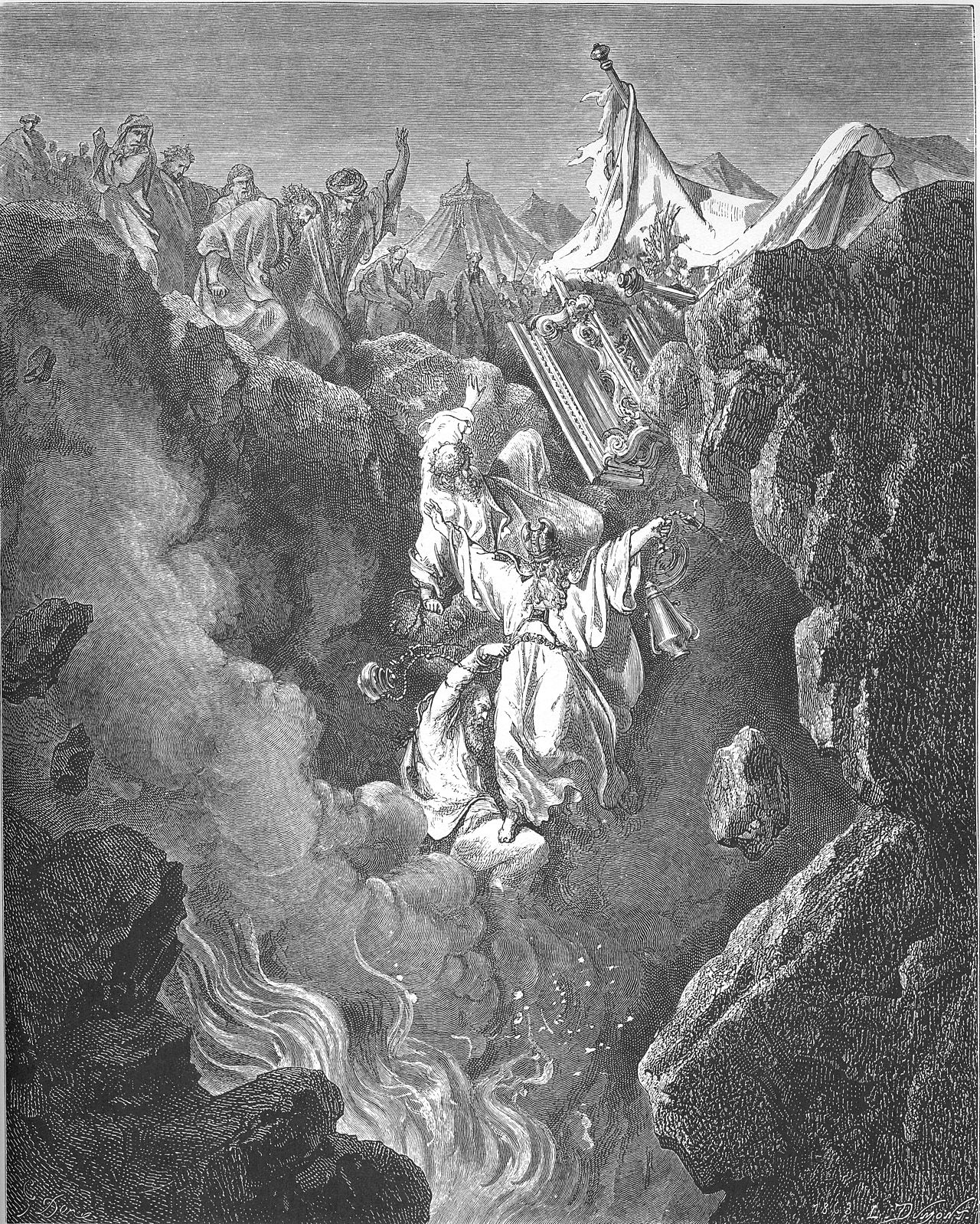
Numberschapter 16
50 verses · Moses, by tradition · 15th to 13th century BC · The Law
Key verse
Now Korah son of Izhar, the son of Kohath son of Levi, along with some Reubenites—Dathan and Abiram, sons of Eliab, and On son of Peleth—conducted
It stands in All the congregation is holy: Korah's charge, verses 1 to 11.
The chapter
Chapter summary
Korah's rebellion. Two hundred fifty princes of Israel. With Korah the Levite, Dathan, Abiram, and On. Rise up against Moses and Aaron: ‘ye take too much upon you, seeing all the congregation are holy, every one of them’. Moses proposes the test of the censers. Dathan and Abiram refuse to come up. In the morning the earth opens her mouth and swallows them with their households; fire from the LORD consumes the 250 at the censer-trial. The congregation murmurs the next day (‘ye have killed the people of the LORD’) and a plague begins. Aaron runs with his censer into the midst and makes atonement; 14,700 die; ‘and the plague was stayed’.
Context
Law · Moses · Numbers overview
The world behind this chapter
Numbers 16The history
The chapter belongs to Korah, a Levite of the clan of Kohath, and to two Reubenites named Dathan and Abiram. Kohath was the clan that carried the holy things of the tabernacle, so Korah already held a place nearer the sanctuary than most Israelites. Reuben was Jacob's firstborn, and the birthright had gone elsewhere, which is the standing behind the second complaint. Two hundred and fifty men called leaders of the congregation and representatives in the assembly stood with them.
The rest of the history, and what it meant to them
The time is the wilderness years, after the refusal at Kadesh-barnea had put the generation under sentence. The chapter gives no date of its own, so the year is held loosely at about 1443 BC on the same chronology the other rows of this book use. The place is the camp itself, which the book's second movement sets on the road between Sinai and Kadesh.
The Kohathites camped on the same side of the tabernacle as the Reubenites, Kohath at 3:29 and Reuben at 2:10, so the two households were neighbours. Albert Barnes points to 3:30, where Elizaphan of a younger Kohathite branch had been set over the families of Kohath.
What a first hearer knew is what the test cost, since offering incense in a censer before the LORD was the act that had killed Nadab and Abihu at Leviticus 10:1 to 2.
What it meant to them
A first hearer was shown that the priesthood is held by the LORD's choice rather than by the standing of the man who wants it. He was also shown that an argument drawn from Scripture can carry an ambition, since Korah built his case on Exodus 19:6, where Israel is called a kingdom of priests. The chapter then answered the question of what the office is for. Aaron took a censer, ran into a crowd that had accused him the day before, and stood between the living and the dead until the plague stopped.
Sources cited
- Timothy R. Ashley, The Book of Numbers (NICOT)
- C. F. Keil and Franz Delitzsch, Commentary on the Old Testament: The Pentateuch
- Albert Barnes, Notes on the Old Testament , on Numbers 16:1 to 2
- Matthew Henry, Commentary on the Whole Bible , 1710, on Numbers 16:1
Where the chapter sits
Numbers 16 falls in Wilderness rebellions and instruction (chapters 15–20). Korah's rebellion; Aaron's rod that budded; waters of Meribah; Moses' striking of the rock.
Korah's rebellion. ‘The earth opened her mouth’, a lesson about priesthood and access.
Before it: From Sinai to Kadesh, chapters 11–14. After it: Approach to Moab, chapters 21–25.
The whole shape of Numbers→The structure of this chapter
The heads below are this chapter's scenes. The numbered points under each are its verses.
A. All the congregation is holy: Korah's charge
1. (vv. 1-2)
Numbers 16:1
“Amram and Izhar were brothers (compare Exo 6:18), and thus Korah, the “son,” i. e. descendant of Izhar, was connected by distant cousinship with Moses and Aaron. Though being a Kohathite, he was of that division of the Levites which had the most honorable charge, yet as Elizaphan, who had been made “chief of the families of the Kohathites” Num 3:30, belonged to the youngest branch descended from Uzziel Num 3:27, Korah probably regarded himself as injured; and therefore took the lead in this rebellion. Of the others, On is not again mentioned. He probably withdrew from the conspiracy.”
1 more voice on this verseWhat preachers and commentators have said about this verse, in their own words.
Numbers 16:1
“The Kohathites encamped on the same side of the tabernacle that the Reubenites did, which perhaps gave Korah an opportunity of drawing them in, whence the Jews say, Woe to the wicked man, and woe to his neighbour, who is in danger of being infected by him.”
Matthew Henry· Commentary on the Whole Bible (1707-1721)puritan
Numbers 16:2
“Note, The pride, ambition, and emulation, of great men, have always been the occasion of a great deal of mischief both in churches and states. God by his grace make great men humble, and so give peace in our time, O Lord! Famous men, and men of renown, as these are described to be, were the great sinners of the old world, Gen. vi.”
Matthew Henry· Commentary on the Whole Bible (1707-1721)puritan
Korah is a Kohathite and Dathan and Abiram are Reubenites, and the two families camped on the same side of the tabernacle, Kohath at 3:29 and Reuben at 2:10, which Matthew Henry reads as how the one drew in the other. Albert Barnes finds the grievance in 3:30, where Elizaphan of the youngest Kohathite branch was made chief over the families of Kohath. The two hundred and fifty who rise with them are called men of renown, a phrase the King James Old Testament uses in one other place, Genesis 6:4.
2. (v. 3)
Numbers 16:3
“All the congregation are holy - Compare the marginal reference. Korah’s object was not to abolish the distinction between the Levites and the people, but to win priestly dignity for himself and his kinsmen Num 16:10. This ultimate design is masked for the present in order to win support from the Reubenites by putting forward claims to spiritual equality on behalf of every Israelite.”
2 more voices on this verse
Numbers 16:3
“They unjustly charge Moses and Aaron with taking the honour they had to themselves, whereas it was evident, beyond contradiction, that they were called of God to it, Heb. v. 4 .”
Matthew Henry· Commentary on the Whole Bible (1707-1721)puritan
Numbers 16:3
“All are holy - A kingdom of priests, an holy nation, as they are called, Exod. xix, 6, a people separated to the service of God, and therefore no less fit to offer sacrifice and incense, than you are. Among them - By his tabernacle and cloud, the tokens of his gracious presence, and therefore ready to receive sacrifices from their own hands.”
John Wesley· Explanatory Notes upon the Old Testament (1765)evangelical
The premise is Exodus 19:6, a kingdom of priests and an holy nation, and it is true. What Korah builds on it is that the priesthood therefore stands open to any Israelite, and the rest of the chapter answers the inference rather than the premise. This is the one place in the Torah where a rebellion argues from Scripture, and Moses hands the same accusation back at the end of verse 7, ye take too much upon you, ye sons of Levi.
3. (vv. 4-5)
Numbers 16:4
“And when Moses heard it,....”
2 more voices on this verse
Numbers 16:4
“Whatever feelings may be entertained respecting Aaron, who had formerly headed a sedition himself [Nu 12:1], it is impossible not to sympathize with Moses in this difficult emergency. But he was a devout man, and the prudential course he adopted was probably the dictate of that heavenly wisdom with which, in answer to his prayers, he was endowed.”
Jamieson, Fausset & Brown· Commentary Critical and Explanatory on the Whole Bible (1871)reformed
Numbers 16:4
“Thus he showed how willing he would have been to yield to them, and how gladly he would have resigned his government, if it would have consisted with his duty to God and his fidelity to the trust reposed in him. Thus also he applied to God, by prayer, for direction what to say and to do upon this sad occasion.”
Matthew Henry· Commentary on the Whole Bible (1707-1721)puritan
Numbers 16:5
We say therefore with confidence that according to the Scriptures God does not know [in the sense of acknowledge] all people. God does not know sin, and God does not know sinners. He is ignorant, so to speak, of those alienated from himself. Hear the Scripture saying "The Lord knows those who are his" and "Let everyone depart from iniquity who calls on the name of the Lord."
Origen of Alexandria· written before 253· HOMILIES ON GENESIS 4:6patristic
1 more voice on this verse
Numbers 16:5
“The Lord will show who are his - It is supposed that St. Paul refers to this place, 2Ti 2:19: The foundation of God - the whole sacrificial system, referring to Christ Jesus, the foundation of the salvation of men; standeth sure, notwithstanding the rebellions, intrusions, and false doctrines of men; having this seal - this stamp of its Divine authenticity, The Lord knoweth them that are his; εγνω Κυριος τους οντας αυτου, a literal translation of וידע יהוה את אשר לו veyoda Yehovah eth asher lo; and both signifying, The Lord approveth of his own; or, will own that which is of his own appointment.”
Adam Clarke· Commentary on the Bible (1810-1826)evangelical
Numbers 16:5
- Quoted in2 Timothy 2:19Nevertheless, God’s firm foundation stands, bearing this seal: “The Lord knows those who are His,” and, “Everyone who calls on the name of the Lord must turn away from iniquity.”
'The Lord knoweth them that are his' (the firm foundation)
Moses answers a public argument by going face down, and he does it three times in this chapter, at verses 4, 22 and 45. The reply he gives sets the question as whom the Lord will shew to be his and whom he hath chosen, which moves the case off qualification and onto choice. The wording of 2 Timothy 2:19 stands close to it, the Lord knoweth them that are his. The trial is put off until morning.
4. (vv. 6-7)
Numbers 16:6
“Take your censers, Korah, and all his company, &c.--that is, since you aspire to the priesthood, then go, perform the highest function of the office--that of offering incense; and if you are accepted well. How magnanimous the conduct of Moses, who was now as willing that God's people should be priests, as formerly that they should be prophets (Nu 11:29).”
Jamieson, Fausset & Brown· Commentary Critical and Explanatory on the Whole Bible (1871)reformed
Numbers 16:7
“And put fire therein,....”
The test is the exact act that killed the sons of Aaron. Leviticus 10:1 has Nadab and Abihu take every man his censer, put fire therein and put incense thereon, and verse 2 says there went out fire from the Lord and devoured them. Verse 35 of this chapter reports the outcome in almost those words. Moses proposes a trial whose precedent stood in the high priest's own family, and two hundred and fifty men accept it.
5. (vv. 8-10)
Numbers 16:8
“And Moses said unto Korah,.... Continued his discourse to him, as the head of the conspiracy, and the ringleader of it: hear, I pray you, ye sons of Levi; to whom also he had been before speaking; though Aben Ezra thinks the first speech was made to Korah and his company, and what follows to the Levites.”
Numbers 16:9
“Note, It will help to keep us from envying those that are above us duly to consider how many there are below us. Instead of fretting that any are preferred before us in honour, power, estate, or interest, in gifts, graces, or usefulness, we have reason to bless God if we, who are less than the least, are not put among the very last.”
Matthew Henry· Commentary on the Whole Bible (1707-1721)puritan
2 more voices on this verse
Numbers 16:9
“Seemeth” is not in the original. Render it as: Is it too little for you, i. e. “is it less than your dignity demands?”
Numbers 16:9
“Seemeth it but a small thing unto you,....”
Numbers 16:10
“And he hath brought thee near to him,.... To be in his courts, to watch in his house, and wait on his priests, for which an ample provision was made by tithes.”
Moses names the object the speech had left unnamed. The complaint was made in the language of equality and the thing wanted was the office, seek ye the priesthood also. The phrase a small thing lands twice in this chapter and in opposite mouths, here of the Levites brought near to God, and at verse 13 of being brought out of Egypt.
6. (v. 11)
Numbers 16:11
“The words of Moses in his wrath are broken. The Aaronic priesthood was of divine appointment; and thus in rejecting it, the conspirators were really rebelling against God.”
Moses puts the quarrel where Exodus 16:8 had already put it, saying that murmuring against the men who were set over them is murmuring against the Lord who set them. Aaron is the man named and Aaron speaks nowhere in this chapter, spoken about, spoken against, and at verse 47 running with a censer. The word murmur runs from here to verse 41 and on into 17:5 and 17:10, where a rod that buds is given as the answer to it.
B. We will not come up
1. (vv. 12-14)
Numbers 16:12
“And Moses sent to call Dathan and Abiram, the sons of Eliab,.... He sent messengers to call them to the house of judgment, as the Targum of Jonathan, to the court of judicature, where the Jews suppose Moses, with the seventy elders, were now sitting: it seems these two men departed either before.”
Numbers 16:13
“With perverse contempt for the promises, Dathan and Abiram designate Egypt by the terms appropriated elsewhere to the land of Canaan.”
Numbers 16:14
Wilt thou put out the eyes of these men? - i. e. “blind them to the fact that you keep none of your promises;” “throw dust in their eyes.”
Dathan and Abiram bring a separate complaint and the chapter keeps it separate. They refuse the summons in the same four words at the start of verse 12 and at the end of verse 14, and they give Egypt the title the Torah gives Canaan, a land that floweth with milk and honey, which Albert Barnes calls a perverse contempt for the promise. Their charge that Moses never brought them into the land is answered two chapters back, where Numbers 14 puts the reason on record. Barnes reads the clause about putting out the eyes of these men as blinding them to broken promises, and others take it as a threat of literal blinding.
2. (v. 15)
Numbers 16:15
“And Moses was very wroth,.... Or "it heated Moses exceedingly" (p); made him very angry, caused him to burn with wrath against them; even the speech they made, the words they uttered, not so much on account of their ill usage of him, as for the dishonour cast upon the Lord: and said unto the Lord, respect not thou their offering; their "Minchah", the word is commonly used for the meat or bread offering.”
1 more voice on this verse
Numbers 16:15
“Herein he seems to refer to the history of Cain, lately written by his own hand, of whom it is said that to him and his offering God had not respect, Gen. iv. These that followed the gainsaying of Korah walked in the way of Cain (these are put together, Jude 11 ), and therefore he prays that they might be frowned upon as Cain was, and put to the same confusion.”
Matthew Henry· Commentary on the Whole Bible (1707-1721)puritan
Moses asks that their offering not be respected, and Matthew Henry hears Genesis 4 in it, where the Lord had not respect unto Cain and to his offering, and sets Jude 11 beside it for naming the way of Cain and the gainsaying of Core in one sentence. Jamieson, Fausset and Brown note that the man called very wroth here is the man 12:3 calls meek above all the men upon the face of the earth. The defence he makes is that he has taken nothing, and Samuel makes the same defence at the close of his own service in 1 Samuel 12:3, whose ox have I taken, or whose ass have I taken.
C. Two hundred fifty censers at the door
1. (vv. 16-17)
Numbers 16:16
“Moses said unto Korah, Be thou and all thy company before the Lord--that is, at "the door of the tabernacle" (Nu 16:18), that the assembled people might witness the experiment and be properly impressed by the issue.”
Jamieson, Fausset & Brown· Commentary Critical and Explanatory on the Whole Bible (1871)reformed
2 more voices on this verse
Numbers 16:16
“And Moses said unto Korah,....”
Numbers 16:16
“Since he could not convince them by his calm and affectionate reasoning, he is ready to enter into bonds to stand God's award, not doubting but that God would appear, to decide the controversy.”
Matthew Henry· Commentary on the Whole Bible (1707-1721)puritan
Numbers 16:17
“And take every man his censer, and put incense therein,....”
1 more voice on this verse
Numbers 16:17
There was something in their behavior very offensive to God; for after His glory had appeared--as at the installation of Aaron (Le 9:23), so now for his confirmation in the sacred office--He bade Moses and Aaron withdraw from the assembly "that He might consume them in a moment."
Jamieson, Fausset & Brown· Commentary Critical and Explanatory on the Whole Bible (1871)reformed
The terms are set for one man against two hundred and fifty, each carrying his own censer, so every man in the company stands on his own act. Aaron is entered on the same footing and told to bring his censer like the rest. The question is settled by what happens at the door of the tent rather than by who makes the better case for himself.
2. (vv. 18-19)
Numbers 16:18
“And they took every man his censer, and that fire in them,....”
1 more voice on this verse
Numbers 16:18
“Yet, to confront Moses and Aaron, in the height of his pride he thus bids defiance to Heaven, and pretends to demand the divine acceptance without a divine warrant; thus wretchedly is the heart hardened through the deceitfulness of sin.”
Matthew Henry· Commentary on the Whole Bible (1707-1721)puritan
Numbers 16:19
“And Korah gathered all the congregation against them,.... Not his own company only, but as many of the whole congregation of Israel as he could get together, and especially the principal men; so that it seems there was a, general prevailing inclination in the people to take part with him against Moses and Aaron, who wished him success in his undertaking, and readily came together to animate and encourage him in it, and to see the issue of it.”
1 more voice on this verse
Numbers 16:19
“Nothing is more terrible to those who are conscious of guilt than the appearances of divine glory; for such a glorious Being must needs be a formidable enemy.”
Matthew Henry· Commentary on the Whole Bible (1707-1721)puritan
Two hundred and fifty men stand at the door of the tent holding censers, which is a place and an act the law had reserved to the house of Aaron. Verse 19 reports that Korah had gathered all the congregation, so by the morning of the trial the camp was with him. The glory of the Lord appears at the same point it appeared in 14:10, when the congregation was reaching for stones.
3. (vv. 20-22)
Numbers 16:20
“And the Lord spake unto Moses, and unto Aaron,.... Out of the cloud: saying; as follows.”
John Gill· Exposition of the Old Testament (1748-1763)Reformed Baptist
Numbers 16:21
“Separate yourselves, from among this congregation,.... Not only from Korah's company, but from the congregation of the children of Israel, whom Korah had got together, besides the two hundred fifty men that were at first with him; who by their words and behaviour, and particularly by their association and standing along with him, showed them to be on his side, which greatly provoked the Lord: that I may consume them in a moment; by fire from him, as the two hundred fifty men were afterwards consumed, Num 16:35.”
1 more voice on this verse
Numbers 16:21
“God thus showed what their sin deserved, and how very provoking it was to him. See what a dangerous thing it is to have fellowship with sinners, and in the least to partake with them.”
Matthew Henry· Commentary on the Whole Bible (1707-1721)puritan
Numbers 16:22
“O God, the God of the spirits of all flesh - אל אלהי הרוחת לכל בשר El Elohey haruchoth lechol basar. This address sufficiently proves that these holy men believed that man is a being compounded of flesh and spirit, and that these principles are perfectly distinct. Either the materiality of the human soul is a human fable, or, if it be a true doctrine, these men did not pray under the influence of the Divine Spirit. In Num 27:16 there is a similar form of expression: Let the Lord, the God of the spirits of all flesh.”
Adam Clarke· Commentary on the Bible (1810-1826)evangelical
The offer to consume the congregation in a moment is the third of its kind, after Exodus 32:10 and Numbers 14:12, and each time Moses stands in the way of it. The title he uses, the God of the spirits of all flesh, occurs twice in Scripture, here and at 27:16 where he asks for a man to be set over the congregation after him. His argument is the argument Abraham made at Genesis 18:23-25, that the many should not be swept away with the guilty.
4. (vv. 23-24)
Numbers 16:23
“And the Lord spake unto Moses,.... When on his face in prayer, and bid him rise up, and told him he had granted his request, and then spoke to him: saying; as follows.”
Numbers 16:24
“The tent, “the tabernacle” of Korah, as a Kohathite, stood on the south side of the tabernacle of the Lord; and those of Dathan and Abiram, as Reubenites, in the outer line of encampment on the same side. Yet though the tents of these three were thus contiguous, they did not share the same fate.”
The order names Korah, Dathan and Abiram, and On the son of Peleth, listed among the leaders in verse 1, is absent from this list and from every list after it. The text gives no account of him, and Albert Barnes takes the silence to mean he drew back from the conspiracy. The word rendered tabernacle here stands for their dwellings, as verse 27 shows by calling the same places their tents.
D. The ground splits and the fire falls
1. (vv. 25-26)
Numbers 16:26
We find that also made clear in Numbers when Korah and Dathan and Abiram claimed for themselves the liberty of sacrificing in opposition to Aaron the priest. There also the Lord teaches through Moses that the people should be separated from them lest they be bound by the same guilt with the criminals and contaminate themselves by the same crime. "Keep away," he says, "from the tents of most shameless wicked men, and do not touch anything that is theirs, lest you perish at the same time in their sin."
Cyprian· written before 258· Epistle LXVII.3patristic
Moses goes to the men who refused to come to him, and the elders of Israel go with him, which puts the eldership visibly on one side before anything happens. The warning to the camp is to stand clear and to touch nothing of theirs, so every neighbour is given the means of separating himself. Everything from here to verse 33 happens in front of the whole congregation.
2. (v. 27)
Numbers 16:27
“So they gat up from the tabernacle of Korah, Dathan, and Abiram, on every side,....”
2 more voices on this verse
Numbers 16:27
“Stood in the door of their tents - Apparently in contumacious defiance.”
Numbers 16:27
“It was in answer to the prayer of Moses that God thus stirred up the hearts of the congregation to shift for their own preservation. Note, To those whom God will save he gives repentance, that they may recover themselves out of the snare of the devil. Grace to separate from evil doers is one of the things that accompany salvation.”
Matthew Henry· Commentary on the Whole Bible (1707-1721)puritan
The households come out and stand in the tent doors, wives and sons and little children, and the text records it and adds nothing. Deuteronomy 11:6 recalls this day and names Dathan and Abiram alone, with Korah left out of it. Numbers 26:11 adds the line that carries furthest, notwithstanding the children of Korah died not, and 1 Chronicles 6:37-38 traces Heman the singer back through Korah, the son of Izhar, the son of Kohath, which are the words of verse 1 here. Psalms 42, 44 to 49, 84, 85, 87 and 88 stand under the name of the sons of Korah.
3. (vv. 28-30)
Numbers 16:28
“And Moses said, hereby ye shall know that the Lord hath sent me to do all these works,....”
1 more voice on this verse
Numbers 16:28
“If the rebels die a common death, he will be content to be called and counted an impostor; not only if they die a natural death, but if they die by any sort of judgment that has formerly been executed on other malefactors. "If they die by the plague, or by fire from heaven, or by the sword, then say, God has disowned Moses;" but, 2.”
Matthew Henry· Commentary on the Whole Bible (1707-1721)puritan
Numbers 16:29
“If these men die the common death of all men,....”
Numbers 16:30
“If the Lord make a new thing - ואם בריאה יברא יהוה veim beriah yibra Yehovah, and if Jehovah should create a creation, i. e., do such a thing as was never done before.”
Adam Clarke· Commentary on the Bible (1810-1826)evangelical
Moses stakes his commission on an outcome he names in advance and offers the common death of all men as the disproof, which is the shape of the test Deuteronomy 18:21-22 later sets for a prophet. The new thing he asks for uses the verb of Genesis 1:1, the word for creating. Quick in verse 30 means alive, and the pit is sheol, so what he describes is a descent into the grave with the dying left out.
4. (vv. 31-33)
Numbers 16:31
“And it came to pass, as he had made an end of speaking all these things,....”
Numbers 16:32
“All the men ... - Not his sons (see Num 26:11), but all belonging to him who had associated themselves with him in this rebellion.”
Numbers 16:33
“They, and all that appertained to them - Korah, Dathan, and Abiram, and all that appertained to their respective families, went down into the pit caused by this supernatural earthquake; while the fire from the Lord consumed the 250 men that bare censers. Thus there were two distinct punishments, the pit and the fire, for the two divisions of these rebels.”
Adam Clarke· Commentary on the Bible (1810-1826)evangelical
1 more voice on this verse
Numbers 16:33
“It was typical of the eternal ruin of sinners who die impenitent, who, perhaps in allusion to this, are said to sink down into the pit ( Ps. ix. 15 ) and to go down quickly into hell, Ps. lv. But David, even when he sinks in deep mire, yet prays in faith, Let not the pit shut her mouth upon me, as it does on the damned, between whom and life there is a gulf fixed, Ps. lxix.”
Matthew Henry· Commentary on the Whole Bible (1707-1721)puritan
The ground splits at the instant the sentence ends, and the text says so before it says anything else. Whether Korah himself went down with them or burned with the two hundred and fifty is read both ways, since verse 32 swallows the men that appertained unto Korah while 26:10 says the earth swallowed them up together with Korah, and the commentators divide over it. Psalm 106:17 recalls the day and names Dathan and the company of Abiram.
5. (vv. 34-35)
Numbers 16:34
“And all Israel that were round about them fled at the cry of them,.... Or because of it, as Aben Ezra; their cry was so loud, their shrieks so dreadful and piercing, that the Israelites about them fled to get out of the sound of them, as well as for their own safety.”
1 more voice on this verse
Numbers 16:34
“38 The censers of these sinners against their own souls, let them make them broad plates for a covering of the altar: for they offered them before the L ORD , therefore they are hallowed: and they shall be a sign unto the children of Israel.”
Matthew Henry· Commentary on the Whole Bible (1707-1721)puritan
Numbers 16:35
“It is most probable that Korah himself was consumed with those 250 that presumed to offer incense; for the priesthood was the thing he aimed at, and therefore we have reason to think that he would not quit his post at the door of the tabernacle. But, behold, those are made sacrifices to the justice of God who flattered themselves with the hopes of being priests.”
Matthew Henry· Commentary on the Whole Bible (1707-1721)puritan
The camp runs from the sound of it, afraid the ground will take them too. Fire comes out from the Lord and consumes the two hundred and fifty, which is the wording of Leviticus 10:2 over Nadab and Abihu and of 11:1 at Taberah. Three judgments fall in this one chapter by three means, the earth at verse 32, the fire here, and the plague at verse 49.
E. Censers beaten out to cover the altar
1. (vv. 36-38)
Numbers 16:36
“And the Lord spake unto Moses,.... Immediately after these men were consumed by fire from him; out of the same cloud from whence that proceeded, he spoke: saying: as follows.”
Numbers 16:37
“Aaron as High Priest and as one of those that offered incense Num 16:17, could not be defiled by going among the dead. The censers were not to be used again for censers, nor the coals on them for kindling the incense to be offered before the Lord. Yet neither of them could fittingly be employed for common purposes. The censers therefore were beaten into plates for the altar; the coals were scattered at a distance.”
Numbers 16:38
“These sinners against their own souls - That is, “against their own lives.” By their sin they had brought destruction upon themselves.”
The censers outlast the men who carried them. Having been brought before the Lord they are counted hallowed, and the metal is beaten into plates to cover the altar, so the instruments of the offence end as the surface of the place where atonement is made. Albert Barnes reads sinners against their own souls as sinners against their own lives, since the sin cost them exactly that.
2. (vv. 39-40)
Numbers 16:39
“And Eleazar the priest took the brazen censers,....”
Numbers 16:40
“To be a memorial unto the children of Israel,....”
Eleazar does the work, and the plates go on the altar where every man bringing a sacrifice will see them. The rule they carry is stated in one line, that no stranger who is not of the seed of Aaron come near to offer incense. 2 Chronicles 26:16-21 records a king of Judah with a censer in his hand being told the same thing by the priests, and Uzziah left the house a leper.
F. Aaron runs with incense between the dead and the living
1. (vv. 41-42)
Numbers 16:41
“On the morrow all the congregation - murmured - It is very likely that the people persuaded themselves that Moses and Aaron had used some cunning in this business, and that the earthquake and fire were artificial; else, had they discerned the hand of God in this punishment, could they have dared the anger of the Lord in the very face of justice?”
Adam Clarke· Commentary on the Bible (1810-1826)evangelical
Numbers 16:42
“And it came to pass, when the congregation was gathered against Moses and against Aaron,....”
One day after the ground closed, the whole congregation lays the deaths at the feet of Moses and Aaron and calls the dead the people of the Lord. Matthew Henry observes that the earth was scarcely closed and the smell of the fire was still in the air. This is the second murmuring in the chapter, at verses 11 and 41, and the word carries on into 17:5 and 17:10 where the rod of Aaron is given as the answer to it.
2. (vv. 43-45)
Numbers 16:43
“And Moses and Aaron came before the tabernacle of the congregation. Whose tent was not far from it, about which the people of Israel were gathered; and from whence they came to the tabernacle, both for shelter and safety, and for advice and instruction how to behave in this crisis; they did not go into it, but stood before it; the Lord being in the cloud over it, they stood in the door of it, Num 16:50; so the Targum of Jonathan,"and Moses and Aaron came from the congregation to the door of the tabernacle.''”
Numbers 16:44
“And the Lord spake unto Moses,.... Out of the cloud: saying; as follows.”
Numbers 16:45
“Get you up from among this congregation,....”
1 more voice on this verse
Numbers 16:45
“They fell upon their faces - In intercession for the people; compare Num 16:22; Num 14:5.”
The same order comes a second time in one chapter, at verse 21 and again here, and the same two men go face down. The difference is the timing, since verse 46 says the plague had already begun while they were still on the ground. Intercession here overtakes a judgment in progress.
3. (vv. 46-48)
Numbers 16:46
“Incense - Which was a sign of intercession, and was to be accompanied with it. Go unto the congregation - He went with the incense, to stir up the people to repentance and prayer, to prevent their utter ruin. This he might do upon this extraordinary occasion, having God's command for his warrant, though ordinarily incense was to be offered only in the tabernacle.”
John Wesley· Explanatory Notes upon the Old Testament (1765)evangelical
Numbers 16:47
“A striking proof of the efficacy of that very Aaronic priesthood which the rebels had presumed to reject. The incense offering which had brought down destruction when presented by unauthorised hands, now in the hand of the true priest is the medium of instant salvation to the whole people. Aaron by his acceptable ministration and his personal self-devotion foreshadows emphatically in this transaction the perfect mediation and sacrifice of Himself made by Christ.”
1 more voice on this verse
Numbers 16:47
“A man clearly worthy to be proposed that all should follow him was he, for when a terrible death on account of the rebels was spreading over the people, he offered himself between the dead and the living, that he might arrest death, and that no more should perish. A man truly of priestly mind and soul, who as a good shepherd with pious affection offered himself for the Lord's flock. And so he broke the sting of death, restrained its violence, refused it further course. Affection aided his deserts, for he offered himself for those who were resisting him.”
Ambrose of Milan· written before 397· Epistle 63patristic
Numbers 16:48
“The living - Whereby it may seem that this plague, like that fire, chap. xi, 1, began in the uttermost parts of the congregation, and so proceeded destroying one after another in an orderly manner, which gave Aaron occasion and direction so to place himself, as a mediator to God on their behalf.”
John Wesley· Explanatory Notes upon the Old Testament (1765)evangelical
The censer that killed two hundred and fifty men the day before now stops a plague, and what has changed is the hand that carries it and the fire that fills it, taken from off the altar. Aaron runs, which is the one action recorded of him in the chapter, and he stands between the dead and the living until the plague is stayed. The office Korah wanted is settled by what it does for the people who had just accused the man holding it.
4. (vv. 49-50)
Numbers 16:49
“Now they that died in the plague were fourteen thousand and seven hundred,.... 14,700. Thus what they were threatened with, that their carcasses should fall in the wilderness, Num 14:29, was more and more fulfilled: beside them that died about the matter of Korah; these are not taken into the number here, even the two hundred fifty men of Korah's company, and the families of Dathan and Abiram, Num 16:32; how many they were is not certain, but they were but few in comparison of these.”
Numbers 16:50
“And Aaron returned unto Moses,.... After he had by his atonement and intercession put a stop to the wrath of God broken forth upon the people: unto the door of the tabernacle of the congregation; where Moses was waiting for his return, and to know the issue of this affair: and the plague was stayed: even before Aaron left the camp, and is here repeated for the certainty of it, and to intimate that it continued to cease, and broke not out again.”
Fourteen thousand and seven hundred die in the plague, and the count is given apart from those who died about the matter of Korah. Jude 11 sets Korah with Cain and Balaam and calls the offence the gainsaying of Core, which reads it as a pattern rather than a single day. The chapter closes with Aaron walking back to the door of the tent, and chapter 17 answers the whole affair with a dead rod that buds.
This page carries no textual note on Numbers 16. Where this site has examined a place the manuscripts differ, the examination is in the manuscripts room. Every place this site examines →
Sources for this chapter
The summary
Jamieson, Fausset & Brown, Commentary Critical and Explanatory; John Calvin, Commentaries; John Wesley, Notes on the Old Testament and Matthew Henry, Complete Commentary.
The exposition
Adam Clarke, Commentary on the Bible; Albert Barnes, Notes on the Old Testament; Alfred Edersheim, The Temple: Its Ministry and Services; Chuck Missler, Learn the Bible in 24 Hours; Jamieson, Fausset & Brown, Commentary Critical and Explanatory on the Whole Bible; John Calvin, Commentary on the Four Last Books of Moses Arranged in the Form of a Harmony; John Gill, Exposition of the Old Testament; Keil and Delitzsch, Biblical Commentary on the Old Testament: The Pentateuch; Matthew Henry, Commentary on the Whole Bible and Sir Robert Anderson, Types in Hebrews.
Keep studying
On this page
Studies4