
Numbers 16:12
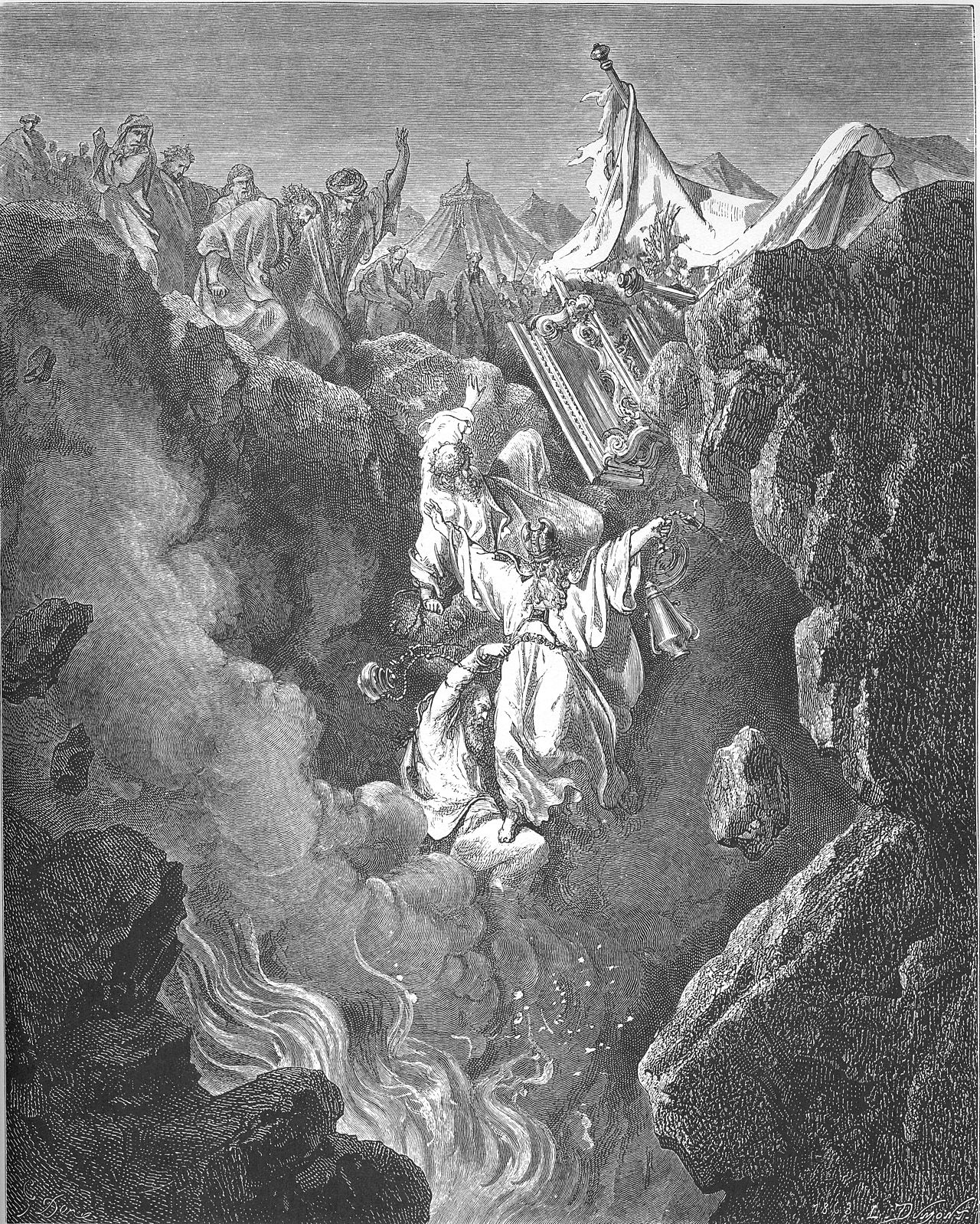
in Numbers 16Then Moses summoned Dathan and Abiram, the sons of Eliab, but they said, “We will not come!
BSB
The same verse in ASV and KJV ▾
ASV
And Moses sent to call Dathan and Abiram, the sons of Eliab; and they said, We will not come up:
KJV
And Moses sent to call Dathan and Abiram, the sons of Eliab: which said, We will not come up:
⋯
This verse in Numbers 16
Commentary
6 notes on this verseAnd Moses sent to call Dathan and Abiram, the sons of Eliab,.... He sent messengers to call them to the house of judgment, as the Targum of Jonathan, to the court of judicature, where the Jews suppose Moses, with the seventy elders, were now sitting: it seems these two men departed either before.
This site's exposition
Moses sent to call Dathan and Abiram
on Numbers 16:12-14
Dathan and Abiram bring a separate complaint and the chapter keeps it separate. They refuse the summons in the same four words at the start of verse 12 and at the end of verse 14, and they give Egypt the title the Torah gives Canaan, a land that floweth with milk and honey, which Albert Barnes calls a perverse contempt for the promise. Their charge that Moses never brought them into the land is answered two chapters back, where Numbers 14 puts the reason on record. Barnes reads the clause about putting out the eyes of these men as blinding them to broken promises, and others take it as a threat of literal blinding.
The record, by era
The Puritans and the Awakening3 voices
); but they would not obey his summons, either because they could not for shame say that to his face which they were resolved to say, and then it is an instance of some remains of modesty in them; or, rather, because they would not so far own his authority, and then it is an instance of the highest degree of impudence.
quarantine:debris (2026-07-29) — leading-punctuation+unbalanced-parens
), yet he humbly condescends to go down to them, to try if he could yet convince and reclaim them. Ministers must thus with meekness instruct those that oppose themselves, and not think it below them to stoop to those that are most stubborn, for their good. Christ himself stretches out his hand to a rebellious and gainsaying people.
quarantine:debris (2026-07-29) — leading-punctuation+unbalanced-parens
A solemn appearance of the pretenders to the priesthood before God, according to order, and a public appearance of the glory of the Lord, which would have consumed the whole congregation if Moses and Aaron had not interceded,
The Nineteenth Century1 voice
A commentator
Jamieson, Fausset & Brown1802–1910
Commentary Critical and Explanatory on the Whole Bible (1871)
proposed
They refused to obey the summons; and their refusal was grounded on the plausible pretext that their stay in the desert was prolonged for some secret and selfish purposes of the leader, who was conducting them like blind men wherever it suited him.
How the passage was read
What the Jewish commentators add
Now Dathan and Abiram were the instigators of this controversy as much as Korach was, as Scripture states, Now Korach took … and Dathan and Abiram … and they rose up in the face of Moses with certain of the children of Israel etc., 84 Above, Verses 1-2.
1 more on this passage, in their own words ▾
THAT THOU [Moses] WOULDST MAKE THYSELF A PRINCE OVER US ‘GAM HISTAREIR’ — [the repetition of this phrase — literally ‘also to rule’ means]: ‘also many forms of lordship.’ Or.
This section is reception history: how the passage was read and kept in the Jewish tradition. Where a reading parts from an essential of the Christian faith, the section says so at that point.
Texts and citation data: Sefaria; each excerpt follows its version’s licence. 4 further sources are cited on this chapter that carry no English text this site may quote or only restate the verse.
The words behind it
10 Hebrew wordsEvery Hebrew word of this verse in the order it stands, with what it means and the door to its own study. The last column counts the times a word stands in the whole Bible: the rarer the word, the more the places it appears belong together.
| Hebrew | Sound | Meaning | Word study | In the Bible |
|---|---|---|---|---|
| וַיִּשְׁלַ֣ח | vaiyishlach | and he sent | H7971 → | 845 times |
| מֹשֶׁ֔ה | mosheh | Moses | H4872 → | 765 times |
| לִקְרֹ֛א | likro' | to summon | H7121 → | 733 times |
| לְדָתָ֥ן | ledatan | <to> Dathan | H1885 → | 10 times |
| וְלַאֲבִירָ֖ם | velaaviram | and <to> Abiram | H48 → | 11 times |
| בְּנֵ֣י | benei | [the] sons of | H1121 → | 4930 times |
| אֱלִיאָ֑ב | ʾeliav | Eliab | H446 → | 21 times |
| וַיֹּאמְר֖וּ | vaiyomeru | and they said | H559 → | 5305 times |
| לֹ֥א | lo' | not | H3808 → | 5168 times |
| נַעֲלֶֽה׃ | naaleh | we will come up | H5927 → | 890 times |
וַיִּשְׁלַ֣חand he sent
vaiyishlachH7971 →845 times
מֹשֶׁ֔הMoses
moshehH4872 →765 times
לִקְרֹ֛אto summon
likro'H7121 →733 times
לְדָתָ֥ן<to> Dathan
ledatanH1885 →10 times
וְלַאֲבִירָ֖םand <to> Abiram
velaaviramH48 →11 times
בְּנֵ֣י[the] sons of
beneiH1121 →4930 times
אֱלִיאָ֑בEliab
ʾeliavH446 →21 times
וַיֹּאמְר֖וּand they said
vaiyomeruH559 →5305 times
לֹ֥אnot
lo'H3808 →5168 times
נַעֲלֶֽה׃we will come up
naalehH5927 →890 times
A shaded row is a word that stands 400 times or fewer in the Bible.
The walk
8 stopsEach card is a verse this one points to, and under it the verses that one points to in turn. Where several paths arrive at the same place, that place is listed first: the text keeps returning to it.
Through
Jude 1:8Yet in the same way these dreamers defile their bodies, reject authority, and slander glorious beings.
it leads to
- Hebrews 13:17
Obey your leaders and submit to them, for they watch over your souls as those who must give an account. To this end, allow them to lead with joy and not with grief, for…
- 2 Peter 2:10–12
Such punishment is specially reserved for those who indulge the corrupt desires of the flesh and despise authority. Bold and self-willed, they are unafraid to slander glorious beings.
- 1 Peter 2:17
Treat everyone with high regard: Love the brotherhood of believers, fear God, honor the king.
- Exodus 22:28
You must not blaspheme God or curse the ruler of your people.
- 1 Timothy 1:10
for the sexually immoral, for homosexuals, for slave traders and liars and perjurers, and for anyone else who is averse to sound teaching
- Hebrews 13:17
Through
Proverbs 29:9If a wise man goes to court with a fool, there will be raving and laughing with no resolution.
it leads to
- Proverbs 26:4
Do not answer a fool according to his folly, or you yourself will be like him.
- Ecclesiastes 10:13
The beginning of his talk is folly, and the end of his speech is evil madness.
- Proverbs 26:4
Through
Isaiah 3:5The people will oppress one another, man against man, neighbor against neighbor; the young will rise up against the old, and the base against the honorable.
it leads to
- Malachi 3:5
“Then I will draw near to you for judgment. And I will be a swift witness against sorcerers and adulterers and perjurers, against oppressors of the widowed and fatherless, and against those who defraud…
- Malachi 3:5
Where this verse is studied
On this page
Studies3
On this verse
On this chapter
About Numbers
Who and where
1 name in this verse with a page on the site.
This page draws on Adam Clarke, Commentary on the Bible; Albert Barnes, Notes on the Old Testament; Jamieson, Fausset & Brown, Commentary Critical and Explanatory on the Whole Bible; John Gill, Exposition of the Old Testament (1748-1763) and Matthew Henry, Commentary on the Whole Bible.