
Numbers 16:33
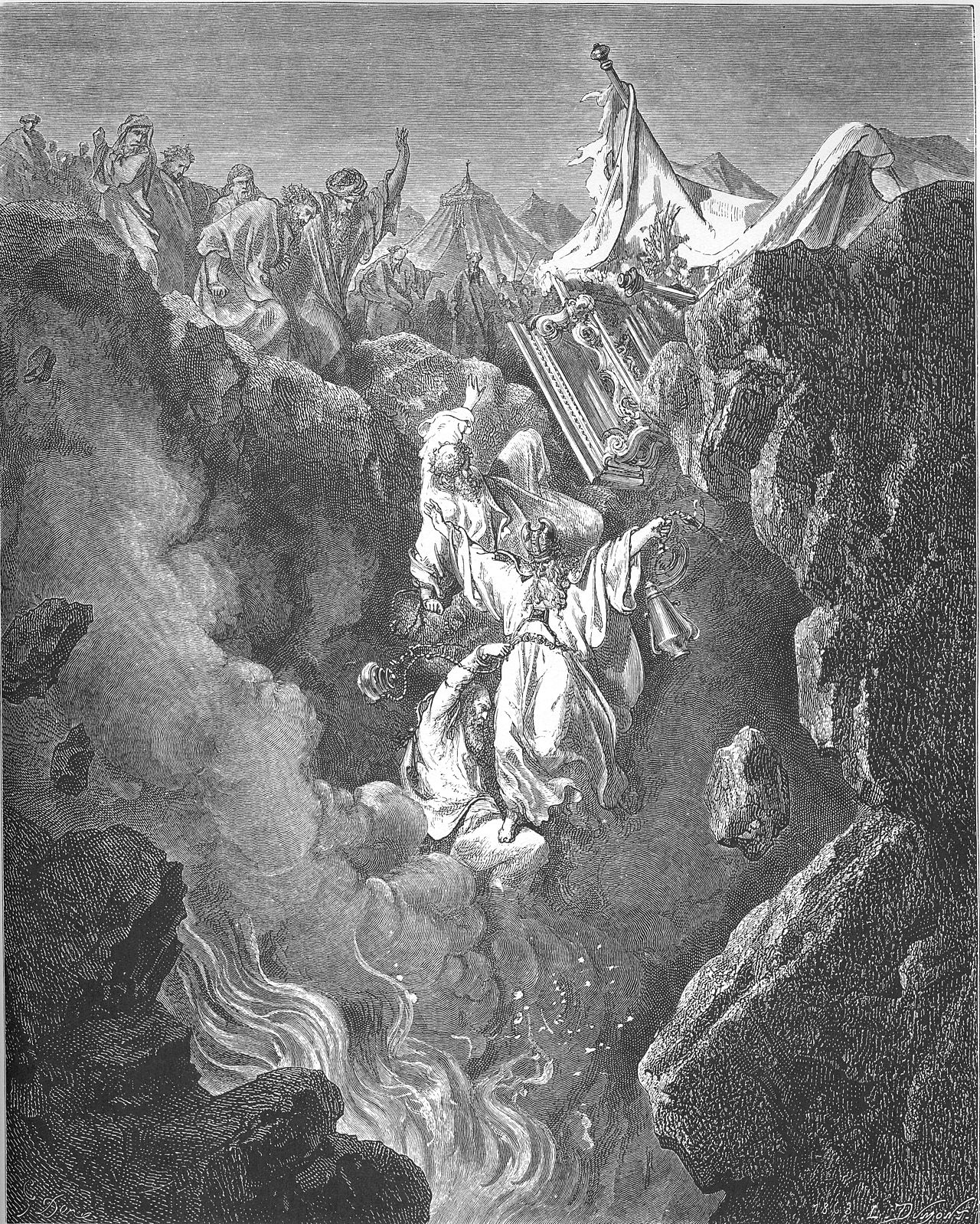
in Numbers 16They went down alive into Sheol with all they owned. The earth closed over them, and they vanished from the assembly.
BSB
The same verse in ASV and KJV ▾
ASV
So they, and all that appertained to them, went down alive into Sheol: and the earth closed upon them, and they perished from among the assembly.
KJV
They, and all that appertained to them, went down alive into the pit, and the earth closed upon them: and they perished from among the congregation.
⋯
This verse in Numbers 16
Commentary
6 notes on this verseThey, and all that appertained to them - Korah, Dathan, and Abiram, and all that appertained to their respective families, went down into the pit caused by this supernatural earthquake; while the fire from the Lord consumed the 250 men that bare censers. Thus there were two distinct punishments, the pit and the fire, for the two divisions of these rebels.
This site's exposition
as he had made an end of speaking
on Numbers 16:31-33
The ground splits at the instant the sentence ends, and the text says so before it says anything else. Whether Korah himself went down with them or burned with the two hundred and fifty is read both ways, since verse 32 swallows the men that appertained unto Korah while 26:10 says the earth swallowed them up together with Korah, and the commentators divide over it. Psalm 106:17 recalls the day and names Dathan and the company of Abiram.
The record, by era
The Church Fathers1 voice
A commentator
Clement of RomeClement's First Letter to the Corinthians, Chapters 3-4 · Written before 99.
proposed
Every kind of honour and happiness was bestowed upon you, and then was fulfilled that which is written, "My beloved ate and drank, and was enlarged and became fat, and kicked." [Deuteronomy 32:15] Hence flowed emulation and envy, strife and sedition, persecution and disorder, war and captivity. So the worthless rose up against the honoured, those of no reputation against such as were renowned, the foolish against the wise, the young against those advanced in years. For this reason righteousness and peace are now far departed from you, inasmuch as every one abandons the fear of God, and has become blind in His faith, neither walks in the ordinances of His appointment, nor acts a part becoming a Christian, but walks after his own wicked lusts, resuming the practice of an unrighteous and ungodly envy, by which death itself entered into the world. [Wisdom 2:24] For thus it is written: "And it came to pass after certain days, that Cain brought of the fruits of the earth a sacrifice unto God; and Abel also brought of the firstlings of his sheep, and of the fat thereof. And God had respect to Abel and to his offerings, but Cain and his sacrifices He did not regard. And Cain was deeply grieved, and his countenance fell. And God said to Cain, Why are you grieved, and why is your countenance fallen? If you offer rightly, but do not divide rightly, have you not sinned? Be at peace: your offering returns to yourself, and you shall again possess it. And Cain said to Abel his brother, Let us go into the field. And it came to pass, while they were in the field, that Cain rose up against Abel his brother, and slew him." [Genesis 4:3-8] You see, brethren, how envy and jealousy led to the murder of a brother. Through envy, also, our father Jacob fled from the face of Esau his brother [Genesis 27:41-45]. Envy made Joseph be persecuted unto death, and to come into bondage. […]
The Medieval Church1 voice
For the quick know and feel what is being done about them; but the dead can feel nothing. For they would go down dead into hell if they committed what is evil without knowledge. But when they know what is evil, and yet do it, they go down quick, miserable, and feeling, into the hell of iniquity.
The Puritans and the Awakening2 voices
It was typical of the eternal ruin of sinners who die impenitent, who, perhaps in allusion to this, are said to sink down into the pit ( Ps. ix. 15 ) and to go down quickly into hell, Ps. lv. But David, even when he sinks in deep mire, yet prays in faith, Let not the pit shut her mouth upon me, as it does on the damned, between whom and life there is a gulf fixed, Ps. lxix.
They, and all that appertained unto them, went down alive into the pit,....
The words behind it
13 Hebrew wordsEvery Hebrew word of this verse in the order it stands, with what it means and the door to its own study. The last column counts the times a word stands in the whole Bible: the rarer the word, the more the places it appears belong together.
| Hebrew | Sound | Meaning | Word study | In the Bible |
|---|---|---|---|---|
| וַיֵּ֨רְד֜וּ | vaiyeredu | and they went down | H3381 → | 381 times |
| הֵ֣ם | hem | they | H1992 → | 553 times |
| וְכָל־ | vekhol | and all | H3605 → | 5413 times |
| אֲשֶׁ֥ר | ʾasher | that | H834 → | 5497 times |
| לָהֶ֛ם | lahem | [belonged] to <the> them | ||
| חַיִּ֖ים | chaiyim | alive | H2416 → | 498 times |
| שְׁאֹ֑לָה | sheolah | Sheol towards | H7585 → | |
| וַתְּכַ֤ס | vatekhas | and it covered | H3680 → | 152 times |
| עֲלֵיהֶם֙ | ʾaleihem | over them | H5921 → | 5755 times |
| הָאָ֔רֶץ | haaretz | the earth | H776 → | 2504 times |
| וַיֹּאבְד֖וּ | vaiyoedu | and they perished | H6 → | 184 times |
| מִתּ֥וֹךְ | mitokh | from among | H8432 → | 418 times |
| הַקָּהָֽל׃ | hakahal | the assembly | H6951 → | 123 times |
וַיֵּ֨רְד֜וּand they went down
vaiyereduH3381 →381 times
הֵ֣םthey
hemH1992 →553 times
וְכָל־and all
vekholH3605 →5413 times
אֲשֶׁ֥רthat
ʾasherH834 →5497 times
לָהֶ֛ם[belonged] to <the> them
lahem
חַיִּ֖יםalive
chaiyimH2416 →498 times
שְׁאֹ֑לָהSheol towards
sheolahH7585 →
וַתְּכַ֤סand it covered
vatekhasH3680 →152 times
עֲלֵיהֶם֙over them
ʾaleihemH5921 →5755 times
הָאָ֔רֶץthe earth
haaretzH776 →2504 times
וַיֹּאבְד֖וּand they perished
vaiyoeduH6 →184 times
מִתּ֥וֹךְfrom among
mitokhH8432 →418 times
הַקָּהָֽל׃the assembly
hakahalH6951 →123 times
A shaded row is a word that stands 400 times or fewer in the Bible.
The walk
8 stopsEach card is a verse this one points to, and under it the verses that one points to in turn. Where several paths arrive at the same place, that place is listed first: the text keeps returning to it.
Through
Jude 1:11Woe to them! They have traveled the path of Cain; they have rushed headlong into the error of Balaam; they have perished in Korah’s rebellion.
it leads to
- 2 Peter 2:15
They have left the straight way and wandered off to follow the way of Balaam son of Beor, who loved the wages of wickedness.
- Revelation 2:14
But I have a few things against you, because some of you hold to the teaching of Balaam, who taught Balak to place a stumbling block before the Israelites so they would eat food…
- 1 John 3:12
Do not be like Cain, who belonged to the evil one and murdered his brother. And why did Cain slay him? Because his own deeds were evil, while those of his brother were righteous.
- Genesis 4:3–14
So in the course of time, Cain brought some of the fruit of the soil as an offering to the LORD,
- Hebrews 11:4
By faith Abel offered God a better sacrifice than Cain did. By faith he was commended as righteous when God gave approval to his gifts. And by faith he still speaks, even though he…
- 2 Peter 2:15
Through
Isaiah 14:15But you will be brought down to Sheol, to the lowest depths of the Pit.
it leads to
- Matthew 11:23
And you, Capernaum, will you be lifted up to heaven? No, you will be brought down to Hades! For if the miracles that were performed in you had been performed in Sodom, it would…
- Matthew 11:23
Through
Psalms 9:15The nations have fallen into a pit of their making; their feet are caught in the net they have hidden.
it leads to
- Psalms 57:6
They spread a net for my feet; my soul was despondent. They dug a pit before me, but they themselves have fallen into it! Selah
- Psalms 35:8
May ruin befall them by surprise; may the net they hid ensnare them; may they fall into the hazard they created.
- Psalms 57:6
Where this verse is studied
On this page
Studies3
On this verse
On this chapter
About Numbers
This page draws on Adam Clarke, Commentary on the Bible; Clement of Rome, Clement's First Letter to the Corinthians, Chapters 3-4; Gregory the Dialogist, THE BOOK OF PASTORAL RULE, Part 3; John Gill, Exposition of the Old Testament; John Gill, Exposition of the Old Testament (1748-1763); Keil and Delitzsch, Biblical Commentary on the Old Testament: The Pentateuch and Matthew Henry, Commentary on the Whole Bible.