
Joshuachapter 7
26 verses · BSBJoshua book hub →
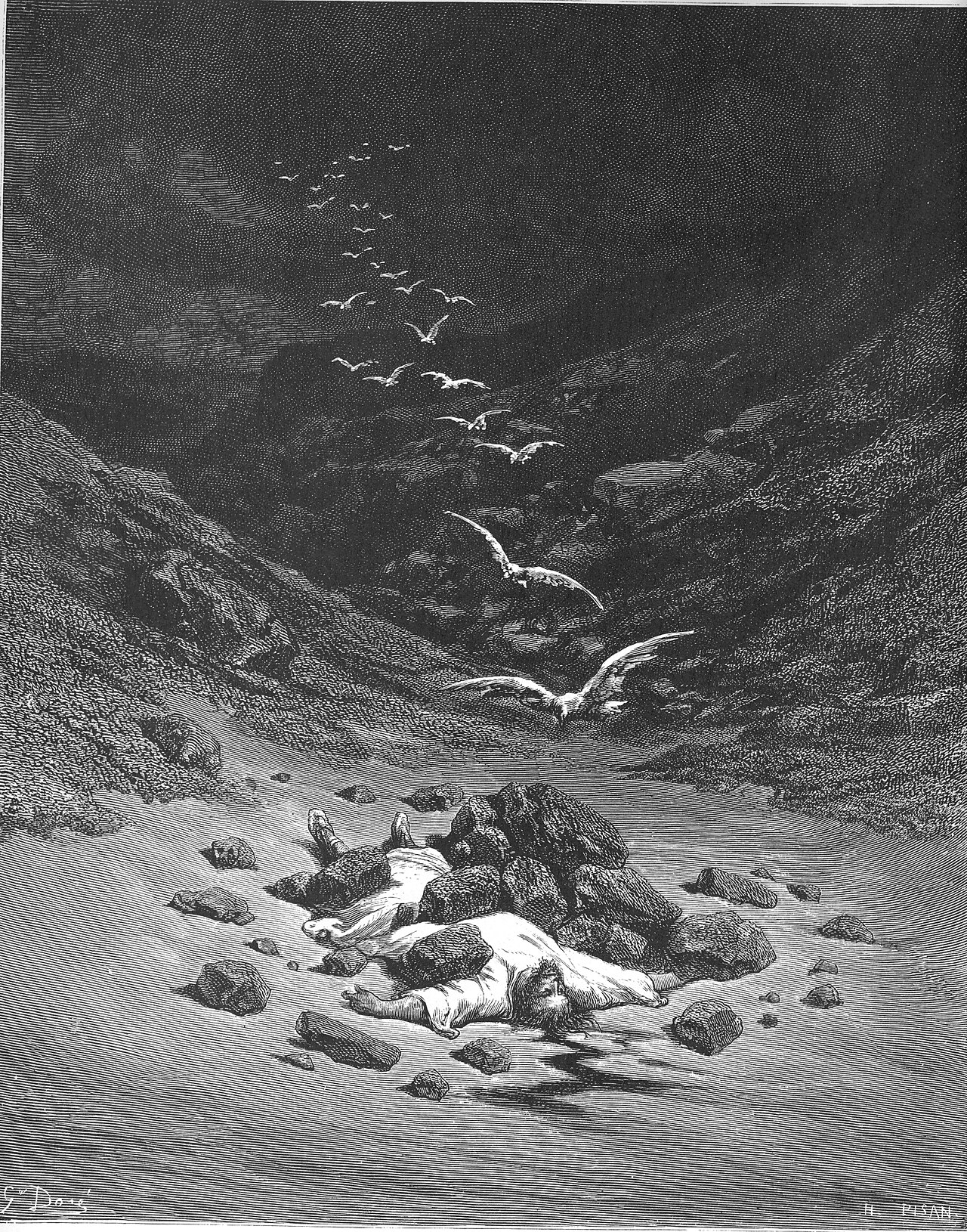
Achan Is Stoned to Death, Gustave Doré, Doré's English Bible (1866), public domain
Key verse
The Israelites, however, acted unfaithfully regarding the things devoted to destruction. Achan son of Carmi, the son of Zabdi, the son of Zerah, of the tribe of Judah, took some of what was set apart. So the anger of the LORD burned against the Israelites.
It stands in Routed at little Ai: hearts melt like water, verses 1 to 9.
The chapter
Chapter summary
Devoted spoil hidden in one tent undoes a nation. Israel is routed at little Ai, thirty-six men fall, 'and the hearts of the people melted, and became as water.' Joshua tears his clothes before the ark till evening, and Jehovah answers not with comfort but with diagnosis: 'Israel hath sinned; yea, they have even transgressed my covenant.' The lot narrows by tribe, family, and household to Achan, who confesses the goodly Babylonish mantle, the two hundred shekels of silver, and the wedge of gold hidden in the earth of his tent. Judgment falls in the valley of Achor, the valley Hosea 2 will later name a door of hope.
Context
History · Joshua · Joshua overview
Where the chapter sits
Joshua 7 falls in Conquest campaigns (chapters 6–12). Jericho and Ai (central); Gibeonite alliance; five-king coalition at Beth-horon (southern); Hazor and the northern kings.
Achan and the trespass. The Babylonish garment, the silver, the wedge of gold; defeat at Ai teaches covenant solidarity.
Before it: Entry into the Land, chapters 1–5. After it: Tribal allotments, chapters 13–22.
The whole shape of Joshua→The world behind this chapter
Joshua 7The history
Ai sat up in the hill country above Jericho, guarding the ascent to the ridge route. The scouts reported it was small and recommended sending only two or three thousand men, a reasonable assessment that turned into thirty-six dead and a rout down the slope.
The rest of the history, and what it meant to them
Achan's confession lists what he took: a beautiful robe from Shinar, two hundred shekels of silver, and a bar of gold weighing fifty shekels. Fine textiles from Mesopotamia were luxury export goods, the kind of thing named in royal gift lists. Two hundred shekels of silver was a serious fortune, several years' wages for a working man. He hid it in the ground inside his tent.
The offender was found by lot, narrowing tribe to clan to household to man. Casting lots to identify a guilty party was a recognized procedure, and the process gave Achan step after step to come forward on his own before the lot reached him.
Tearing clothes, putting dust on the head, and lying face down before the ark until evening were the standard signs of public mourning and appeal. Joshua's prayer is a raw one, he asks why God brought them across the river at all, and what will happen to God's own reputation when the Canaanites hear.
What it meant to them
The lesson the first hearers took was that the covenant is corporate. The text says Israel acted unfaithfully, though only one man had. A nation under a shared oath does not have private sins.
The place was named the Valley of Achor, trouble, and later prophets used that name deliberately when they spoke of God turning a valley of trouble into a door of hope.
Sources cited
- John H. Walton, Victor H. Matthews & Mark W. Chavalas, The IVP Bible Background Commentary: Old Testament
- Carl Friedrich Keil & Franz Delitzsch, Commentary on the Old Testament
The structure of this chapter
The heads below are this chapter's scenes. The numbered points under each are its verses.
A. Routed at little Ai: hearts melt like water
1. (v. 1)
Joshua 7:1
“But also we should not let it be passed over without comment that by one sinner wrath comes upon all the people.…But let us also see what sort of sin this person did. He stole, it says, "a tongue of gold" and placed it in his own tent.”
Read the whole quotation
I do not think so great a force of sin was in that theft of a little gold that it defiled the innumerable church of the Lord. But let us see if a deeper understanding does not reveal the enormity and severity of the sin.
Origen of Alexandria· written before 253· HOMILIES ON JOSHUA 7.6-7· Joshua 7:1patristic
Joshua 7:1, 1 more voiceWhat preachers and commentators have said about this verse, in their own words.
Joshua 7:1
“Committed a trespass - (compare Lev 5:15 note), “acted treacherously and committed a breach of faith.” This suitably describes the sin of Achan, who had purloined and hidden away that which had been dedicated to God by the ban Jos 6:19.”
Read the whole quotation
The “trespass” was the act of one man, yet is imputed to all Israel, who also share in the penalty of it Jos 7:5. This is not to be explained as though all the people participated in the covetousness which led to Achan’s sin Jos 7:
Albert Barnes· Notes, Explanatory and Practical, on the Old and New Testaments (1832-1869)· Joshua 7:1evangelical
a.The accursed thing first occurs at 6:18, in the warning Joshua gave before the city fell, that taking it would make the camp of Israel a curse. Here the sentence opens with the children of Israel committing the trespass, plural, and only afterward names the one man who took anything. Achan is traced four generations back to Zerah of Judah, and the chapter prints the same line again at verse 18, so a reader can place him in the tribe that receives the first and largest portion in chapter 15. The anger is kindled while the camp still knows nothing.
2. (vv. 2-3)
Joshua 7:2
“Sent men from Jericho to Ai - This is the place called Hai, Gen 12:8. It was in the east of Beth-el, north of Jericho, from which it was distant about ten or twelve miles. From Jos 7:4, Jos 7:5 it appears to have been situated upon a hill, and belonged to the Amorites, as we learn from Jos 7:7.”
Read the whole quotation
It is very likely that it was a strong place, as it chose to risk a siege, notwithstanding the extraordinary destruction of Jericho which it had lately witnessed.
Adam Clarke· Commentary on the Bible (1810-1826)· Joshua 7:2evangelical
Joshua 7:3
“Let not all the people go up, . . .”
Read the whole quotation
for they are but few--As the population of Ai amounted to twelve thousand (Jos 8:25), it was a considerable town; though in the hasty and distant reconnoitre made by the spies, it probably appeared small in comparison to Jericho; and this may have been the reason for their proposing so small a detachment to capture it.
Jamieson, Fausset & Brown· Commentary Critical and Explanatory on the Whole Bible (1871)· Joshua 7:3reformed
a.sent men from Jericho to: Jericho was taken on instructions given in advance, by a plan no commander would have chosen. Ai is scouted first, and the force is sized by an estimate of the enemy, they are but few, with the added reason that the march is not worth the labour. Nobody asks God anything in these two verses, which is the lapse the book states outright at 9:14, when Israel makes a league with Gibeon and asked not counsel at the mouth of the Lord. Barnes works the town's fighting strength back from the twelve thousand of 8:25, so the arithmetic of the spies was sound; what it left out was the reason the last wall came down.
3. (vv. 4-5)
Joshua 7:4
“About three thousand men - The spies sent to reconnoitre the place (Jos 7:3) reported that the town was meanly garrisoned, and that two or three thousand men would be sufficient to take it. These were accordingly sent up, and were repulsed by the Amorites.”
Adam Clarke· Commentary on the Bible (1810-1826)· Joshua 7:4evangelical
Joshua 7:4, 2 more voices
Joshua 7:4
“So there went up thither of the people about three thousand men,....”
John Gill· Exposition of the Old Testament (1748-1763)· Joshua 7:4reformed
Joshua 7:4
“He, as a public person, interested himself more than any other in this public loss, and is therein an example to princes and great men, and teaches them to lay much to heart the calamities that befal their people: he is also a type of Christ, to whom the blood of his subjects is precious, Ps. lxxii.”
Matthew Henry· Commentary on the Whole Bible (1707-1721)· Joshua 7:4puritan
Joshua 7:5
“Shebarim - Rather, perhaps, “the stone quarries.” The smallness of the slaughter among the Israelites indicates that they fled early, probably without real conflict in battle.”
Albert Barnes· Notes, Explanatory and Practical, on the Old and New Testaments (1832-1869)· Joshua 7:5evangelical
a.Thirty and six men is a small loss beside the numbers this book usually reports, and the effect runs far past the figure. The hearts of the people melted and became as water is the wording Rahab used of Canaan at 2:11 and the wording 5:1 used of the Amorite kings, so the sentence written twice about the enemy is now written about Israel. Barnes reads Shebarim as the stone quarries, and the short casualty list points to a line that broke before there was much fighting.
4. (vv. 6-9)
Joshua 7:6
“Joshua rent his clothes, and fell to the earth . . . before the ark . . . he and the elders--It is evident, from those tokens of humiliation and sorrow, that a solemn fast was observed on this occasion.”
Read the whole quotation
The language of Joshua's prayer is thought by many to savor of human infirmity and to be wanting in that reverence and submission he owed to God.
Jamieson, Fausset & Brown· Commentary Critical and Explanatory on the Whole Bible (1871)· Joshua 7:6reformed
Joshua 7:7
“Alas, O Lord God - Particles of exclamations and distress, or what are called interjections, are nearly the same in all languages: and the reason is because they are the simple voice of nature. The Hebrew word which we translate alas is אהה ahah.”
Adam Clarke· Commentary on the Bible (1810-1826)· Joshua 7:7evangelical
Joshua 7:8
“O Lord, what shall I say,.... For the comfort and encouragement of the people of Israel, in vindication of thy power and faithfulness, and against the charge of weakness in thyself, unfaithfulness to thy promises, and unkindness to thy people, brought by our enemies: when Israel hath turned their backs before their enemies?”
Read the whole quotation
or after they have done it; what is to be said now, this being the case? he speaks as a man confounded, and at the utmost loss how to account for the power, the providence, and promises of God.
John Gill· Exposition of the Old Testament (1748-1763)· Joshua 7:8reformed
Joshua 7:9
“What wilt thou do unto thy great name? - i. e. “after the Canaanites have cut off our name what will become of Thy Name?” This bold expostulation, that of one wrestling in sore need with God in prayer, like the similar appeals of Moses in earlier emergencies (Compare the marginal references), is based upon God’s past promises and mercies.”
Read the whole quotation
What would be said of (God by the pagan if now He permitted Israel to be destroyed?
Albert Barnes· Notes, Explanatory and Practical, on the Old and New Testaments (1832-1869)· Joshua 7:9evangelical
a.Joshua's complaint takes up the wilderness generation's own words, would to God we had been content and dwelt on the other side Jordan, which is the murmur of Exodus 14:12 and Numbers 14:2 pointed back across the river. Then he argues the way Moses argued, what wilt thou do unto thy great name, the plea of Exodus 32:12 and Numbers 14:15-16 and Deuteronomy 9:28 put in fewer words. Clarke observes that no rebuke follows for the prayer itself, and that the answer corrects the posture rather than the words. Jamieson, Fausset and Brown record that many readers hear human weakness in the language, and the chapter neither defends him nor blames him.
B. Israel hath sinned: get thee up
1. (vv. 10-12)
Joshua 7:10
“And the Lord said unto Joshua, get thee up,....”
Read the whole quotation
From the ground where he lay prostrate, with his face to it: this he said, not as refusing his supplication to him, but rather as encouraging and strengthening him; though chiefly he said this in order to instruct him, and that he might prepare for what he was to do: wherefore liest thou thus upon thy face? in this manner, so distressed and dejected; or for this thing, as the Targum, for this defeat of the army; something else is to be done besides prayer and supplication.
John Gill· Exposition of the Old Testament (1748-1763)· Joshua 7:10reformed
Joshua 7:10, 1 more voice
Joshua 7:10
“Wherefore liest thou thus upon thy face? - It is plain there was nothing in Joshua’s prayer or complaint that was offensive to God, for here there is no reprehension: Why liest thou thus? this is no time for complaint; something else is indispensably necessary to be done.”
Adam Clarke· Commentary on the Bible (1810-1826)· Joshua 7:10evangelical
Joshua 7:11
“Also stolen, and dissembled also - The anger of God and the heinousness of Israel’s sin are marked by the accumulation of clause upon clause. As a climax they had even appropriated to their own use the consecrated property purloined from God.”
Albert Barnes· Notes, Explanatory and Practical, on the Old and New Testaments (1832-1869)· Joshua 7:11evangelical
Joshua 7:12
“Because they were accursed - From this verse it appears that the nature of the execration or anathema was such, that those who took of the thing doomed to destruction fell immediately under the same condemnation. The inhabitants of Jericho and all that they had were accursed: therefore they and all their substance were to be destroyed.”
Read the whole quotation
The Israelites took of the accursed thing, and therefore became accursed with it. This was certainly understood when the curse was pronounced: Every man who touches this property shall be involved in the same execration.
Adam Clarke· Commentary on the Bible (1810-1826)· Joshua 7:12evangelical
a.The answer begins by telling Joshua to get off the ground, and then lays the charge with Israel as its subject rather than Achan. After Israel hath sinned, five more verbs follow: transgressed, taken, stolen, dissembled, and put it even among their own stuff, each one a step further from the first act. Verse 12 suspends what Joshua was given at 1:5, that God would not fail him nor forsake him, and makes its return conditional on destroying the accursed from among them. Clarke draws the mechanism out of the word itself, that whatever touched the devoted thing fell under the same sentence, so Israel stands accursed by contact rather than by consent.
2. (vv. 13-15)
Joshua 7:13
“Up, sanctify the people - Joshua, all the time that God spake, lay prostrate before the ark: he is now commanded to get up, and sanctify the people, i.e., cause them to wash themselves, and get into a proper disposition to hear the judgment of the Lord relative to the late transactions.”
Adam Clarke· Commentary on the Bible (1810-1826)· Joshua 7:13evangelical
Joshua 7:14
“Ye shall be brought according to your tribes - It has been a subject of serious inquiry in what manner and by what means the culpable tribe, family, household, and individual, were discovered.”
Read the whole quotation
The Jews have many conceits on the subject; the most rational is, that the tribes being, in their representatives, brought before the high priest, the stone on the breastplate gave immediate intimation by suddenly losing its lustre. According to them, this is what is termed consulting God by Urim and Thummim.
Adam Clarke· Commentary on the Bible (1810-1826)· Joshua 7:14evangelical
Joshua 7:15
“And it shall be, that he that is taken with the accursed thing shall be burnt with fire,....”
John Gill· Exposition of the Old Testament (1748-1763)· Joshua 7:15reformed
Joshua 7:15, 2 more voices
Joshua 7:15
“However God was hereby glorified, and the judgment executed was thus made the more tremendous. The punishment itself that was inflicted on him.”
Read the whole quotation
He was stoned (some think as a sabbath breaker, supposing that the sacrilege was committed on the sabbath day), and then his dead body was burnt, as an accursed thing, of which there should be no remainder left.
Matthew Henry· Commentary on the Whole Bible (1707-1721)· Joshua 7:15puritan
Joshua 7:15
“He and all that he has must be burnt with fire, that there might be no remainders of the accursed thing among them; and the reason given for this severe sentence is because the criminal has, (1.)”
Read the whole quotation
Given a great affront to God: He has transgressed the covenant of the Lord, who is jealous particularly for the honour of the holy covenant.
Matthew Henry· Commentary on the Whole Bible (1707-1721)· Joshua 7:15puritan
a.The remedy is a public assembly, and the people are told to sanctify themselves before the search starts, the same preparation ordered at Sinai in Exodus 19:10 and at the Jordan in Joshua 3:5. The narrowing runs by tribes, then families, then households, then man by man, and each step says the Lord taketh rather than naming a method; Clarke reports the older Jewish explanations, including the stone of the high priest's breastplate losing its light. He hath wrought folly in Israel uses a phrase Scripture keeps for a short list of acts, Genesis 34:7 over Dinah, Deuteronomy 22:21, and again in Judges 19 and 20.
C. Achan's mantle, silver, and wedge of gold
1. (vv. 16-18)
Joshua 7:16
“So Joshua rose up early in the morning,....”
Read the whole quotation
Which showed his readiness and diligence to obey the command of God; and as there was much work to do, it required that he should rise early: and brought Israel by their tribes: before the Lord, at the tabernacle, where he and the high priest and elders attended; each tribe was thither brought by their representatives: and the tribe of Judah was taken: either his stone in the breastplate of the high priest looked dull, as some say, or rather the lot being cast fell on that tribe.
John Gill· Exposition of the Old Testament (1748-1763)· Joshua 7:16reformed
Joshua 7:17
“And he brought the family of Judah,....”
Read the whole quotation
That is, the tribe of Judah, as Kimchi and Ben Melech interpret it, (z); or rather, the several families in that tribe, even the heads of them: and he took the family of the Zarhites: which descended from Zerah the son of Judah; that was taken by lot: and he brought the family of the Zarhites man by man; and cast lots on them: and Zabdi was taken: that part of the family of the Zarhites which sprung from Zabdi, a son of Zerah. (z) So R. Sol. Ohel Moed, fol. 94. 2.
John Gill· Exposition of the Old Testament (1748-1763)· Joshua 7:17reformed
Joshua 7:18
“And he brought his household man by man,.... The household of Zabdi, the heads of each house therein: and Achan, the son of Carmi, the son of Zabdi, the son of Zerah, of the tribe of Judah, was taken; the lot fell upon him, and he was laid hold on, and detained.”
John Gill· Exposition of the Old Testament (1748-1763)· Joshua 7:18reformed
Joshua 7:18, 1 more voice
Joshua 7:18
“It was strange that Achan, being conscious to himself of guilt, when he saw the lot come nearer and nearer to him, had not either the wit to make an escape or the grace to make a confession; but his heart was hardened through the deceitfulness of sin, and it proved to be to his own destruction.”
Matthew Henry· Commentary on the Whole Bible (1707-1721)· Joshua 7:18puritan
a.Four rounds of lot, and the tribe taken is Judah, the tribe that receives the first and largest inheritance in chapter 15 and carries the sceptre of Genesis 49:10. Henry weighs what that costs the most honoured name in the census lists. Achan watches the lot come nearer through three rounds and says nothing until it reaches him. Proverbs 16:33 states the principle the whole procedure runs on, that the lot is cast into the lap and the disposing of it belongs to the Lord.
2. (vv. 19-20)
Joshua 7:19
“Give glory to the Lord - A form of solemn adjuration by which the person addressed was called upon before God to declare the truth. The phrase assumes that the glory of God is always promoted by manifestation of the truth (compare the marginal references).”
Albert Barnes· Notes, Explanatory and Practical, on the Old and New Testaments (1832-1869)· Joshua 7:19evangelical
Joshua 7:20
“But human habits have so long applied themselves to this admiration of money that no one is thought worthy of honor unless he is rich. This is no new habit. No, this vice (and that makes the matter worse) grew long years ago in human hearts.”
Read the whole quotation
When the city of Jericho fell at the sound of the priests' trumpets and Joshua the son of Nun gained the victory, he knew that the valor of the people was weakened through love of money and desire for gold.
Ambrose of Milan· written before 397· On the Duties of the Clergy 2.26.129· Joshua 7:20patristic
Joshua 7:20, 1 more voice
Joshua 7:20
“I have sinned against the Lord God - This seems a very honest and hearty confession, and there is hope that this poor culprit escaped perdition.”
Adam Clarke· Commentary on the Bible (1810-1826)· Joshua 7:20evangelical
a.Joshua calls him my son, and give glory to the God of Israel is a formula of solemn adjuration, a demand for the truth under oath; the same words are put to the healed man in John 9:24 by men who want an admission out of him. Barnes reads it as summoning a man before God to speak plainly. Achan answers without argument, indeed I have sinned against the Lord God of Israel, and the older commentators divide over what the confession was worth to him, Clarke holding out hope for the man while others read an admission the lot had already forced.
3. (v. 21)
Joshua 7:21
“A goodly Babylonian garment - literally, “a robe or cloak of Shinar,” the plain in which Babylon was situated Gen 10:10. It was a long robe such as was worn by kings on state occasions Jon 3:6, and by prophets 1Ki 19:13; Zec 13:4.”
Read the whole quotation
The Assyrians were in early times famous for the manufacture of beautiful dyed and richly embroidered robes (compare Eze 23:15). That such a robe should be found in a Canaanite city is natural enough.
Albert Barnes· Notes, Explanatory and Practical, on the Old and New Testaments (1832-1869)· Joshua 7:21evangelical
Joshua 7:21, 1 more voice
Joshua 7:21
“When I saw - He accurately describes the progress of his sin, which began at his eye, which he permitted to gaze upon them, which inflamed his desire, and made him covet them; and that desire made him take them; and having taken, resolve to keep them; and to that end hide them in his tent.”
John Wesley· Explanatory Notes upon the Old Testament (1765)· Joshua 7:21evangelical
a.I saw among the spoils: The confession gives the order, and the order is what the verse is for: I saw, then I coveted, then I took, then I hid. Genesis 3:6 runs the same three steps, saw and desired and took, and 2 Samuel 11:2-4 runs them again. The Babylonish garment is literally a robe of Shinar, the plain named at Genesis 10:10, so the goods themselves say where they came from and how far trade reached into a Canaanite town; Barnes notes that robes of that make were worn by kings and prophets. Two hundred shekels of silver and a wedge of gold at fifty shekels weight is a large sum, and the tenth commandment names the step that came before the taking.
4. (vv. 22-23)
Joshua 7:22
“And they ran - Partly longing to free themselves and all the people from the curse under which they lay; and partly that none of Achan's relations might get thither before them, and take away the things. It was hid - That is, the parcel of things mentioned, ver. 21 and 24.”
John Wesley· Explanatory Notes upon the Old Testament (1765)· Joshua 7:22evangelical
Joshua 7:22, 1 more voice
Joshua 7:22
“So Joshua sent messengers,....”
John Gill· Exposition of the Old Testament (1748-1763)· Joshua 7:22reformed
Joshua 7:23
“And they took them out of the midst of the tent,....”
John Gill· Exposition of the Old Testament (1748-1763)· Joshua 7:23reformed
a.The messengers run, and running is the only quick movement in a chapter that otherwise proceeds by assembly and lot. The tent is opened and the ground matches the confession exactly, the garment buried and the silver under it, as verse 21 had said. Then the goods are laid out before the Lord, so the silver and the gold reach the treasury they were devoted to at 6:19, after a defeat and thirty-six graves.
5. (vv. 24-25)
Joshua 7:24
“Joshua - took Achan - and all that he had - He and his cattle and substance were brought to the valley to be consumed; his sons and his daughters, probably, to witness the judgments of God inflicted on their disobedient parent. See Jos 7:25.”
Adam Clarke· Commentary on the Bible (1810-1826)· Joshua 7:24evangelical
Joshua 7:24, 1 more voice
Joshua 7:24
“If it be pretended that some of them were infants; the text doth not say so, but only calls them sons and daughters.”
Read the whole quotation
And considering that Achan was an old man, as is most probable, because he was the fifth person from Judah, it seems most likely, that the children were grown up, and so capable of knowing, and concealing, or discovering this fact.
John Wesley· Explanatory Notes upon the Old Testament (1765)· Joshua 7:24evangelical
Joshua 7:25
“Why hast thou troubled us?”
Read the whole quotation
- Here is a reference to the meaning of Achan’s or Achar’s name, מה עכרתנו meh Achar-tanu; and as עכר achar is used here, and not עכן achan, and the valley is called the valley of Achor, and not the valley of Achan, hence some have supposed that Achar was his proper name, as it is read 1Ch 2:7, and in some MSS., and ancient versions. See the note on Jos 7:
Adam Clarke· Commentary on the Bible (1810-1826)· Joshua 7:25evangelical
Joshua 7:25, 1 more voice
Joshua 7:25
“They were stoned (which was the punishment of such offenders, Lev. xxiv, 14 Num. xv, 35,) and not burned to death; but God would have their dead carcases burned to shew his utmost detestation of such persons as break forth into sins of such a public scandal and mischief.”
John Wesley· Explanatory Notes upon the Old Testament (1765)· Joshua 7:25evangelical
a.Achan's sons and daughters are brought down to the valley with the oxen and the tent, and what happened to them is disputed. Verse 25 carries both pronouns, stoned him with stones and burned them with fire, and readers have taken the them for the family or for the goods and the cattle. Deuteronomy 24:16 forbids putting children to death for a father and 2 Kings 14:6 quotes that law as binding, which is the ground of the narrower reading; those who hold that the household died with him point to verse 24 and read the family as knowing what lay buried under their own floor. Joshua's question uses the verb the valley takes its name from, why hast thou troubled us, and the sentence he pronounces turns that same verb back.
6. (v. 26)
Joshua 7:26
“They raised over him a great heap of stones - The burial-places, both of heroes and eminent culprits, were anciently thus distinguished; and transactions of this kind gave rise to those great piles of stones called cairns, that are so frequently to be met with, especially in northern countries.”
Read the whole quotation
From the whole of this account we may see the exceeding sinfulness of sin, and the great danger of not withstanding its first approaches. By covetousness many lives and many souls have been destroyed, and yet the living lay it not to heart!
Adam Clarke· Commentary on the Bible (1810-1826)· Joshua 7:26evangelical
Joshua 7:26, 1 more voice
Joshua 7:26
“A great heap of stones - As a monument of the sin and judgment here mentioned, that others might be warned by the example; and as a brand of infamy, as chap. viii, 29;”
John Wesley· Explanatory Notes upon the Old Testament (1765)· Joshua 7:26evangelical
a.This is the second heap of stones in the book, after the twelve stones set up at Gilgal in chapter 4, and a third goes over the king of Ai at 8:29. The place keeps the name of the trouble, and 1 Chronicles 2:7 calls the man himself Achar, the troubler of Israel, so the name and the deed are held together in the record. Hosea 2:15 takes that same valley and gives it back as a door of hope, and Isaiah 65:10 has it as a place for herds to lie down, which is what later Scripture does with the worst ground in Joshua.
This page carries no textual note on Joshua 7. Where this site has examined a place the manuscripts differ, the examination is in the manuscripts room. Every place this site examines →
This page draws on 9 works. Open the list of works
This page draws on Adam Clarke; Albert Barnes; Ambrose of Milan, On the Duties of the Clergy 2.26.129; Jamieson, Fausset & Brown; John Gill; John Wesley, Explanatory Notes upon the Old Testament (1765); Keil and Delitzsch, Biblical Commentary on the Old Testament: Joshua, Judges, Ruth; Matthew Henry and Origen of Alexandria, HOMILIES ON JOSHUA 7.6-7.
Keep studying
On this page
Studies3
On this chapter
On this book