
Genesischapter 9
29 verses · Moses, by tradition · 15th to 13th century BC · The Law
And God blessed Noah and his sons and said to them, “Be fruitful and multiply and fill the earth.
Introduction
Moses, by tradition, The Law, Genesis Overview.
This chapter was written for Israel in the wilderness, a people about to receive laws on blood, on killing and on the peoples of Canaan, and tradition gives it to Moses. It opens with a covenant God makes after the flood with Noah and with every living creature. It then turns to a family scene that shows sin surviving the flood. Listen for the reason God gives for protecting human life, and for the sign He sets in the sky. Notice too which name falls under the curse at the end. That name told Israel where the peoples they would meet came from.
Context
- Who
- Israel in the wilderness, being given the reason behind their own laws about blood and about Canaan
- What
- An account of God's blessing and covenant with Noah after the flood, sealed by the rainbow, and of Noah's drunkenness and his sons' response.
- Where
- The land below the mountains of Ararat, and later Noah's vineyard and his tent.
- When
- Before any dated history; the chapter follows the flood and closes with Noah's death at the age of 950.
- Why
- To give the reason behind Israel's laws on blood and on murder, and to show that the covenant holds the world steady while sin continues.
Historical context
The chapter stands at the end of the generations of Noah and carries a covenant God makes with Noah, with his sons and with every living creature. Noah then plants a vineyard, and the chapter closes on what his sons do at the tent.
Show the rest of the historical context, 4 more paragraphs
Meat is expressly permitted here with one restriction, that it is eaten without its blood. That rule runs through the whole later system of sacrifice and was still being applied by the church at Acts 15. Blood rituals were common in the surrounding cultures, and here the blood is treated as the life and is held to belong to God.
Capital justice is put on a stated basis, since human life is protected because human beings carry God's image. The law codes of the region graded penalties by the social class of the victim, and the Code of Hammurabi punishes the killing of a nobleman and of a commoner at very different rates.
The bow set in the cloud is a weapon of war hung up. The gods of that world were pictured carrying bows, and this one lays his down and turns it away from the earth.
The vineyard carries its own weight. Terraced vine growing marked settled life in the hill country, and wine in that period was potent. The curse that follows falls on Canaan, and Israel, on the road to Canaan, is being told where the peoples they will meet came from.
Significance
A nation about to receive its laws heard the reason underneath them, that life is sacred because people carry God's image and that the blood belongs to God.
Show the rest of the significance, 1 more paragraph
The bow gave them something to look at, since the covenant it seals is made with every living creature and holds the world from being unmade again.
This chapter in Jewish lifeWhat this chapter is in Jewish life and reading.
What is done
This chapter is heard inside the second portion of the annual cycle, in the same sitting as the flood and the table of the nations (src/lib/hebraic/readings.ts). The blessing on Noah, the covenant of the bow and the drunkenness in the tent are read together with what comes before them. The card above carries the portion and the prophetic reading set beside it.
How it is read
The corpus holds the English text of two comments on this chapter and the reference alone for twenty two more. Radak is quoted from the CC-BY translation of Eliyahu Munk, HaChut Hameshulash.
Radak reads the blessing of the first verse as a renewal rather than a new gift. The household had stood under the blessing given at creation, and the blessing was said again to reassure them after the flood. He holds that the blessing was chiefly "the promise that they would once again be fruitful and multiply" (Radak on Genesis 9:1:1). On the nineteenth verse he reads the word for the spreading of the sons as a scattering. He points to the same word used of the people leaving Saul at 1 Samuel 13:11 (Radak on Genesis 9:19:1). He notes that the word is used again of the dispersion at Babel.
Rashi comments on eighteen verses of this chapter, and the corpus holds the text of none of them, because the licence Sefaria reports for that English version keeps it out. They run from Rashi on Genesis 9:2:1 on the fear of man to Rashi on Genesis 9:24:1 on Noah waking. Those comments cover the blood of the fourth verse, the reckoning for blood in the fifth and the image of God in the sixth. They cover the covenant in the ninth to the eleventh, the bow in the twelfth to the seventeenth, and the tent in the twentieth to the twenty fourth. Ibn Ezra stands on three verses, at Ibn Ezra on Genesis 9:8:1, 9:13:1 and 9:15:1.
What the rabbis say
The corpus records forty places where the Midrash and the Talmud cite this chapter, thirty three under Midrash and seven under Talmud, with the locator for each one and no text. The chapter carries no quoted saying in this corpus, so the references stand here and the sayings are read at the source.
Bereshit Rabbah reads the second verse at 29:4, the third at 34:13, the seventh at 34:15 and the eighth and ninth together at 35:1. It reads the twelfth verse at 35:2, the thirteenth at 13:12, the twenty fourth at 36:6 to 36:7 and the twenty fifth at 59:9. It reads the twenty sixth verse at 26:3 and the twenty eighth at 32:6.
Bereshit Rabbati reads five verses of the chapter in Parashat Noah, at 24 on the third verse, 37 on the fifth, 20 on the eleventh, 21 on the fifteenth and 5 on the sixteenth. Bamidbar Rabbah reads the first verse at 11:2, the second at 12:4, the fourth at 14:12 and the twentieth at 10:4. Aggadat Bereshit reads the first verse at 4:2, the twelfth at 1:1, the eighteenth at 10:1, the nineteenth at 10:3 and the twenty second at 37:2. Midrash Tehillim reads the tenth verse at 93:3, Devarim Rabbah reads the twenty seventh at 1:1, and Otzar Midrashim reads the ninth at Sefer Tagin 25:16.
The Talmud is cited at Bava Kamma 91b:8 on the reckoning for blood and at Avodah Zarah 5a:7 on the seventh verse. It is cited at Berakhot 40a:14 and 25b:11 on the drunkenness and the covering of the father. The Jerusalem Talmud reads the blood of the fourth verse at Nazir 6:1:6, and Avot DeRabbi Natan reads the image of God at 16:2 and 39:1.
Sources: Radak, Radak on Genesis 9:1:1 and 9:19:1, in HaChut Hameshulash, translated by Eliyahu Munk, CC-BY, about 1200; Rashi and Ibn Ezra, their twenty two comments on Genesis 9, cited by reference; the licence Sefaria reports for the English versions keeps the text out of the corpus; The Midrash and the Talmud, the forty locators on Genesis 9 in scripts/data/sources/sefaria/genesis/9.json; MannaFest, the annual cycle table at src/lib/hebraic/readings.ts, 2026.
The heads below are this chapter's scenes. The numbered points under each are its verses.
Be Fruitful; Lifeblood Is Sacred
Genesis 9:1-3
The blessing of 1:28 is spoken again over Noah, and two things have changed. The words about subduing the earth and ruling the creatures are gone, and in their place the fear and dread of man falls on every living creature. Everything that lives and moves is now food, where 1:29 gave only the green plants. Man eats meat from here on.
Genesis 9:1
“And God blessed Noah--Here is republished the law of nature that was announced to Adam, consisting as it originally did of several parts. Be fruitful, &c.--The first part relates to the transmission of life, the original blessing being reannounced in the very same words in which it had been promised at first [Ge 1:28].”
Jamieson, Fausset & Brown · Commentary Critical and Explanatory on the Whole Bible (1871)reformed
The fear and dread of you: Jamieson, Fausset and Brown read this as man's rule over the creatures set up again, now held by fear where at first it rested on kindness. The dread keeps every beast from man's haunts, apart from those in his service. The rule of 1:28 now rests on fear.
Genesis 9:2
“And the fear of you and the dread of you--The second part re-establishes man's dominion over the inferior animals; it was now founded not as at first in love and kindness, but in terror; this dread of man prevails among all the stronger as well as the weaker members of the animal tribes and keeps away from his haunts all but those employed in his service.”
Jamieson, Fausset & Brown · Commentary Critical and Explanatory on the Whole Bible (1871)reformed
I now give you all things: Irenaeus held that mankind ate no meat before the flood. Now everything that lives and moves is food, clean and unclean alike. Matthew Henry sets beside this that every creature God made is good, citing 1 Timothy 4.
Genesis 9:3
“Every moving thing - shall be meat - There is no positive evidence that animal food was ever used before the flood. Noah had the first grant of this kind, and it has been continued to all his posterity ever since. It is not likely that this grant would have been now made if some extraordinary alteration had not taken place in the vegetable world, so as to render its productions less nutritive than they were before; and probably such a change in the constitution of man as to render a grosser and higher diet necessary.”
Adam Clarke · Commentary on the Bible (1810-1826)evangelical
1 more voice on this verse
Genesis 9:3
“And He changed the food of men, giving them leave to eat flesh: for from Adam the first-formed until the Flood men ate only of seeds and the fruit of trees, and to eat flesh was not permitted to them.”
Irenaeus · written before 202 · The Demonstration of the Apostolic Preaching, Section 22patristic
meat with its lifeblood still in it: One thing is held back from the grant, meat with its lifeblood still in it. Leviticus 17:11 puts the same ground under the altar, that the life of the flesh is in the blood and God gave it to make atonement. Adam Clarke reads the rule here as guarding what would become the instrument of expiation, the means by which sin is covered. Acts 15:20 keeps it for Gentile believers.
Genesis 9:4
“Man must not prejudice his own life by eating that food which is unwholsome, and prejudicial to his health. But flesh with the life thereof, which is the blood thereof, shall ye not eat - Blood made atonement for the soul, Lev. xvii, 11. The life of the sacrifice was accepted for the life of the sinner.”
John Wesley · Explanatory Notes upon the Old Testament (1765)evangelical
1 more voice on this verse
Genesis 9:4
“But flesh with the life thereof, which is the blood - Though animal food was granted, yet the blood was most solemnly forbidden, because it was the life of the beast, and this life was to be offered to God as an atonement for sin. Hence the blood was ever held sacred, because it was the grand instrument of expiation, and because it was typical of that blood by which we enter into the holiest. 1. Before the deluge it was not eaten, because animal food was not in use.”
Adam Clarke · Commentary on the Bible (1810-1826)evangelical
Genesis 9:5-7
I will require the life of any man or beast: The ground of the death penalty is that God made mankind in His own image, damaged at the fall and still standing after the flood. The Hebrew behind his fellow man reads a man his brother, and it reaches back to chapter 4, where Cain killed Abel and was marked for protection. Hebrews 12:24 sets the blood of Jesus over Abel's blood, speaking a better word. Verse 7 turns back to the blessing, be fruitful and multiply.
Genesis 9:5
“Surely your blood - will I require; at the hand of every beast - This is very obscure, but if taken literally it seems to be an awful warning against cruelty to the brute creation; and from it we may conclude that horse-racers, hare-hunters, bull-baiters, and cock-fighters shall be obliged to give an account to God for every creature they have wantonly destroyed. Instead of חיה chaiyah, “beast,” the Samaritan reads Yod Kaph chai, “living,” any “living creature or person;” this makes a very good sense, and equally forbids cruelty either to men or brutes.”
Adam Clarke · Commentary on the Bible (1810-1826)evangelical
2 more voices on this verse
Genesis 9:5
“Indeed, I will require your blood, and the blood of your souls from all beasts, and from the hand of man (Gen. IX, 5). He compared it to bestial malice, or rather even accumulated the wickedness of man beyond the ferocity of beasts, by saying: From the hand of the brother of man. Indeed, beasts have nothing in common with us in nature, and they are not bound by any brotherly right. If they harm humans, they harm them as strangers.”
Ambrose of Milan · written before 397 · On Noah and the Ark, 26.94patristic
Genesis 9:5
“Our lives are not so our own as that we may quit them at our own pleasure, but they are God's and we must resign them at his pleasure; if we in any way hasten our own deaths, we are accountable to God for it.”
Matthew Henry · Commentary on the Whole Bible (1707-1721)puritan
Whoever sheds the blood of man: The Hebrew runs sheds, blood, man, then man, blood, shed, so the words turn back on the man who shed it. Adam Clarke held that God requires a man's life only for wilful murder, and the one who kills by accident is set apart. Numbers 35 gives such a man a city of refuge.
Genesis 9:6
“Whoso sheddeth man's blood . . . for in the image of God made he man--It is true that image has been injured by the fall, but it is not lost. In this view, a high value is attached to the life of every man, even the poorest and humblest, and an awful criminality is involved in the destruction of it.”
Jamieson, Fausset & Brown · Commentary Critical and Explanatory on the Whole Bible (1871)reformed
2 more voices on this verse
Genesis 9:6
“Wilful murderers must be put to death. This is the sin which is here designed to be restrained by the terror of punishment (1.) God will punish murderers: At the hand of every man's brother will I require the life of man, that is, "I will avenge the blood of the murdered upon the murderer." 2 Chron. xxiv.”
Matthew Henry · Commentary on the Whole Bible (1707-1721)puritan
Genesis 9:6
“Whoso sheddeth man’s blood, by man shall his blood - Hence it appears that whoever kills a man, unless unwittingly, as the Scripture expresses it, shall forfeit his own life. A man is accused of the crime of murder; of this crime he is guilty or he is not: if he be guilty of murder he should die; if not, let him be punished according to the demerit of his crime; but for no offense but murder should he lose his life.”
Adam Clarke · Commentary on the Bible (1810-1826)evangelical
spread out across the earth: John Gill reads the command beside verse 6: murder cuts lives off, and the charge is to multiply them. Matthew Henry hears the whole earth handed to them. The builders of Babel resist this very call at 11:4, afraid of being scattered.
Genesis 9:7
“And you, be ye fruitful and multiply,.... Instead of taking away the lives of men, the great concern should be to multiply them; and this indeed is one reason of the above law, to prevent the decrease and ruin of mankind; and which was peculiarly needful, when there were so few men in the world as only four, and therefore it is repeated in stronger terms: bring forth abundantly in the earth, and multiply therein; that the whole earth might be overspread with men, and repeopled sufficiently, as it was by the sons of Noah, see Gen 9:19.”
The Bow Set in the Cloud
Genesis 9:8-11
Then God said to Noah and his sons with him: The word covenant first enters the Bible at 6:18, spoken to this same man before the ark was built. Here it is established on the far side of the water, and it runs one way: God binds Himself and asks nothing back. The parties are Noah, his descendants after him, and every living creature that came out of the ark. The promise is exact: no flood will destroy the earth again.
Genesis 9:8
“And God spake unto Noah, and to his sons with him,.... Not only what is contained in the preceding verses, but in the subsequent ones: saying; as follows.”
1 more voice on this verse
Genesis 9:8
“And his Lord spoke to [Noah], as he desired that Noah hear, "Because of your righteousness, a remnant was preserved and did not perish in that flood that took place.”
Ephrem the Syrian · written before 373 · COMMENTARY ON GENESIS 6.13.2patristic
I now establish My covenant: The Hebrew verb is present: God sets the covenant up as He speaks. With only four men alive, as John Gill counts at verse 7, the descendants after you take in every people listed in chapter 10. Genesis 17:7 repeats the phrase for Abraham.
Genesis 9:9
“I that am faithful and able to make it good." 3. That God's covenants are established more firmly than the pillars of heaven or the foundations of the earth, and cannot be disannulled. That God's covenants are made with the covenanters and with their seed; the promise is to them and their children.”
Matthew Henry · Commentary on the Whole Bible (1707-1721)puritan
1 more voice on this verse
Genesis 9:9
“God's purpose, therefore, was to eliminate all apprehension from Noah's thinking and for him to be quite assured that this would not happen again. He said, remember, "Just as I brought on the deluge out of love, so as to put a stop to their wickedness and prevent their going to further extremes, so in this case too it is out of my love that I promise never to do it again, so that you may live free of all dread and in this way see your present life to its close."”
John Chrysostom · written before 407 · HOMILIES ON GENESIS 28.4patristic
and with every living creature: The beasts stand inside the covenant as parties to it, beside Noah and his descendants. Adam Clarke drew from verse 5 a warning against cruelty to every living creature. Hosea 2:18 makes a covenant with the beasts again.
all life be cut off: What God said in His heart at 8:21 He now says to Noah as a covenant. Isaiah 54:9 holds up this oath from the days of Noah as the pattern for God's pledge to Zion. Cut off is karath, the verb for making a covenant.
Genesis 9:12-13
The sign of the covenant is announced in verse 12 and named in verse 13. It is the rainbow, and the Hebrew word qeshet is the word for a war bow, hung in the cloud with its arc turned away from the earth. Adam Clarke notes that the Greeks and Romans, like the Hebrews, already read the rainbow as a sign sent from heaven. God set it between Himself and the earth.
Genesis 9:12
“After these things God made a covenant with Noah and with all those who came out of the ark with him, saying, "All flesh shall never again perish in the waters of a flood.”
Ephrem the Syrian · written before 373 · COMMENTARY ON GENESIS 6.15.3patristic
I have set My rainbow: Jamieson, Fausset and Brown read set as appointed, so a rainbow already seen in the clouds becomes the sign of the covenant. Adam Clarke credits Isaac Newton with explaining how it forms. The other party named here is the earth itself.
Genesis 9:13
“I do set my bow in the cloud - On the origin and nature of the rainbow there had been a great variety of conjectures, till Anthony de Dominis, bishop of Spalatro, in a treatise of his published by Bartholus in 1611, partly suggested the true cause of this phenomenon, which was afterwards fully explained and demonstrated by Sir Isaac Newton. To enter into this subject here in detail would be improper; and therefore the less informed reader must have recourse to treatises on Optics for its full explanation.”
Adam Clarke · Commentary on the Bible (1810-1826)evangelical
1 more voice on this verse
Genesis 9:13
“I do set my bow in the cloud--set, that is, constitute or appoint. This common and familiar phenomenon being made the pledge of peace, its appearance when showers began to fall would be welcomed with the liveliest feelings of joy.”
Jamieson, Fausset & Brown · Commentary Critical and Explanatory on the Whole Bible (1871)reformed
Connectionscovenant sign, Revelation 4:3
Genesis 9:14-17
Whenever I form clouds over the earth: God says twice that He will see the rainbow and remember the covenant, at verse 15 and verse 16. The keeping of it rests on the one who made it. The sign is set to appear when the clouds gather, which is the hour the old fear would come back. Verse 16 calls it the everlasting covenant.
I will remember My covenant: When God remembers in Genesis, He acts, as at 8:1, when He remembered Noah and the waters went down. The rainbow calls the covenant to mind whenever clouds form. Jamieson, Fausset and Brown picture each shower after the flood met with joy.
the everlasting covenant: This is the first covenant in Scripture called everlasting. The phrase returns for Abraham at 17:7, for David at 2 Samuel 23:5 and for the blood of Christ at Hebrews 13:20. Adam Clarke reasoned that the rainbow must appear whenever sun and rain meet in the clouds, so it stands as proof for every generation.
Genesis 9:16
“The rainbow is the reflection of the beams of the sun, which intimates that all the glory and significancy of the seals of the covenant are derived from Christ the Sun of righteousness, who is also described with a rainbow about his throne ( Rev. iv.”
Matthew Henry · Commentary on the Whole Bible (1707-1721)puritan
1 more voice on this verse
Genesis 9:16
“THE story of Noah's preservation in the ark is a suggestive representation of salvation by our Lord Jesus Christ. It is, we think, especially intended to depict that part of our salvation which lies in the washing of regeneration. In the same way as Baptism is the outward symbol of regeneration, so also is the ark, "wherein few, that is, eight souls were saved by water." The ark was immersed in those dreadful rains and awful waterfalls which deluged the earth, and Noah's family were buried in that ark to all the world.”
the sign of the covenant: The Hebrew for sign is oth, the word used for the mark the LORD placed on Cain at 4:15. It returns for circumcision, the sign of the covenant with Abraham at 17:11. God names the bow a sign three times in six verses.
Genesis 9:17
“This is the token - אות oth, The Divine sign or portent: The bow shall be in the cloud. For the reasons above specified it must be there, when the circumstances already mentioned occur; if therefore it cannot fail because of the reasons before assigned, no more shall my promise; and the bow shall be the proof of its perpetuity. Both the Greeks and Latins, as well as the Hebrews, have ever considered the rainbow as a Divine token or portent; and both of these nations have even deified it, and made it a messenger of the gods.”
Adam Clarke · Commentary on the Bible (1810-1826)evangelical
Noah's Vineyard and Shame
Genesis 9:18-19
The sons of Noah who came out of the ark: The text names Ham as the father of Canaan before the story of the tent begins, and names him so again in verse 22. Three sons carry the whole earth, and the table of nations at 10:1 is built out of them. Canaan is the son the curse of verse 25 will fall on.
Genesis 9:18
“Now the three sons of Noah were Shem, Ham and Japheth, from whom again the race was multiplied: for these were the beginning of mankind after the flood. Now of these one fell under a curse, and the two (others) inherited a blessing by reason of their works.”
Irenaeus · written before 202 · The Demonstration of the Apostolic Preaching, Sections 19-21patristic
the whole earth was populated: John Gill reads this as the command of verse 7 fulfilled, the earth populated again by Noah's three sons. The Hebrew verb means scattered abroad. Chapter 11 tells how the spread came about at Babel.
Genesis 9:20-23
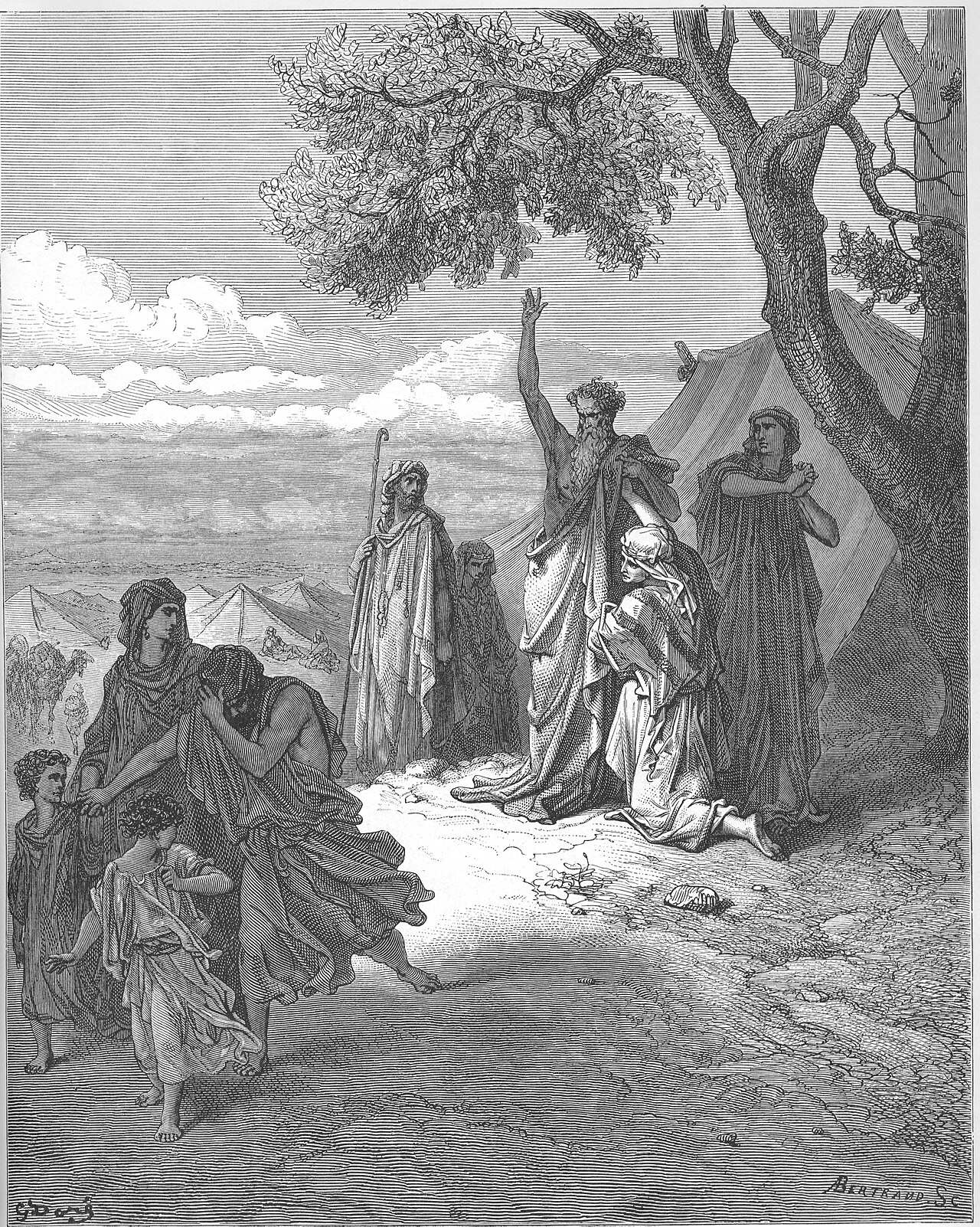
a man of the soil: Noah plants a vineyard, drinks its wine and lies uncovered inside his tent. Ham sees his father's nakedness and goes out to tell it, while Shem and Japheth walk in backward and cover him without looking. The garment they carry on their shoulders answers the garments of skin God made at 3:21, and the beats of Eden run again here, a planting, a fruit, a nakedness and a covering. Canaan was already born, so this falls years after the ark.
Genesis 9:20
“Noah began to be a husbandman - איש האדמה ish haadamah, A man of the ground, a farmer; by his beginning to be a husbandman we are to understand his recommencing his agricultural operations, which undoubtedly he had carried on for six hundred years before, but this had been interrupted by the flood. And the transaction here mentioned might have occurred many years posterior to the deluge, even after Canaan was born and grown up, for the date of it is not fixed in the text.”
Adam Clarke · Commentary on the Bible (1810-1826)evangelical
1 more voice on this verse
Genesis 9:20
“When Christ says, "I am the true vine," the blood of Christ is assuredly not water but wine. We are redeemed and made alive by his blood. But in the cup it is not wine as such that redeems but his blood. This is declared by the sacrament and testimony of all the Scriptures. For we find this even in Genesis also, in respect of the sacrament prefigured in Noah. That he drank wine was to them a precursor and figure of the Lord's passion.”
Cyprian · written before 258 · Epistle LXII.2-3patristic
he became drunk and uncovered himself: Adam Clarke held that Noah, a man of the soil planting the first vineyard, drank the wine without knowing its strength. Matthew Henry called the drunkenness a blot on a righteous man. He read blameless at 6:9 as sincerity.
Genesis 9:21
“He drank of the wine, etc. - It is very probable that this was the first time the wine was cultivated; and it is as probable that the strength or intoxicating power of the expressed juice was never before known. Noah, therefore, might have drunk it at this time without the least blame, as he knew not till this trial the effects it would produce. I once knew a case which I believe to be perfectly parallel.”
Adam Clarke · Commentary on the Bible (1810-1826)evangelical
1 more voice on this verse
Genesis 9:21
“That the fairest copy that ever mere man wrote since the fall had its blots and false strokes. It was said of Noah that he was perfect in his generations ( ch. vi. 9 ), but this shows that it is meant of sincerity, not a sinless perfection.”
Matthew Henry · Commentary on the Whole Bible (1707-1721)puritan
saw his father’s nakedness: Ham sees, then carries the story outside. Adam Clarke held that Canaan probably joined his father in treating Noah with contempt. That reading would account for the curse falling on Canaan at verse 25.
Genesis 9:22
“For another mystery was accomplished and predicted in the days of Noah, of which you are not aware. It is this: in the blessings wherewith Noah blessed his two sons, and in the curse pronounced on his son's son. For the Spirit of prophecy would not curse the son that had been by God blessed along with [his brothers]. But since the punishment of the sin would cleave to the whole descent of the son that mocked at his father's nakedness, he made the curse originate with his son.”
Justin Martyr · written before 165 · Dialogue with Trypho, Chapter CXXXIXpatristic
1 more voice on this verse
Genesis 9:22
“And Ham, the father of Canaan, etc. - There is no occasion to enter into any detail here; the sacred text is circumstantial enough. Ham, and very probably his son Canaan, had treated their father on this occasion with contempt or reprehensible levity. Had Noah not been innocent, as my exposition supposes him, God would not have endued him with the spirit of prophecy on this occasion, and testified such marked disapprobation of their conduct.”
Adam Clarke · Commentary on the Bible (1810-1826)evangelical
walking backward, they covered: The brothers' care is spelled out step by step: the garment on the shoulders, the backward walk, the turned faces. Matthew Henry saw here a robe of reverence thrown over the faults of parents, beside the love that covers faults in 1 Peter 4. Clement of Alexandria praised the chastity that covered it.
Genesis 9:23
“The chaste son could not endure looking upon the immodest nakedness of a good man; chastity covered over what drunkenness had exposed in a transgression committed in ignorance but manifest to all.”
Clement of Alexandria · written before 215 · The Instructor Book 2patristic
1 more voice on this verse
Genesis 9:23
“There is a mantle of love to be thrown over the faults of all, 1 Pet. iv. Besides this, there is a robe of reverence to be thrown over the faults of parents and other superiors.”
Matthew Henry · Commentary on the Whole Bible (1707-1721)puritan
Genesis 9:24-25
When Noah awoke from his drunkenness: Noah speaks this curse, and it falls on Canaan. Justin Martyr read the shift as deliberate: the word could not land on a son God had blessed by name in verse 1, so it settled on his line. John Gill takes Noah to be prophesying on learning what his youngest son had done. The curse names the Canaanite nations, and Genesis 15:16 grounds their judgment on their own iniquity.
Genesis 9:24
“It is probable that there is a long interval included between these verses and that this prophecy, like that of Jacob on his sons, was not uttered till near the close of Noah's life when the prophetic spirit came upon him; this presumption is strengthened by the mention of his death immediately after.”
Jamieson, Fausset & Brown · Commentary Critical and Explanatory on the Whole Bible (1871)reformed
A servant of servants: means the lowest of servants. Canaan is named servant again in verses 26 and 27, under Shem and under Japheth. Matthew Henry notes that the Canaanites long prospered while cursed, until their iniquity was full.
Genesis 9:25
“Cursed be Canaan - See on the preceding verses. In the 25th, 26th, and 27th verses, instead of Canaan simply, the Arabic version has Ham the father of Canaan; but this is acknowledged by none of the other versions, and seems to be merely a gloss.”
Adam Clarke · Commentary on the Bible (1810-1826)evangelical
1 more voice on this verse
Genesis 9:25
“The Canaanites were under a curse of slavery, and yet, for a great while, had the dominion; for a family, a people, a person, may lie under the curse of God, and yet may long prosper in the world, till the measure of their iniquity, like that of the Canaanites, be full. Many are marked for ruin that are not yet ripe for ruin. Therefore, Let not thy heart envy sinners.”
Matthew Henry · Commentary on the Whole Bible (1707-1721)puritan
Genesis 9:26-27
The blessing goes to the LORD, the God of Shem. The line runs from Shem through the genealogy of 11:10 to 26 to Abram, and out of Abram comes the promise of 12:3, that all the families of the earth will be blessed through him. Japheth is given room and a place in Shem's tents, and Canaan is servant to both. Matthew Henry reads that as the nations coming in under a blessing given to another.
Genesis 9:26
“Blessed be the Lord God of Shem--rather, "Blessed of Jehovah, my God, be Shem,"--an intimation that the descendants of Shem should be peculiarly honored in the service of the true God, His Church being for ages established among them (the Jews), and of them, concerning the flesh, Christ came.”
Jamieson, Fausset & Brown · Commentary Critical and Explanatory on the Whole Bible (1871)reformed
1 more voice on this verse
Genesis 9:26
“Observe, [1.] He calls the Lord the god of Shem; and happy, thrice happy, is that people whose God is the L ORD , Ps. cxliv. All blessings are included in this.”
Matthew Henry · Commentary on the Whole Bible (1707-1721)puritan
ConnectionsGenesis 12:3
expand the territory of Japheth: The verb expand, yapht, plays on the name Japheth. The words may he dwell can be read of God or of Japheth. Matthew Henry reads them both ways, God dwelling in Shem's tents with Christ to come from his loins, and Japheth dwelling in God's tents.
Genesis 9:27
“And again, many dwell in large tents that do not dwell in God's tents, as Japheth did. Secondly, Shem has the blessing of heaven above: He shall (that is, God shall) dwell in the tents of Shem, that is "From his loins Christ shall come, and in his seed the church shall be continued. " The birth-right was now to be divided between Shem and Japheth, Ham being utterly discarded.”
Matthew Henry · Commentary on the Whole Bible (1707-1721)puritan
Genesis 9:28-29
After the flood, Noah lived 350 years: Noah lives 350 years after the flood, and the refrain of Genesis 5 closes over him, and then he died. The man who walked through the judgment still comes under the sentence of 3:19. Jerome reads the 120 years of 6:3 as a term of warning to that generation. Noah's whole life ran 950 years.
Genesis 9:28
“And Noah lived after the flood three hundred and fifty years.”
2 more voices on this verse
Genesis 9:28
“But Noah lived three hundred and fifty years after the flood, and all the days of his life were nine hundred and fifty years, and he died.”
Bede · written before 735 · Commentary on Genesis (Hexaemeron)patristic
Genesis 9:28
“4 But flesh with the life thereof, which is the blood thereof, shall ye not eat. 5 And surely your blood of your lives will I require; at the hand of every beast will I require it, and at the hand of man; at the hand of every man's brother will I require the life of man. 6 Whoso sheddeth man's blood, by man shall his blood be shed: for in the image of God made he man.”
Matthew Henry · Commentary on the Whole Bible (1707-1721)puritan
a total of 950 years: Noah's 950 years rank third in Genesis, after Methuselah and Jared. Jerome pressed his 350 years after the flood against reading 6:3 as a limit of 120 years on a human life.
How this psalm is built
The form: A covenant speech to Noah and his sons, followed by the account of the vineyard and the oracle spoken over the three lines, as Jamieson, Fausset & Brown classes it.
The patterns in this chapter
| Device | What it does | Where to see it |
|---|---|---|
| Be fruitful and multiply, said at both ends | Verse 1 opens with the blessing and verse 7 closes with it, and the charter over the creatures, the grant of food, the guard on blood and the ground of that guard all stand between the two. John Gill reads verse 7 as the same word repeated in stronger terms, and he ties the repetition to the law just given, since the concern is to multiply human lives rather than to take them, in a world that then held four men.John Gill, Exposition of the Old Testament, 1748 to 1763, on Genesis 9:7. | Genesis 9:1, Genesis 9:7 |
| The law of nature republished in its parts | Jamieson, Fausset and Brown read verses 1 to 4 as a republication of the law announced to Adam, and they number its parts as the text gives them. The first part concerns the transmission of life and comes in the very words of Genesis 1:28. The second re-establishes man's dominion over the animals, now founded in terror where it had been founded in love and kindness. The third concerns the means of sustaining life, and it carries one restriction with it.Jamieson, Fausset & Brown, Commentary Critical and Explanatory on the Whole Bible, 1871, on Genesis 9:1. | Genesis 9:1, Genesis 9:2, Genesis 9:3, Genesis 9:4 |
| The bow of war hung in the cloud | The Hebrew word at verse 13 is qeshet, the ordinary word for a war bow, and it stands in the cloud with its arc turned away from the earth. This site's published exposition of verses 12 and 13 marks the choice of word. Jamieson, Fausset and Brown read the verb with it, holding that set there means constitute or appoint, so that a common and familiar sight was made the pledge of peace and would afterwards be welcomed when showers began.This site's published exposition of Genesis, the published note on Genesis 9:12 and 13 in the store, whose sources are Adam Clarke, Commentary on the Bible, and Jamieson, Fausset & Brown, Commentary Critical and Explanatory on the Whole Bible. | Genesis 9:13, Genesis 9:14 |
| I will remember, said twice over | God says at verse 15 and again at verse 16 that He will see the bow and remember the covenant. This site's published exposition of verses 14 to 17 draws the point out: the keeping of the covenant rests on the one who made it, and the sign is set to appear at the hour the clouds gather, which is the hour the old fear would return. Verse 16 gives the covenant its name, the everlasting covenant.This site's published exposition of Genesis, the published note on Genesis 9:14 to 17 in the store, whose sources are Matthew Henry, Commentary on the Whole Bible, and John Gill, Exposition of the Old Testament. | Genesis 9:15, Genesis 9:16 |
| The oracle spoken over the three lines | Verses 25 to 27 are three sayings, one over Canaan, one over Shem and one over Japheth, and they are the first words Genesis records from Noah's own mouth. John Gill holds that they were spoken by inspiration under a spirit of prophecy rather than in a drunken fit or in the heat of passion, since the text says Noah had awaked from his wine. Jamieson, Fausset and Brown hold that a long interval stands before them, and that the prophecy came near the close of Noah's life, which they infer from the death notice following at once.John Gill, Exposition of the Old Testament, 1748 to 1763, on Genesis 9:25. | Genesis 9:25, Genesis 9:26, Genesis 9:27 |
The debate over the curse on Canaan
16 more paragraphs on the patterns
The name is deliberate. On this reading the word falls on Canaan because God had already blessed Noah's sons by name at verse 1, so the curse settles on the line that came from the offender rather than on the man God had blessed. This site's published exposition of verses 24 and 25 records that Justin Martyr read the shift that way in the Dialogue with Trypho. The reading takes the text exactly as it stands and explains the one thing that puzzles every reader. The strongest objection is that verse 22 names Ham as the one who saw and told, and Canaan is absent from the account of the tent, so the sentence lands on a son for a father's act.
The name is a later reading. On this reading the curse was aimed at Ham and Canaan's name entered the verse afterwards. Adam Clarke records the evidence for it, that the Arabic version reads Ham the father of Canaan at verses 25, 26 and 27 in place of Canaan alone. Clarke also gives the objection himself, that the Arabic reading is acknowledged by none of the other versions and appears to be merely a gloss (Commentary on the Bible, 1832, on Genesis 9:25).
The words are prophecy rather than temper. John Gill holds that Noah spoke after he had awaked from his wine, by inspiration and under a spirit of prophecy, and that the sayings are either a declaration of what Canaan's case already was or a prediction of what it would be (Exposition of the Old Testament, 1748 to 1763, on Genesis 9:25). Jamieson, Fausset and Brown place the sayings late, holding that a long interval is included before them and that the prophetic spirit came on Noah near the close of his life, as with Jacob over his sons (Commentary Critical and Explanatory on the Whole Bible, 1871, on Genesis 9:24). The strongest objection to their placing is that it rests on the death notice standing immediately after the oracle, which is an inference from the order of the text rather than a date the text gives.
What the sayings settle is narrower than they have often been made to carry. Matthew Henry observes that the Canaanites lay under a curse of slavery and yet held dominion for a great while, and he draws the general rule from it, that a family, a people or a person may lie under the curse of God and still prosper in the world until the measure of their iniquity is full (Commentary on the Whole Bible, 1710, on Genesis 9:25). This site's published exposition of verses 24 and 25 grounds the later judgment of the Canaanite nations on their own iniquity at Genesis 15:16, which is the reason the text itself gives when that judgment comes.
The debate over the grant of food and the blood
Whether animal food begins here. Adam Clarke holds that it does, that Noah had the first grant of this kind and it has continued to all his posterity since (Commentary on the Bible, 1832, on Genesis 9:3). Jamieson, Fausset and Brown reach the same reading with a hedge, that man was for the first time, as it would seem, allowed the use of animal food, and they note that the grant came with one restriction attached (Commentary Critical and Explanatory on the Whole Bible, 1871, on Genesis 9:3). The strongest objection is that the text states the grant and leaves its cause unstated, and Clarke's account of an altered vegetable world and an altered human constitution is offered by him as probable rather than as taught.
Why the blood is held back. Adam Clarke reads the prohibition as a guard on the instrument of expiation, since the blood was the life of the beast and that life was to be offered to God as an atonement, and he ties it to Leviticus 17:11 (Commentary on the Bible, 1832, on Genesis 9:4). John Wesley reads it the same way, that blood made atonement for the soul and the life of the sacrifice was accepted for the life of the sinner (Explanatory Notes upon the Old Testament, 1765, on Genesis 9:4). Jamieson, Fausset and Brown read it as a rule about cruelty, holding that the sole intention was to prevent the excesses of cannibal ferocity in eating the flesh of living animals, to which men of the earlier ages were liable (Commentary Critical and Explanatory on the Whole Bible, 1871, on Genesis 9:4). The strongest objection to the sacrificial reading is that the rule is given to the whole race centuries before the altar law of Israel. The strongest objection to the reading about cruelty is that Leviticus 17:11 gives the ground explicitly, and gives it as atonement.
The New Testament's use
The council at Jerusalem keeps the rule of verse 4 for Gentile believers, as this site's published exposition of verse 4 records at Acts 15:20.
The letter to the Hebrews takes up the blood that verse 5 reaches back to. This site's published exposition of verses 5 to 7 records Hebrews 12:24, where the blood of Jesus speaks a better word than the blood of Abel.
The sign of verse 13 comes back at the throne. Matthew Henry reads the rainbow of this chapter with the rainbow about the throne at Revelation 4, and takes the seals of the covenant to draw their glory from Christ (Commentary on the Whole Bible, 1710, on Genesis 9:16).
The blessing of verse 26 runs forward through the book. This site's published exposition of verses 26 and 27 follows Shem's line through the genealogy of Genesis 11:10 to Abram, and out of Abram to the promise of Genesis 12:3 that all the families of the earth will be blessed through him.
What verse 13 says, and what has been established about it
What the text says. God sets His bow in the clouds and names it the sign of the covenant, and verse 14 ties its appearing to the hour He forms clouds over the earth. Verses 15 and 16 say what God will do when He sees it.
What has been established, and by whom. Adam Clarke reports the history of the explanation: the origin and nature of the rainbow was a matter of conjecture until Anthony de Dominis, bishop of Spalatro, partly suggested the true cause in a treatise published by Bartholus in 1611, which Sir Isaac Newton afterwards fully explained and demonstrated (Commentary on the Bible, 1832, on Genesis 9:13). Clarke draws the theological use of that himself at verse 17, that the bow must appear when the stated conditions occur, and that a promise tied to something which cannot fail is a promise that cannot fail either.
What is contested. Whether the bow appeared before this day is left open by the verb. Jamieson, Fausset and Brown read set as constitute or appoint, which allows a common and familiar phenomenon to be given a new office here (Commentary Critical and Explanatory on the Whole Bible, 1871, on Genesis 9:13). Adam Clarke's account of the optics runs the same way, since the cause he describes belongs to light and water rather than to a new creation. The text states the appointment and leaves the history of the phenomenon unstated.
Keep studying
Studies7
Places1
Words12
Subjects1
Sources for this chapter
The summary
Jamieson, Fausset & Brown, Commentary Critical and Explanatory; John Wesley, Notes on the Old Testament and Matthew Henry, Complete Commentary.
The form and classifications
Adam Clarke, Commentary on the Bible, 1832, on Genesis 9:17; Jamieson, Fausset & Brown, Commentary Critical and Explanatory on the Whole Bible, 1871, on Genesis 9:1; John Gill, Exposition of the Old Testament, 1748 to 1763, on Genesis 9:25 and Matthew Henry, Commentary on the Whole Bible, 1710, on Genesis 9:9.
The exposition
Adam Clarke, Commentary on the Bible; Clement of Alexandria, The Instructor Book 2; Irenaeus, The Demonstration of the Apostolic Preaching, Section 22; Jamieson, Fausset & Brown, Commentary Critical and Explanatory on the Whole Bible; Jerome, Hebrew Questions on Genesis; John Calvin, Commentary on Genesis; John Gill; Justin Martyr, Dialogue with Trypho and Matthew Henry, Commentary on the Whole Bible.