
Genesischapter 45
28 verses · Moses, by tradition · 15th to 13th century BC · The Law
In Jewish life
The reading
Weekly portion 11 of 54
וַיִּגַּשׁ Vayigash, Genesis 44:18 to 47:27
Read with it: Ezekiel 37:15 to 37:28.
The verse numbers here are the ones a Hebrew Bible carries, which differ from an English Bible by a verse or two in several places. The Sephardi reading is named only where this site records a difference; communities vary beyond what is listed. What these books are, and how a Christian reader meets them →
How it is read
Rashi reads the clearing of the room as a kindness done to the brothers rather than a demand for privacy: "He could not bear that the Egyptians should stand by him" while his brothers were shamed (Rashi on Genesis 45:1:1, the Pentateuch with Rashi's commentary by M. Rosenbaum and A. M. Silbermann, 1929 to 1934, public domain), and their silence at his words he explains in three words, "out of shame" (Rashi on Genesis 45:3:1). Joseph's title before Pharaoh he takes as an office, "he made me his colleague and he bestowed on me the dignity of" father to the king (Rashi on Genesis 45:8:1), and the command to go up he explains by the land itself, "because the land of Israel is situated higher than all the neighbouring countries", on Kiddushin 69a (Rashi on Genesis 45:9:1). The weeping on Benjamin's neck he reads as a sight of what would come, "for the Temples which were to be in Benjamin's territory and which would ultimately be laid in ruins" (Rashi on Genesis 45:14:1), and he marks the moment the brothers could speak at last, "after they saw that he wept and realized that he was peaceably inclined towards them" (Rashi on Genesis 45:15:1). Joseph's parting word to them on the road he takes as advice about study rather than about quarrelling, in the first of two explanations: "Do not busy yourselves with Halachic discussions lest the road become unsteady for you" (Rashi on Genesis 45:24:1). Ramban reads the choice of Goshen as Joseph knowing his father: "Joseph knew that his father would not want to stay in that part of the land of Egypt where the royal palace was" (Ramban on Genesis 45:10:1, the Commentary on the Torah by Ramban, translated and annotated by Charles B. Chavel, Shilo Publishing House, New York, 1971 to 1976, CC-BY). Sforno reads Joseph's command to hurry as a son's wish for his father, "in order to afford him the joy to see all this with his own eyes" (Sforno on Genesis 45:13:1, translated by Eliyahu Munk, HaChut Hameshulash, CC-BY), and Radak keeps to the plain report, that the brothers "They loaded their beasts and they were quick about it in order to get started on the way home to Canaan" (Radak on Genesis 45:21:1, Munk translation, CC-BY). One comment of Rashi at 45:4:1 and one of Ibn Ezra at 45:22:1 stand without English in the corpus, so both are citations.
What the rabbis say
The corpus records forty rabbinic locators on this chapter, thirty-six of them Midrash and four Talmud. Midrash Lekach Tov is the densest work here, cited at Genesis 45:4:1, 45:4:2, 45:5:1, 45:7:1, 45:7:2, 45:10:1, 45:11:1, 45:13:1, 45:15:1 and 45:20:1, which is the disclosure and the message to Jacob almost sentence by sentence. Bereshit Rabbah is cited at 25:3, 90:1, 93:2, 93:8, 93:10, 93:11, 93:12, 94:2, 94:3 and 95:3, Bereshit Rabbati at Parashat Vayigash 3, 4, 27 and 29, Aggadat Bereshit at 37:2, 61:2, 65:3, 73:3 and 79:4, and Midrash Aggadah at Genesis 45:2:1 and 45:27:1. Bamidbar Rabbah 14:8, Esther Rabbah 7:25, Midrash Sekhel Tov at Bereshit 45:10:1 and 45:11:1 and Ein Yaakov (Glick Edition), Taanit 1:43 each stand once. The four Talmud locators are Chagigah 4b:8 at the brothers' dismay, Avodah Zarah 9b:3 at the count of the famine years, Jerusalem Talmud Eruvin 3:1:8 at the gifts sent to Jacob, and Avot DeRabbi Natan 30:4 at the news reaching the father. Rashi hands on further sayings with their locators, among them Genesis Rabbah 93:10 and 93:12 and Kiddushin 69a.
The text, verse by verse
Each word shows the Hebrew, the English under it, how it sounds and its Strong’s number. A rule between verses marks where the Hebrew manuscripts end a paragraph.
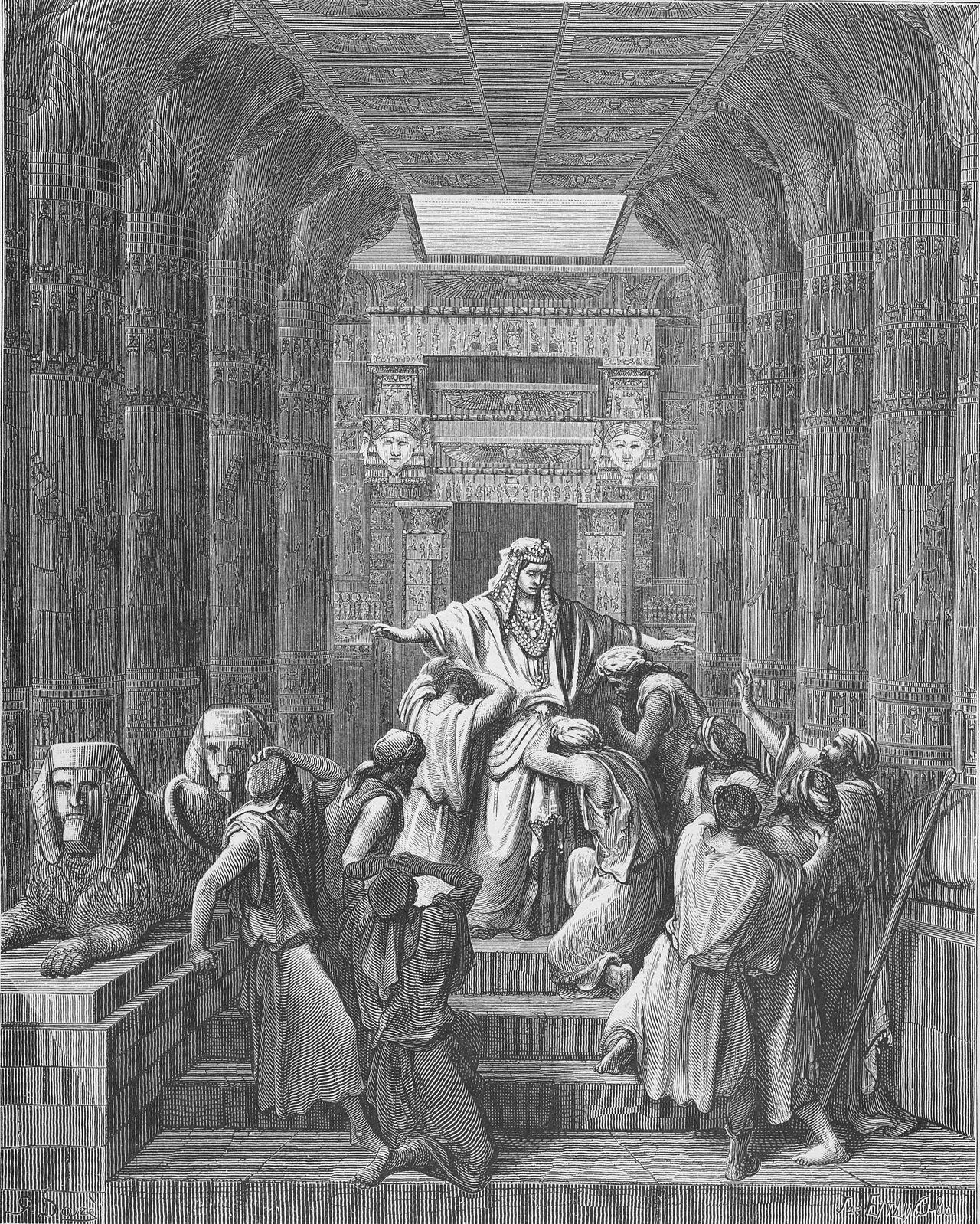
I Am Joseph, Your Brother
Ramban on Genesis 45:1
THEN JOSEPH COULD NOT ‘L’HITHAPEIK’ (REFRAIN HIMSELF) BEFORE ALL THEM THAT STOOD BY HIM. He could not bear that the Egyptians should stand by him witnessing how his brothers would be put to shame when he makes himself known to them. This is the language of Rashi.
Read it in full at Sefaria · Commentary on the Torah by Ramban (Nachmanides). Translated and annotated by Charles B. Chavel. New York, Shilo Pub. House, 1971-1976
Onkelos Genesis 45:1
Yoseif could not contain his emotions in the presence of all who stood before him, and he cried out Let everyone leave my presence.
Read it in full at Sefaria · Metsudah Chumash, Metsudah Publications, 2009 [with Onkelos translation]
Ramban on Genesis 45:10
Joseph knew that his father would not want to stay in that part of the land of Egypt where the royal palace was. Therefore he now informed him that he will settle him in the land of Goshen.
Read it in full at Sefaria · Commentary on the Torah by Ramban (Nachmanides). Translated and annotated by Charles B. Chavel. New York, Shilo Pub. House, 1971-1976
Ramban on Genesis 45:11
Joseph said this by way of respect for his father. To his brothers he said, For G-d did send me before you to preserve life, 39 Verse 5 here. and to give you a remnant, 40 Verse 7 here.
Read it in full at Sefaria · Commentary on the Torah by Ramban (Nachmanides). Translated and annotated by Charles B. Chavel. New York, Shilo Pub. House, 1971-1976
Ramban on Genesis 45:12
I.e., in the Holy Language. This is the opinion of the commentators, 41 Rashi, Ibn Ezra and R’dak. and it is also the translation of Onkelos.
Read it in full at Sefaria · Commentary on the Torah by Ramban (Nachmanides). Translated and annotated by Charles B. Chavel. New York, Shilo Pub. House, 1971-1976
Ibn Ezra on Genesis 45:14
NECK. Scripture employs both the plural and singular forms for the neck. 10 The singular of neck is tzavvar. Cf.
Read it in full at Sefaria · Ibn Ezra's commentary on the Pentateuch, tran. and annot. by H. Norman Strickman and Arthur M. Silver. Menorah Pub., 1988-2004
Pharaoh Sends Wagons for Jacob
Jacob's Spirit Revives
Hebrew words in this chapter
The 40 most used Hebrew words of the chapter, counted by lemma. The article, the object marker, the negatives and the common prepositions are left out.
| Word | Sense here | Uses | Strong’s |
|---|---|---|---|
| יוֹסֵףYôwçêph | Joseph | 14 | H3130 |
| אָחʼâch | brother | 12 | H251 |
| אָמַרʼâmar | to say | 11 | H559 |
| אָבʼâb | father | 11 | H1 |
| אֶרֶץʼerets | land | 11 | H776 |
| מִצְרַיִםMitsrayim | Egypt | 10 | H4714 |
| נָתַןnâthan | to give | 6 | H5414 |
| פַּרְעֹהParʻôh | Pharaoh | 6 | H6547 |
| עַיִןʻayin | eye | 6 | H5869 |
| שָׁלַחshâlach | he sent me | 6 | H7971 |
| בֵּןbên | son | 6 | H1121 |
| בַּיִתbayith | household of | 5 | H1004 |
| עוֹדʻôwd | still | 5 | H5750 |
| בּוֹאbôwʼ | to come | 5 | H935 |
| אֱלֹהִיםʼĕlôhîym | God | 4 | H430 |
| רָאָהrâʼâh | to see | 4 | H7200 |
| בִּנְיָמִיןBinyâmîyn | Benjamin | 4 | H1144 |
| דָבַרdâbar | to speak | 4 | H1696 |
| נָשָׂאnâsâʼ | and you will carry | 4 | H5375 |
| אִישׁʼîysh | man | 3 | H376 |
| Word | Sense here | Uses | Strong’s |
|---|---|---|---|
| שָׁמַעshâmaʻ | and they heard | 3 | H8085 |
| חַיchay | alive | 3 | H2416 |
| הֵנָּהhênnâh | hither | 3 | H2008 |
| שָׁנֶהshâneh | year | 3 | H8141 |
| חָמֵשׁchâmêsh | five | 3 | H2568 |
| שׂוּםsûwm | make | 3 | H7760 |
| בָּכָהbâkâh | and he wept | 3 | H1058 |
| עָשָׂהʻâsâh | do | 3 | H6213 |
| הָלַךְhâlak | went | 3 | H1980 |
| טוּבṭûwb | good thing of | 3 | H2898 |
| עֲגָלָהʻăgâlâh | cart | 3 | H5699 |
| דֶּרֶךְderek | way | 3 | H1870 |
| יָכֹלyâkôl | be able | 2 | H3201 |
| עָמַדʻâmad | he stood | 2 | H5975 |
| קוֹלqôwl | voice | 2 | H6963 |
| נָגַשׁnâgash | draw near | 2 | H5066 |
| מָכַרmâkar | you sold | 2 | H4376 |
| עַתָּהʻattâh | now | 2 | H6258 |
| רָעָבrâʻâb | famine | 2 | H7458 |
| חָיָהchâyâh | and to preserve alive | 2 | H2421 |
Keep studying
Sources for this chapter
The Hebrew text
STEP Bible, the tagged Hebrew text and its English glosses and James Strong, Strong's Exhaustive Concordance.
In Jewish life
Rashi, Rashi on Genesis 45:1:1, 45:2:1, 45:3:1, 45:5:1, 45:6:1, 45:8:1, 45:9:1, 45:11:1, 45:12:1, 45:14:1, 45:15:1, 45:16:1, 45:17:1, 45:18:1, 45:19:1, 45:23:1, 45:24:1 and 45:26:1, the Pentateuch with Rashi's commentary by M. Rosenbaum and A. M. Silbermann, 1929 to 1934, public domain; Rashi on Genesis 45:4:1, cited only; Ramban, Ramban on Genesis 45:10:1, the Commentary on the Torah by Ramban (Nachmanides), translated and annotated by Charles B. Chavel, Shilo Publishing House, New York, 1971 to 1976, CC-BY; Sforno, Sforno on Genesis 45:13:1, translated by Eliyahu Munk, HaChut Hameshulash, CC-BY; Radak, Radak on Genesis 45:20:1 and 45:21:1, translated by Eliyahu Munk, HaChut Hameshulash, CC-BY; Ibn Ezra, Ibn Ezra on Genesis 45:22:1, cited only, no English version in the corpus under a licence permitting quotation; Midrash, Midrash Lekach Tov, Genesis 45:4:1, 45:4:2, 45:5:1, 45:7:1, 45:7:2, 45:10:1, 45:11:1, 45:13:1, 45:15:1 and 45:20:1; Bereshit Rabbah 25:3, 90:1, 93:2, 93:8, 93:10, 93:11, 93:12, 94:2, 94:3 and 95:3; Bereshit Rabbati, Parashat Vayigash 3, 4, 27 and 29; Aggadat Bereshit 37:2, 61:2, 65:3, 73:3 and 79:4; Midrash Aggadah, Genesis 45:2:1 and 45:27:1; Midrash Sekhel Tov, Bereshit 45:10:1 and 45:11:1; Bamidbar Rabbah 14:8; Esther Rabbah 7:25; Ein Yaakov (Glick Edition), Taanit 1:43; Babylonian Talmud, Chagigah 4b:8, Avodah Zarah 9b:3; Kiddushin 69a as Rashi cites it; Jerusalem Talmud, Jerusalem Talmud Eruvin 3:1:8 and Avot DeRabbi Natan, Avot DeRabbi Natan 30:4.
The rabbinic texts
Ramban, Commentary on the Torah by Ramban (Nachmanides). Translated and annotated by Charles B. Chavel. New York, Shilo Pub. House, 1971-1976; Ibn Ezra, Ibn Ezra's commentary on the Pentateuch, tran. and annot. by H. Norman Strickman and Arthur M. Silver. Menorah Pub., 1988-2004; Targum, Metsudah Chumash, Metsudah Publications, 2009 [with Onkelos translation] and Sefaria, texts and citation data.