
Ezrachapter 8
36 verses · Ezra, by tradition · 5th century BC · History
These are the family heads and genealogical records of those who returned with me from Babylon during the reign of King Artaxerxes:
Introduction
Ezra, by tradition, History, Ezra Overview.
This chapter was written for people who knew the long road from Babylon and the danger of travelling it with wealth. It is told in Ezra's own voice, as the close of chapter 7 was. Its first hearers would have recognised the families named in it and the value of what was carried. The chapter joins a list of households to an account of faith put to a practical test. Listen for the reason Ezra gives for refusing soldiers, and for how carefully the gold and silver are weighed. Read it as trust in God and honest accounting in the same hands.
Context
- Who
- People about to carry a fortune across bandit country with no guards
- What
- A register of those who returned with Ezra, and an account of the fast, the road to Jerusalem and the delivery of the offerings at Jerusalem.
- Where
- The Ahava Canal in Babylonia where the caravan gathered, the road to Jerusalem, and the temple where the gifts were weighed.
- When
- The first to the fifth month of 458 BC, about four months on the road, dated by the book itself and held with the same certainty as chapter 7.
- Why
- To show that the LORD kept a caravan safe when Ezra trusted Him before the king, and that the gifts reached His house in full.
Historical context
The caravan gathers at a canal called Ahava and camps three days while Ezra reviews the roster. He finds priests but no Levites at all, and has to send messengers to recruit some. Only thirty-eight Levites come, plus 220 temple servants. Two generations after the return, the support staff of the temple was still hard to recruit.
Show the rest of the historical context, 4 more paragraphs
The route was not direct. Nobody crossed the Arabian desert; caravans went northwest up the Euphrates and then south through Syria, roughly nine hundred miles, which matches the four months the text records.
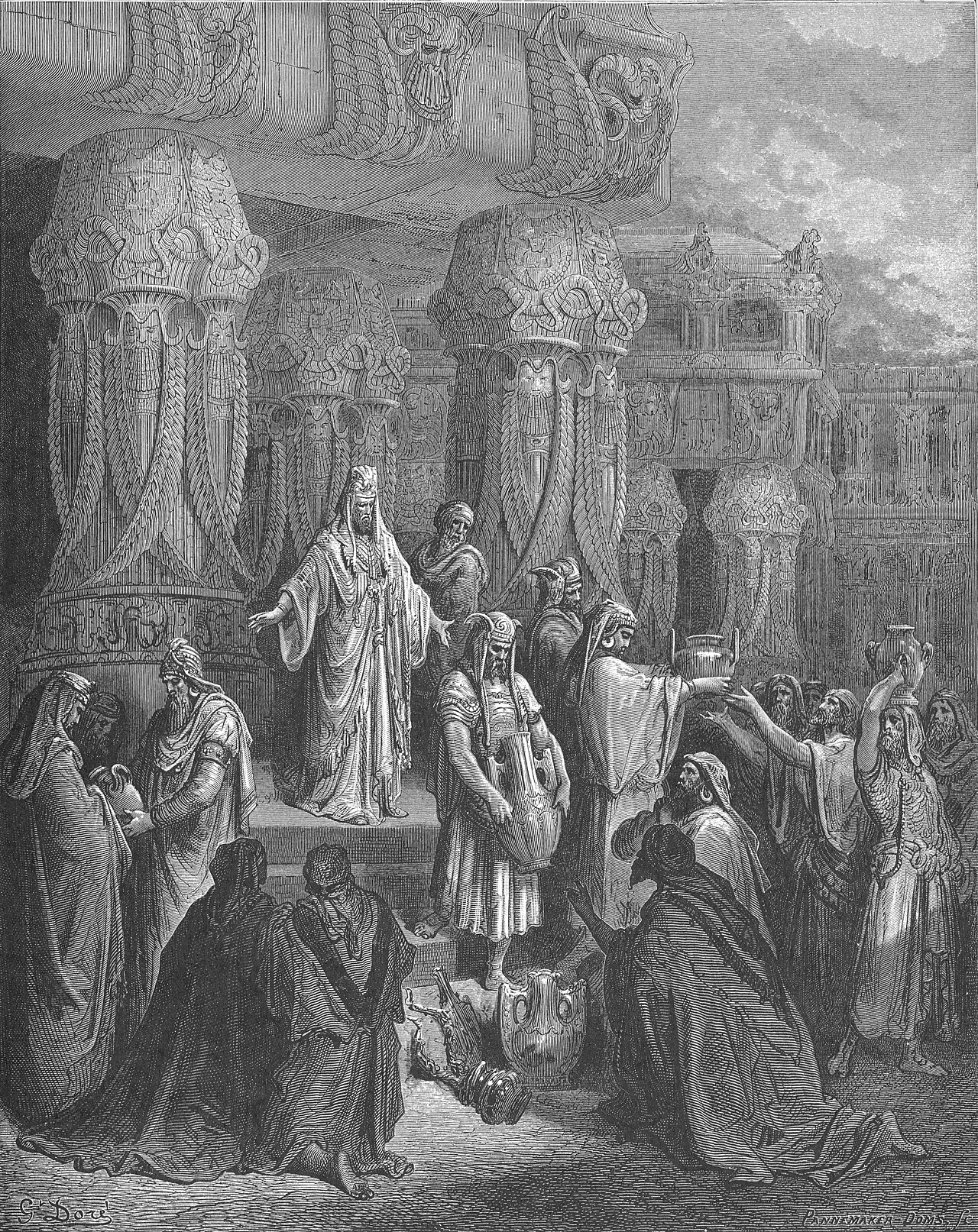
The cargo is the reason the chapter exists. Ezra weighs out to twelve priests 650 talents of silver, silver vessels worth 100 talents, 100 talents of gold, gold bowls, and two vessels of fine bronze "precious as gold." By any reckoning that is tons of precious metal moving slowly through country with no police.
Ezra had already told the king that God's hand is on all who seek Him, and says he was ashamed to ask for soldiers and horsemen after saying that. So they fasted at the river instead and asked God for a safe road, for themselves, their children, and their goods.
The handling of the money is careful in a way that reflects experience. It is weighed out publicly to named men, weighed back in publicly at the temple, and the whole thing recorded by number and weight. Ezra treated an act of faith and an audit trail as compatible.
Significance
For the travelers this was a deliberate test of a public claim. Ezra had told a pagan king that his God protects those who seek Him, and then declined the escort that would have made the statement unnecessary.
Show the rest of the significance, 1 more paragraph
It also modeled something the community needed: trust in God and meticulous accounting in the same paragraph. Nobody in that caravan could ever accuse anyone of skimming, because it was weighed at both ends.
This chapter in Jewish lifeWhat this chapter is in Jewish life and reading.
What is done
This chapter is not read in the synagogue year. The site's own table in src/lib/hebraic/readings.ts printed parashot total 0 and haftarah uses total 0 for Ezra, and no festival reading.
The chapter records a fast, and the corpus sets tractate Taanit beside it. Rashi glosses the word in the twenty-first verse as "to fast" (Rashi on Ezra 8:21:1). Under the twenty-third verse, where the prayer was answered, the corpus carries Taanit 8b:8 and Jerusalem Talmud Taanit 4:3:3. It also carries Midrash Tanchuma, Bamidbar 17:1 under the fifteenth verse and Midrash Tanchuma, Pekudei 7:1 under the thirty-fourth.
How it is read
Rashi is the one commentator on this chapter whose English the corpus carries, quoted here from The Judaica Press complete Tanach with Rashi, translated by A. J. Rosenberg, which Sefaria reports as CC-BY. He reads the list of families as the heads of the immigrants (Rashi on Ezra 8:1:1), and marks where two names make one family (Rashi on Ezra 8:3:1). The last ones of the thirteenth verse he reads as "the last ones to go after Ezra" (Rashi on Ezra 8:13:1).
From the flowing river, as he glosses its name (Rashi on Ezra 8:15:1), Ezra sent to Iddo, "who was the greatest and most esteemed in Casiphia" (Rashi on Ezra 8:17:1). The Nethinites who came were "the Nethnites that King David had appointed" (Rashi on Ezra 8:20:1), in the translator's spelling.
The fast turns on Ezra's refusal to ask for an escort. "For I was ashamed of the king, and I did not wish to request of him chariots and horsemen in order to guide us." (Rashi on Ezra 8:22:1). The answer to the prayer he reads from the outcome, "for we arrived safely in Jerusalem" (Rashi on Ezra 8:23:1). The weighing of the gifts he places by the river Ahava, where Ezra set apart chiefs of the priests to carry the silver and gold to the treasuries of the House (Rashi on Ezra 8:24:1). The silver vessels were a talent each (Rashi on Ezra 8:26:1), and the bowls were for sprinkling the blood of the sacrifices (Rashi on Ezra 8:27:1).
The corpus carries six further notes on this chapter without an English text, each marked linked because Sefaria holds no English version of the ref. They stand cited and unquoted at Ibn Ezra on Ezra 8:10:1, 8:14:1 and 8:19:1, at Metzudat David on Ezra 8:2:1 and 8:4:1, and at Rashi on Ezra 8:5:1.
What the rabbis say
The corpus carries forty rabbinic locators on this chapter and the text of none, so each is cited here rather than quoted. On the ninth verse it holds Bava Batra 116a:13, Ein Yaakov, Bava Batra 8:6 and Ein Yaakov (Glick Edition), Bava Batra 8:5.
The fifteenth verse, the flowing river, draws the heaviest run in the chapter. The corpus holds Eruvin 65a:16 and Kiddushin 69b:6, with Ein Yaakov, Eiruvin 6:12 and Yevamot 9:1, and Ein Yaakov (Glick Edition), Eiruvin 6:7 and Yevamot 9:1. With them stand Midrash Sekhel Tov, Bereshit 22:4:1, Midrash Tanchuma, Bamidbar 17:1, Midrash Tanchuma Buber, Bamidbar 20:1 and Midrash Tehillim 137:1. It also holds Yalkut Shimoni on Torah 99:1, 691:1, 915:5 and 915:6.
On the seventeenth verse the corpus holds Tractate Soferim 7:4 and Vayikra Rabbah 5:5. On the twenty-second, the shame before the king, it holds Aggadat Bereshit 8:2. On the twenty-third, the answered fast, it holds Taanit 8b:8, Jerusalem Talmud Taanit 4:3:3, Ein Yaakov, Taanit 1:33, Ein Yaakov (Glick Edition), Taanit 1:34, Eikhah Rabbah 1:51 and Mishnat Rabbi Eliezer 12:19.
The gifts and the offerings carry the rest. On the twenty-seventh verse the corpus holds Arakhin 10b:13, Ein Yaakov, Arakhin 2:3 and Jerusalem Talmud Sukkah 5:6:4. On the twenty-eighth it holds Jerusalem Talmud Berakhot 8:5:4, on the thirty-second Bereshit Rabbah 56:1, and on the thirty-fourth Bamidbar Rabbah 2:17 and Midrash Tanchuma, Pekudei 7:1. On the thirty-fifth it holds Horayot 6a:2 and 6a:10, Temurah 15b:1, Jerusalem Talmud Horayot 1:8:3, Sifra, Vayikra Dibbura DeChovah, Chapter 3 5, and Yalkut Shimoni on Torah 468:2. On the forty-seventh it holds Pirkei DeRabbi Eliezer 44:10. What each of them teaches is a saying of the rabbis, and is reported as theirs wherever this site quotes one. The quotations wait on a fetch that carries the text.
Sources: Rashi, Rashi on Ezra 8:1:1 to 8:29:1, The Judaica Press complete Tanach with Rashi, translated by A. J. Rosenberg, reported CC-BY; Rashi on Ezra 8:5:1 cited by ref because the corpus carries no English text; Ibn Ezra, Ibn Ezra on Ezra 8:10:1, 8:14:1 and 8:19:1, cited by ref because the corpus carries no English text; Metzudat David, Metzudat David on Ezra 8:2:1 and 8:4:1, cited by ref because the corpus carries no English text; The Sefaria corpus, scripts/data/sources/sefaria/ezra/8.json, the 40 Talmud and Midrash locators of this chapter; The site's own files, src/lib/hebraic/readings.ts, probed for this book and printing parashot total 0, haftarah uses total 0 and festivalReadingForBook null.
The heads below are this chapter's scenes. The numbered points under each are its verses.
The chief men who went up with Ezra from Babylon
Ezra 8:1-3
family heads and genealogical records: The chapter opens a second registry in the same form as Ezra 2 and Nehemiah 7. Three men are named without a count: Gershom of Phinehas, Daniel of Ithamar, and Hattush of the descendants of David. Zechariah of Parosh leads the first counted house with 150 men.
Ezra 8:1
“These are now the chief of their fathers, and this is the genealogy of them,.... Which follows from hence to the end of Ezr 8:14, that went up with me from Babylon; with Ezra the priest and scribe, the writer of this book: in the reign of Artaxerxes the king; that is, Darius Hystaspis, in the seventh year of his reign, see Ezr 7:1, though many think Artaxerxes Longimanus is meant.”
from the descendants of Phinehas, Gershom: The roll opens with two priests. John Gill traces Gershom to Eleazar through Phinehas and takes this Daniel for a priest of Ithamar's line, a different man from the prophet. At verse 24 Ezra sets apart twelve leading priests, so Gill reckons that more priests travelled than the two named.
Ezra 8:2
“Of the sons of Phinehas; Gershom: of the sons of Ithamar; Daniel,.... Not Daniel the prophet, he was of the royal blood, and of the tribe of Judah; this was a priest, a descendant of Ithamar, as Gershom was of Eleazar in the line of Phinehas: of the sons of David; Hattush; perhaps the same with him in 1Ch 3:22, who was a descendant of David the king; these three men seem to have come alone without any of their families, at least they are not mentioned, nor their numbers given, as the rest that follow be.”
1 more voice on this verse
Ezra 8:2
“Punctuate as follows: Ezr 8:2. ... of the sons of David, Hattush of the sons of Shechaniah. Ezr 8:3. Of the sons of Pharosh, Zechariah .... Hattush, the descendant of David, was the grandson of Shechaniah (see marginal reference). Most of these names Ezr 8:2-14 occur also as those of heads of families in the list of the Jews who returned with Zerubbabel Ezr 2:3-15. The Septuagint and Syriac versions supply omissions in Ezr 8:5, Ezr 8:10.”
Hattush of the descendants of Shecaniah: Albert Barnes reads Hattush as the grandson of Shecaniah, which matches the Berean punctuation. The house of Parosh sends men a second time. Its first company numbered 2,172 in Ezra 2:3, and Barnes notes that most names in verses 2 to 14 recur from that register.
Ezra 8:3
“Of the sons of Shechaniah - There were three of this name; the second is mentioned Ezr 8:6, and the third Ezr 10:2. They were all different persons, as may be seen from their fathers’ houses.”
Adam Clarke · Commentary on the Bible (1810-1826)evangelical
Ezra 8:4-14
and with him 200 men: Eleven lay houses follow, each with its own count, beginning with Eliehoenai of Pahath-Moab and 200 men. Pahath-Moab, Adin and Elam also stand in Ezra 2 and Nehemiah 7, where the numerals differ. The difference is traced to copyists or to two stages of one register, with no verdict given.
from the descendants of Zattu: Zattu sent 945 men in the first return, by Ezra 2:8. Shecaniah son of Jahaziel now leads 300, the most registered with any family head in verses 3 to 14. Albert Barnes notes that the Septuagint and Syriac supply omissions here and at verse 10.
from the descendants of Adin: Adin had sent 454 men with the first return, by the count of Ezra 2:15. Ebed son of Jonathan now brings 50. Of the houses in this roll that came twice, only Bebai at verse 11 sends a smaller second company.
from the descendants of Elam: Elam had sent 1,254 men with the first return, by the count of Ezra 2:7. Jeshaiah now brings 70 more. The same house returns in Ezra 10, where Shecaniah proposes the covenant at verse 2 and six men of Elam are named at verse 26.
from the descendants of Shephatiah: Shephatiah had sent 372 men with the first return, by the count of Ezra 2:4. There it stood second, after Parosh. Here it comes sixth among the lay houses, and the roll of chapter 8 keeps an order of its own until verse 10.
from the descendants of Joab: In Ezra 2 the line of Joab is counted inside the house of Pahath-moab, through Jeshua and Joab, at verse 6. Here Joab stands as a house apart from Pahath-moab of verse 4. Its 218 men make the second largest company in the roll.
from the descendants of Bani: Bani had sent 642 men with the first return, by the count of Ezra 2:10. From this verse to verse 14 the roll follows Ezra 2:10 to 14, Bani, Bebai, Azgad, Adonikam and Bigvai, and the verse numbers match. Shelomith brings 160.
from the descendants of Bebai: Bebai had sent 623 men with the first return, by the count of Ezra 2:11. Its 28 are the smallest company in this roll. Four men of the same house are named at Ezra 10:28 among those who had married foreign women.
from the descendants of Azgad: Azgad had sent 1,222 men with the first return, by Ezra 2:12, one of seven lay entries in that register above a thousand. Johanan son of Hakkatan now brings 110. That is about one man for every eleven who came before.
from the later descendants of Adonikam: The word later marks these men off from the house of Adonikam that came first, 666 men by the count of Ezra 2:13. Three leaders share this company of 60. Bigvai at verse 14 has two, and each other house of the roll has one.
from the descendants of Bigvai: Bigvai had sent 2,056 men with the first return, by the count of Ezra 2:14. A Bigvai also stands among the leaders named with Zerubbabel at Ezra 2:2. Uthai and Zaccur now bring 70.
No Levites at the river, so ministers are sought and found
I found no Levites there: Ezra gathers the exiles at the canal to Ahava, and they camp there three days. When he searches among the people and the priests, he finds no Levites. The tribe set apart for the temple's service is the one group missing from a company bound for the temple.
Ezra 8:15
“Ahava was both a town and a river Ezr 8:21. The modern name of the place is Hit. It is famous for its bitumen springs, and is situated on the Euphrates, at a distance of about 80 miles from Babylon, toward the northwest. None of the sons of Levi - The Levites appear to have been disinclined to return to Jerusalem (see Ezr 3:8 note).”
2 more voices on this verse
Ezra 8:15
“Some priests there were, but no others that were Levites. Where was the spirit of that sacred tribe? Ezra, a priest, like Moses proclaims, Who is on the Lord's side?”
Matthew Henry · Commentary on the Whole Bible (1707-1721)puritan
Ezra 8:15
“It is probable that the Ahava was one of the streams or numerous canals of Mesopotamia communicating with the Euphrates [Cyclopædia of Biblical Literature]. But it was certainly in Babylonia on the banks of that stream; and perhaps the place appointed for general rendezvous was in the neighborhood of a town of the same name.”
Jamieson, Fausset & Brown · Commentary Critical and Explanatory on the Whole Bible (1871)reformed
Ezra 8:16-17
Then I summoned the leaders: Ezra summons nine leaders and two teachers and sends them to Iddo, the leader at Casiphia, and to his kinsmen. Their message is a single request, that they "should bring to us ministers for the house of our God." The site of Casiphia is disputed among the commentators.
Ezra 8:16
“The deputation was despatched to Iddo, who was a prince or chief of the Nethinims--for the Persian government allowed the Hebrews during their exile to retain their ecclesiastical government by their own chiefs, as well as to enjoy the privilege of free worship.”
Jamieson, Fausset & Brown · Commentary Critical and Explanatory on the Whole Bible (1871)reformed
Iddo, the leader at Casiphia: Jamieson, Fausset and Brown make Iddo a chief, and they add that Persia let the exiles keep their own chiefs and their own worship. Adam Clarke ties the name Casiphia to keseph, the Hebrew word for silver. Clarke thinks the temple servants there worked silver mines.
Ezra 8:17
“At the place Casiphia - The most judicious commentators are agreed that by Casiphia, the Caspian mountains, between Media and Hyrcania, are intended; where, probably, the Nethinim were employed in working silver mines: כסף keseph, from which the word comes, signifies silver.”
Adam Clarke · Commentary on the Bible (1810-1826)evangelical
Ezra 8:18-20
the gracious hand of our God: The recruiting is credited first to "the gracious hand of our God" upon them. Sherebiah comes with his sons and brothers, 18 men, and Hashabiah with Jeshaiah of Merari, 20 men. Then 220 temple servants come, whom David and the officials had appointed to assist the Levites.
Ezra 8:18
“And Sherebiah - Either a name has fallen out before the words “a man of understanding,” or the “and” here has crept into the text by accident. Sherebiah appears among the most earnest of the Levites under Nehemiah (see the marginal references).”
1 more voice on this verse
Ezra 8:18
“By the good hand - If where ministers have been wanting, the vacancies are well supplied, let us ascribe it to the good hand of God, qualifying them for the service, inclining them to it, and opening a door for them.”
John Wesley · Explanatory Notes upon the Old Testament (1765)evangelical
from the descendants of Merari: John Gill places Hashabiah in the same division of Levites as Sherebiah, and he counts 38 Levites in verses 18 and 19. Verse 15 had found none. The first return had brought 74, by the count of Ezra 2:40.
Ezra 8:19
“And Hashabiah, and with him Jeshaiah of the sons of Merari,.... These were of the same division of Levites as Sherebiah: his brethren and their sons, twenty; these thirty eight, with those they came with, were all Levites; the Nethinims follow.”
They also brought 220 of the temple servants: These 220 temple servants came beside the 38 Levites of verses 18 and 19. They outnumber the Levites nearly six to one. In the first return the temple servants and the descendants of Solomon's servants numbered 392 together, by Ezra 2:58.
Ezra 8:20
“Ezra has procured Levites to go along with him; but what will that avail, unless he have God with him? That is therefore his chief care. In all our ways we must acknowledge God, and in those particularly wherein we are endeavouring to serve the interest of his kingdom among men.”
Matthew Henry · Commentary on the Whole Bible (1707-1721)puritan
A fast at Ahava, because we were ashamed to ask for soldiers
I proclaimed a fast: At the Ahava Canal, where the Levites had just been found missing, Ezra proclaims a fast. Its purpose is to ask God for safety on the road for the company. The fast is held so "that we might humble ourselves before our God" ahead of a dangerous crossing.
Ezra 8:21
“Therefore he resolved that his followers should, by a solemn act of fasting and prayer, commit themselves to the Keeper of Israel. Their faith, considering the many and constant perils of a journey across the Bedouin regions, must have been great, and it was rewarded by the enjoyment of perfect safety during the whole way.”
Jamieson, Fausset & Brown · Commentary Critical and Explanatory on the Whole Bible (1871)reformed
1 more voice on this verse
Ezra 8:21
“Really, Ezra had two alternatives there: the carnal or the spiritual. He could have resorted to the carnal and asked for that band of soldiers and horsemen; it would not have been sinful, but it would have been on a low level of faith.”
Derek Prince · Fasting for Self-Humbling (radio teaching, Fasting series pt. 1)Pentecostal-Charismatic
Ezra 8:22-23
I was ashamed to ask the king: Ezra fasts because he was ashamed to ask the king for an escort. "The hand of our God is gracious to all who seek Him, but His great anger is against all who forsake Him". The fast is answered in one short sentence: "He granted our request."
Ezra 8:22
“I was ashamed to require - a band - He had represented God, the object of his worship, as supremely powerful, and as having the strongest affection for his true followers: he could not, therefore, consistently with his declarations, ask a band of soldiers from the king to protect them on the way, when they were going expressly to rebuild the temple of Jehovah, and restore his worship.”
Adam Clarke · Commentary on the Bible (1810-1826)evangelical
He granted our request: John Gill, citing Jarchi, reads the granted request as their safe coming to Jerusalem. Matthew Henry joins the fast to the next verse. Ezra still sets apart twelve leading priests to guard the silver and gold, and Henry teaches that prayer must be seconded with endeavour.
Ezra 8:23
“So we fasted, and besought our God for this,.... Sought the Lord by fasting and prayer for a good journey, and preservation in it: and he was entreated of us; accepted their prayer, as Jarchi, so that they came safe to Jerusalem.”
1 more voice on this verse
Ezra 8:23
“Note, Our prayers must always be seconded with our endeavours; the care of Christ's gospel, his church, and ordinances, must not be so left with him but that it must also be committed to faithful men, 2 Tim. ii.”
Matthew Henry · Commentary on the Whole Bible (1707-1721)puritan
Silver weighed out: you are holy, and so are these vessels
Ezra 8:24-27
twelve of the leading priests: Ezra sets apart twelve of the leading priests, together with Sherebiah, Hashabiah and ten of their brothers, as a watch over the treasure. He weighs into their hands 650 talents of silver, silver articles weighing 100 talents, and 100 talents of gold. Every amount is weighed at the handover.
Ezra 8:24
“Then I separated twelve of the chief of the priests,.... That were in company with him; so that it seems there were more than the two mentioned, Ezr 8:2, very probably their families, or some of their brethren, were with them: Sherebiah, Hashabiah, and ten of their brethren with them; these men named were Levites, and not priests, Ezr 8:18 and therefore the copulative "and" must be supplied: and Sherebiah, &c. or with the twelve priests, Sherebiah, &c. and ten Levites more with them; so that the number of priests and Levites were equal, and in all twenty four.”
the king, his counselors, his leaders: The givers here answer Ezra 7:15 and 16, which sent Ezra with silver and gold from the king, his counselors and the people's freewill offerings. This verse adds the king's leaders to them.
articles of silver weighing 100 talents: Adam Clarke takes the 100 talents of silver articles as the weight of all the vessels together, one total for the set. He priced the 650 talents of silver at £292,500 in the money of his day. The gold came to £700,000.
Ezra 8:26
“Silver vessels a hundred talents - That is, The weight of all the silver vessels amounted to one hundred talents; not that there were one hundred vessels of silver, each a talent in weight. Reckoning in round sums, 650 talents of silver at £450 the talent, amount to £292,500 sterling. Silver vessels, 100 talents, amount to £45,000; gold, 100 talents, at £7,000 per talent, amount to £700,000 independently of the 20 basons of gold, amounting to 1000 drachms. Now the golden drachm or daric was worth about 1£.”
Adam Clarke · Commentary on the Bible (1810-1826)evangelical
valued at 1,000 darics: Albert Barnes reads the 1,000 darics as the value of the 20 gold bowls together, so each bowl was valued at 50 darics. The word for the fine polished bronze occurs only here in Hebrew. Barnes gives its sense as yellow or glittering.
Ezra 8:27
“Twenty basons of gold, of a thousand drams - Not of a thousand drams (i. e., darics) each, but worth altogether a thousand darics. As the value of the daric was about 22 shillings of British money, each basin, or saucer, would have been worth (apart from the fashioning) 55 British pounds. Of fine copper - The word translated “fine,” which occurs here only, is thought to mean either “yellow” or “glittering” (see the margin).”
Ezra 8:28-30
Ezra charges the priests and Levites in the same terms as the articles: "You are holy to the LORD, and these articles are holy." Men set apart carry things set apart, and one charge covers both: guard them until they are weighed out in the chambers of the house.
Ezra 8:28
“And I said unto them, ye are holy unto the Lord, the vessels are holy also,.... As they were dedicated and set apart to holy service, so the vessels were sacred to holy uses, and therefore not to be converted to any other: and the silver and the gold are a freewill offering unto the Lord God of your fathers: and therefore not to be made use of but in his service.”
in the chambers of the house: John Gill reads the chambers as the storerooms and treasuries of the temple, where the gifts were to be laid up. Three bodies would witness the weighing. Gill says the carriers were to deliver the full weight they received, before the leading priests, the Levites and the family heads.
Ezra 8:29
“Watch ye, and keep them,.... The vessels, the gold, and the silver, that they be not hurt and diminished: until ye weigh them before the chief of the priests and the Levites, and chief of the fathers of Israel at Jerusalem, in the chambers of the house of the Lord: that is, until they had delivered them in full weight, as they had received them, in the presence of those persons as witnesses, and into their hands, in order to be laid up in the chambers and treasuries of the temple.”
So the priests and Levites took charge: The priests and Levites here are the men set apart at verse 24. John Gill counts them as twelve priests and twelve Levites, and he takes Sherebiah and Hashabiah for Levites from verses 18 and 19. The two orders carried the treasure in equal numbers.
Ezra 8:30
“So took the priests and the Levites,.... The twelve priests and twelve Levites, mentioned in Ezr 8:24, the weight of the silver and the gold, and the vessels, to bring them to Jerusalem unto the house of our God; this they undertook to do, and did.”
The hand of our God upon us all the way to Jerusalem
the hand of our God was upon us: On the twelfth day of the first month the company sets out from the Ahava Canal. The phrase "the hand of our God was upon us" appears for the third time in this chapter. It protected them from enemies and bandits along the way.
Ezra 8:31
“The Jews with Ezra left Babylon on the first day of the first month Ezr 7:9. They reached Ahava in nine days, and, having remained there three Ezr 8:15, quitted it, and resumed their journey on the twelfth. They reached Jerusalem on the first day of the fifth month Ezr 7:9, four months after the departure from Babylon.”
Ezra 8:32-34
rested there for three days: The company reaches Jerusalem and rests three days, the same span it had spent at Ahava over the missing Levites. On the fourth day the silver, gold and sacred articles are weighed into the hand of Meremoth son of Uriah, the priest. This closes the charge given at verse 29.
Ezra 8:32
“And we came to Jerusalem, and abode there three days. Before they went about any business, delivered what was committed to them for the use of the temple, and the commissions to the king's officers; as it was but proper they should have some rest after such a fatiguing journey.”
1 more voice on this verse
Ezra 8:32
“Let those that have stedfastly set their faces towards the new Jerusalem proceed and persevere to the end till they appear before God in Zion, and they shall find that he who has begun the good work will perform it. That his treasurers were faithful.”
Matthew Henry · Commentary on the Whole Bible (1707-1721)puritan
Meremoth son of Uriah, the priest: Meremoth son of Uriah receives the treasure as the priest. Eleazar son of Phinehas carries the name of the priestly house that heads the roll at verse 2. Two Levites stand with them, so priest and Levite together receive what priest and Levite had carried.
Ezra 8:33
“The returned exiles offered burnt offerings, and Ezra delivered the royal commission to the satraps and inferior magistrates; while the Levitical portion of them lent all the assistance they could in performing the additional work which the arrival of so many new worshippers occasioned.”
Jamieson, Fausset & Brown · Commentary Critical and Explanatory on the Whole Bible (1871)reformed
verified by number and weight: John Gill gives the recorded total weight two uses. It kept an account of the freewill offering of silver and gold given in Babylon for the house of God. It also vouched for the priests and Levites who took charge of it, should their honesty be questioned.
Ezra 8:34
“By number and by weight of everyone,.... They were delivered in by tale and weight, which exactly agreed to the number and weight in which they received them: and all the weight was written at that time; an account was taken in writing, and laid up, that it might not only be known hereafter what freewill offerings had been made in Babylon, but that it might be a voucher for the fidelity and integrity of those that brought them, should it ever be called in question.”
Ezra 8:35-36
sacrificed burnt offerings to the God of Israel: The exiles first offer burnt offerings: 12 bulls for all Israel, 96 rams, 77 lambs and 12 male goats. Twelve names all Israel, though only part of the tribes had come home. Worship comes before business, as at the altar of Ezra 3 before the foundation was laid.
Ezra 8:35
“That will be dispensed with when we want opportunity which when the door is opened again will be expected from us. That among their sacrifices they had a sin-offering; for it is the atonement that sweetens and secures every mercy to us, which will not be truly comfortable unless iniquity be taken away and our peace made with God.”
Matthew Henry · Commentary on the Whole Bible (1707-1721)puritan
1 more voice on this verse
Ezra 8:35
“Compare the marginal reference. The idea of offerings for all Israel pervades in this case the entire sacrifice, with the exception of the lambs, whose number (77) is unique, and has not been accounted for.”
to the royal satraps and governors: Adam Clarke takes the royal satraps as a Persian title. Bede knew a text where they glorified the people and the house of God. In his reading the satraps and governors raised the people by making the king's authority honourable to all.
Ezra 8:36
“The king’s lieutenants - אחשדרפני achashdarpeney: this is generally understood to mean lieutenant or deputy, and is probably of Persian origin, though here greatly corrupted. The Vulgate renders it regis satrapis, to the satraps of the king, which is the Persian satrab. A viceroy in Persian is soubah-dar; viceroys, soubahdaran. Darafreen signifies a person in whom one has confidence; and achi is an epithet of a vizir. These two words conjoined will make nearly that of the text. But I do not give any of these etymologies with confidence.”
Adam Clarke · Commentary on the Bible (1810-1826)evangelical
Keep studying
Studies2
Places1
Sources for this chapter
The summary
Jamieson, Fausset & Brown, Commentary Critical and Explanatory; John Wesley, Notes on the Old Testament and Matthew Henry, Complete Commentary.
The context
C. F. Keil, The Books of Ezra, Nehemiah, and Esther and Matthew Henry, Commentary on the Whole Bible.
The exposition
Adam Clarke, Commentary on the Bible; Albert Barnes, Notes, Explanatory and Practical, on the Old and New Testaments (1832-1869); Bede, Commentary on Ezra and Nehemiah; Berean Standard Bible; Derek Prince, Fasting for Self-Humbling (radio teaching, Fasting series pt. 1); Jamieson, Fausset & Brown, Commentary Critical and Explanatory on the Whole Bible; John Gill; John Wesley, Explanatory Notes upon the Old Testament; Keil, The Books of Ezra, Nehemiah, and Esther; Matthew Henry, Commentary on the Whole Bible and W. F. Adeney, Ezra, Nehemiah and Esther (Expositor's Bible).