
2 Samuelchapter 2
32 verses · Samuel, Nathan and Gad, by tradition · 10th century BC · History
And it came to pass after this, that David enquired of the Lord, saying, Shall I go up into any of the cities of Judah? And the Lord said unto him, Go up. And David said, Whither shall I go up? And he said, Unto Hebron.
Introduction
Samuel, Nathan and Gad, by tradition, History, 2 Samuel Overview.
This chapter opens the years when Israel had two kings at once. Its first hearers were the children of the tribes that lived through that division, after a defeat that left the Philistines holding much of the north. The tribes had to decide whose house would rule them, and the answer took seven and a half years and cost lives on both sides. Listen for David asking the LORD before he moves, and for the commander in the north who holds the real power. Watch also for a death in the field that one family will remember for years.
Context
- Who
- Israelites living through a civil war between two houses
- What
- The anointing of David over Judah, the crowning of Saul's son over the north, and the first battle of the civil war at Gibeon.
- Where
- Hebron in the Judean hills, Mahanaim east of the Jordan, and the pool of Gibeon a few miles north of Jerusalem.
- When
- About 1011 BC, at the start of the seven years and six months at Hebron that 5:5 records.
- Why
- To show David waiting on the LORD for his throne while the north set up a king by one commander's will, and to plant the feud between Joab and Abner.
Historical context
2 Samuel names no author, and Samuel himself is dead before the book opens. The oldest internal lead is 1 Chronicles 29:29, which names the histories of Samuel the seer, Nathan the prophet and Gad the seer behind the acts of David. The chapter covers the years at Hebron, about 1011 to 1005 BC, and the length is the text's own figure of seven years and six months at 5:5. The places are Hebron in the Judean hills and the pool of Gibeon, with Saul's surviving son set up at Mahanaim east of the Jordan. That eastern capital measures how much of the western hill country the Philistines held after Gilboa. A first hearer knew that anointing meant olive oil poured over the head before witnesses, the public act that set apart a priest or a king. He knew Judah could do it for its own tribe alone, and that Hebron was its natural capital, high, well watered, and holding the burial cave of Abraham and Sarah. He knew the real power in the north was Abner, Saul's cousin and army commander, and that a commander who held the troops' loyalty was a kingmaker. The pool of Gibeon is a real place, a rock-cut shaft about thirty-seven feet across and eighty feet deep with a spiral stair carved to the water. Settling a quarrel with twelve champions a side was a recognised way to avoid general slaughter, and Abner's killing of Asahel created a blood debt his brothers were bound to collect.
Significance
Hearers who remembered these years knew how close Israel came to becoming two nations a generation early. The chapter shows David asking God before every move and waiting for tribes to come to him, while the north props up a king nobody chose. It also plants the trouble of the next twenty years, since Joab's family now holds a grudge no king will be able to control.
This chapter in Jewish lifeWhat this chapter is in Jewish life and reading.
How it is read
The corpus for this chapter holds twenty-four commentary entries and forty rabbinic locators. Three entries carry English text under a licence that permits quotation, and all three are Rashi in the Metsudah translation, Lakewood, N.J., CC-BY, cited below by ref alone. The other twenty-one are Radak at twelve places, Metzudat David at six and Malbim at three, and Sefaria holds no English version of any of them, so they are cited and never quoted.
Rashi's longest comment here is on why Abner set Saul's son on a throne. He reads it as an argument from a verse. The promise to Jacob that kings would come from him was spoken when every son but Benjamin had been born. Abner took it that two kings were owed to Benjamin, Saul and then Ish-bosheth (Rashi on II Samuel 2:8:1). The reading turns a political act into a claim about a promise, which is how the classical commentators handle the long war between the two houses.
Twice Rashi settles a hard word through Targum Jonathan. The name given to the ground where the young men fell he takes from the sharpness of swords. He notes that the Targum renders it as the plain of killing (Rashi on II Samuel 2:16:1). Of the blow that killed Asahel he writes that the place meant is "the fifth rib, the place where the bile and the liver are set". He records that the Targum reads it instead as the side of the thigh (Rashi on II Samuel 2:23:1). The commentators cited without text stand across the whole chapter, among them Radak on II Samuel 2:4:1 on the anointing at Hebron, Metzudat David on II Samuel 2:10:1 and Malbim on II Samuel 2:5:1.
What the rabbis say
Forty rabbinic locators stand on this chapter in the corpus, thirty-two from the Midrash and eight from the Talmud, every one of them a locator without text. The contest of the young men at the pool draws the most of them. Among them are Bereshit Rabbah 53:10, Bereshit Rabbah 53:11, Bamidbar Rabbah 19:2, Jerusalem Talmud Peah 1:1:47, Jerusalem Talmud Sotah 1:8:10 and Midrash Tanchuma, Ki Tisa 20:1. Abner's words to Asahel are taken up at Gittin 68a:3 and Ein Yaakov, Gittin 7:1, and the killing of Asahel at Sanhedrin 49a:3, Sanhedrin 49a:13 and Ein Yaakov, Sanhedrin 6:19. The end of the pursuit, where Abner calls to Joab and Joab answers, is taken up at Megillah 29a:4. The reign of Ish-bosheth is dated at Seder Olam Rabbah 13:1 and Seder Olam Rabbah 13:2, and the same verse draws Zevachim 102a:17.
Five of this chapter's locators are anchored in the corpus at verse numbers beyond the chapter's own count, so they are left out here rather than cited at a verse that does not exist.
Sources: Rashi, Rashi on II Samuel 2:8:1, 2:16:1 and 2:23:1, The Metsudah Tanach series, Lakewood, N.J., CC-BY; Radak, Radak on II Samuel 2:4:1 and eleven further places, cited only, no English version in the corpus; Metzudat David, Metzudat David on II Samuel 2:10:1 and five further places, cited only; Malbim, Malbim on II Samuel 2:5:1, 2:1:1 and 2:2:1, cited only; The Midrash and the Talmud on this chapter, Bereshit Rabbah 53:10 and 53:11; Jerusalem Talmud Peah 1:1:47; Gittin 68a:3; Sanhedrin 49a:3 and 49a:13; Megillah 29a:4; Seder Olam Rabbah 13:1 and 13:2, as the corpus records them.
The heads below are this chapter's scenes. The numbered points under each are its verses.
Anointed at Hebron; a thank-you to Jabesh-gilead
David enquired of the Lord: David does not march for Hebron on his own judgment; he enquires of the Lord first, the pattern that marks the whole chain running through 5:19, 5:23 and 21:1. Saul's one recorded enquiry as king went unanswered at 28:6, and the contrast between the two kings is drawn without a word of comment here. The Lord answers in two exchanges, first the city and then the tribe, and David waits for both.
2 Samuel 2:1
“Enquired of the Lord - Through Abiathar, the high priest. The death of Saul and Jonathan had entirely changed David’s position, and therefore he needed divine guidance how to act under the new circumstances in which he was placed. Compare the marginal references. Hebron was well suited for the temporary capital of David’s kingdom, being situated in a strong position in the mountains of Judah, amidst David’s friends, and withal having especially sacred associations (see the marginal references note). It appears to have also been the center of a district 2Sa 2:3.”
1 more voice on this verseWhat preachers and commentators have said about this verse, in their own words.
2 Samuel 2:1
“In all our motions and removals it is comfortable to see God going before us; and we may, if by faith and prayer we set him before us. God, according to the promise, directed his path, bade him go up, told him whither, unto Hebron, a priest's city, one of the cities of refuge, so it was to David, and an intimation that God himself would be to him a little sanctuary.”
Matthew Henry · Commentary on the Whole Bible (1707-1721)puritan
2 Samuel 2:2-3
his two wives also: Ahinoam the Jezreelitess and Abigail the Carmelite, already David's wives from the wilderness years, go up with him to Hebron, and his fighting men bring their own households as well. The move reads as a whole camp resettling rather than one man alone taking a throne. Hebron itself was a city of the priests and lay at the center of Judah, near the graves of the patriarchs.
2 Samuel 2:2
“So David went up thither,.... From Ziklag to Hebron, which was sixteen miles according to Bunting (y). and his two wives also, Ahinoam the Jezreelitess, and Abigail, Nabal's wife, the Carmelite; who were beloved by him, and who had shared with him in his troubles, and which he took with him to partake of his honour and grandeur, wealth and riches; in which he was now a type of Christ. See Rom 8:17. (y) Ut supra, (Travels &c.) p. 137.”
John Wesley notes that Hebron was full of priests and of David’s court, so the men and their households settled in the towns near it. Matthew Henry reads the move as a reward. The men who shared David’s troubles now share his kingdom.
2 Samuel 2:3
“Dwelt in - That is, the cities or towns belonging to Hebron, which was the Metropolis. For in Hebron itself there was not space for them all, because it was filled with priests, and with David's court.”
John Wesley · Explanatory Notes upon the Old Testament (1765)evangelical
1 more voice on this verse
2 Samuel 2:3
“Thus, if we suffer with Christ, we shall reign with him, 2 Tim. ii. Nay, Christ does more for his good soldiers than David could do for his; David found lodging for them-- They dwelt in the cities of Hebron, and adjacent towns; but to those who continue with Christ in his temptations he appoints a kingdom, and will feast them at his own table, Luke xxii.”
Matthew Henry · Commentary on the Whole Bible (1707-1721)puritan
anointed David king over the house of Judah: The men of Judah anoint David king at Hebron, the second of the three anointings that carry him to the throne: Samuel's private anointing at 16:13, this public one over Judah alone, and the anointing over all Israel still to come at 5:3. The kingdom promised long before arrives one tribe at a time. In the same verse the men of Judah bring David word that Jabesh-gilead buried Saul, joining the report of loyalty to the report of a new king in one breath.
2 Samuel 2:4
“Anointed David king - He was anointed before by Samuel, by which he acquired jus ad regnum, a right To the kingdom; by the present anointing he had jus in regno, authority Over the kingdom. The other parts of the kingdom were, as yet, attached to the family of Saul.”
Adam Clarke · Commentary on the Bible (1810-1826)evangelical
2 more voices on this verse
2 Samuel 2:4
“Anointed - This they did upon just grounds, because not only the kingdom was promised to that tribe, but David was designed and anointed by God, whose will both they and all Israel were obliged to obey. And they resolved not to neglect their duty, though they saw the other tribes would. Yet their modesty is observable, they make him king of Judah only, and not of all Israel.”
John Wesley · Explanatory Notes upon the Old Testament (1765)evangelical
2 Samuel 2:4
“Thus the kingdom of the Messiah, the Son of David, is set up by degrees; he is Lord of all by divine designation, but we see not yet all things put under him, Heb. ii.”
Matthew Henry · Commentary on the Whole Bible (1707-1721)puritan
2 Samuel 2:5-7
Blessed be ye of the Lord: David sends a blessing to Jabesh-gilead for the kindness they showed Saul in burying him, calling it kindness and truth and promising to requite it. The vocabulary anticipates the kindness shown later to Jonathan's line at 9:3, though here it is spoken over the grave of the king David never raised his own hand against. The message closes with a summons, let their hands be strengthened, for Judah has already made David king, an invitation to the rest of Israel left open rather than forced.
2 Samuel 2:5
“David sent messengers unto the men of Jabesh-gilead--There can be no doubt that this message of thanks for their bold and dangerous enterprise in rescuing the bodies of Saul and his sons was an expression of David's personal and genuine feeling of satisfaction. At the same time, it was a stroke of sound and timely policy.”
Jamieson, Fausset & Brown · Commentary Critical and Explanatory on the Whole Bible (1871)reformed
2 more voices on this verse
2 Samuel 2:5
“According as our obligations were to love and honour any while they lived, we ought to show respect to their remains (that is, their bodies, names, and families) when they are dead. "Saul was your lord," says David, "and therefore you did well to show him this kindness and do him this honour." 2.”
Matthew Henry · Commentary on the Whole Bible (1707-1721)puritan
2 Samuel 2:5
“David sent messengers unto - Jabesh-gilead - This was a generous and noble act, highly indicative of the grandeur of David’s mind. He respected Saul as his once legitimate sovereign; he loved Jonathan as his most intimate friend. The former had greatly injured him, and sought his destruction; but even this did not cancel his respect for him, as the anointed of God, and as the king of Israel. This brings to my remembrance that fine speech of Saurin, when speaking of the banishment of the Protestants from France by the revocation of the edict of Nantes.”
Adam Clarke · Commentary on the Bible (1810-1826)evangelical
John Wesley reads loving devotion and faithfulness as one thing, kindness proved in deeds. Matthew Henry adds that the LORD’s kindness can be trusted. David pledges his own favor beside it.
2 Samuel 2:6
“And now the Lord show kindness and truth unto you,.... Or true kindness; confer real favours, bestow upon you good and substantial blessings, blessings indeed! and I also will requite you this kindness, because ye have done this thing. He not only prayed to God to bless them and reward them for it, but would remember them himself, and at a proper opportunity would show favour to them for this act of kindness to Saul.”
1 more voice on this verse
2 Samuel 2:6
“Kindness and truth - That is, true and real kindness; not in words only, but also in actions, as you have done to your king. I will requite - So far am I from being offended with you for this kindness to my late enemy.”
John Wesley · Explanatory Notes upon the Old Testament (1765)evangelical
Adam Clarke reads the summons as an appeal for the loyalty of Jabesh-gilead. Saul had once rescued that town from Nahash, king of the Ammonites, and Clarke judges that David feared its men would hold to the house of Saul. Their courage was known.
2 Samuel 2:7
“Now let your hands be strengthened - David certainly wished to attach the men of Jabesh to his interest; he saw that they were generous and valiant, and must be of great service to him whose part they espoused; and he was no doubt afraid that they would attach themselves to the house of Saul, in consideration of the eminent services Saul had rendered them in rescuing them from Nahash, king of the Ammonites.”
Adam Clarke · Commentary on the Bible (1810-1826)evangelical
Abner crowns Ish-bosheth at Mahanaim
2 Samuel 2:8-9
took Ish–bosheth the son of Saul: Abner, captain of Saul's host, takes Ish-bosheth and makes him king, not over Judah but over Gilead, the Ashurites, Jezreel, Ephraim, Benjamin and the rest of Israel. Chronicles gives the same man's name as Esh-baal, and the readings among the scholars hold that Samuel's text substitutes bosheth, shame, for baal in later transmission. The kingdom Abner builds is Abner's in substance; Ish-bosheth's name fills the verse, but every verb belongs to the son of Ner.
2 Samuel 2:8
“But Abner, the son of Ner, captain of Saul's host,.... This man's father, Ner, was Saul's uncle, 1Sa 14:50, and he was his own cousin, and being general of his army, a post he was willing to keep, might be the reasons for doing what he did, as follows: took Ishbosheth the son of Saul; and who seems to be his only son left, except what he had by his concubine. This man's name is Eshbaal in 1Ch 8:33. Baal is the name of a shameful idol, and which was therefore sometimes called Bosheth, "shame".”
1 more voice on this verse
2 Samuel 2:8
“Abner the son of Ner - This man had long been one of the chief captains of Saul’s army, and commander-in-chief on several occasions; he was probably envious of David’s power, by whom he had often been out-generalled in the field.”
Adam Clarke · Commentary on the Bible (1810-1826)evangelical
made him king over Gilead: Albert Barnes reads the list as the order of Abner’s reconquest, Gilead east of the Jordan first, then Asher, the plain of Jezreel, Ephraim and Benjamin. Adam Clarke says the Philistines still held western towns.
2 Samuel 2:9
“The Ashurites - If the tribe of Asher, the verse indicates the order in which Abner recovered the different districts from the Philistines, and added them to the dominions of Ish-bosheth, beginning with Gilead, and then gradually adding, on the west of Jordan, first the territory of Asher as far as Carmel and the whole plain of Esdraelon, and then the country of Ephraim and Benjamin, being in fact all Israel, as distinguished from Judah; and this reconquest may have occupied five years. Ish-bosheth’s reign over Israel may not have been reckoned to begin until the conquest was complete.”
1 more voice on this verse
2 Samuel 2:9
“Gilead - Largely so taken, for all the land of Israel beyond Jordan. Ashurites - That is, the tribe of Asher, as the Chaldee paraphrast and others understand it.”
John Wesley · Explanatory Notes upon the Old Testament (1765)evangelical
2 Samuel 2:10-11
forty years old when he began to reign: Ish-bosheth is forty years old when he begins to reign and reigns two years, while David reigns in Hebron over Judah alone seven years and six months. The five and a half years the text does not account for have drawn more than one reading: some hold Abner spent that time subduing the northern tribes before crowning Ish-bosheth, others that the two-year count marks only the settled portion of a longer, contested reign. The verse states both numbers plainly and leaves the gap between them unexplained.
2 Samuel 2:10
“Ishbosheth, Saul's son, was forty years old when he began to reign over Israel,.... Being born the same year his father began to reign.”
1 more voice on this verse
2 Samuel 2:10
“Ish-bosheth - reigned two years - It is well observed that Ish-bosheth reigned all the time that David reigned in Hebron, which was seven years and six months. Perhaps the meaning of the writer is this: Ish-bosheth reigned two years before any but the tribe of Judah had attached themselves to the interest of David. Some think that Abner in effect reigned the last five years of Ish-bosheth, who had only the name of king after the first two years.”
Adam Clarke · Commentary on the Bible (1810-1826)evangelical
seven years and six months: John Gill adds the thirty-three years David later reigned over all Israel in Jerusalem. The sum is forty years and six months. Scripture rounds it to forty at 5:4.
2 Samuel 2:11
“And the time that David was king in Hebron over the house of Judah,.... And over them only: was seven years and six months; to which being added thirty three years he reigned over all Israel in Jerusalem, made forty years and six months; and which, for the roundness of the number, is usually called forty years. See 2Sa 5:4.”
Deadly play at the pool of Gibeon
2 Samuel 2:12-13
went out from Mahanaim to Gibeon: Abner leads Ish-bosheth's servants out to Gibeon, and Joab leads David's servants out to meet him, and the two companies sit down on opposite sides of one pool. The meeting looks at first like a parley, and the next verses turn it into a battlefield. This is the opening move of the long war between the house of Saul and the house of David that 3:1 will name outright.
2 Samuel 2:12
“This expedition to Gibeon may have been for the purpose of shifting his metropolis to his own tribe of Benjamin, and to his family place, “Gibeah of Saul,” close to Gibeon, with the further purpose of attacking the kingdom of David. “To go out” 2Sa 2:12-13 is a technical phrase for going out to war 1Sa 18:30.”
by the pool of Gibeon: Albert Barnes places the pool at El-jib, the old Gibeon, where a spring rises in a limestone cave. The remains of a tank there measure about 120 feet by 110. Matthew Henry notes that the water between the two camps gave both sides time to think.
2 Samuel 2:13
“On the east of the hill (El-jib, the ancient Gibeon) is a copious spring, which issues in a cave excavated in the limestone rock, so as to form a large reservoir. In the trees further down are the remains of a pool or tank of considerable size (120 feet by 110 feet). This is doubtless “the pool of Gibeon.” Sat down - i. e. halted and encamped.”
2 Samuel 2:14-16
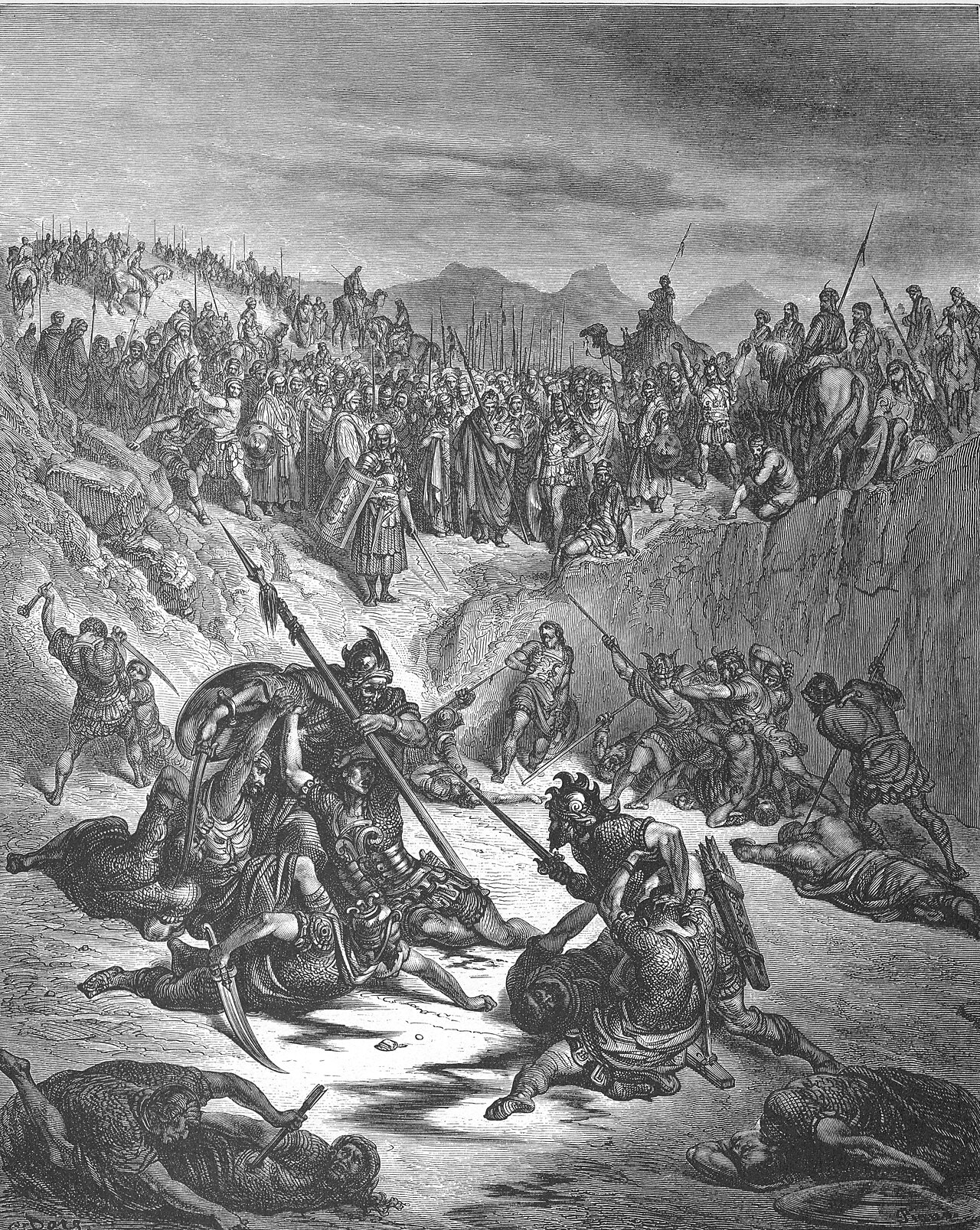
Let the young men now arise, and play before us: Abner proposes that the young men arise and play before them, and Joab agrees, but the game is twelve against twelve with swords, and every pair falls together, each man's blade in his fellow's side. The place is named Helkath-hazzurim from what happened there, a field remembered by its dead rather than by any victor. What began as a contest between champions ends as mutual slaughter with no survivor on either side of the pairs.
2 Samuel 2:14
“Abner said to Joab, Let the young men now arise, and play before us--Some think that the proposal was only for an exhibition of a little tilting match for diversion.”
Jamieson, Fausset & Brown · Commentary Critical and Explanatory on the Whole Bible (1871)reformed
3 more voices on this verse
2 Samuel 2:14
“He meant, "Let them fight before us," when he said, "Let them play before us." Fools thus make a mock at sin. but he is unworthy the name of a man that can be thus prodigal of human blood, that can thus throw about firebrands, arrows, and death, and say, Am not I in sport?”
Matthew Henry · Commentary on the Whole Bible (1707-1721)puritan
2 Samuel 2:14
“Let the young men - play before us - This was diabolical play, where each man thrust his sword into the body of the other, so that the twenty-four (twelve on each side) fell down dead together! But this was the signal for that sanguinary skirmish which immediately took place.”
Adam Clarke · Commentary on the Bible (1810-1826)evangelical
2 Samuel 2:14
“He speaks like a vain-glorious and cruel man, and a soldier of fortune, that esteemed it a sport to see men wounding and killing one another. So this he designed, partly for their mutual recreation and trial of skill; and partly, that by this occasion they might be engaged in a battle. But he is unworthy the name of a man, who is thus prodigal of human blood.”
John Wesley · Explanatory Notes upon the Old Testament (1765)evangelical
The twelve of Abner all came from Benjamin, his own tribe. John Gill reads them as men Abner picked for their courage and their loyalty to him. Matthew Henry reads their eagerness as ambition to please their commander.
2 Samuel 2:15
“Then there arose and went over by number twelve of Benjamin,.... Whom Abner had picked out of that tribe, being his own, and whom he knew to be stout and courageous men, and closely attached to him.”
John Wesley reads the grip as a hold on the long hair of the head. Albert Barnes renders Helkath-hazzurim as the field of sharp blades. Wesley reads it as the field of rocks, for men who died where they stood.
2 Samuel 2:16
“Caught every one his fellow by the head - Probably by the beard, if these persons were not too young to have one, or by the hair of the head. Alexander ordered all the Macedonians to shave their beards; and being asked by Parmenio why they should do so, answered, “Dost thou not know that in battle there is no better hold than the beard?” Helkath-hazzurim - “The portion of the mighty;” or, “The inheritance of those who were slain,” according to the Targum.”
Adam Clarke · Commentary on the Bible (1810-1826)evangelical
2 more voices on this verse
2 Samuel 2:16
“By the head - By the hair of the head, which after their manner was of a considerable length. Helkath-kazzurim - Or, the field of rock; that is, of men who stood like rocks unmovable, each one dying upon the spot where he fought.”
John Wesley · Explanatory Notes upon the Old Testament (1765)evangelical
2 Samuel 2:16
“Yet the stout-hearted were spoiled, and slept their sleep, Ps. lxxvi. Poor honour for men to purchase at so vast an expense! Those that lose their lives for Christ shall find them.”
Matthew Henry · Commentary on the Whole Bible (1707-1721)puritan
Abner was beaten: The mock combat becomes a full battle, and Abner is beaten before the servants of David. It is the first defeat named in the war between the two houses, and it sets the pattern 3:1 will state as a rule: David grew stronger and stronger, and the house of Saul grew weaker and weaker.
2 Samuel 2:17
“And there was a very sore battle that day,.... When the twenty four men fell together, and no decision could be made thereby, or any triumph on either side, both armies drew up in battle array, and fought very furiously: and Abner was beaten, and the men of Israel, before the servants of David; the army under him had the worst of it, and were routed, and obliged to flee before the army of David under the command of Joab.”
1 more voice on this verse
2 Samuel 2:17
“Neither side had the advantage in the combat of twelve a side; hence, the quarrel was fought out with great fierceness by the two armies, and the victory was won by David.”
Asahel outruns his own life
2 Samuel 2:18-19
light of foot as a wild roe: Three sons of Zeruiah are named among David's men, Joab, Abishai and Asahel, and Asahel alone is singled out as light of foot as a wild roe. He fixes on Abner in the rout and will not turn aside to the right hand or the left, pursuit becoming the whole of his attention. The same speed that lets him catch a fleeing general carries him past every warning the following verses will give him.
2 Samuel 2:18
“And there were three sons of Zeruiah there,.... In the battle: Joab, and Abishai, and Asahel; Joab was the general of the array, Abishai was he who went into Saul's host at night, and took away his spear and cruse of water at his head, 1Sa 26:6; and it is for the sake of the third, Asahel, that the account is given, the story of his death being about to be told.”
1 more voice on this verse
2 Samuel 2:18
“Asahel was as light of foot as a wild roe - To be swift of foot was deemed a great accomplishment in the heroes of antiquity; ποδας ωκυς Αχιλλευς, the swift-footed Achilles, is an epithet which Homer gives to that hero no less than thirty times in the course of the Ilias. It has a qualification also among the Roman soldiers; they were taught both to run swiftly, and to swim well.”
Adam Clarke · Commentary on the Bible (1810-1826)evangelical
Jamieson, Fausset and Brown note that the armor of the commander was the greatest trophy of a battle. Asahel wanted the equipment of Abner, and he had outrun every man in the pursuit. Matthew Henry calls the aim brave and too great for him.
2 Samuel 2:19
“Asahel pursued after Abner--To gain the general's armor was deemed the grandest trophy. Asahel, ambitious of securing Abner's, had outstripped all other pursuers, and was fast gaining on the retreating commander. Abner, conscious of possessing more physical power, and unwilling that there should be "blood" between himself and Joab, Asahel's brother, twice urged him to desist.”
Jamieson, Fausset & Brown · Commentary Critical and Explanatory on the Whole Bible (1871)reformed
1 more voice on this verse
2 Samuel 2:19
“The design was brave, had he been par negotio--equal to its accomplishment: but let not the swift man glory in his swiftness, any more than the strong man in his strength; magnis excidit ausis--he perished in an attempt too vast for him. How generous Abner was in giving him notice of the danger he exposed himself to, and advising him not to meddle to his own hurt, 2 Chron. xxv.”
Matthew Henry · Commentary on the Whole Bible (1707-1721)puritan
2 Samuel 2:20-23
Art thou Asahel?: Abner asks Asahel by name to turn aside and take a lesser man's armor rather than force a fight he does not want, twice, and twice Asahel refuses. Abner kills him with the hinder end of his own spear, driving the butt through his body rather than the point, which the older writers read as a mark of reluctance rather than skill. The debt is not settled here; Joab collects it in the next chapter, and a killing that opens as self-defense becomes the ground for a murder among brothers.
2 Samuel 2:20
“Then Abner looked behind him,.... Perceiving one at his heels, and making haste up to him. And said, art thou Asahel? for it seems he knew him personally, being well acquainted with his family: and he answered, I am; so that they were very near to each other, as to discourse together, and be heard and understood by each other.”
Albert Barnes reads the offer as leave to seize one of the young men as a lesser trophy. Adam Clarke notes that Asahel was the faster of the two. Abner saw that he must kill Asahel or be killed by him.
2 Samuel 2:21
“Take thee his armor - It seems Asahel wished to get the armor of Abner as a trophy; this also was greatly coveted by ancient heroes. Abner wished to spare him, for fear of exciting Joab’s enmity; but as Asahel was obstinate in the pursuit, and was swifter of foot than Abner, the latter saw that he must either kill or be killed, and therefore he turned his spear and ran it through the body of Asahel.”
Adam Clarke · Commentary on the Bible (1810-1826)evangelical
Matthew Henry reads Abner’s question about his face before Joab as a sign that he expected David to reign. Jamieson, Fausset and Brown add that Abner wanted no blood between himself and the brother of Asahel. Gregory the Dialogist praises his warning.
2 Samuel 2:22
“But when the passionate so attack others that they cannot be altogether shunned, they should be smitten, not with open rebuke, but sparingly with a certain respectful cautiousness. And this we shall shew better if we bring forward what was done by Abner. For, when Asahel attacked him with the violence of inconsiderate haste, it is written, "Abner spake unto Asahel, saying. Turn thee aside from following me, lest I be driven to smite thee to the ground. Howbeit he scorned to listen, and refused to turn aside.”
Gregory the Dialogist · written before 604 · The Book of Pastoral Rule, Part 3, Chapter 16patristic
1 more voice on this verse
2 Samuel 2:22
“It is commendable for enemies to be thus respectful one to another. Abner's care how he should lift up his face to Joab gives cause to suspect that he really believed David would have the kingdom at last, according to the divine designation, and then, in opposing him, he acted against his conscience. How fatal Asahel's rashness was to him.”
Matthew Henry · Commentary on the Whole Bible (1707-1721)puritan
Albert Barnes notes that the butt of a spear was pointed so it could stand in the ground, as at 1 Samuel 26:7. The Hebrew word for stomach means the belly, from a verb for being fat. Every man who came to the place paused.
2 Samuel 2:23
“Howbeit, he refused to turn aside,.... Determined on making him his captive if possible. Wherefore Abner, with the hinder end of the spear; he had in his hand, which seems to have had a pike at both ends; so that with the hinder end of it, next to Asahel, he thrust it at him, without turning to him: and smote him under the fifth rib; the place where hang the gall and liver, as the Jewish commentators from their Talmud (i) observe.”
1 more voice on this verse
2 Samuel 2:23
“With the hinder end ... - i. e. the wooden end, which was more or less pointed to enable the owner to stick it in the ground 1Sa 26:7. The fifth rib - The word so rendered here (and in marginal references) means the abdomen, and is not etymologically connected with the Hebrew for five, as the translation “fifth rib” supposes, but with a verb meaning to be fat, or strong.”
Shall the sword devour for ever?
2 Samuel 2:24-25
the hill of Ammah: Joab and Abishai keep after Abner until sundown, and the children of Benjamin gather themselves into one troop on a hilltop, the tribe of Saul's own house standing by Ish-bosheth's general. The loyalty is tribal as much as political, the same Benjamin that gave Israel its first king now closing ranks around his son's captain. The chase has reached its limit, and the next verses turn from pursuit to parley.
2 Samuel 2:24
“30 And Joab returned from following Abner: and when he had gathered all the people together, there lacked of David's servants nineteen men and Asahel. 31 But the servants of David had smitten of Benjamin, and of Abner's men, so that three hundred and threescore men died. 32 And they took up Asahel, and buried him in the sepulchre of his father, which was in Bethlehem.”
Matthew Henry · Commentary on the Whole Bible (1707-1721)puritan
John Gill notes that with a troop of Benjamites around him Abner could stop in safety. The hilltop let him call across to Joab and be heard. Abner turns there to speak.
2 Samuel 2:26-28
Shall the sword devour for ever?: Abner calls out to Joab with a question rather than a threat, shall the sword devour for ever, and do you not know it will be bitterness in the end? The line reads as plain prophecy of the two years' war still to come between the houses. Joab answers that the people would have stood down at morning regardless, then blows the trumpet himself, and the fighting stops for that day without either man claiming the other yielded first.
The oath of Joab reads two ways. John Wesley and Adam Clarke take it to mean that the troops would have gone home that morning had Abner never proposed the contest of verse 14. Albert Barnes reads it as a boast that the pursuit would have run until morning had Abner kept silent.
2 Samuel 2:27
“Joab’s speech means either “unless thou hadst spoken (challenged us to fight, 2Sa 2:14), the people would have returned from the pursuit of their brethren (many hours ago, even) this morning;” or, “If thou hadst not spoken (asked for peace, 2Sa 2:26), surely the people would have returned, etc., in the morning, i. e. would not have ceased the pursuit until the morning.” The latter interpretation is the more accordant with Joab’s boastful character.”
Matthew Henry reads the retreat as Joab keeping to the mind of David, who was slow to shed the blood of Israel. John Gill notes that no pitched battle between the two houses is recorded after this day. The war went on in skirmishes.
2 Samuel 2:28
“So Joab blew a trumpet,.... Or caused one to be blown as a signal of a retreat: and all the people stood still, and pursued after Israel no more; as soon as they heard the trumpet sound, the meaning of which they understood, they stepped at once, and left off their pursuit: neither fought they any more; that day, and perhaps no pitched battle afterwards; for none we read of, though the war continued after this a long time, and there might be often skirmishes, which greatly weakened Abner's party. See 2Sa 3:1.”
1 more voice on this verse
2 Samuel 2:28
“It is true of every sin (O that men would consider it in time!) that it will be bitterness in the latter end. At the last it bites like a serpent those on whom it fawned. Joab, though a conqueror, generously grants it, and sounds a retreat, knowing very well his master's mind and how averse he was to the shedding of blood.”
Matthew Henry · Commentary on the Whole Bible (1707-1721)puritan
passed over Jordan, and went through all Bithron: Abner and his men walk through the night, crossing the Jordan and the whole length of Bithron to reach Mahanaim by morning. The march is given in geography rather than comment, the defeated general covering ground the way a man moves when he has nothing left to say.
2 Samuel 2:29
“Through the plain - See 1Sa 23:24. Bithron is unknown. From the expression all (the) Bithron, it seems likely that it is a tract of country, intersected by ravines lying on the east side of Jordan.”
2 Samuel 2:30-31
there lacked of David’s servants nineteen men: Joab gathers his men and counts the cost: nineteen of David's servants are missing along with Asahel, against three hundred and sixty of Benjamin and Abner's men who have fallen. The ratio is stated without triumph, a lopsided victory recorded in numbers rather than praised in words. The house of David has won the field on the very day the two houses first drew swords against each other.
2 Samuel 2:30
“And Joab returned from following Abner,.... It being in his commission from David to shed as little blood as he could: and when he had gathered all the people together; who had been pursuing the Israelites, some one way and some another: there lacked of David's servants nineteen men, and Asahel; who is particularly mentioned, because a very honourable man, valiant and courageous, a relation of David, and brother of Joab the general, and the loss of him was greater than all the rest.”
Matthew Henry judges the slaughter small, and he doubts either side put its whole force in the field. John Gill counts the 360 Benjamites by the bodies left on the field. Henry adds that Abner’s dead were buried where they fell.
2 Samuel 2:31
“But the servants of David had smitten of Benjamin, and Abner's men,.... Of those of the tribe of Benjamin that joined him, and of those that he brought with him from Mahanaim; so many of them were smitten, as appeared by their bodies lying on the field of battle: so that three hundred and threescore men died; the number of the slain on each side was very unequal.”
buried him in the sepulchre of his father, which was in Beth–lehem: Asahel is carried home and buried in his father's tomb at Bethlehem, the town that has already given the book its king and will go on giving it its center of gravity through the mighty men of chapter 23. Joab and his men march all night and reach Hebron at daybreak, and the chapter that opened with David enquiring of the Lord closes with a burial and an army coming home to him. The long war of 3:1 is already in motion before this chapter's last verse ends.
2 Samuel 2:32
“Joab, having stopped the pursuit, passed the night with his army on the field of battle; the next morning he numbered the missing, and buried the dead; they carried the body of Asahel to Bethlehem and buried him there, and then joined David at Hebron. Hebron would be about 14 miles from Bethlehem, or about five hours’ march.”
1 more voice on this verse
2 Samuel 2:32
“Thus are distinctions made between the dust of some and that of others; but in the resurrection no other difference will be made but that between godly and ungodly, which will remain for ever.”
Matthew Henry · Commentary on the Whole Bible (1707-1721)puritan
How this psalm is built
The form: Narrative, an accession account joined to the first battle report of the war between the two houses, as table classes it.
The patterns in this chapter
| Device | What it does | Where to see it |
|---|---|---|
| The enquiry before the move | The chapter opens on David asking the LORD whether to go up and then which city, and waiting for both answers. Matthew Henry reads the double question as the pattern that governs David's whole rise. Saul's one recorded enquiry as king went unanswered at 1 Samuel 28:6, and the narrator draws the contrast without a word of comment.Matthew Henry, Commentary on the Whole Bible, 1710, on 2 Samuel 2:1. | 2 Samuel 2:1 |
| Twelve against twelve, each man killing his fellow | Verses 15 and 16 set an equal number from each side and give both sides the same end. Every pair falls together with each man's blade in his fellow's side, so the contest names no victor. The place takes its name from what happened there, Helkath-hazzurim. | 2 Samuel 2:15, 2 Samuel 2:16 |
| The tally of the dead, counted on both sides | Verses 30 and 31 close the day in figures rather than in praise. Nineteen of David's men are missing besides Asahel, against three hundred and sixty of Benjamin and Abner's men. The site's published exposition reads the ratio as stated without triumph, a lopsided victory recorded rather than celebrated. | 2 Samuel 2:30, 2 Samuel 2:31 |
| Shall the sword devour forever | Abner ends the pursuit with a question rather than a threat, and asks whether Joab knows it will be bitterness in the end. John Gill reads the line as a plain forecast of the war still to come between the two houses. Joab answers, blows the trumpet, and the fighting stops for that day.John Gill, Exposition of the Old Testament, 1748 to 1763, on 2 Samuel 2:26. | 2 Samuel 2:26, 2 Samuel 2:27, 2 Samuel 2:28 |
The two reign figures, and the years between them
11 more paragraphs on the patterns
Verse 10 says Ish-bosheth was forty years old when he began to reign and reigned two years. Verse 11 says David reigned in Hebron over Judah seven years and six months. The gap of five and a half years is stated in the text and explained nowhere in it.
Albert Barnes reconstructs the missing years as Abner's reconquest of the north, so that Ish-bosheth was crowned only after the ground had been taken back. Adam Clarke offers a matching solution to the same puzzle. John Gill holds that the two-year count marks the settled portion of a longer and contested reign. The site's published exposition names the question as open and passes no verdict on it, and this row keeps that.
The name Ish-bosheth, and the name in Chronicles
The same son of Saul is called Ish-bosheth here and Esh-baal at 1 Chronicles 8:33. John Gill sets out the philology. The reading carried in the site's exposition is that Samuel's text substitutes bosheth, shame, for baal in later transmission, once Baal had become an idol's name in Israel's ear. The same substitution stands behind Mephibosheth at 4:4 against Merib-baal at 1 Chronicles 8:34.
The pool of Gibeon, and what is on the ground
Verse 13 places the two companies on opposite sides of the pool of Gibeon. Albert Barnes identifies the pool by its remains, which is the one point in this chapter where the record on the ground and the record in the text meet directly. The site's published dossier carries the wider archaeological question for this book under four finds. They are the Tel Dan Stele, the Mesha Stele, the Stepped Stone Structure and the Large Stone Structure in the City of David, and Khirbet Qeiyafa. None of the four bears on this chapter.
The death of Asahel, and the debt it creates
Abner asks Asahel twice to turn aside and take a lesser man's armour. Asahel refuses twice, and Abner kills him with the butt of his spear rather than the point. The Berean text at verse 23 reads that the spear went into his stomach. Albert Barnes corrects the older English rendering under the fifth rib and holds that the wound fell in the abdomen. John Gill cites a Talmudic tradition on where the wound fell.
The debt is not settled in this chapter. Joab collects it at 3:27, and a killing that opens as self-defence becomes the ground for a murder. The same wound description marks four private killings in this book, at 2:23, at 3:27, at 4:6 and at 20:10, and the site's published exposition traces the phrase across all four.
How the scene was taught
Gregory the Dialogist takes Abner and Asahel into the Book of Pastoral Rule as a lesson in correcting the hot-tempered. He reads Abner's warning, given twice before the blow, as the model for reproving such a person sparingly and with respectful caution rather than by open rebuke. Augustine of Hippo cites David's blessing on the men of Jabesh-gilead at verse 5 in On the Care of the Dead. The question there is what burying a body can do for the one who has left it.
Keep studying
Studies1
Sources for this chapter
The summary
Jamieson, Fausset & Brown, Commentary Critical and Explanatory; John Wesley, Notes on the Old Testament and Matthew Henry, Complete Commentary.
The form and classifications
This site's published book sections table, src/lib/bible/book-sections.ts, the entry "2 Samuel": "history" and This site's published exposition of the chapter, data/commentary/2-samuel-2-exposition.json, the note at 2:1 and its thread on enquiring of the LORD.
The exposition
Adam Clarke, Commentary on the Bible; Albert Barnes; Gregory the Dialogist, The Book of Pastoral Rule, Part 3, Chapter 16; Jamieson Fausset and Brown, Commentary Critical and Explanatory on the Whole Bible; Jamieson, Fausset & Brown, Commentary Critical and Explanatory on the Whole Bible; John Gill; John Wesley, Explanatory Notes upon the Old Testament; Keil and Delitzsch, Biblical Commentary on the Books of Samuel; Matthew Henry, Commentary on the Whole Bible and W. G. Blaikie, The Second Book of Samuel (Expositor's Bible).