
2 Samuel 2:31
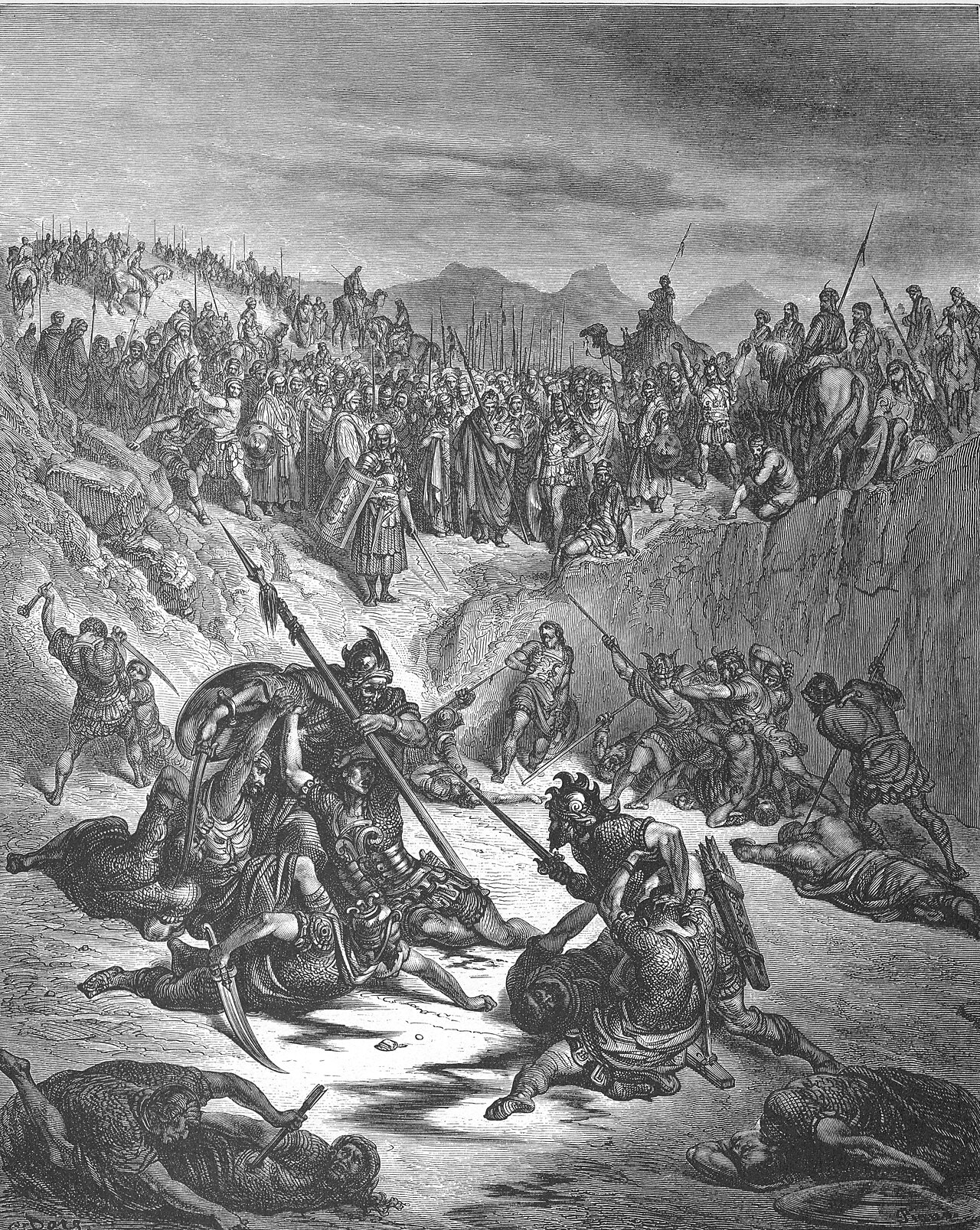
in 2 Samuel 2but they had struck down 360 Benjamites who were with Abner.
BSB
The same verse in ASV and KJV ▾
ASV
But the servants of David had smitten of Benjamin, and of Abner’s men, so that three hundred and threescore men died.
KJV
But the servants of David had smitten of Benjamin, and of Abner’s men, so that three hundred and threescore men died.
⋯
This verse in 2 Samuel 2
Commentary
6 notes on this verseA commentator
Jamieson, Fausset & Brown1802–1910
Commentary Critical and Explanatory on the Whole Bible (1871)
Asahel pursued after Abner--To gain the general's armor was deemed the grandest trophy. Asahel, ambitious of securing Abner's, had outstripped all other pursuers, and was fast gaining on the retreating commander. Abner, conscious of possessing more physical power, and unwilling that there should be "blood" between himself and Joab, Asahel's brother, twice urged him to desist.
This site's exposition
there lacked of David’s servants nineteen men
on 2 Samuel 2:30-31
Joab gathers his men and counts the cost: nineteen of David's servants are missing along with Asahel, against three hundred and sixty of Benjamin and Abner's men who have fallen. The ratio is stated without triumph, a lopsided victory recorded in numbers rather than praised in words. The house of David has won the field on the very day the two houses first drew swords against each other.
The record, by era
The Puritans and the Awakening4 voices
6 And now the L ORD shew kindness and truth unto you: and I also will requite you this kindness, because ye have done this thing. 7 Therefore now let your hands be strengthened, and be ye valiant: for your master Saul is dead, and also the house of Judah have anointed me king over them.
quarantine:scripture (2026-07-29) — scripture-overlap:96%@v6-7
6, 20, 44 ), in comparison with which this was nothing. It is to be hoped that they had grown wiser and more moderate. Asahel's funeral is here mentioned; the rest they buried in the field of battle, but he was carried to Bethlehem, and buried in the sepulchre of his father,
quarantine:debris (2026-07-29) — leading-citation-number+unbalanced-parens
But the servants of David had smitten of Benjamin, and Abner's men,.... Of those of the tribe of Benjamin that joined him, and of those that he brought with him from Mahanaim; so many of them were smitten, as appeared by their bodies lying on the field of battle: so that three hundred and threescore men died; the number of the slain on each side was very unequal.
A fool's lips and hands enter into contention. The seat of the war was Gibeon. Abner chose it because it was in the lot of Benjamin, where Saul had the most friends; yet, since he offered battle, Joab, David's general, would not decline it, but there joined issue with him, and met him by the pool of Gibeon,
The words behind it
11 Hebrew wordsEvery Hebrew word of this verse in the order it stands, with what it means and the door to its own study. The last column counts the times a word stands in the whole Bible: the rarer the word, the more the places it appears belong together.
| Hebrew | Sound | Meaning | Word study | In the Bible |
|---|---|---|---|---|
| וְעַבְדֵ֣י | veavdei | and [the] servants of | H5650 → | 799 times |
| דָוִ֗ד | david | David | H1732 → | 999 times |
| הִכּוּ֙ | hiku | they had struck down | H5221 → | 499 times |
| מִבִּנְיָמִ֔ן | mibinyamin | of Benjamin | H1144 → | 166 times |
| וּבְאַנְשֵׁ֖י | uveanshei | and among [the] men of | H582 → | 566 times |
| אַבְנֵ֑ר | ʾavner | Abner | H74 → | 63 times |
| שְׁלֹשׁ־ | shelosh- | three | H7969 → | 432 times |
| מֵא֧וֹת | meot | hundred<s> | H3967 → | 581 times |
| וְשִׁשִּׁ֛ים | veshishim | and sixty | H8346 → | |
| אִ֖ישׁ | ʾish | man | H376 → | 1663 times |
| מֵֽתוּ׃ | metu | they had died | H4191 → | 839 times |
וְעַבְדֵ֣יand [the] servants of
veavdeiH5650 →799 times
דָוִ֗דDavid
davidH1732 →999 times
הִכּוּ֙they had struck down
hikuH5221 →499 times
מִבִּנְיָמִ֔ןof Benjamin
mibinyaminH1144 →166 times
וּבְאַנְשֵׁ֖יand among [the] men of
uveansheiH582 →566 times
אַבְנֵ֑רAbner
ʾavnerH74 →63 times
שְׁלֹשׁ־three
shelosh-H7969 →432 times
מֵא֧וֹתhundred<s>
meotH3967 →581 times
וְשִׁשִּׁ֛יםand sixty
veshishimH8346 →
אִ֖ישׁman
ʾishH376 →1663 times
מֵֽתוּ׃they had died
metuH4191 →839 times
A shaded row is a word that stands 400 times or fewer in the Bible.
The walk
8 stopsEach card is a verse this one points to, and under it the verses that one points to in turn. Where several paths arrive at the same place, that place is listed first: the text keeps returning to it.
Through
2 Samuel 3:1Now the war between the house of Saul and the house of David was protracted. And David grew stronger and stronger, while the house of Saul grew weaker and weaker.
it leads to
- 1 Kings 14:30
There was war between Rehoboam and Jeroboam throughout their days.
- Job 8:7
Though your beginnings were modest, your latter days will flourish.
- Proverbs 4:18–19
The path of the righteous is like the first gleam of dawn, shining brighter and brighter until midday.
- 2 Samuel 2:17
The battle that day was intense, and Abner and the men of Israel were defeated by the servants of David.
- Ephesians 6:12
For our struggle is not against flesh and blood, but against the rulers, against the authorities, against the powers of this world’s darkness, and against the spiritual forces of evil in the heavenly realms.
- 1 Kings 14:30
Through
1 Kings 20:11And the king of Israel replied, “Tell him: ‘The one putting on his armor should not boast like one taking it off.’”
it leads to
- Proverbs 27:1
Do not boast about tomorrow, for you do not know what a day may bring.
- 1 Samuel 17:44–47
“Come here,” he called to David, “and I will give your flesh to the birds of the air and the beasts of the field!”
- Ecclesiastes 9:11
I saw something else under the sun: The race is not to the swift, nor the battle to the strong; neither is the bread to the wise, nor the wealth to the intelligent, nor…
- Proverbs 27:1
About 2 Samuel
This page draws on Jamieson, Fausset & Brown, Commentary Critical and Explanatory on the Whole Bible; John Gill, Exposition of the Old Testament; John Gill, Exposition of the Old Testament (1748-1763) and Matthew Henry, Commentary on the Whole Bible.