
2 Samuel 2:7
in 2 Samuel 2Now then, be strong and courageous, for though Saul your lord is dead, the house of Judah has anointed me as their king.”
BSB
The same verse in ASV and KJV ▾
ASV
Now therefore let your hands be strong, and be ye valiant; for Saul your lord is dead, and also the house of Judah have anointed me king over them.
KJV
Therefore now let your hands be strengthened, and be ye valiant: for your master Saul is dead, and also the house of Judah have anointed me king over them.
⋯
This verse in 2 Samuel 2
Commentary
6 notes on this verseNow let your hands be strengthened - David certainly wished to attach the men of Jabesh to his interest; he saw that they were generous and valiant, and must be of great service to him whose part they espoused; and he was no doubt afraid that they would attach themselves to the house of Saul, in consideration of the eminent services Saul had rendered them in rescuing them from Nahash, king of the Ammonites.
This site's exposition
Blessed be ye of the Lord
on 2 Samuel 2:5-7
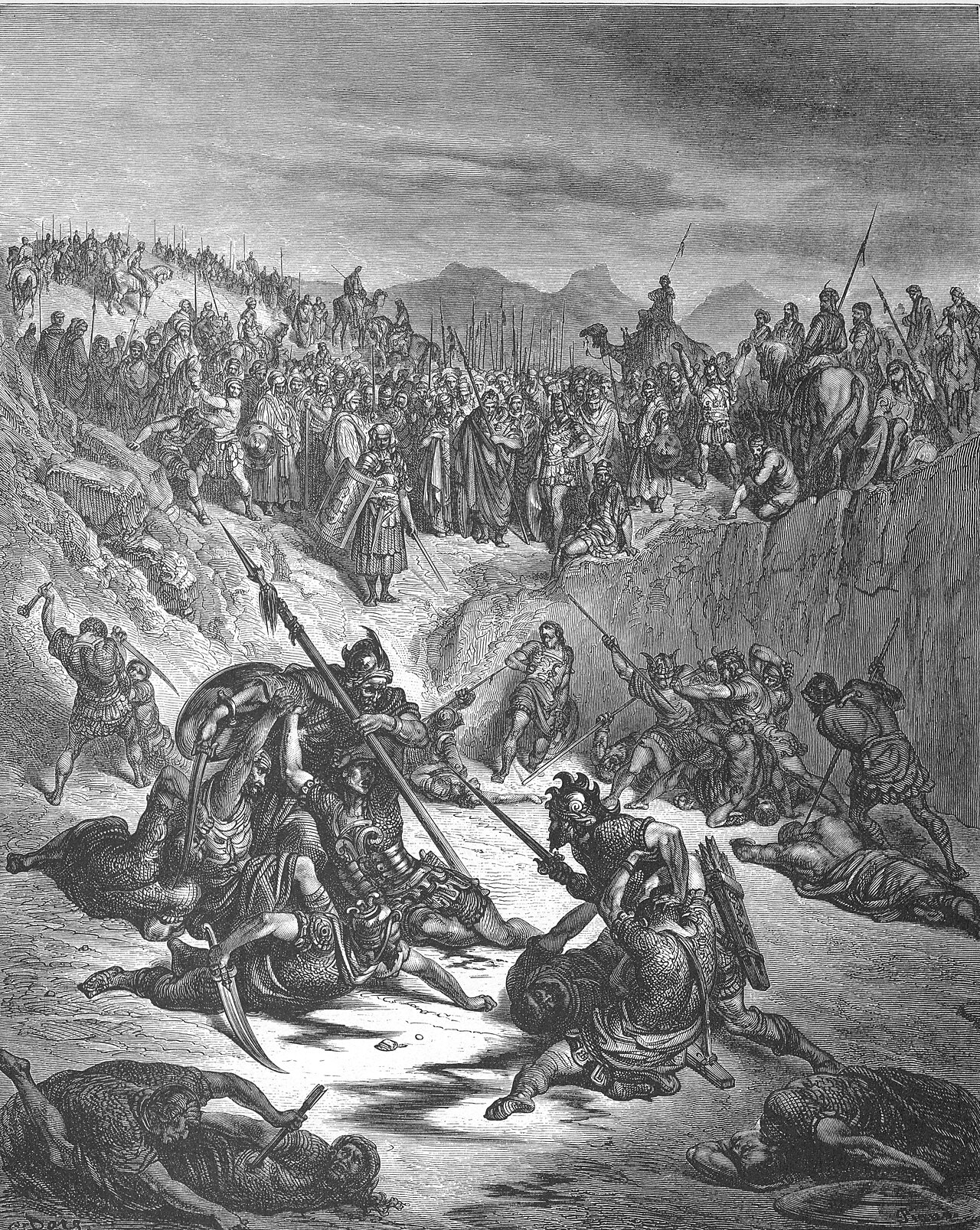
David sends a blessing to Jabesh-gilead for the kindness they showed Saul in burying him, calling it kindness and truth and promising to requite it. The vocabulary anticipates the kindness shown later to Jonathan's line at 9:3, though here it is spoken over the grave of the king David never raised his own hand against. The message closes with a summons, let their hands be strengthened, for Judah has already made David king, an invitation to the rest of Israel left open rather than forced.
This site's exposition
be strong and courageous
Adam Clarke reads the summons as an appeal for the loyalty of Jabesh-gilead. Saul had once rescued that town from Nahash, king of the Ammonites, and Clarke judges that David feared its men would hold to the house of Saul. Their courage was known.
The record, by era
The Puritans and the Awakening2 voices
10 Ishbosheth Saul's son was forty years old when he began to reign over Israel, and reigned two years. But the house of Judah followed David. 11 And the time that David was king in Hebron over the house of Judah was seven years and six months.
quarantine:scripture (2026-07-29) — scripture-overlap:98%@v10-11
Now therefore let your hands be strengthened, and be ye valiant,....
The Nineteenth Century1 voice
A commentator
Jamieson, Fausset & Brown1802–1910
Commentary Critical and Explanatory on the Whole Bible (1871)
David sent messengers unto the men of Jabesh-gilead--There can be no doubt that this message of thanks for their bold and dangerous enterprise in rescuing the bodies of Saul and his sons was an expression of David's personal and genuine feeling of satisfaction. At the same time, it was a stroke of sound and timely policy.
The words behind it
17 Hebrew wordsEvery Hebrew word of this verse in the order it stands, with what it means and the door to its own study. The last column counts the times a word stands in the whole Bible: the rarer the word, the more the places it appears belong together.
| Hebrew | Sound | Meaning | Word study | In the Bible |
|---|---|---|---|---|
| וְעַתָּ֣ה׀ | veatah | and now | H6258 → | 433 times |
| תֶּחֱזַ֣קְנָה | techezaknah | let them be strong | H2388 → | 291 times |
| יְדֵיכֶ֗ם | yedeikhem | hands your | H3027 → | 1618 times |
| וִֽהְיוּ֙ | vihyu | and become | H1961 → | 3559 times |
| לִבְנֵי־ | livnei- | <into> sons of | H1121 → | 4930 times |
| חַ֔יִל | chayil | strength | H2428 → | 246 times |
| כִּי־ | ki- | for | H3588 → | 4482 times |
| מֵ֖ת | met | he has died | H4191 → | 839 times |
| אֲדֹנֵיכֶ֣ם | ʾadoneikhem | lord<s> your | H113 → | 333 times |
| שָׁא֑וּל | shaul | Saul | H7586 → | 402 times |
| וְגַם־ | vegam- | and also | H1571 → | 769 times |
| אֹתִ֗י | ʾoti | <obj.> me | H853 → | 10935 times |
| מָשְׁח֧וּ | mashechu | they have anointed | H4886 → | 70 times |
| בֵית־ | veit- | [the] house of | H1004 → | 2046 times |
| יְהוּדָ֛ה | yehudah | Judah | H3063 → | 819 times |
| לְמֶ֖לֶךְ | lemelekh | to king | H4428 → | 2525 times |
| עֲלֵיהֶֽם׃ פ | ʾaleihem | over them | H5921 → | 5755 times |
וְעַתָּ֣ה׀and now
veatahH6258 →433 times
תֶּחֱזַ֣קְנָהlet them be strong
techezaknahH2388 →291 times
יְדֵיכֶ֗םhands your
yedeikhemH3027 →1618 times
וִֽהְיוּ֙and become
vihyuH1961 →3559 times
לִבְנֵי־<into> sons of
livnei-H1121 →4930 times
חַ֔יִלstrength
chayilH2428 →246 times
כִּי־for
ki-H3588 →4482 times
מֵ֖תhe has died
metH4191 →839 times
אֲדֹנֵיכֶ֣םlord<s> your
ʾadoneikhemH113 →333 times
שָׁא֑וּלSaul
shaulH7586 →402 times
וְגַם־and also
vegam-H1571 →769 times
אֹתִ֗י<obj.> me
ʾotiH853 →10935 times
מָשְׁח֧וּthey have anointed
mashechuH4886 →70 times
בֵית־[the] house of
veit-H1004 →2046 times
יְהוּדָ֛הJudah
yehudahH3063 →819 times
לְמֶ֖לֶךְto king
lemelekhH4428 →2525 times
עֲלֵיהֶֽם׃ פover them
ʾaleihemH5921 →5755 times
A shaded row is a word that stands 400 times or fewer in the Bible.
The walk
8 stopsEach card is a verse this one points to, and under it the verses that one points to in turn. Where several paths arrive at the same place, that place is listed first: the text keeps returning to it.
Through
Ephesians 6:10Finally, be strong in the Lord and in His mighty power.
it leads to
- Philippians 4:13
I can do all things through Christ who gives me strength.
- Isaiah 40:31
But those who wait upon the LORD will renew their strength; they will mount up with wings like eagles; they will run and not grow weary, they will walk and not faint.
- Joshua 1:9
Have I not commanded you to be strong and courageous? Do not be afraid; do not be discouraged, for the LORD your God is with you wherever you go.”
- 1 Corinthians 16:13
Be on the alert. Stand firm in the faith. Be men of courage. Be strong.
- 1 Peter 5:10
And after you have suffered for a little while, the God of all grace, who has called you to His eternal glory in Christ, will Himself restore you, secure you, strengthen you, and establish…
- Philippians 4:13
Through
Genesis 15:1After these events, the word of the LORD came to Abram in a vision: “Do not be afraid, Abram. I am your shield, your very great reward.”
it leads to
- Isaiah 41:10
Do not fear, for I am with you; do not be afraid, for I am your God. I will strengthen you; I will surely help you; I will uphold you with My right hand…
- Psalms 119:114
You are my hiding place and my shield; I put my hope in Your word.
- Psalms 84:11
For the LORD God is a sun and a shield; the LORD gives grace and glory; He withholds no good thing from those who walk with integrity.
- Isaiah 41:10
About 2 Samuel
Who and where
2 names in this verse with a page on the site.
- PersonPatriarchsJudahJacob's fourth son who pledges himself for Benjamin; the tribe that carries the scepter to Shiloh (49:10) and the line to Christ (…
- PersonUnited monarchySaulIsrael's first king, head and shoulders above the people; began in humility, ended in rejection — sparing what God devoted, consul…
This page draws on Adam Clarke, Commentary on the Bible; Jamieson, Fausset & Brown, Commentary Critical and Explanatory on the Whole Bible; John Gill, Exposition of the Old Testament; John Gill, Exposition of the Old Testament (1748-1763) and Matthew Henry, Commentary on the Whole Bible.