
2 Samuel 2:17
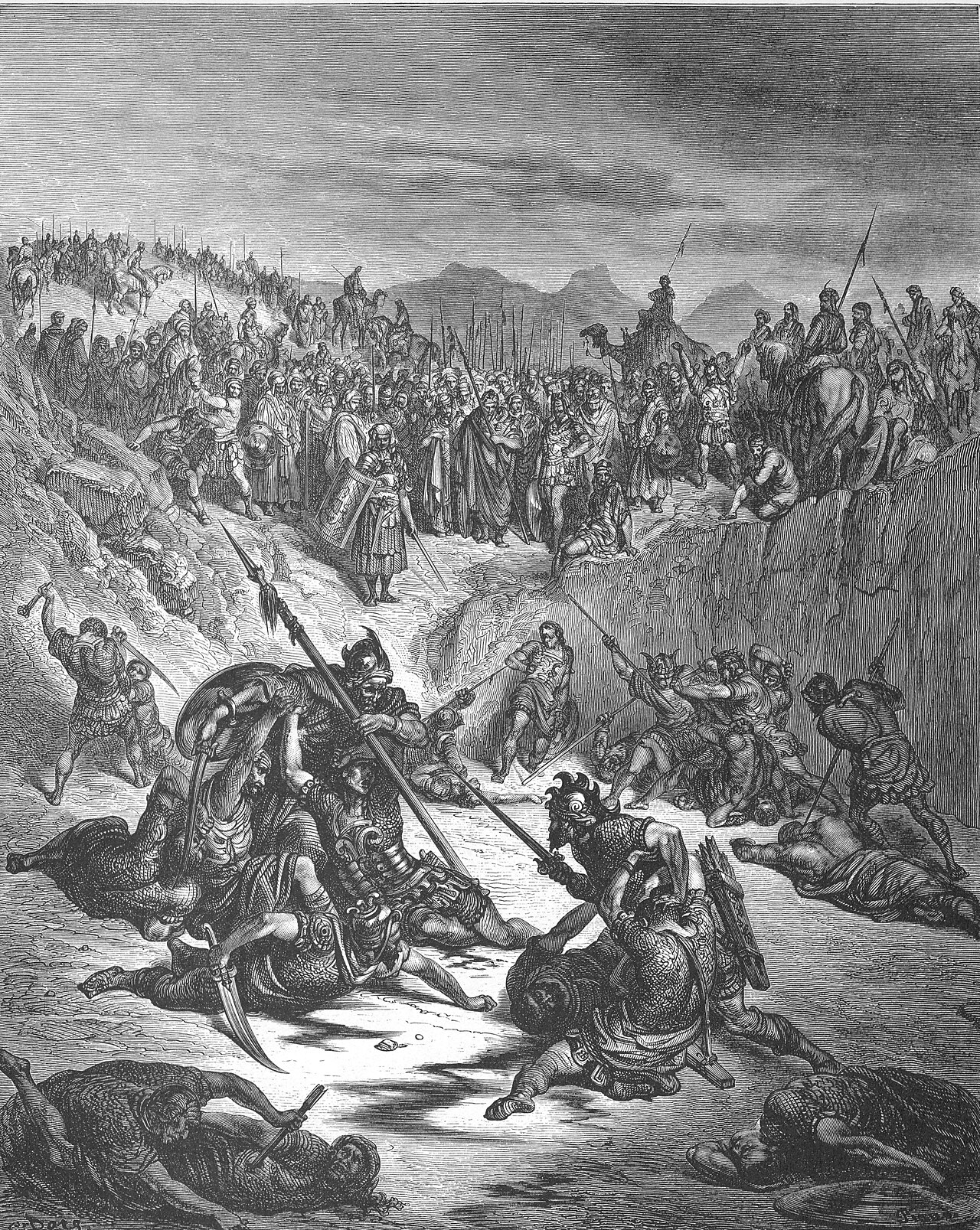
in 2 Samuel 2The battle that day was intense, and Abner and the men of Israel were defeated by the servants of David.
BSB
The same verse in ASV and KJV ▾
ASV
And the battle was very sore that day; and Abner was beaten, and the men of Israel, before the servants of David.
KJV
And there was a very sore battle that day; and Abner was beaten, and the men of Israel, before the servants of David.
⋯
This verse in 2 Samuel 2
Commentary
5 notes on this verseThis site's exposition
Abner and the men of Israel were defeated
The mock combat becomes a full battle, and Abner is beaten before the servants of David. It is the first defeat named in the war between the two houses. It sets the pattern 3:1 will state: David grew stronger and stronger, while the house of Saul grew weaker and weaker.
The record, by era
The Puritans and the Awakening2 voices
Asahel, the brother of Joab and cousin-german to David, was one of the principal commanders of David's forces, and was famous for swiftness in running: he was as light of foot as a wild roe (
quarantine:debris (2026-07-29) — unbalanced-parens
And there was a very sore battle that day,.... When the twenty four men fell together, and no decision could be made thereby, or any triumph on either side, both armies drew up in battle array, and fought very furiously: and Abner was beaten, and the men of Israel, before the servants of David; the army under him had the worst of it, and were routed, and obliged to flee before the army of David under the command of Joab.
The Nineteenth Century2 voices
A commentator
Jamieson, Fausset & Brown1802–1910
Commentary Critical and Explanatory on the Whole Bible (1871)
proposed
Abner the son of Ner, captain of Saul's host took Ish-bosheth--Here was the establishment of a rival kingdom, which, however, would probably have had no existence but for Abner. Ish-bosheth--or "Esh-baal" (1Ch 8:33;
quarantine:debris (2026-07-29) — unbalanced-parens
A commentator
Albert Barnes1798–1870
Notes, Explanatory and Practical, on the Old and New Testaments (1832-1869)
proposed
Neither side had the advantage in the combat of twelve a side; hence, the quarrel was fought out with great fierceness by the two armies, and the victory was won by David.
How the passage was read
What the Jewish commentators add
On the verses either side of this one
The Plain of Swords. Yonasan translates the plain of Killing on account of the swords just like you say [in Scriptures] (Tehilim, 44) 2 Rashi is showing how the word צוּר, sharpness, is used in reference to a sword. "You also turned back the sharpness of his sword."
This section is reception history: how the passage was read and kept in the Jewish tradition. Where a reading parts from an essential of the Christian faith, the section says so at that point.
Texts and citation data: Sefaria; each excerpt follows its version’s licence. 7 further sources are cited on this chapter that carry no English text this site may quote or only restate the verse.
The words behind it
14 Hebrew wordsEvery Hebrew word of this verse in the order it stands, with what it means and the door to its own study. The last column counts the times a word stands in the whole Bible: the rarer the word, the more the places it appears belong together.
| Hebrew | Sound | Meaning | Word study | In the Bible |
|---|---|---|---|---|
| וַתְּהִ֧י | vatehi | and it was | H1961 → | 3559 times |
| הַמִּלְחָמָ֛ה | hamilchamah | the battle | H4421 → | 320 times |
| קָשָׁ֥ה | kashah | severe | H7186 → | |
| עַד־ | ʾad- | up to | H5704 → | 1261 times |
| מְאֹ֖ד | meod | muchness | H3966 → | 300 times |
| בַּיּ֣וֹם | baiyom | on the day | H3117 → | 2304 times |
| הַה֑וּא | hahu' | <the> that | H1931 → | 1879 times |
| וַיִּנָּ֤גֶף | vaiyinagef | and he was defeated | H5062 → | 49 times |
| אַבְנֵר֙ | ʾavner | Abner | H74 → | 63 times |
| וְאַנְשֵׁ֣י | veanshei | and [the] men of | H582 → | 566 times |
| יִשְׂרָאֵ֔ל | yisrael | Israel | H3478 → | 2507 times |
| לִפְנֵ֖י | lifnei | <to> before | H6440 → | 2123 times |
| עַבְדֵ֥י | ʾavdei | [the] servants of | H5650 → | 799 times |
| דָוִֽד׃ | david | David | H1732 → | 999 times |
וַתְּהִ֧יand it was
vatehiH1961 →3559 times
הַמִּלְחָמָ֛הthe battle
hamilchamahH4421 →320 times
קָשָׁ֥הsevere
kashahH7186 →
עַד־up to
ʾad-H5704 →1261 times
מְאֹ֖דmuchness
meodH3966 →300 times
בַּיּ֣וֹםon the day
baiyomH3117 →2304 times
הַה֑וּא<the> that
hahu'H1931 →1879 times
וַיִּנָּ֤גֶףand he was defeated
vaiyinagefH5062 →49 times
אַבְנֵר֙Abner
ʾavnerH74 →63 times
וְאַנְשֵׁ֣יand [the] men of
veansheiH582 →566 times
יִשְׂרָאֵ֔לIsrael
yisraelH3478 →2507 times
לִפְנֵ֖י<to> before
lifneiH6440 →2123 times
עַבְדֵ֥י[the] servants of
ʾavdeiH5650 →799 times
דָוִֽד׃David
davidH1732 →999 times
A shaded row is a word that stands 400 times or fewer in the Bible.
The walk
5 stopsEach card is a verse this one points to, and under it the verses that one points to in turn. Where several paths arrive at the same place, that place is listed first: the text keeps returning to it.
Through
2 Samuel 3:1Now the war between the house of Saul and the house of David was protracted. And David grew stronger and stronger, while the house of Saul grew weaker and weaker.
it leads to
- 1 Kings 14:30
There was war between Rehoboam and Jeroboam throughout their days.
- Proverbs 4:18–19
The path of the righteous is like the first gleam of dawn, shining brighter and brighter until midday.
- Job 8:7
Though your beginnings were modest, your latter days will flourish.
- Ephesians 6:12
For our struggle is not against flesh and blood, but against the rulers, against the authorities, against the powers of this world’s darkness, and against the spiritual forces of evil in the heavenly realms.
- Job 17:9
Yet a righteous one holds to his way, and the one with clean hands grows stronger.
- 1 Kings 14:30
Where this verse is studied
On this page
About 2 Samuel
Who and where
1 name in this verse with a page on the site.
This page draws on Albert Barnes, Notes, Explanatory and Practical, on the Old and New Testaments (1832-1869); Jamieson Fausset and Brown, Commentary Critical and Explanatory on the Whole Bible; Jamieson, Fausset & Brown, Commentary Critical and Explanatory on the Whole Bible; John Gill, Exposition of the Old Testament; John Gill, Exposition of the Old Testament (1748-1763) and Matthew Henry, Commentary on the Whole Bible.