
1 Samuelchapter 28
25 verses · BSB1 Samuel book hub →
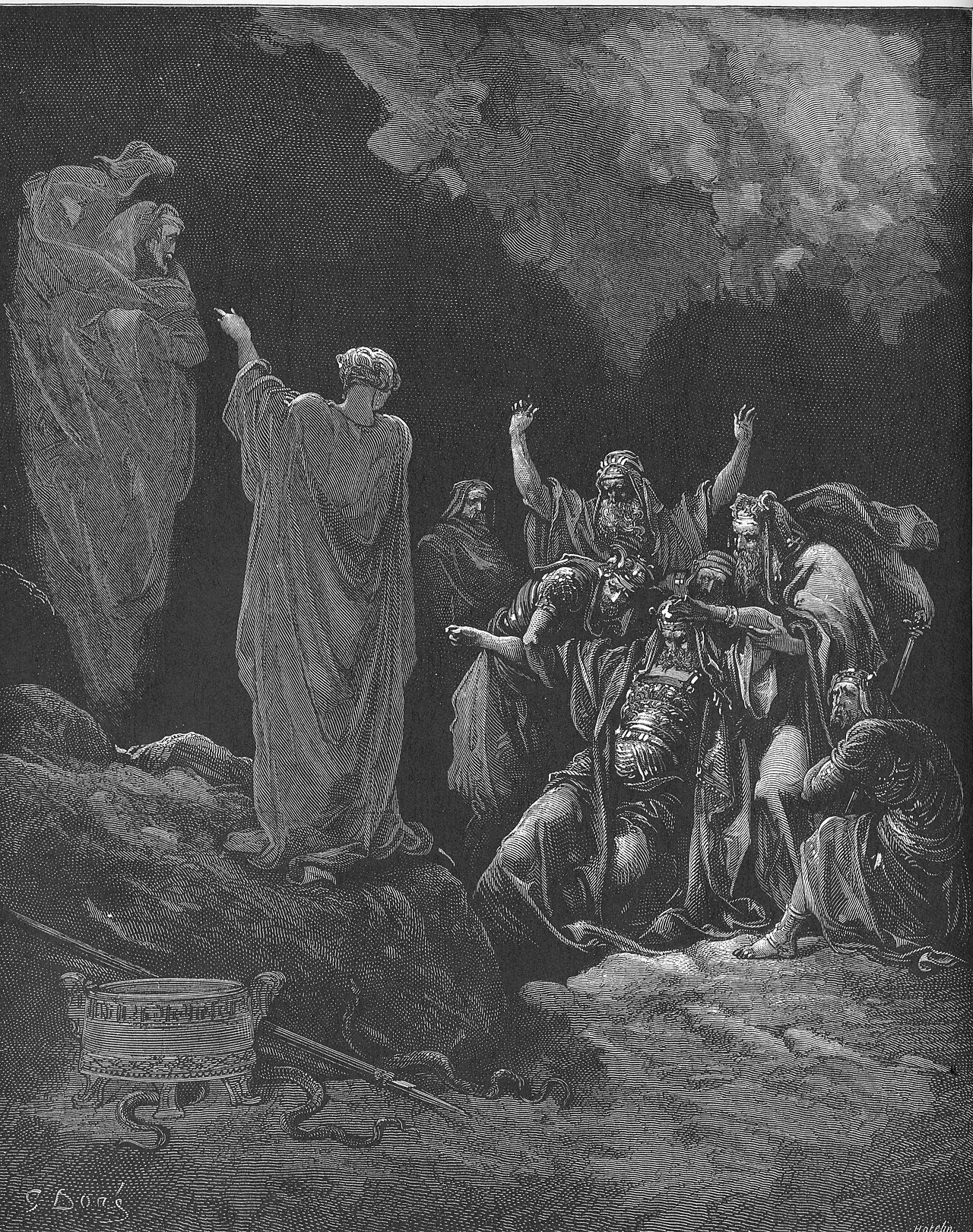
Saul and the Witch of Endor, Gustave Doré, Doré's English Bible (1866), public domain
Key verse
Now by this time Samuel had died, and all Israel had mourned for him and buried him in Ramah, his own city. And Saul had removed the mediums and spiritists from the land.
It stands in scene A of the chapter, verses 1 to 6.
The chapter
Chapter summary
The Philistines muster and Saul's heart trembles greatly. Samuel is dead, and Saul himself had cleared the land of mediums; now 'Jehovah answered him not, neither by dreams, nor by Urim, nor by prophets' (28:6). So the king who purged the necromancers disguises himself, goes by night to the woman at En-dor, and asks her to bring up Samuel. Whatever she expected, she cries out at what comes: an old man covered with a robe, and Saul falls on his face. The word is worse than the silence: Jehovah hath rent the kingdom out of thy hand and given it to David; to-morrow shalt thou and thy sons be with me. He falls his full length on the earth.
Context
History · Samuel, Nathan, Gad · 1 Samuel overview
Where the chapter sits
1 Samuel 28 falls in David's rise in Saul's shadow (chapters 16–31). David anointed in secret; Goliath; Jonathan's covenant; Saul's pursuit; the cave of Adullam; Nabal and Abigail; the Philistine sanctuary; Saul's death at Gilboa.
The witch of Endor. Saul in disguise; Samuel's spirit called up; the word of judgment repeated.
Before it: Saul's reign: promise and rejection, chapters 9–15.
The whole shape of 1 Samuel→The world behind this chapter
1 Samuel 28The history
Every legitimate channel is closed, and the chapter says so: the LORD did not answer him, by dreams, or by Urim, or by prophets. Those were the three recognized means of guidance in Israel. Samuel is dead, the priesthood of Nob is dead by Saul's own order, and Abiathar with the ephod is in David's camp. Saul destroyed his own access and now cannot get an answer.
The rest of the history, and what it meant to them
Consulting the dead was practiced everywhere around Israel, Mesopotamian texts give detailed procedures for questioning ghosts, and the Law of Moses made it a capital offense. Saul himself had expelled the mediums from the land, which is why the woman fears a trap, and why the king has to disguise himself and travel at night. Endor lies north of the Philistine position at Shunem, so the ride there and back went around an enemy army in the dark.
Readers have long divided over what happens next. Some hold that God permitted Samuel himself to appear, which the woman's scream of terror supports, she was not expecting anything of the kind. Others hold it was a deceiving spirit impersonating him. The house reading follows the text as it stands: it says Samuel, and what he says is true, consistent with everything he said in life, and utterly against the interests of the woman conducting the séance.
The message is a summary judgment. The LORD has done as he spoke by me: he has torn the kingdom out of your hand and given it to David, because you did not obey his voice and carry out his fierce wrath against Amalek. Then the sentence: tomorrow you and your sons will be with me, and the army of Israel will be given into the hand of the Philistines.
The last scene is strangely tender. Saul collapses, having eaten nothing all day and night, and the medium, a criminal by his own decree, kills her fattened calf, bakes unleavened bread, and makes him eat before he goes back to die.
What it meant to them
For first hearers the chapter was a warning about what happens when a man silences every voice that tells him the truth and then, desperate, goes looking for a voice from the grave.
Saul's own words say it best: God has turned away from me and answers me no more; therefore I have summoned you. He knows the answer already. He rides all night to hear it from a dead man rather than repent to a living God.
Sources cited
- John H. Walton, Victor H. Matthews, and Mark W. Chavalas, The IVP Bible Background Commentary: Old Testament
- Keil and Delitzsch, Biblical Commentary on the Old Testament: The Books of Samuel
A. God answers not by dreams, nor Urim, nor prophets
1. (vv. 1-2)
a.David has been living among the Philistines since chapter 27, and Achish now calls in the debt: Saul's rival is ordered into battle against Saul's own nation. David's answer at verse 2, Surely thou shalt know what thy servant can do, commits to nothing while sounding like consent, and Achish hears only what he wants to hear. The king rewards the ambiguity by naming David keeper of his head for ever, captain of his own bodyguard.
1 Samuel 28:1, 1 voiceWhat preachers and commentators have said about these verses, in their own words.
1 Samuel 28:1
“The Philistines gathered their armies together - Sir Isaac Newton conjectures that the Philistines had got a great increase to their armies by vast numbers of men which Amasis had driven out of Egypt. This, with Samuel’s death, and David’s disgrace, were no inconsiderable motives to a new war, front which the Philistines had now every thing to hope. Thou shalt go out with me to battle - This he said, being deceived by what David had told him.”
Adam Clarke· Commentary on the Bible (1810-1826)evangelical
1 Samuel 28:2, 1 voice
1 Samuel 28:2
“Surely thou shalt know what thy servant can do - This was another equivocal answer; and could only be understood by his succeeding conduct. It might imply what he could do in favor of the Philistines against Israel; or in favor of Israel against the Philistines. Achish understood it in the former sense; and therefore he said to David, I will make thee keeper of my head for ever; i.e., Thou shalt be captain of my life-guards.”
Adam Clarke· Commentary on the Bible (1810-1826)evangelical
2. (v. 3)
a.buried him in Ramah: The narrator pauses to recall two facts before the chapter's real business: Samuel is dead and mourned, and Saul had once purged the land of mediums and wizards, obeying the law of Leviticus 19:31 and Deuteronomy 18:10-11. Both notices are placed here on purpose, so that the king who goes to consult the dead in the next verses does it against his own law and without the prophet who might have restrained him. Jamieson, Fausset and Brown read the notice as the narrator's own explanation for what follows: Saul is left without any lawful means of enquiry precisely because he had cut off the unlawful ones.
1 Samuel 28:3, 1 voice
1 Samuel 28:3
“It does not appear when Saul had suppressed witchcraft; it was probably in the early part of his reign. Familiar spirits ... wizards - i. e. ventriloquists ... wise or cunning men. See Lev 19:31 note.”
3. (vv. 4-5)
a.Shunem and Gilboa face each other across the valley of Jezreel, and Endor lies just beyond the Philistine camp on the far side of the ridge, so Saul's night trip later in the chapter will cross ground his own enemy is holding. Verse 5 gives the king's state before he does anything: he was afraid, and his heart greatly trembled, the same dismay that gripped the whole army at the sight of Goliath in chapter 17, except now no young shepherd stands ready to answer for him. Matthew Henry reads the fear as the guilty blood of Amalek and the innocent blood of the priests at Nob finally catching up with him.
1 Samuel 28:4, 2 voices
1 Samuel 28:4
“Gilboa - Now called Jebel Fukuak. But the ancient name is preserved in the village of Jelbon, situated on the south side of the mountain. It was separated from Shunem (see the marginal reference) by the deep valley of Jezreel. The Philistines either advanced along the seacoast, and then entered the valley of Jezreel from the west, or they came by the present road right through Samaria, starting from Aphek 1Sa 29:1.”
1 Samuel 28:4
“To her house he repaired by night in disguise, accompanied by two faithful servants. En-dor--"the fountain of the circle" (that figure being constantly affected by magicians) was situated directly on the other side of the Gilboa range, opposite Tabor; so that, in this midnight adventure, Saul had to pass over the shoulder of the ridge on which the Philistines were encamped.”
Jamieson, Fausset & Brown· Commentary Critical and Explanatory on the Whole Bible (1871)reformed
1 Samuel 28:5, 1 voice
1 Samuel 28:5
“Now he remembered the guilty blood of the Amalekites which he had spared, and the innocent blood of the priests which he had spilt. His sins were set in order before his eyes, which put him into confusion, embarrassed all his counsels, robbed him of all his courage, and produced in him a certain fearful looking for of judgment and fiery indignation.”
Matthew Henry· Commentary on the Whole Bible (1707-1721)puritan
4. (v. 6)
a.This is Saul's one recorded enquiry of the Lord as king, and it meets total silence across all three lawful channels: dreams, Urim, and prophets. The pattern set against David's own habit of enquiry, at 23:2, 23:4 and 30:8, and after him 2 Sam 2:1, 5:19 and 5:23, makes the contrast the book's own argument rather than a later reader's addition. Chronicles states the verdict this chapter leaves the reader to draw: he enquired not of the Lord, therefore he slew him.
1 Samuel 28:6, 2 voices
1 Samuel 28:6
“The Lord answered him not - He used the three methods by which supernatural intelligence was ordinarily given: - 1. Dreams. - The person prayed for instruction; and begged that God would answer by a significant dream. 2. Urim. - This was a kind of oracular answer given to the high priest when clothed with the ephod, on which were the Urim and Thummim. How these communicated the answer, is not well known. 3. Prophets. - Who were requested by the party concerned to consult the Lord on the subject in question, and to report his answer.”
Adam Clarke· Commentary on the Bible (1810-1826)evangelical
1 Samuel 28:6
“He did not enquire in faith, but with a double unstable mind. He enquired of the Lord when it was too late, when the days of his probation were over and he was finally rejected. Seek the Lord while he may be found, for there is a time when he will not be found.”
Matthew Henry· Commentary on the Whole Bible (1707-1721)puritan
B. The woman at En-dor and an old man in a robe
1. (vv. 7-8)
a.Saul does not go himself first; he sends his servants to find what his own decree had made illegal to keep. Endor lay seven or eight miles from Gilboa on the far side of the Philistine camp, so reaching it by night meant passing near the very army Saul feared. He goes disguised, in another man's clothes, because he does not want the woman to know who is asking and suspects she would refuse a king the practice she might risk for a stranger.
1 Samuel 28:7, 2 voices
1 Samuel 28:7
“Enquire - A different word from that in 1Sa 28:6, though nearly synonymous with it. It is more frequently applied to inquiry of a false god, as e. g. 2Ki 1:2; Isa 8:19; Isa 19:3. En-dor (see Jos 11:2 note) was seven or eight miles from the slopes of Gilboa, on the north of little Hermon, where the Philistines were encamped; so that Saul must have run great risks in going there.”
1 Samuel 28:7
“He knew the heinousness of the sin of witchcraft, else he would not have cut off those that had familiar spirits; yet now he had recourse to that as an oracle which he had before condemned as an abomination. It is common for men to inveigh severely against those sins which they are in no temptation to, but afterwards to be themselves overcome by them.”
Matthew Henry· Commentary on the Whole Bible (1707-1721)puritan
1 Samuel 28:8, 2 voices
1 Samuel 28:8-14
“On the other hand, many eminent writers (considering that the apparition came before her arts were put in practice; that she herself was surprised and alarmed; that the prediction of Saul's own death and the defeat of his forces was confidently made), are of opinion that Samuel really appeared.”
Jamieson, Fausset & Brown· Commentary Critical and Explanatory on the Whole Bible (1871)reformed
1 Samuel 28:8
“Disguised - Both because he was ashamed to be known, or thought guilty of this practice; and because he suspected, the woman, had she known him, would not practice her art before him.”
John Wesley· Explanatory Notes upon the Old Testament (1765)evangelical
2. (vv. 9-10)
a.The woman names Saul's own law back to him without knowing who stands in front of her, and her fear is for her life rather than for the sin itself, which Matthew Henry notes is the common order among sinners, dread of punishment before dread of judgment. Saul answers with an oath sworn by the very name whose law he is about to break, As the Lord liveth, promising a safety he has no standing to promise since the penalty was never his to waive. The narrator leaves the irony to stand without comment: a king invokes the Lord to guarantee the success of consulting the dead.
1 Samuel 28:9, 1 voice
1 Samuel 28:9
“She considered what Saul had done, not what God had done, against such practices, and feared a snare laid for her life more than a snare laid for her soul. It is common for sinners to be more afraid of punishment from men than of God's righteous judgment. Saul promises with an oath not to betray her,”
Matthew Henry· Commentary on the Whole Bible (1707-1721)puritan
1 Samuel 28:10, 1 voice
1 Samuel 28:10
“It was his duty as a king to punish her and he knew it, yet he swears no to do it; as if he could by his own oath bind himself from doing that which, by the divine command, he was bound to do. But he promised more than he could perform when he said, There shall no punishment happen to thee; for he that could not secure himself could much less secure her from divine vengeance.”
Matthew Henry· Commentary on the Whole Bible (1707-1721)puritan
3. (vv. 11-14)
a.Saul names exactly who he wants, and the woman's own reaction settles a question the older commentaries return to: she cries out and immediately recognizes Saul, as though what appeared was not the sort of spirit her own art was used to raising. She first calls it gods ascending out of the earth, a general word for a supernatural being rather than a claim of deity, and only when Saul asks for a shape does she describe an old man covered with a mantle. That mantle is the detail that convinces Saul, the same garment Samuel wore when Saul tore it at 15:27 and heard the kingdom's rending read out of the tear. He falls with his face to the ground before the man whose robe had already carried this news to him once.
1 Samuel 28:11, 2 voices
1 Samuel 28:11
“Bring me up Samuel - Dr. Trench observes, “All human history has failed to record a despair deeper or more tragic than his, who, having forsaken God and being of God forsaken, is now seeking to move hell; and infinitely guilty as he is, assuredly there is something unutterably pathetic in that yearning of the disanointed king to change words with the friend and counselor of his youth, and if he must hear his doom, to hear it from no other lips but his” (‘Shipwrecks of Faith, ‘ p. 47).”
1 Samuel 28:11
“Samuel - Whose kindness and compassion as he had formerly experienced, so now he expected it in his deep distress. This practice of divination by the dead, or the souls of dead persons, was very usual among all nations.”
John Wesley· Explanatory Notes upon the Old Testament (1765)evangelical
1 Samuel 28:12, 2 voices
1 Samuel 28:12
“When the woman saw Samuel - That Samuel did appear on this occasion, is most evident from the text; nor can this be denied from any legitimate mode of interpretation: and it is as evident that he was neither raised by the power of the devil nor the incantations of the witch, for the appearances which took place at this time were such as she was wholly unacquainted with.”
Adam Clarke· Commentary on the Bible (1810-1826)evangelical
1 Samuel 28:12
“Saw Samuel - The words are express, the woman saw Samuel, instead of the spirit whom she expected to see, God ordering it so for his own glory. She cried with a loud voice - Terrified and astonished, and thence easily conjectured, whom she had been talking with.”
John Wesley· Explanatory Notes upon the Old Testament (1765)evangelical
1 Samuel 28:13, 3 voices
1 Samuel 28:13
“Samuel in hades! Samuel, he who was special among the prophets, who was dedicated to God from his birth, who before his birth is said to be in the temple, who at the same time he was weaned was clothed with the ephod and double cloak and became a priest of the Lord, the child to whom the Lord when he speaks uttered his messages, he was brought up by a medium?… Why is Samuel in hades?…Samuel comes up, and note that she does not say that she saw the soul of Samuel.”
Origen of Alexandria· written before 253· HOMILY ON 1 KINGS 28.3.2, 7.1patristic
1 Samuel 28:13
“Gods - אלהים 'ĕlohı̂ym is here used in a general sense of a supernatural appearance, either angel or spirit. Hell, or the place of the departed (compare 1Sa 28:19; 2Sa 12:23) is represented as under the earth Isa 14:9-10; Eze 32:18.”
1 Samuel 28:13
“Gods - That is, a God, and divine person, glorious, and full of majesty and splendour, exceeding not only mortal men, but common ghosts. She used the plural number, gods, either after the manner of the Hebrew language, which commonly uses that word of one person: or, after the language and custom of the heathens.”
John Wesley· Explanatory Notes upon the Old Testament (1765)evangelical
1 Samuel 28:14, 3 voices
1 Samuel 28:14
“Why, even now the followers of Simon [Magus] are so confident of their art that they undertake to bring back the souls of the prophets from hell. And this, I believe, because their power lies in their ability to deceive. This power was actually granted to the witch of Endor, who brought back the soul of Samuel after Saul had consulted God in vain. Apart from that case, God forbid we should believe that any soul, much less a prophet, could be called forth by a demon.”
Tertullian· written before 220· ON THE SOUL 57.7-9patristic
1 Samuel 28:14
“An old man cometh up, and he is covered with a mantle - This seems to have been a second apparition; she cannot mean that she had seen gods ascending out of the earth, and these gods were like an old man with a mantle. The angelic appearance first mentioned prepared the way for Samuel; and the whole was done so as to show to the woman that her art had not prevailed in the present instance, and that what was now taking place was wholly independent of her incantations.”
Adam Clarke· Commentary on the Bible (1810-1826)evangelical
1 Samuel 28:14
“A mantle - The usual habit of prophets, and particularly of Samuel, chap. xv, 27. If it was not Samuel, but an other spirit in his shape, it is not true, that Saul perceived it was Samuel.”
John Wesley· Explanatory Notes upon the Old Testament (1765)evangelical
C. To-morrow shalt thou and thy sons be with me
1. (vv. 15-16)
a.The text names the speaker without qualification: And Samuel said to Saul. Two readings have stood in the church since the fathers. Keil and Delitzsch and Adam Clarke read it as a true appearance permitted by God rather than produced by the woman's craft, pointing to her own terror as proof her art had not caused what she saw. Matthew Henry calls the figure an evil spirit in Samuel's mantle offering Saul cold comfort meant to drive him toward despair, and Tertullian argues the same power that let a demon impersonate a dead man for the followers of Simon was granted once here and nowhere else in Scripture.
1 Samuel 28:15, 3 voices
1 Samuel 28:15
“If the prophets, the forerunners of Christ, all went down into hades before the Christ, so too Samuel has gone down there. For he does not merely go down, but he goes down as a holy man. Wherever the holy man may be, he is holy. Is Christ no longer Christ, since he was once in hades? Was he no longer Son of God, since he existed in an underworld place, "that every knee should bow in the name of Jesus Christ in heaven and on earth and under the earth"?”
Origen of Alexandria· written before 253· HOMILY ON 1 KINGS 28.8.1patristic
1 Samuel 28:15
“Called Samuel - Happy had it been, if he had called Samuel sooner, or rather the God of Samuel! It was now too late: destruction was at hand and God had determined, it should not be stayed.”
John Wesley· Explanatory Notes upon the Old Testament (1765)evangelical
1 Samuel 28:15
"God denies me, therefore I come to thee. Flectere si nequeo superos, Acheronta movebo. " -- If I fail with heaven, I will move hell. It is cold comfort which this evil spirit in Samuel's mantle gives to Saul, and is manifestly intended to drive him to despair and self-murder.
Matthew Henry· Commentary on the Whole Bible (1707-1721)puritan
1 Samuel 28:16, 1 voice
1 Samuel 28:16
“Wherefore then dost thou ask of me - Was ever I wont to give answers that were not dictated by the Lord? It is his counsel alone that I communicate.”
Adam Clarke· Commentary on the Bible (1810-1826)evangelical
2. (vv. 17-19)
a.The rending of the kingdom repeats what Samuel had told Saul face to face at 15:28, spoken now a second time from beyond the grave. Verse 18 names the ground that chapter had already stated: Saul did not carry out the Lord's sentence on Amalek, the war Exodus 17 swore from generation to generation and Deuteronomy 25 commanded finished. Samuel's own word at 15:23 had set rebellion beside the sin of witchcraft, and Saul closes his reign proving the comparison true by consulting one. Tomorrow shalt thou and thy sons be with me is carried out within a day at chapter 31, and Matthew Henry reads with me only as the common state of the dead, separate from the body, stopping short of naming what company Saul keeps there.
1 Samuel 28:17, 3 voices
1 Samuel 28:17-19
“Is a little demon capable of prophesying concerning the entire people of God that the Lord is about to deliver Israel?…Can also a little demon know this, that after a king has been appointed with the anointing oil of a prophet, that tomorrow Saul and his sons with him will forfeit their lives?… But I cannot give to a little demon such a great power that he can prophesy concerning Saul and the people of God and he can prophesy concerning David that he will become king.”
Origen of Alexandria· written before 253· HOMILIES ON 1 KINGS 5.5, 5.8patristic
1 Samuel 28:17
“The Lord hath done to him - I believe these words are spoken of Saul; and as they are spoken to him, it seems evident that him should be thee. The Vulgate has tibi, the Septuagint σοι, to Thee: and this is the reading of five of Kennicott’s and De Rossi’s MSS., as well as of both the Bibles printed at Venice in 1518, where we read לך lecha, to Thee, instead of לו lo, to Him. As he spake by me - Here was no illusion; none but Samuel could say this.”
Adam Clarke· Commentary on the Bible (1810-1826)evangelical
1 Samuel 28:17
“Yet, to make him believe that he was Samuel, the apparition affirmed that it was God who spoke by him. The devil knows how to speak with an air of religion, and can teach false apostles to transform themselves into the apostles of Christ and imitate their language.”
Matthew Henry· Commentary on the Whole Bible (1707-1721)puritan
1 Samuel 28:18, 1 voice
1 Samuel 28:18
“Satan had helped him to palliate and excuse that sin when Samuel was dealing with him to bring him to repentance, but now he aggravates it, to make him despair of God's mercy.”
Matthew Henry· Commentary on the Whole Bible (1707-1721)puritan
1 Samuel 28:19, 2 voices
1 Samuel 28:19
“Tomorrow you and your sons will be with me, whether Samuel said it, or an evil spirit, it is understood no otherwise than without a body, that is, in another life. For by no means could wicked Saul be there after death, where good Jonathan …”
Bede· written before 735· Commentary on Samuelpatristic
1 Samuel 28:19
“Rather, “will deliver Israel also.” Saul had not only brought ruin upon his own house but upon Israel also; and when Saul and Jonathan fell the camp (not “host”) would be plundered by the conquerors 1Sa 31:8; 2Sa 1:10.”
3. (v. 20)
a.Saul collapses at full length on the ground, undone as much by a day and a night without bread as by the sentence he has just heard. John Wesley reads the fall as if the Philistines' arrows had already found him, the body giving out before the battle even begins. Adam Clarke notes that the woman had likely withdrawn during Samuel's appearance and returns only now to find the king alone and prostrate on her floor.
1 Samuel 28:20, 2 voices
1 Samuel 28:20
“Then Saul fell straightway all along on the earth - Literally, he fell with his own length, or with the fullness of his stature. He was so overwhelmed with this most dreadful message, that he swooned away, and thus fell at his own length upon the ground. The woman, being terrified, had probably withdrawn to some distance at the first appearance of the prophet; and Saul was left alone with Samuel. After some short time, the woman came again unto Saul, found him sore troubled, and offered him those succours which humanity dictated.”
Adam Clarke· Commentary on the Bible (1810-1826)evangelical
1 Samuel 28:20
“Fell - As if the Archers of the Philistines had already hit him, and there was no strength in him, to bear up against these heavy tidings: especially, as we cannot doubt, but all his past sins were now brought to his remembrance and what authority has any man to affirm, that he felt no contrition all this time?”
John Wesley· Explanatory Notes upon the Old Testament (1765)evangelical
4. (vv. 21-25)
a.The woman who kept the craft Saul's own law had outlawed is the one who feeds him when no one from his own camp is present to do it, and he refuses to eat until his servants join her in persuading him. She kills the fatted calf and bakes it unleavened only for want of time to let bread rise, not for any ceremony, and Matthew Henry recalls that Josephus praised her courtesy toward a stranger who could do nothing for her in return. The chapter ends as it began, in darkness, with Saul and his two men going away that night the way they had come.
1 Samuel 28:22, 1 voice
1 Samuel 28:22
“She had a fat calf at hand (and the word signifies one that was made use of in treading out the corn, and therefore could the worse be spared); this she prepared for his entertainment,”
Matthew Henry· Commentary on the Whole Bible (1707-1721)puritan
1 Samuel 28:23, 2 voices
1 Samuel 28:23
“The bed - Rather, “the bench” or divan, such as in the East still runs along the wall, furnished with cushions, for those who sit at meals Est 1:6; Eze 23:41.”
1 Samuel 28:23
“Had he laboured only under a defect of animal spirits, food might have helped him; but, alas! his case was out of the reach of such succours. What are dainty meats to a wounded conscience? As vinegar upon nitre, so is he that sings songs to a heavy heart, so disagreeable and unwelcome.”
Matthew Henry· Commentary on the Whole Bible (1707-1721)puritan
1 Samuel 28:24, 2 voices
1 Samuel 28:24
“The woman had a fat calf - The ancients used great despatch in their cookery. In hot countries they could not keep flesh meat by them any length of time; hence they generally kept young animals, such as calves, lambs, and kids, ready for slaughter; and when there was occasion, one of them was killed, and dressed immediately. Unleavened bread - There was not time to bake leavened bread; that would have taken considerable time, in order that the leaven might leaven the whole lump.”
Adam Clarke· Commentary on the Bible (1810-1826)evangelical
1 Samuel 28:24
“Josephus is large in applauding the extraordinary courtesy and liberality of this woman, and recommending what she did as an example of compassion to the distressed, and readiness to communicate for their relief, though we have no prospect of being recompensed.”
Matthew Henry· Commentary on the Whole Bible (1707-1721)puritan
1 Samuel 28:25, 2 voices
1 Samuel 28:25
“They rose up, and went away that night - The transactions of this chapter occupy one night only. 1. Saul came by night to En-dor, 1Sa 28:8. 2. He consulted the woman, and had his conference with Samuel the same night; for no time whatever appears to have been lost after his arrival at En-dor. 3. He was overcome by the heavy tidings which he heard; and which for a time appear to have deprived him of all power. 4. The woman kills a calf; dresses a part; makes and bakes bread; and Saul and his servants eat. And,”
Adam Clarke· Commentary on the Bible (1810-1826)evangelical
1 Samuel 28:25
“Perhaps, indeed, now that rage and envy possessed him to the uttermost, he was the better reconciled to his hard fate, being told that his sons, and Jonathan among the rest, whom he hated for his affection to David, should die with him. If he must fall, he cared not what desolations of his family and kingdom accompanied his fall, hoping it would be the worse for his successor.”
Matthew Henry· Commentary on the Whole Bible (1707-1721)puritan
Threads running through this chapter
- The war with AmalekPattern, v. 18
The text of this chapter
This page carries no textual note on 1 Samuel 28. Where this site has examined a place the manuscripts differ, the examination is in the manuscripts room. Every place this site examines →
This page draws on 11 works. Open for the list.
This page draws on Adam Clarke; Albert Barnes; Bede, Commentary on Samuel; Jamieson Fausset and Brown, Commentary Critical and Explanatory on the Whole Bible; Jamieson, Fausset & Brown, Commentary Critical and Explanatory on the Whole Bible (1871); John Gill, Exposition of the Old Testament; John Wesley; Keil and Delitzsch, Biblical Commentary on the Books of Samuel; Matthew Henry; Origen of Alexandria and Tertullian.
Keep studying
On this page