
1 Samuel 28:13
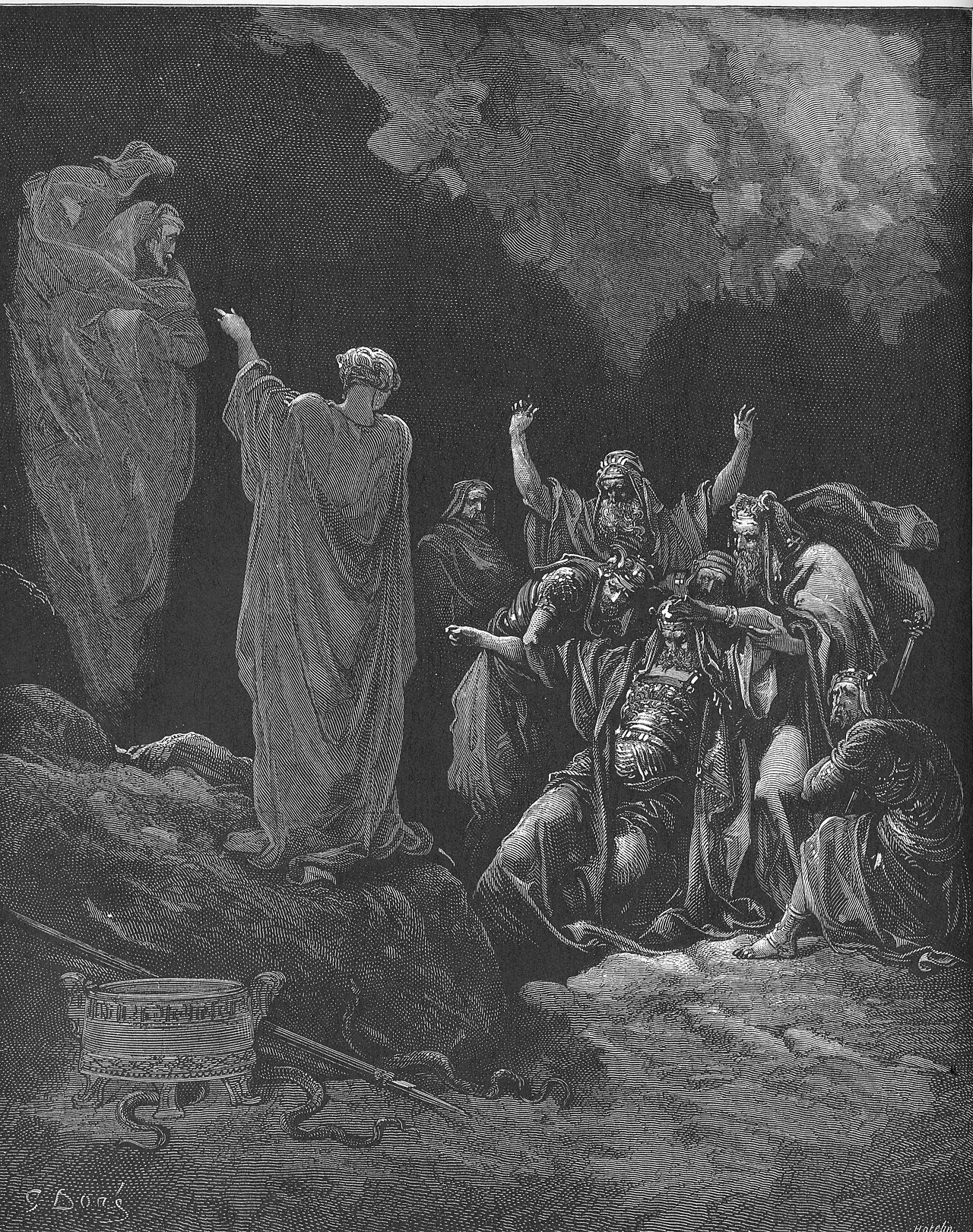
in 1 Samuel 28“Do not be afraid,” the king replied. “What do you see?” “I see a god coming up out of the earth,” the woman answered.
BSB
The same verse in ASV and KJV ▾
ASV
And the king said unto her, Be not afraid: for what seest thou? And the woman said unto Saul, I see a god coming up out of the earth.
KJV
And the king said unto her, Be not afraid: for what sawest thou? And the woman said unto Saul, I saw gods ascending out of the earth.
⋯
This verse in 1 Samuel 28
Commentary
10 notes on this verseSamuel in hades! Samuel, he who was special among the prophets, who was dedicated to God from his birth, who before his birth is said to be in the temple, who at the same time he was weaned was clothed with the ephod and double cloak and became a priest of the Lord, the child to whom the Lord when he speaks uttered his messages, he was brought up by a medium?… Why is Samuel in hades?…Samuel comes up, and note that she does not say that she saw the soul of Samuel.
This site's exposition
Bring me up Samuel
on 1 Samuel 28:11-14
Saul names exactly who he wants, and the woman's own reaction settles a question the older commentaries return to: she cries out and immediately recognizes Saul, as though what appeared was not the sort of spirit her own art was used to raising. She first calls it gods ascending out of the earth, a general word for a supernatural being rather than a claim of deity, and only when Saul asks for a shape does she describe an old man covered with a mantle. That mantle is the detail that convinces Saul, the same garment Samuel wore when Saul tore it at 15:27 and heard the kingdom's rending read out of the tear. He falls with his face to the ground before the man whose robe had already carried this news to him once.
This site's exposition
a god coming up out of the earth
The woman's word for what she sees coming up is elohim, and Adam Clarke notes that the Chaldee version renders it an angel of the LORD. Albert Barnes explains the direction: the place of the dead was pictured beneath the earth, as in Isaiah 14:9-10. Origen took it as the medium's belief about the gods.
The record, by era
The Church Fathers1 voice
A commentator
Origen of AlexandriaCOMMENTARY ON THE GOSPEL OF JOHN 20.393 · Written before 253.
proposed
They [the Jews] reflected on the death of Abraham and the prophets, understanding that Samuel, too, when he was under the earth because of death, was brought up by a medium who thought the gods were somewhere below the earth and who said, "I saw gods ascending from the earth." They had not, however, comprehended the life of Abraham and the prophets, nor that the God of Abraham, Isaac and Jacob was not the God of them as men who were dead, but as men who were alive.
The Puritans and the Awakening3 voices
Gods - That is, a God, and divine person, glorious, and full of majesty and splendour, exceeding not only mortal men, but common ghosts. She used the plural number, gods, either after the manner of the Hebrew language, which commonly uses that word of one person: or, after the language and custom of the heathens.
And the king said unto her, be not afraid,....
Saul, being told of gods ascending, was eager to know what was the form of this deity, and in what shape he appeared, so far was he from conceiving any horror at it, his heart being wretchedly hardened by the deceitfulness of sin.
The Nineteenth Century1 voice
A commentator
Albert Barnes1798–1870
Notes, Explanatory and Practical, on the Old and New Testaments (1832-1869)
Gods - אלהים 'ĕlohı̂ym is here used in a general sense of a supernatural appearance, either angel or spirit. Hell, or the place of the departed (compare 1Sa 28:19; 2Sa 12:23) is represented as under the earth Isa 14:9-10; Eze 32:18.
2 more voices on this verse
The Nineteenth Century2 voices
A commentator
Jamieson, Fausset & Brown1802–1910
Commentary Critical and Explanatory on the Whole Bible (1871)
On the other hand, many eminent writers (considering that the apparition came before her arts were put in practice; that she herself was surprised and alarmed; that the prediction of Saul's own death and the defeat of his forces was confidently made), are of opinion that Samuel really appeared.
I saw gods ascending out of the earth - The word אלהום elohim, which we translate gods, is the word which is used for the Supreme Being throughout the Bible; but all the versions, the Chaldee excepted, translate it in the plural number, as we do. The Chaldee has, I see מלאכא דיי malacha dayeya, an angel of the Lord, ascending from the earth. This sight alarmed the woman; it was what she did not expect; in this she could not recognise her familiar, and she was terrified at the appearance.
How the passage was read
What the Jewish commentators add
On the verses either side of this one
She screamed loudly. For she saw him ascending not in the usual manner. Radak suggests that the moment the woman saw the manner in which Shmuel came up, she realized that the man who had come to her was Shaul, and that is why she screamed.
This section is reception history: how the passage was read and kept in the Jewish tradition. Where a reading parts from an essential of the Christian faith, the section says so at that point.
Texts and citation data: Sefaria; each excerpt follows its version’s licence. 5 further sources are cited on this chapter that carry no English text this site may quote or only restate the verse.
The words behind it
17 Hebrew wordsEvery Hebrew word of this verse in the order it stands, with what it means and the door to its own study. The last column counts the times a word stands in the whole Bible: the rarer the word, the more the places it appears belong together.
| Hebrew | Sound | Meaning | Word study | In the Bible |
|---|---|---|---|---|
| וַיֹּ֨אמֶר | vaiyomer | and he said | H559 → | 5305 times |
| לָ֥הּ | lah | to <the> her | ||
| הַמֶּ֛לֶךְ | hamelekh | the king | H4428 → | 2525 times |
| אַל־ | ʾal- | may not | H408 → | 724 times |
| תִּֽירְאִ֖י | tiri | you fear | H3372 → | 315 times |
| כִּ֣י | ki | for | H3588 → | 4482 times |
| מָ֣ה | mah | what? | H4100 → | 752 times |
| רָאִ֑ית | rait | have you seen | H7200 → | 1300 times |
| וַתֹּ֤אמֶר | vatomer | and she said | H559 → | 5305 times |
| הָֽאִשָּׁה֙ | haishah | the woman | H802 → | 781 times |
| אֶל־ | ʾel- | to | H413 → | 5510 times |
| שָׁא֔וּל | shaul | Saul | H7586 → | 402 times |
| אֱלֹהִ֣ים | ʾelohim | gods | H430 → | 2601 times |
| רָאִ֖יתִי | raiti | I have seen | H7200 → | 1300 times |
| עֹלִ֥ים | ʾolim | coming up | H5927 → | 890 times |
| מִן־ | min- | from | H4480 → | 1188 times |
| הָאָֽרֶץ׃ | haaretz | the earth | H776 → | 2504 times |
וַיֹּ֨אמֶרand he said
vaiyomerH559 →5305 times
לָ֥הּto <the> her
lah
הַמֶּ֛לֶךְthe king
hamelekhH4428 →2525 times
אַל־may not
ʾal-H408 →724 times
תִּֽירְאִ֖יyou fear
tiriH3372 →315 times
כִּ֣יfor
kiH3588 →4482 times
מָ֣הwhat?
mahH4100 →752 times
רָאִ֑יתhave you seen
raitH7200 →1300 times
וַתֹּ֤אמֶרand she said
vatomerH559 →5305 times
הָֽאִשָּׁה֙the woman
haishahH802 →781 times
אֶל־to
ʾel-H413 →5510 times
שָׁא֔וּלSaul
shaulH7586 →402 times
אֱלֹהִ֣יםgods
ʾelohimH430 →2601 times
רָאִ֖יתִיI have seen
raitiH7200 →1300 times
עֹלִ֥יםcoming up
ʾolimH5927 →890 times
מִן־from
min-H4480 →1188 times
הָאָֽרֶץ׃the earth
haaretzH776 →2504 times
A shaded row is a word that stands 400 times or fewer in the Bible.
The walk
8 stopsEach card is a verse this one points to, and under it the verses that one points to in turn. Where several paths arrive at the same place, that place is listed first: the text keeps returning to it.
Through
Exodus 22:28You must not blaspheme God or curse the ruler of your people.
it leads to
- Acts 23:5
“Brothers,” Paul replied, “I was not aware that he was the high priest, for it is written: ‘Do not speak evil about the ruler of your people.’”
- Ecclesiastes 10:20
Do not curse the king even in your thoughts, or curse the rich even in your bedroom, for a bird of the air may carry your words, and a winged creature may report your…
- Jude 1:8
Yet in the same way these dreamers defile their bodies, reject authority, and slander glorious beings.
- Exodus 22:8–9
If the thief is not found, the owner of the house must appear before the judges to determine whether he has taken his neighbor’s property.
- Exodus 21:17
Anyone who curses his father or mother must surely be put to death.
- Acts 23:5
Through
Exodus 4:16He will speak to the people for you. He will be your spokesman, and it will be as if you were God to him.
it leads to
- Exodus 7:1–2
The LORD answered Moses, “See, I have made you like God to Pharaoh, and your brother Aaron will be your prophet.
- Psalms 82:6
I have said, ‘You are gods; you are all sons of the Most High.’
- John 10:34–35
Jesus replied, “Is it not written in your Law: ‘I have said you are gods’?
- Exodus 7:1–2
Where this verse is studied
On this page
Studies1
About 1 Samuel
This page draws on 9 works. Open the list of works
This page draws on Adam Clarke, Commentary on the Bible; Albert Barnes, Notes on the Old Testament; Albert Barnes, Notes, Explanatory and Practical, on the Old and New Testaments (1832-1869); Jamieson, Fausset & Brown, Commentary Critical and Explanatory on the Whole Bible; John Gill, Exposition of the Old Testament (1748-1763); John Wesley, Explanatory Notes upon the Old Testament; Matthew Henry, Commentary on the Whole Bible; Origen of Alexandria, HOMILY ON 1 KINGS 28.3.2, 7.1 and Origen of Alexandria, COMMENTARY ON THE GOSPEL OF JOHN 20.393.