
1 Samuel 28:8
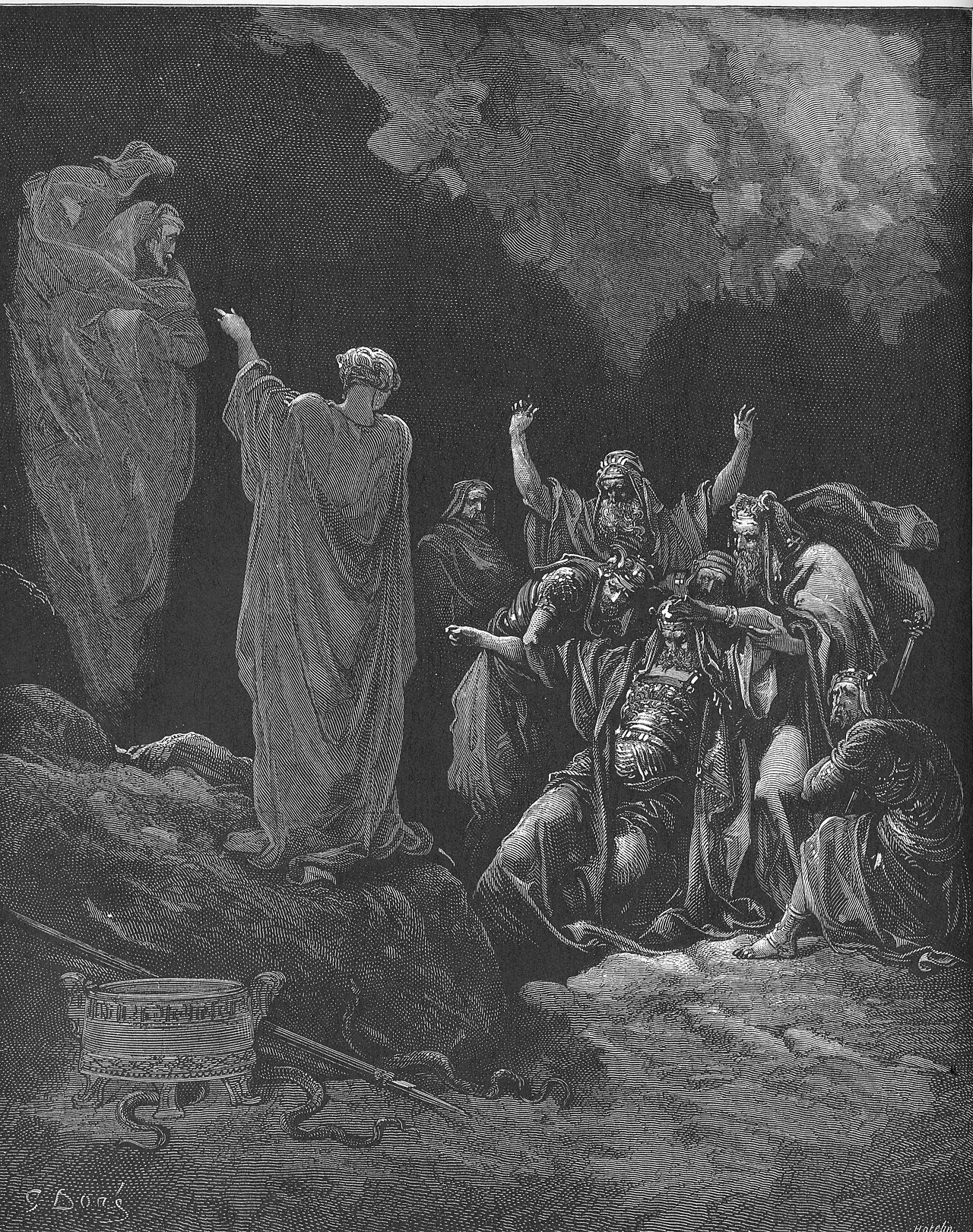
in 1 Samuel 28So Saul disguised himself by putting on different clothes, and he set out with two of his men. They came to the woman at night, and Saul said, “Consult a spirit for me. Bring up for me the one I name.”
BSB
The same verse in ASV and KJV ▾
ASV
And Saul disguised himself, and put on other raiment, and went, he and two men with him, and they came to the woman by night: and he said, Divine unto me, I pray thee, by the familiar spirit, and bring me up whomsoever I shall name unto thee.
KJV
And Saul disguised himself, and put on other raiment, and he went, and two men with him, and they came to the woman by night: and he said, I pray thee, divine unto me by the familiar spirit, and bring me him up, whom I shall name unto thee.
⋯
This verse in 1 Samuel 28
Commentary
11 notes on this verseA commentator
Jamieson, Fausset & Brown1802–1910
Commentary Critical and Explanatory on the Whole Bible (1871)
On the other hand, many eminent writers (considering that the apparition came before her arts were put in practice; that she herself was surprised and alarmed; that the prediction of Saul's own death and the defeat of his forces was confidently made), are of opinion that Samuel really appeared.
This site's exposition
Seek me a woman
on 1 Samuel 28:7-8
Saul does not go himself first; he sends his servants to find what his own decree had made illegal to keep. Endor lay seven or eight miles from Gilboa on the far side of the Philistine camp, so reaching it by night meant passing near the very army Saul feared. He goes disguised, in another man's clothes, because he does not want the woman to know who is asking and suspects she would refuse a king the practice she might risk for a stranger.
This site's exposition
So Saul disguised himself by putting on different clothes
Saul's request to bring up a named person assumes that the dead live on and know what the living cannot, as Matthew Henry observes. Albert Barnes links the medium's craft with the ventriloquist's art. The Greeks had necromancers who called up departed spirits for the same purpose.
The record, by era
The Medieval Church1 voice
He therefore changed his appearance, etc. The people of the Jews, having changed their habit in worst either of their earthly kingdom or of faith and works, by which they ought to have been spiritually adorned and loved, came to the hearing of such a …
The Puritans and the Awakening4 voices
Disguised - Both because he was ashamed to be known, or thought guilty of this practice; and because he suspected, the woman, had she known him, would not practice her art before him.
Samuel appears, and foretells his defeat and death, ver. 12-19. Saul faints, and is with difficulty persuaded to take any sustenance, ver. 20-25. Commentary on Chapter XXVIII 2.
quarantine:anchor (2026-07-29) — cites-ver-20-anchored-7-11
And Saul disguised himself, and put on other raiment,....
This supposes that it was generally taken for granted that souls exist after death, and that when men die there is not an end of them: it supposes too that great knowledge was attributed to separate souls.
3 more voices on this verse
The Puritans and the Awakening1 voice
Such is the power of natural conscience that even those who do evil blush and are ashamed to do it. He tells her his errand and promises her impunity. All he desires of her is to bring up one from the dead, whom he had a mind to discourse with.
The Nineteenth Century2 voices
Saul disguised himself - That he might not be known by the woman, lest she, being terrified, should refuse to use her art.
A commentator
Albert Barnes1798–1870
Notes, Explanatory and Practical, on the Old and New Testaments (1832-1869)
proposed
Divine - Compare to 1Sa 6:2, note; Num 23:23, note. Bring me him up - The art of the ventriloquist seems to have been always connected with necromancy. The Greeks had necromancers who called up departed spirits to give answers to those who consulted them.
The words behind it
25 Hebrew wordsEvery Hebrew word of this verse in the order it stands, with what it means and the door to its own study. The last column counts the times a word stands in the whole Bible: the rarer the word, the more the places it appears belong together.
| Hebrew | Sound | Meaning | Word study | In the Bible |
|---|---|---|---|---|
| וַיִּתְחַפֵּ֣שׂ | vaiyitchapes | and he disguised himself | H2664 → | |
| שָׁא֗וּל | shaul | Saul | H7586 → | 402 times |
| וַיִּלְבַּשׁ֙ | vaiyilbash | and he was clothed | H3847 → | 110 times |
| בְּגָדִ֣ים | begadim | garments | H899 → | 217 times |
| אֲחֵרִ֔ים | ʾacherim | other | H312 → | 166 times |
| וַיֵּ֣לֶךְ | vaiyelekh | and he went | H1980 → | 1546 times |
| ה֗וּא | hu' | he | H1931 → | 1879 times |
| וּשְׁנֵ֤י | ushenei | and two | H8147 → | 768 times |
| אֲנָשִׁים֙ | ʾanashim | men | H582 → | 566 times |
| עִמּ֔וֹ | imo | with him | H5973 → | 1050 times |
| וַיָּבֹ֥אוּ | vaiyavou | and they came | H935 → | 2568 times |
| אֶל־ | ʾel- | to | H413 → | 5510 times |
| הָאִשָּׁ֖ה | haishah | the woman | H802 → | 781 times |
| לָ֑יְלָה | layelah | night | H3915 → | 233 times |
| וַיֹּ֗אמֶר | vaiyomer | and he said | H559 → | 5305 times |
| קָֽסֳמִי | kasomi- | divine | H7080 → | |
| נָ֥א | na' | please | H4994 → | 404 times |
| לִי֙ | li | for <the> me | ||
| בָּא֔וֹב | baov | by <the> necromancy | H178 → | 17 times |
| וְהַ֣עֲלִי | vehaali | and bring up | H5927 → | 890 times |
| לִ֔י | li | for <the> me | ||
| אֵ֥ת | ʾet | <obj.> | H853 → | 10935 times |
| אֲשֶׁר־ | ʾasher- | [the one] whom | H834 → | 5497 times |
| אֹמַ֖ר | ʾomar | I will say | H559 → | 5305 times |
| אֵלָֽיִךְ׃ | ʾelayikh | to you | H413 → | 5510 times |
וַיִּתְחַפֵּ֣שׂand he disguised himself
vaiyitchapesH2664 →
שָׁא֗וּלSaul
shaulH7586 →402 times
וַיִּלְבַּשׁ֙and he was clothed
vaiyilbashH3847 →110 times
בְּגָדִ֣יםgarments
begadimH899 →217 times
אֲחֵרִ֔יםother
ʾacherimH312 →166 times
וַיֵּ֣לֶךְand he went
vaiyelekhH1980 →1546 times
ה֗וּאhe
hu'H1931 →1879 times
וּשְׁנֵ֤יand two
usheneiH8147 →768 times
אֲנָשִׁים֙men
ʾanashimH582 →566 times
עִמּ֔וֹwith him
imoH5973 →1050 times
וַיָּבֹ֥אוּand they came
vaiyavouH935 →2568 times
אֶל־to
ʾel-H413 →5510 times
הָאִשָּׁ֖הthe woman
haishahH802 →781 times
לָ֑יְלָהnight
layelahH3915 →233 times
וַיֹּ֗אמֶרand he said
vaiyomerH559 →5305 times
קָֽסֳמִיdivine
kasomi-H7080 →
נָ֥אplease
na'H4994 →404 times
לִי֙for <the> me
li
בָּא֔וֹבby <the> necromancy
baovH178 →17 times
וְהַ֣עֲלִיand bring up
vehaaliH5927 →890 times
לִ֔יfor <the> me
li
אֵ֥ת<obj.>
ʾetH853 →10935 times
אֲשֶׁר־[the one] whom
ʾasher-H834 →5497 times
אֹמַ֖רI will say
ʾomarH559 →5305 times
אֵלָֽיִךְ׃to you
ʾelayikhH413 →5510 times
A shaded row is a word that stands 400 times or fewer in the Bible.
The walk
8 stopsEach card is a verse this one points to, and under it the verses that one points to in turn. Where several paths arrive at the same place, that place is listed first: the text keeps returning to it.
Through
Isaiah 8:19When men tell you to consult the spirits of the dead and the spiritists who whisper and mutter, shouldn’t a people consult their God instead? Why consult the dead on behalf of the living?
it leads to
- Leviticus 20:6
Whoever turns to mediums or spiritists to prostitute himself with them, I will also set My face against that person and cut him off from his people.
Reached by 2 separate paths from here.
- 1 Chronicles 10:13
So Saul died for his unfaithfulness to the LORD, because he did not keep the word of the LORD and even consulted a medium for guidance,
- 2 Chronicles 33:6
He sacrificed his sons in the fire in the Valley of Hinnom. He practiced sorcery, divination, and witchcraft, and consulted mediums and spiritists. He did great evil in the sight of the LORD, provoking…
- Psalms 106:28
They yoked themselves to Baal of Peor and ate sacrifices offered to lifeless gods.
- Leviticus 20:6
Through
1 Chronicles 10:13So Saul died for his unfaithfulness to the LORD, because he did not keep the word of the LORD and even consulted a medium for guidance,
it leads to
- Leviticus 19:31
You must not turn to mediums or spiritists; do not seek them out, or you will be defiled by them. I am the LORD your God.
Reached by 2 separate paths from here.
- 1 Samuel 15:23
For rebellion is like the sin of divination, and arrogance is like the wickedness of idolatry. Because you have rejected the word of the LORD, He has rejected you as king.”
- Isaiah 8:19
When men tell you to consult the spirits of the dead and the spiritists who whisper and mutter, shouldn’t a people consult their God instead? Why consult the dead on behalf of the living?
- Leviticus 19:31
Through
2 Chronicles 35:22Josiah, however, did not turn away from him; instead, in order to engage him in battle, he disguised himself. He did not listen to Neco’s words from the mouth of God, but went to…
it leads to
- 2 Chronicles 18:29
And the king of Israel said to Jehoshaphat, “I will disguise myself and go into battle, but you wear your royal robes.” So the king of Israel disguised himself and went into battle.
Reached by 2 separate paths from here.
- 2 Chronicles 18:29
Where this verse is studied
On this page
Studies1
About 1 Samuel
Who and where
1 name in this verse with a page on the site.
This page draws on Adam Clarke, Commentary on the Bible; Albert Barnes, Notes on the Old Testament; Albert Barnes, Notes, Explanatory and Practical, on the Old and New Testaments (1832-1869); Bede, Commentary on Samuel; Jamieson, Fausset & Brown, Commentary Critical and Explanatory on the Whole Bible; John Gill, Exposition of the Old Testament (1748-1763); John Wesley, Explanatory Notes upon the Old Testament and Matthew Henry, Commentary on the Whole Bible.