
1 Samuel 28:11
in 1 Samuel 28“Whom shall I bring up for you?” the woman asked. “Bring up Samuel,” he replied.
BSB
The same verse in ASV and KJV ▾
ASV
Then said the woman, Whom shall I bring up unto thee? And he said, Bring me up Samuel.
KJV
Then said the woman, Whom shall I bring up unto thee? And he said, Bring me up Samuel.
⋯
This verse in 1 Samuel 28
Commentary
12 notes on this verseA commentator
Albert Barnes1798–1870
Notes, Explanatory and Practical, on the Old and New Testaments (1832-1869)
Bring me up Samuel - Dr. Trench observes, “All human history has failed to record a despair deeper or more tragic than his, who, having forsaken God and being of God forsaken, is now seeking to move hell; and infinitely guilty as he is, assuredly there is something unutterably pathetic in that yearning of the disanointed king to change words with the friend and counselor of his youth, and if he must hear his doom, to hear it from no other lips but his” (‘Shipwrecks of Faith, ‘ p. 47).
This site's exposition
Bring me up Samuel
on 1 Samuel 28:11-14
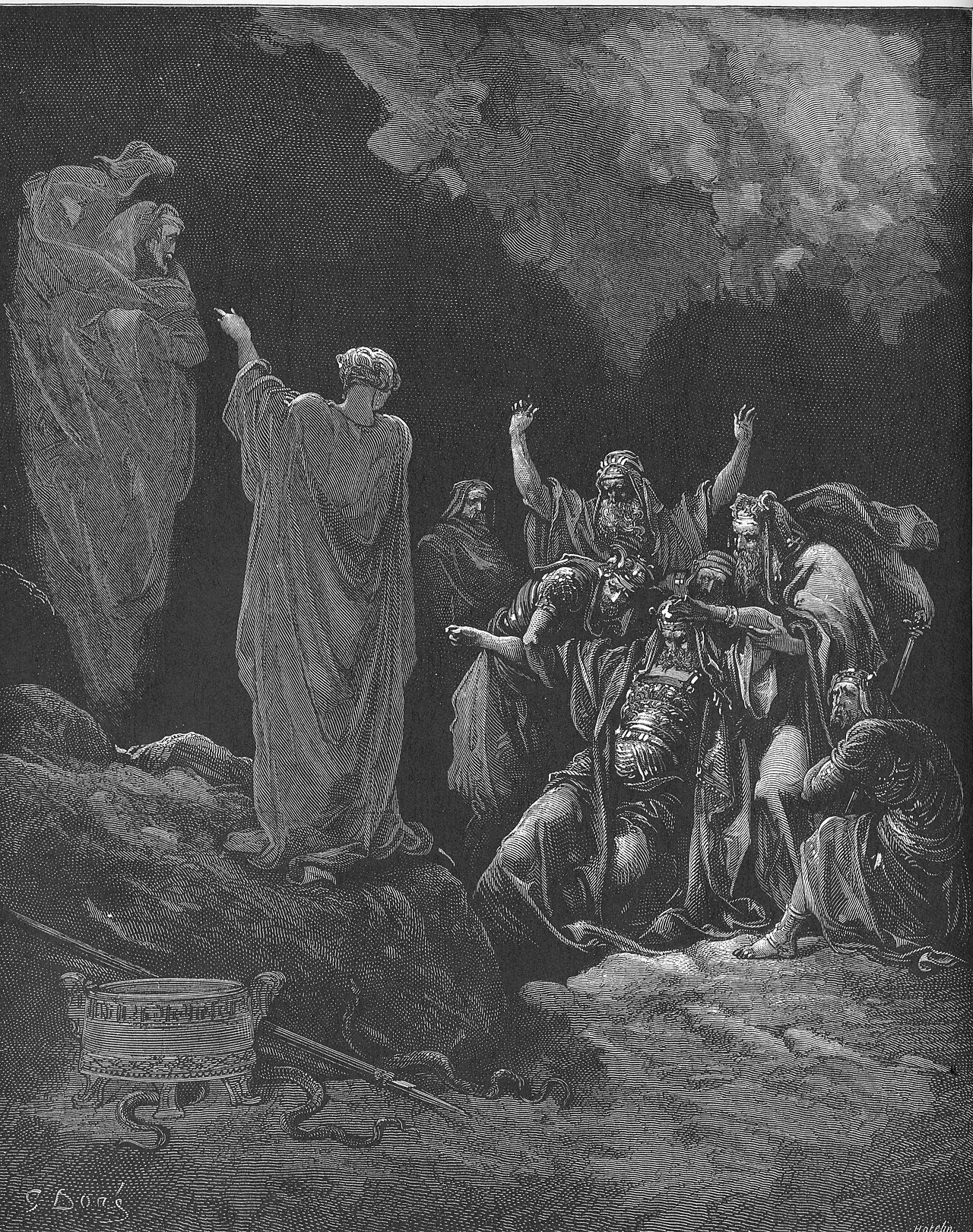
Saul names exactly who he wants, and the woman's own reaction settles a question the older commentaries return to: she cries out and immediately recognizes Saul, as though what appeared was not the sort of spirit her own art was used to raising. She first calls it gods ascending out of the earth, a general word for a supernatural being rather than a claim of deity, and only when Saul asks for a shape does she describe an old man covered with a mantle. That mantle is the detail that convinces Saul, the same garment Samuel wore when Saul tore it at 15:27 and heard the kingdom's rending read out of the tear. He falls with his face to the ground before the man whose robe had already carried this news to him once.
The record, by era
The Church Fathers2 voices
Is it not the case then, if such a great man was under the earth and the medium did bring him up, that a little demon has sway over the soul of the prophet? What can I say? These things are recorded. Is it true or is it not true? To say that it is not true drives us to unbelief. It comes down on the heads of those who speak it. But to say it is true presents for us an enquiry and quandary.And we well know that some among our brothers look askance at the Scripture and say, I do not believe in the medium. The medium says that she saw Samuel. She is lying! Samuel was not brought up. Samuel does not speak. Just as there are false prophets who say, "Thus says the Lord," and "The Lord did not speak," so too this little demon lies when it proclaims that it brings up the one pointed out by Saul. For, "whom shall I bring up?" He says, "Bring up Samuel for me." These things are said by those who state that this history is not true.
For what is it which has been written? "And the woman said, Whom shall I bring up for you?" Whose expression is the one which says, "The woman said"? Is it the expression of the Holy Spirit, from whom the Scripture is believed to be recorded, or is it the expression of someone else? For the narrative expression, as those involved with all sorts of words also know, is above all the expression of the author.
The Medieval Church2 voices
And the woman said to him: Whom shall I raise up for you? etc. And the people of the Jews, entering their synagogue, through the prophecies once summarized and completed in Christ, desire as if to be raised up from the dead for themselves, namely …
And the woman said to Saul, etc. She calls one seen in the plural, as is very customary in Scripture, where often many are designated by the singular, and singular individuals by the plural number. Finally, when one calf was made, the people said: These …
The Puritans and the Awakening1 voice
Samuel - Whose kindness and compassion as he had formerly experienced, so now he expected it in his deep distress. This practice of divination by the dead, or the souls of dead persons, was very usual among all nations.
5 more voices on this verse
The Puritans and the Awakening3 voices
Samuel appears, and foretells his defeat and death, ver. 12-19. Saul faints, and is with difficulty persuaded to take any sustenance, ver. 20-25. Commentary on Chapter XXVIII 2.
quarantine:anchor (2026-07-29) — cites-ver-20-anchored-7-11
By all means, bring me up Samuel. " Note, Many that despise and persecute God's saints and ministers when they are living would be glad to have them again when they are gone. Send Lazarus to me, and send Lazarus to my father's house, Luke xvi. The sepulchres of the righteous are garnished.
quarantine:debris (2026-07-29) — odd-straight-quotes
Then said the woman, whom shall I bring up unto thee?....
The Nineteenth Century2 voices
A commentator
Jamieson, Fausset & Brown1802–1910
Commentary Critical and Explanatory on the Whole Bible (1871)
On the other hand, many eminent writers (considering that the apparition came before her arts were put in practice; that she herself was surprised and alarmed; that the prediction of Saul's own death and the defeat of his forces was confidently made), are of opinion that Samuel really appeared.
Whom shall I bring up - The woman certainly meant no more than making her familiar personify whomsoever the querist should wish. In the evocation of spirits this is all that, according to the professed rules of their art, such persons pretend to; for over human souls in paradise or in the infernal regions they have no power. If we allow that there is such an art founded on true principles, all it can pretend to is, to bring up the familiar; cause him when necessary to assume the form and character of some particular person, and to give such notices relative to futurity as he is able to collect. And this even in the cases to which authenticity is generally allowed, is often scanty, vague, and uncertain, for fallen spirits do not abound in knowledge: this is an attribute of God, and rays of this perfection are imparted to pure and holy intelligences; and even Satan himself, as may be seen from most of his temptations, is far from excelling in knowledge. He may be cunning and insidious, but he certainly is not wise and prudent; we in general give this fallen spirit credit for much more wisdom than he possesses.
How the passage was read
What the Jewish commentators add
On the verses either side of this one
She screamed loudly. For she saw him ascending not in the usual manner. Radak suggests that the moment the woman saw the manner in which Shmuel came up, she realized that the man who had come to her was Shaul, and that is why she screamed.
This section is reception history: how the passage was read and kept in the Jewish tradition. Where a reading parts from an essential of the Christian faith, the section says so at that point.
Texts and citation data: Sefaria; each excerpt follows its version’s licence. 5 further sources are cited on this chapter that carry no English text this site may quote or only restate the verse.
The words behind it
11 Hebrew wordsEvery Hebrew word of this verse in the order it stands, with what it means and the door to its own study. The last column counts the times a word stands in the whole Bible: the rarer the word, the more the places it appears belong together.
| Hebrew | Sound | Meaning | Word study | In the Bible |
|---|---|---|---|---|
| וַתֹּ֙אמֶר֙ | vatomer | and she said | H559 → | 5305 times |
| הָֽאִשָּׁ֔ה | haishah | the woman | H802 → | 781 times |
| אֶת־ | ʾet- | <obj.> | H853 → | 10935 times |
| מִ֖י | mi | whom? | H4310 → | 423 times |
| אַֽעֲלֶה־ | ʾaaleh- | will I bring up | H5927 → | 890 times |
| לָּ֑ךְ | lakh | for <the> you | ||
| וַיֹּ֕אמֶר | vaiyomer | and he said | H559 → | 5305 times |
| אֶת־ | ʾet- | <obj.> | H853 → | 10935 times |
| שְׁמוּאֵ֖ל | shemuel | Samuel | H8050 → | 141 times |
| הַֽעֲלִי־ | haali- | bring up | H5927 → | 890 times |
| לִֽי׃ | li | for <the> me |
וַתֹּ֙אמֶר֙and she said
vatomerH559 →5305 times
הָֽאִשָּׁ֔הthe woman
haishahH802 →781 times
אֶת־<obj.>
ʾet-H853 →10935 times
מִ֖יwhom?
miH4310 →423 times
אַֽעֲלֶה־will I bring up
ʾaaleh-H5927 →890 times
לָּ֑ךְfor <the> you
lakh
וַיֹּ֕אמֶרand he said
vaiyomerH559 →5305 times
אֶת־<obj.>
ʾet-H853 →10935 times
שְׁמוּאֵ֖לSamuel
shemuelH8050 →141 times
הַֽעֲלִי־bring up
haali-H5927 →890 times
לִֽי׃for <the> me
li
A shaded row is a word that stands 400 times or fewer in the Bible.
Where this verse is studied
On this page
Studies1
About 1 Samuel
Who and where
1 name in this verse with a page on the site.
This page draws on 10 works. Open the list of works
This page draws on Adam Clarke, Commentary on the Bible; Albert Barnes, Notes, Explanatory and Practical, on the Old and New Testaments (1832-1869); Albert Barnes, Notes on the Old Testament; Bede, Commentary on Samuel; Jamieson, Fausset & Brown, Commentary Critical and Explanatory on the Whole Bible; John Gill, Exposition of the Old Testament (1748-1763); John Wesley, Explanatory Notes upon the Old Testament; Matthew Henry, Commentary on the Whole Bible; Origen of Alexandria, HOMILY ON 1 KINGS 28.2.2-3 and Origen of Alexandria, HOMILY ON 1 KINGS 28.4.2.