
1 Samuel 28:10
in 1 Samuel 28Then Saul swore to her by the LORD: “As surely as the LORD lives, no punishment shall come upon you for this.”
BSB
The same verse in ASV and KJV ▾
ASV
And Saul sware to her by Jehovah, saying, As Jehovah liveth, there shall no punishment happen to thee for this thing.
KJV
And Saul sware to her by the Lord, saying, As the Lord liveth, there shall no punishment happen to thee for this thing.
⋯
This verse in 1 Samuel 28
Commentary
6 notes on this verseA commentator
Jamieson, Fausset & Brown1802–1910
Commentary Critical and Explanatory on the Whole Bible (1871)
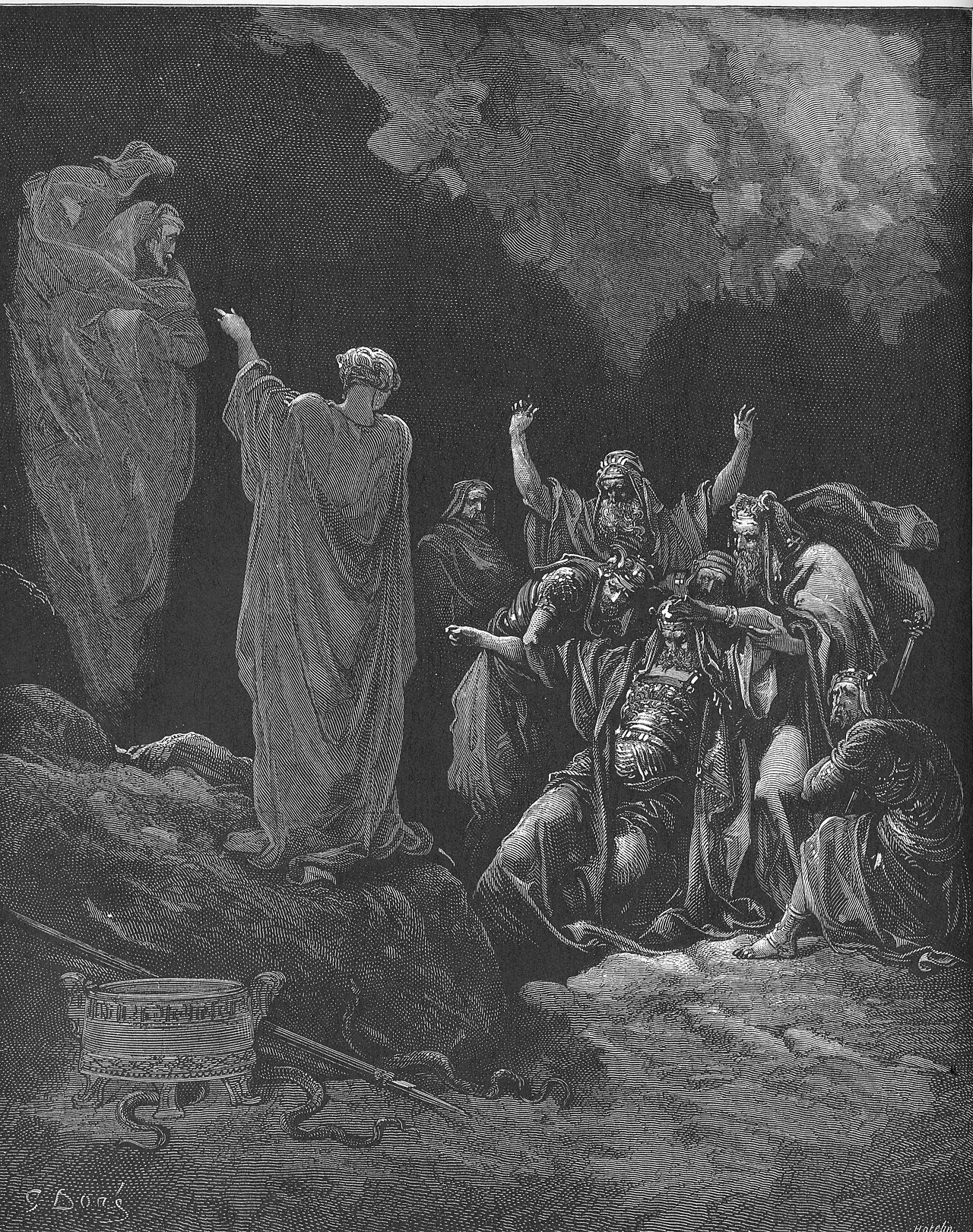
On the other hand, many eminent writers (considering that the apparition came before her arts were put in practice; that she herself was surprised and alarmed; that the prediction of Saul's own death and the defeat of his forces was confidently made), are of opinion that Samuel really appeared.
This site's exposition
layest thou a snare for my life
on 1 Samuel 28:9-10
The woman names Saul's own law back to him without knowing who stands in front of her, and her fear is for her life rather than for the sin itself, which Matthew Henry notes is the common order among sinners, dread of punishment before dread of judgment. Saul answers with an oath sworn by the very name whose law he is about to break, As the Lord liveth, promising a safety he has no standing to promise since the penalty was never his to waive. The narrator leaves the irony to stand without comment: a king invokes the Lord to guarantee the success of consulting the dead.
This site's exposition
Then Saul swore to her by the LORD
Saul's own law made him the judge who should punish the woman, and Matthew Henry says he knew it. His oath promises a safety he could not give even to himself. Within a day he falls on Gilboa, as chapter 31 records.
The record, by era
The Puritans and the Awakening3 voices
It was his duty as a king to punish her and he knew it, yet he swears no to do it; as if he could by his own oath bind himself from doing that which, by the divine command, he was bound to do. But he promised more than he could perform when he said, There shall no punishment happen to thee; for he that could not secure himself could much less secure her from divine vengeance.
Samuel appears, and foretells his defeat and death, ver. 12-19. Saul faints, and is with difficulty persuaded to take any sustenance, ver. 20-25. Commentary on Chapter XXVIII 2.
quarantine:anchor (2026-07-29) — cites-ver-20-anchored-7-11
And Saul sware to her by the Lord,....
The words behind it
12 Hebrew wordsEvery Hebrew word of this verse in the order it stands, with what it means and the door to its own study. The last column counts the times a word stands in the whole Bible: the rarer the word, the more the places it appears belong together.
| Hebrew | Sound | Meaning | Word study | In the Bible |
|---|---|---|---|---|
| וַיִּשָּׁ֤בַֽע | vaiyishava' | and he swore | H7650 → | 186 times |
| לָהּ֙ | lah | to <the> her | ||
| שָׁא֔וּל | shaul | Saul | H7586 → | 402 times |
| בַּֽיהוָ֖ה | bayahweh | by Yahweh | H3068 → | 6520 times |
| לֵאמֹ֑ר | lemor | <to> saying | H559 → | 5305 times |
| חַי־ | chai- | [by] [the] life | H2416 → | 498 times |
| יְהוָ֕ה | yahweh | of Yahweh | H3068 → | 6520 times |
| אִֽם־ | ʾim- | if | H518 → | 1069 times |
| יִקְּרֵ֥ךְ | yikerekh | it will happen to you | H7136 → | |
| עָוֹ֖ן | ʾavon | punishment | H5771 → | 233 times |
| בַּדָּבָ֥ר | badavar | in the matter | H1697 → | 1440 times |
| הַזֶּֽה׃ | hazeh | <the> this | H2088 → | 1180 times |
וַיִּשָּׁ֤בַֽעand he swore
vaiyishava'H7650 →186 times
לָהּ֙to <the> her
lah
שָׁא֔וּלSaul
shaulH7586 →402 times
בַּֽיהוָ֖הby Yahweh
bayahwehH3068 →6520 times
לֵאמֹ֑ר<to> saying
lemorH559 →5305 times
חַי־[by] [the] life
chai-H2416 →498 times
יְהוָ֕הof Yahweh
yahwehH3068 →6520 times
אִֽם־if
ʾim-H518 →1069 times
יִקְּרֵ֥ךְit will happen to you
yikerekhH7136 →
עָוֹ֖ןpunishment
ʾavonH5771 →233 times
בַּדָּבָ֥רin the matter
badavarH1697 →1440 times
הַזֶּֽה׃<the> this
hazehH2088 →1180 times
A shaded row is a word that stands 400 times or fewer in the Bible.
The walk
8 stopsEach card is a verse this one points to, and under it the verses that one points to in turn. Where several paths arrive at the same place, that place is listed first: the text keeps returning to it.
Through
Genesis 3:5“For God knows that in the day you eat of it, your eyes will be opened and you will be like God, knowing good and evil.”
it leads to
- Ezekiel 28:2
“Son of man, tell the ruler of Tyre that this is what the Lord GOD says: Your heart is proud, and you have said, ‘I am a god; I sit in the seat of…
- 2 Thessalonians 2:4
He will oppose and exalt himself above every so-called god or object of worship. So he will seat himself in the temple of God, proclaiming himself to be God.
- 2 Corinthians 11:13–15
For such men are false apostles, deceitful workers, masquerading as apostles of Christ.
- Genesis 2:17
but you must not eat from the tree of the knowledge of good and evil; for in the day that you eat of it, you will surely die.”
- 2 Corinthians 4:4
The god of this age has blinded the minds of unbelievers so they cannot see the light of the gospel of the glory of Christ, who is the image of God.
- Ezekiel 28:2
Through
Mark 6:23And he swore to her, “Whatever you ask of me, I will give you, up to half my kingdom!”
it leads to
- Esther 5:3
“What is it, Queen Esther?” the king inquired. “What is your request? Even up to half the kingdom, it will be given to you.”
- Esther 7:2
and as they drank their wine on that second day, the king asked once more, “Queen Esther, what is your petition? It will be given to you. What is your request? Even up to…
- Matthew 4:9
“All this I will give You,” he said, “if You will fall down and worship me.”
- Esther 5:3
Where this verse is studied
On this page
Studies1
About 1 Samuel
Who and where
1 name in this verse with a page on the site.
This page draws on Jamieson, Fausset & Brown, Commentary Critical and Explanatory on the Whole Bible; John Gill, Exposition of the Old Testament (1748-1763); John Wesley, Explanatory Notes upon the Old Testament and Matthew Henry, Commentary on the Whole Bible.