
1 Kingschapter 13
34 verses · Jeremiah, by tradition · 6th century BC · History
And he cried against the altar in the word of the Lord, and said, O altar, altar, thus saith the Lord; Behold, a child shall be born unto the house of David, Josiah by name; and upon thee shall he offer the priests of the high places that burn incense upon thee, and men’s bones shall be burnt upon thee.
Introduction
Jeremiah, by tradition, History, 1 Kings Overview.
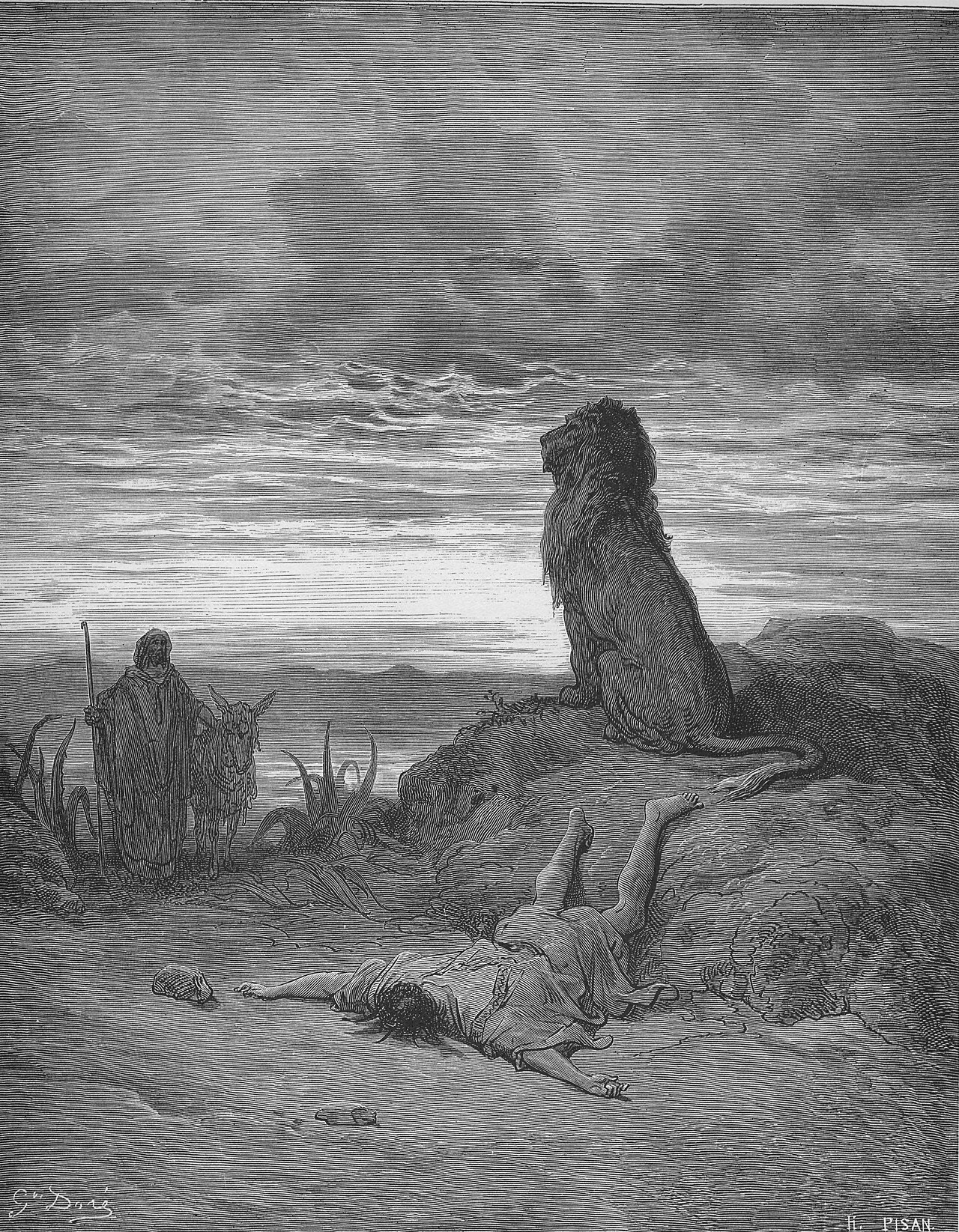
The writer of Kings is not named, and Jewish tradition gives the book to Jeremiah. He set this chapter directly after the founding of the northern shrines. His first hearers were exiles who had heard many voices claim to speak for God and had followed the wrong ones. The chapter is a prophetic narrative about two prophets, and neither is named. It asks how a person holds on to a word God has given when a respected voice offers a newer one. Listen for the command about food and the road, and watch what the lion does and does not do.
Context
- Who
- Israelites deciding whether a word already given is overturned by a persuasive voice
- What
- An account of a prophet from Judah who condemns the altar at Bethel, keeps his charge before the king and then breaks it at an old prophet's table.
- Where
- The new altar at Bethel, and the road running south from it toward Judah.
- When
- About 930 BC, while the Bethel shrine was new; the chapter gives no date, so the year is a reckoning.
- Why
- To show that the word against Bethel stands and that a word God has given directly is not overturned by another man's claim.
Historical context
The chapter turns on two prophets and names neither. One is a man of God who came from Judah, and the other is an old prophet who had stayed on at Bethel after Jeroboam's changes.
Show the rest of the historical context, 6 more paragraphs
Bethel is the place to understand first. It was an ancient holy site, the place where Jacob saw the ladder, and it stood just north of the border, which caught pilgrims before they reached Jerusalem.
The occasion is a dedication in progress. A king burning incense at his own altar was the whole point of the ceremony, so the sentence is passed on the altar while Jeroboam stands at it.
A first hearer knew what a split altar cost. Ash from burnt sacrifices built up in a heap and was disposed of with care, so an altar breaking and spilling its ashes ruined the installation rather than marking it.
He also read the refusal of food as a public act. Refusing hospitality was a verdict on a place, in the way a modern envoy refuses to shake hands, so the charge to eat and drink nothing there belonged to the message itself.
That is what makes the old prophet's claim so costly. Persuading the man to eat at Bethel cancelled the sign he had been sent to give.
The death is marked as a judgment rather than an accident. The lion killed the man and then left the body, ate nothing and did not touch the donkey standing beside it.
Significance
The first hearers took away a hard rule. A word you were given directly is not overturned by someone claiming a newer word, even a man with a prophet's reputation.
Show the rest of the significance, 1 more paragraph
They also heard the lying prophet ask to be buried in the same grave, because the word against Bethel would surely come to pass. Three centuries later Josiah spared exactly that tomb.
This chapter in Jewish lifeWhat this chapter is in Jewish life and reading.
How it is read
Rashi names the man of God at the first verse rather than leaving him anonymous. He writes, "This was Yeddo", and sends the reader to II Chronicles for the name (Rashi on I Kings 13:1:1, The Metsudah Tanach series, Lakewood, N.J, CC-BY). At the cry against the altar he reads the doubled word as a cry against two altars at once, "[The one] in Beis Eil and [the one] in Dan" (Rashi on I Kings 13:2:1). Beside it he carries Radak's alternative, that repetition is simply how a summons is spoken in Scripture, as a name is called twice at the binding of Isaac. The sign is read as given for that same day, the altar splitting by itself and the ashes spilling to the ground while the prophet still stood there (Rashi on I Kings 13:3:1).
The withered hand carries the sharpest line of the chapter in the corpus. Rashi reads the withering as a measure of what heaven guards. He writes: "The Holy One Blessed Is He, avenged the honor of a righteous person more than His own honor." (Rashi on I Kings 13:4:1). He states the proof from the king's own body. While the man was standing and offering sacrifices to idols his hand did not stiffen. It stiffened when he slandered the righteous man. Metzudat David's note in the same place says the hand had been stretched out to signal the servants to seize the prophet. At the king's plea Rashi hears the pronoun and holds him to it. He glosses the request for prayer with the words "But not my God, because he was still in a state of rebellion" (Rashi on I Kings 13:6:1). The invitation home he takes as plain hospitality, a meal to eat (Rashi on I Kings 13:7:1).
On the old prophet the corpus is direct and records a dispute rather than settling it. Rashi calls him "A false prophet" at his first appearance and again when the word comes to him at the table (Rashi on I Kings 13:11:1 and 13:20:1). From Radak he carries the list of names the tradition has proposed for him: Micah, Amaziah, Iddo, or Jonathan the son of Gershom, one after another with none preferred. At the call over the table Rashi keeps two readings again. The old prophet called out to the man of God, and Targum Yonatan renders that he prophesied about him (Rashi on I Kings 13:21:1). At the burial he reads the grave as the old prophet's own plot in the city. Metzudat David's alternative is that it was the grave the man had dug for himself (Rashi on I Kings 13:30:1). The donkey of the twenty-third verse he explains as the one brought out for the man of God to ride (Rashi on I Kings 13:23:1).
Malbim, Radak and Metzudat David comment across the chapter as well. The corpus carries their refs with the reason that Sefaria holds no English version of them, so they stand here cited and unquoted. The corpus holds Malbim on I Kings 13:5:1, 13:8:1, 13:15:1, 13:16:1 and 13:25:1. It holds Radak on I Kings 13:9:1, 13:12:1, 13:17:1, 13:18:1, 13:22:1, 13:28:1 and 13:29:1. It holds Metzudat David on I Kings 13:26:1.
What the rabbis say
The corpus carries forty rabbinic locators for this chapter and the text of none, so each is cited and linked here rather than quoted. Six stand on the second verse, where a prophet names a king three centuries before his birth. That verse is the reason the chapter is read as a test case in prophecy. The six are Bereshit Rabbah 45:8, Ein Yaakov (Glick Edition), Yevamot 4:3, Ein Yaakov, Yevamot 4:11, Jerusalem Talmud Berakhot 1:6:10, Jerusalem Talmud Nedarim 3:7:2 and Kohelet Rabbah 3:2:3. Four stand on the first verse, where the man of God comes up out of Judah. They are Avot DeRabbi Natan, Recension B 37:7, Midrash Lekach Tov, Deuteronomy 33:1:2, Pesikta DeRav Kahana 2:6 and Sifrei Devarim 342:6. Midrash Tanchuma, Ki Tisa 6:1 and Midrash Tanchuma, Toldot 12:5 stand across the first and second together.
The withered hand and the prayer that restored it carry Bereshit Rabbah 67:3 on the fourth verse and Midrash Tanchuma, Ki Tisa 6:3 on the sixth. The refusal of the king's bread carries Mekhilta DeRabbi Shimon Ben Yochai 19:14 and Midrash Lekach Tov, Genesis 3:1:4 on the eighth. The charge about eating and drinking carries Ein Yaakov, Sanhedrin 10:7 on the ninth.
The old prophet carries a run of his own, and it is the longest in the chapter. On his appearance at the eleventh verse the corpus carries Jerusalem Talmud Berakhot 9:2:12, Jerusalem Talmud Sanhedrin 11:5:4 and Shir HaShirim Rabbah 2:5:3, with Jerusalem Talmud Sanhedrin 11:5:8 set across the eleventh to the twentieth. On the twelfth it carries Midrash Sekhel Tov, Bereshit 27:33:3. On the lie itself at the eighteenth, where one prophet claims an angel spoke to him, it carries Ein Yaakov (Glick Edition), Sanhedrin 10:4, Midrash Aggadah, Exodus 2:20:4 and Sanhedrin 89b:2. On the twentieth, where the true word comes through the man who lied, it carries five. Three of them are Ein Yaakov (Glick Edition), Sanhedrin 11:83, Sanhedrin 104a:4 and Tanna DeBei Eliyahu Rabbah 12:1. The other two are Introductions to Tanaitic Literature, Introduction to Halakhic Midrashim, Sifrei Numbers 354 and Otzar Midrashim, The Aleph Bet of ben Sira 1:16. On the sentence pronounced at the twenty-first it carries Jerusalem Talmud Moed Katan 3:5:26, Midrash Tannaim on Deuteronomy 18:19:3, Sifrei Devarim 177:1 and Yalkut Shimoni on Torah 886:2. On the lion standing by the body at the twenty-eighth it carries Yalkut Shimoni on Torah 527:1.
The chapter closes on the king who watched all of it and changed nothing. On the thirty-third verse the corpus carries Ein Yaakov (Glick Edition), Sanhedrin 11:73, Midrash Sekhel Tov, Bereshit 47:22:1 and Sanhedrin 102a:17. On the thirty-fourth, where the account calls this the sin of the house, it carries Ein Yaakov (Glick Edition), Sanhedrin 11:69 and Sanhedrin 101b:11. What each of them teaches is a saying of the rabbis, and is reported as theirs wherever this site quotes one. The quotations wait on a fetch that carries the text.
Sources: Rashi, Rashi on I Kings 13:1:1, 13:2:1, 13:3:1, 13:4:1, 13:6:1, 13:7:1, 13:11:1, 13:20:1, 13:21:1, 13:23:1 and 13:30:1, The Metsudah Tanach series, Lakewood, N.J, CC-BY; Radak, Radak on I Kings 13:9:1, 13:12:1, 13:17:1, 13:18:1, 13:22:1, 13:28:1 and 13:29:1, cited by ref because the corpus carries no English text; Malbim, Malbim on I Kings 13:5:1, 13:8:1, 13:15:1, 13:16:1 and 13:25:1, cited by ref because the corpus carries no English text; Metzudat David, Metzudat David on I Kings 13:26:1, cited by ref because the corpus carries no English text; The Sefaria corpus, scripts/data/sources/sefaria/1-kings/13.json, the 40 Talmud and Midrash locators of this chapter.
The heads below are this chapter's scenes. The numbered points under each are its verses.
A cry against the altar, and a king's hand dried up
1 Kings 13:1-2
there came a man of God out of Judah: The man of God comes from Judah under no name the text gives him, and he speaks against Jeroboam's new altar three centuries before the reform it describes. He names the king who will do it, Josiah, one of only two figures in the Old Testament named in prophecy before birth, the other being Cyrus at Isa 44:28. The altar built to rival Jerusalem hears its own end pronounced at its dedication.
1 Kings 13:1
“Rather, “in the word of the Lord.” The meaning seems to be, not merely that the prophet was bid to come, but that he came in the strength and power of God’s word, a divinely inspired messenger. (Compare 1Ki 13:2, 1Ki 13:5,1Ki 13:32.) By the altar - “On the altar;” i, e. on the ledge, or platform, halfway up the altar, whereupon the officiating priest always stood to sacrifice. Compare 1Ki 12:32 note.”
Matthew Henry notes the reversal: the priests who burn incense on this altar will themselves be burned on it. Adam Clarke counts about three hundred and forty years to the fulfillment. Josiah does it at 2 Kings 23:15 and 16.
1 Kings 13:2
“He cried against the altar - He denounced the destruction of this idolatrous system. A child shall be born - Josiah by name - This is one of the most remarkable and most singular prophecies in the Old Testament. It here most circumstantially foretells a fact which took place three hundred and forty years after the prediction; a fact which was attested by the two nations.”
Adam Clarke · Commentary on the Bible (1810-1826)evangelical
1 more voice on this verse
1 Kings 13:2
“That the altar he now consecrated should be desecrated. Idolatrous worship will not continue, but the word of the Lord will endure for ever. That the priests of the high places he now made should themselves be made sacrifices to the justice of God, and the first and only sacrifices upon this altar that would be pleasing to him.”
Matthew Henry · Commentary on the Whole Bible (1707-1721)puritan
he gave a sign the same day: The sign given the same day is smaller than the prophecy it backs, an altar rent and its ashes spilled now, to certify a word that will not close for three hundred years. Barnes calls this pattern of an immediate sign proving a remote one rare before this point in the history, though it recurs later at 2 Ki 19:29 and Isa 7:14. A hearer who cannot wait three centuries for Josiah gets something to see before he leaves the ground.
1 Kings 13:3
He gave a sign - A sign of this kind - an immediate prophecy to prove the divine character of a remote prophecy - had scarcely been given before this. In the later history, however, such signs are not unfrequent (compare 2Ki 19:29; Isa 7:14-16). The ashes ... shall be poured out - i. e., “The half-burnt remains of the offerings shall be ignominiously spilled upon the ground.”
1 Kings 13:4-6
Lay hold on him: Jeroboam's own hand executes the sign: stretched out to seize the prophet, it dries up mid-gesture and the altar splits at the same moment. The king who moments before commanded the man of God's arrest now asks that same man to pray for his healing, and the prayer is granted though nothing in the text says the king's heart changed with his hand. Gill and the bench read the healing as mercy rather than reward, since Jeroboam returns to his idolatry within the chapter.
1 Kings 13:4
“But when in the temple of our God, that wicked king Jeroboam took away the gifts that his father had laid up and offered them to idols on the holy altar, did not his right hand, which he stretched, wither, and his idols, which he called on, were not able to help him? Then, turning to the Lord, he asked for pardon, and at once his hand, which had withered by sacrilege, was healed by true religion.”
Ambrose of Milan · written before 397 · Concerning Virginity 2.5.38patristic
Albert Barnes pictures a crack running down the altar, with the ashes and pieces of the offerings poured out on the ground. Matthew Henry reads the split altar as a sign of its ruin under Josiah and a rebuke to hearts harder than stone. The sign of verse 3 came true that day.
1 Kings 13:5
“The altar also was rent,.... Split into two parts perhaps, and one fell one way, and the other another; and the ashes poured out from the altar; the ashes of the burnt offering, these were spilled on the ground; all which was done without any outward force, or any visible means thereof: according to the sign which the man of God had given by the word of the Lord; by his direction and order.”
2 more voices on this verse
1 Kings 13:5
“We need not suppose a complete shattering of the altar, but rather the appearance of a crack or fissure in the fabric, which, extending from top to bottom, caused the embers and the fragments of the victims to fall until they reached the ground.”
1 Kings 13:5
“How could the gift be acceptable when the altar that should sanctify it was an abomination? It was a reproach to the people, whose hearts were harder than these stones and rent not under the word of the Lord. It was a specimen of what should be done to it in the accomplishment of this prophecy by Josiah; it was now rent, in token of its being then ruined.”
Matthew Henry · Commentary on the Whole Bible (1707-1721)puritan
Jeroboam says your God to the man of God, and Adam Clarke reads the pronoun as a confession that the LORD was no longer his. Matthew Henry notes that the king's own incense could do nothing here. The prayer of the man he tried to seize healed him.
1 Kings 13:6
“Entreat - the face of the Lord thy God - The face of God is his favor, as we see in many parts of the sacred writings. He says, thy God; for Jeroboam knew that he was not his God, for he was now in the very act of acknowledging other gods, and had no portion in the God of Jacob.”
Adam Clarke · Commentary on the Bible (1810-1826)evangelical
1 more voice on this verse
1 Kings 13:6
“He wounded, and no hand but his can make whole. Not by his own sacrifice or incense, but by the prayer and intercession of the prophet, whom he had just now threatened and aimed to destroy. The time may come when those that hate the preaching would be glad of the prayers of faithful ministers.”
Matthew Henry · Commentary on the Whole Bible (1707-1721)puritan
1 Kings 13:7-8
Come home with me, and refresh thyself: The king's offer of a meal and a reward is ordinary hospitality, and the man of God's refusal is not personal but obedience to a specific charge. He will not take so much as bread in the place whose altar he has just condemned, half the king's house included in the refusal. Henry reads the courtesy as reasonable and the refusal as necessary, since eating at Bethel would answer the sign with a compromise.
1 Kings 13:7
“And the king said unto the man of God, come home with me, and refresh thyself,.... By eating a meal with him, after such a journey he had taken, and delivered his prophecies, and put up his prayers for the king: and I will give thee a reward; for his prayers, by means of which his hand was restored to him; but takes no notice of the Lord, the author of this miraculous cure, nor expresses the least degree of thankfulness and gratitude to him.”
1 more voice on this verse
1 Kings 13:7
“I will give thee a reward - It was customary to honor a prophet with a gift, if he performed any service that was requested at his hands (see the marginal references).”
Half a king's house was a great offer, and Balaam gave a like answer to Balak at Numbers 22:18. John Gill reads the refusal as obedience to God, spoken with courtesy to the king. Verse 9 gives the reason.
1 Kings 13:8
“And the man of God said unto the king,.... In answer to his civility to him, to assure him it was not out of contempt to him, or ill will to him, or slight of his favour, but in obedience to the will of God: if thou wilt give half of thine house; of the riches in it, and even of his kingdom: I will not go in with thee, neither will I eat bread nor drink water in this place; this idolatrous place; the reason follows.”
1 Kings 13:9-10
Eat no bread, nor drink water: The command not to eat, not to drink, and not to return by the same road is laid on the prophet as a positive test distinct from the message itself, obedience proven by a rule that has no reason given in the text. He keeps it exactly, eating nothing and choosing a different way home. Barnes reads the extra command as designed to test obedience under a plain, arbitrary charge rather than a moral one, which is what makes the rest of the chapter possible.
1 Kings 13:9
“Eat no bread, nor drink water - The reason of the command is evident. The man of God was not to accept the hospitality of any dweller at Bethel, in order to show in a marked way, which men generally could appreciate, God’s abhorrence of the system which Jeroboam had “devised of his own heart.” Nor turn again by the same way that thou camest - This command seems to have been given simply to test the obedience of the prophet by laying him under a positive as well as a moral obligation.”
The new road kept the charge of verse 9 to the letter. It also left a route that could be traced, and at verse 12 the old prophet asks his sons which way he went. The lion meets him on the road at verse 24.
1 Kings 13:10
“So he went another way, and returned not by the way that he came to Bethel. Neither ate nor drank with the king, though that is not expressed; nor did he go back the same way he came; but in each particular observed the divine command, and was obedient to it.”
An old prophet's lie: an angel spake unto me
1 Kings 13:11-13
Now there dwelt an old prophet: An old prophet living at Bethel hears the whole account secondhand from his sons and saddles his ass to catch the man who has already left on foot. Barnes notes that Israelites who kept faith with the Lord after Jeroboam's changes generally left for Jerusalem, so a prophet who stayed at the new center of the calf worship is already a different kind of man than the visitor from Judah. The chase itself is the old prophet's own choice; nothing in the text says he was sent.
1 Kings 13:11
“And altho' an holy prophet may possibly have continued in the kingdom of Israel, he would never have gone from his own habitation, to dwell at Beth- el, the chief seat of idolatry, unless with design to preach against it: which it is evident he did not; his sons seem to have been present at, and, and to have joined with others in that idolatrous worship.”
John Wesley · Explanatory Notes upon the Old Testament (1765)evangelical
1 more voice on this verse
1 Kings 13:11
“The truly pious Israelites quitted their homes when Jeroboam made his religious changes, and, proceeding to Jerusalem, strengthened the kingdom of Rehoboam 2Ch 10:16-17. This “old prophet” therefore, who, without being infirm in any way, had remained under Jeroboam, and was even content to dwell at Bethel - the chief seat of the new worship - was devoid of any deep and earnest religious feeling.”
The sons had been at the altar that day and watched the man of God leave. Jamieson, Fausset and Brown take them for worshippers at Bethel, and they allow that the sons served as priests there. Their father knows the prophecy only from their report.
1 Kings 13:12
“And their father said unto them, what way went he?.... Having a strong inclination to see him, and converse with him: for his sons had seen what way the man of God went which came from Judah; they took notice of it; and, as the Targum, they showed it to their father.”
The old prophet rides out to catch a man with a head start. Donkeys run through the rest of the chapter: one is saddled for the man of God at verse 23, stands beside his body at verse 24, and carries it home at verse 29. Adam Clarke notes that the lion leaves the donkey untouched.
1 Kings 13:13
“And he said unto his sons, saddle me the ass,.... Which he used to ride on; intimating he had a mind to ride after him, and overtake him, as he might reasonably think he might, since the man of God was on foot: so they saddled him the ass, and he rode thereon; after the man of God, taking the way his sons directed.”
1 Kings 13:14-15
found him sitting under an oak: He finds the man of God resting under an oak and invites him home for bread, the same invitation Jeroboam already made and the man of God already refused. Clarke reads the old prophet's motive as ordinary curiosity about the prophecy just pronounced against Bethel, not malice, and nothing in the narrative before this point contradicts that reading.
1 Kings 13:14
“And went after the man of God - I can hardly think that this was with any evil design. His sons had given him such an account of the prediction, the power, and influence of this prophet, that he wished to have a particular acquaintance with him, in order that he might get farther information relative to the solemn import of the prophecy which he had denounced against the idolatry at Beth-el. This good man could not have been an object of the old prophet’s malevolence.”
Adam Clarke · Commentary on the Bible (1810-1826)evangelical
Come home with me, and eat: The old prophet makes the same offer the king made at verse 7, a meal at home. The man of God refused the king. Matthew Henry asks whether he had forgotten Deuteronomy 8:3, that man lives on every word from the mouth of the LORD.
1 Kings 13:15
“Then said he unto him, come home with me, and eat bread. In which invitation no doubt he was hearty, and might have no ill design in it, only to have some conversation with him, as being a good man, and a prophet of the Lord, especially upon the subject of his prophecies at Bethel.”
1 Kings 13:16-18
I may not return with thee: The man of God repeats to the old prophet the exact refusal he gave the king, bread and water withheld from Bethel by direct charge from the Lord. The old prophet answers with a claim to his own angelic message countermanding it, and the text stops to tell the reader what the man of God is not told: but he lied unto him. Clarke and Jamieson, Fausset and Brown both weigh why an established prophet would deceive a stranger over so small a matter, and neither settles it beyond calling it a strange and costly lie.
1 Kings 13:16
“And he said, I may not return with thee, nor go in with thee,.... Into the city, and into his house in it, being such an idolatrous place, and especially being forbidden of God: neither will I eat bread nor drink water with thee in this place; he was resolute and determined to abide by the commandment of the Lord, though there is reason to believe that he was now both hungry and thirsty.”
1 more voice on this verse
1 Kings 13:16
“He imposed upon him by asserting his quondam character as a prophet: I am a prophet also as thou art; he pretended he had a vision of an angel that sent him on this errand. But it was all a lie; it was a banter upon prophecy, and profane in the highest degree. When this old prophet is spoken of ( 2 Kings xxiii.”
Matthew Henry · Commentary on the Whole Bible (1707-1721)puritan
The charge is spoken three times in the chapter, at verses 9, 17 and 22. It names bread, water, and the way back each time. Albert Barnes holds that a charge given this plainly should have been kept until God gave evidence as strong to release it.
1 Kings 13:17
“For it was said to me by the word of the Lord,.... By the angel that was sent to him, who gave him his message and instructions; which he was persuaded came from the Lord himself, and therefore looked upon himself under obligation to regard them as such: thou shall eat no bread, &c. the same that he observed to the king, 1Ki 13:9.”
Jamieson, Fausset and Brown read the angel as a messenger and name the messenger as the old prophet's own sons. Adam Clarke notes that the text says outright he was lying. Paul sets the same test at Galatians 1:8, where even an angel who brings a contrary word is to be under a curse.
1 Kings 13:18
“An angel spake unto me - That he lied unto him is here expressly asserted, and is amply proved by the event. But why should he deceive him? The simple principle of curiosity to know all about this prediction, and the strange facts which had taken place, of which he had heard at second hand by means of his sons, was sufficient to induce such a person to get the intelligence he wished by any means.”
Adam Clarke · Commentary on the Bible (1810-1826)evangelical
1 more voice on this verse
1 Kings 13:18
“The "angel," that is, "messenger," was his own sons, who were worshippers, perhaps priests, at Beth-el.”
Jamieson, Fausset & Brown · Commentary Critical and Explanatory on the Whole Bible (1871)reformed
So he went back with him: He turns back on the strength of another man's claimed revelation and eats the bread he had twice refused. Henry calls the judgments that follow unfathomable, since the deceived man and his deceiver both answer to a Lord who does not explain every dealing in this life. The obedience that survived a king's table falls at a stranger's word.
1 Kings 13:19
“So he went back with him,.... In which he sinned; for as he had most certainly the command of God not to eat and drink in that place, he ought to have had the countermand from the Lord, and not trusted to another person.”
1 more voice on this verse
1 Kings 13:19
“The judgments of God are unfathomable. The deceived and the deceiver are his, and he giveth not account of any of his matters. Certainly there must be a judgment to come, when these things will be called over again, and when those that sinned most and suffered least, in this world, will receive according to their works.”
Matthew Henry · Commentary on the Whole Bible (1707-1721)puritan
A lion that kills but will not eat
1 Kings 13:20-22
as they sat at the table: While the two men sit at the meal that broke the charge, the word of the Lord comes on the old prophet, and the sentence he speaks against his guest is the same word he had just contradicted in his own mouth. Keil and the bench read the case as obedience to a direct, personal word admitting no second revision, even one claiming a fresh angelic message, so the man of God is judged for trusting a report over the command he already had. The false prophet who lied speaks true judgment in the same breath, and the text names the irony without resolving it.
1 Kings 13:20
“The word of the Lord came unto the prophet that brought him back - “A great clamor,” says Dr. Kennicott, “has been raised against this part of the history, on account of God’s denouncing sentence on the true prophet by the mouth of the false prophet: but if we examine with attention the original words here, they will be found to signify either he who brought him back; or, whom he had brought back; for the very same words, אשר השיבו asher heshibo, occur again in 1Ki 13:23, where they are now translated, whom he had brought back; and where…”
Adam Clarke · Commentary on the Bible (1810-1826)evangelical
Albert Barnes notes that the man of God broke a plain command of God, the same sin Jeroboam committed with his calves and his feast. The judgment on him puts that sin before all Bethel. Matthew Henry names it in one word, disobedience.
1 Kings 13:21
“Forasmuch as thou hast disobeyed the mouth of the Lord - It was his duty not to have suffered himself to be persuaded. He should have felt that his obedience was being tried, and should have required, ere he considered himself released, “the same, or as strong, evidence,” as that on which he had received the obligation. Disobedience to certain positive commands of God, was one which it was at this time very important to punish signally, since it was exactly the sin of Jeroboam and his adherents.”
1 more voice on this verse
1 Kings 13:21
“It was, in one word, disobedience to an express command. Judgment is given upon it: Thy carcase shall not come to the sepulchre of thy fathers, that is, "Thou shalt never reach thy own house, but shalt be a carcase quickly, nor shall thy dead body be brought to the place of thy fathers' sepulchres, to be interred." 2.”
Matthew Henry · Commentary on the Whole Bible (1707-1721)puritan
Burial with one's fathers was the hope of every Israelite. This sentence takes it away, and Adam Clarke reads it as a warning of an early death. John Gill notes the fulfillment: verse 30 lays him in the old prophet's own tomb.
1 Kings 13:22
“But camest back, and hast eaten bread and drunk water in the place, of the which the Lord did say to thee, eat no bread, nor drink no water,.... Which command he observed when first there, though invited by the king; and yet, after he had got out of the place, was prevailed upon to return and transgress the command: thy carcass shall not come unto the sepulchre of thy fathers; signifying that he should die before he came to the land of Judah, and he should be buried in another place, and which was verified.”
1 more voice on this verse
1 Kings 13:22
“Thy carcass shall not come - This intimated to him that he was to die an untimely death, but probably did not specify by what means.”
Adam Clarke · Commentary on the Bible (1810-1826)evangelical
1 Kings 13:23-25
after he had eaten bread, and after he had drunk: The old prophet saddles the ass for his guest but does not ride with him, and Wesley reads the omission as a guilty conscience unwilling to share the road with a man now under sentence. A lion kills him on the way and then behaves against its nature, neither dragging off the body nor touching the ass standing beside it, and travelers report the scene exactly as they find it. Clarke calls the restraint itself the visible hand of God, a judgment stopped precisely at death and carried no further.
1 Kings 13:23
“Saddled for him - But, it is observable, he doth not accompany him; his guilty conscience making him fear to be involved in the same judgment with him.”
John Wesley · Explanatory Notes upon the Old Testament (1765)evangelical
1 more voice on this verse
1 Kings 13:23
“Had he never read that man lives not by bread alone? That his death was for the glory of God; for by this it appeared, (1.) That nothing is more provoking to him than disobedience to an express command, though in a small matter, which makes his proceedings against our first parents, for eating the forbidden fruit, the easier to be accounted for.”
Matthew Henry · Commentary on the Whole Bible (1707-1721)puritan
Adam Clarke reads the death of the man of God as a sin unto death in the sense of 1 John 5:16, the body killed on the road and the soul spared. Gregory the Dialogist held that a hard end may purge a small sin in one of God's servants. The lion kept to its commission.
1 Kings 13:24
“A lion met him - and slew him - By permitting himself to be seduced by the old prophet, when he should have acted only on the expressly declared counsel of God, he committed the sin unto death; that is, such a sin as God will punish with the death of the body, while he extends mercy to the soul. See my notes on 1Jn 5:16 (note), 1Jn 5:17 (note). From the instance here related, we see, as in various other cases, that often judgment begins at the house of God.”
Adam Clarke · Commentary on the Bible (1810-1826)evangelical
1 more voice on this verse
1 Kings 13:24
“Seeing we find it written, that what death soever the just man dieth, that his justice shall not be taken from him: what hurt cometh to God's elect servants (walking no question the way to everlasting life), if for a little while they have some pitiful end? and perhaps it proceedeth from some small sin of theirs, which by such kind of death God's pleasure is that it should be purged.”
Gregory the Dialogist · written before 604 · Dialogues, Book 4, Chapter 24patristic
Travelers saw the scene and carried the news into the city where the old prophet lived. Matthew Henry reads the death as serving the glory of God, and the report made it public. Bethel heard it.
1 Kings 13:25
“And, behold, men passed by,.... Travellers on the road; nor did the lion offer to seize on them, nor desert the carcass upon their approach: and saw the carcass cast in the way, and the lion standing by the carcass; as before described: and they came and told it in the city where the old prophet dwelt; which was Bethel, by which means he came to have knowledge of it.”
It is the man of God: Word reaches the old prophet at Bethel before he goes to see for himself, and he reads the death correctly on a report alone: this is the man of God, disobedient to the word of the Lord, delivered to the lion by that same word. He states the theology of the judgment without yet naming his own part in causing the disobedience he condemns.
1 Kings 13:27-28
And he spake to his sons, saying: The old prophet rides out himself now and finds the tableau standing exactly as reported, carcase, ass and lion together in the road. The lion had not eaten the carcase, nor torn the ass, the same restraint Clarke already called preternatural, and Keil reads the standing lion and the untouched ass together as visible proof that the beast acted under commission rather than hunger.
1 Kings 13:27
“And he spoke to his sons, saying, saddle me the ass,.... For it seems he had more than one, for he had sent away the man of God with one before: and they saddled him; the ass he commonly rode on.”
The same judgment falls again at 20:36, where a man who refuses a prophet's word is killed by a lion. Adam Clarke sees the lion and the donkey standing guard over the fallen prophet. The body was kept for burial.
1 Kings 13:28
“The lion had not eaten the carcass, nor torn the ass - All here was preternatural. The lion, though he had killed the man, does not devour him; the ass stands quietly by, not fearing the lion; and the lion does not attempt to tear the ass: both stand as guardians of the fallen prophet. How evident is the hand of God in all!”
Adam Clarke · Commentary on the Bible (1810-1826)evangelical
1 Kings 13:29-30
took up the carcase of the man of God: The old prophet lifts the body himself, carries it home on the ass, and buries it in his own grave, the funeral rites of a man mourning someone he calls brother though they met only once. Gill notes the man of God could not lie in his fathers' sepulchre as the sentence required, since he died far from Judah, so the old prophet's own grave becomes the only honor left to give him. The lament, Alas, my brother, is the ordinary funeral cry of the period, the same form Jeremiah later uses at 22:18.
1 Kings 13:29
“If there by any truth in the vulgar opinion, surely the corpse bled afresh when he touched it, for he was in effect the murderer, and it was but a poor reparation for the injury to inter the dead body.”
Matthew Henry · Commentary on the Whole Bible (1707-1721)puritan
John Gill and Adam Clarke both point to Jeremiah 22:18, where the same cry over a dead brother is withheld from Jehoiakim. Clarke reads the grief of the old prophet as partly for his own part in the death of the man of God. The prophet who lied to him now mourns him.
1 Kings 13:30
“And he laid his carcass in his own grave,.... Which he had prepared for himself; for, as he came from Samaria, it could not be the sepulchre of his fathers; and this was showing all the respect, and doing all the honour to him, he well could: and they mourned over him; the prophet and his sons: saying, alas, my brother; which was an usual form of lamentation at funerals in later times, see Jer 22:18.”
1 more voice on this verse
1 Kings 13:30
“Alas, my brothers - This lamentation is very simple, very short, and very pathetic. Perhaps the old prophet said it as much in reference to himself, who had been the cause of his untimely death, as in reference to the man of God, whose corpse he now committed to the tomb. But the words may be no more than the burden of each line of the lamentation which was used on this occasion. See instances of this among the Asiatics in the note on Jer 22:18 (note).”
Adam Clarke · Commentary on the Bible (1810-1826)evangelical
1 Kings 13:31-32
lay my bones beside his bones: The old prophet asks to be buried in the same grave, and Henry reads his reason as plainly stated: what the man of God cried against Bethel's altar will surely come to pass, and he wants his own bones lying where they will be safe when it does. Three centuries later at 2 Ki 23:16-18, Josiah burns the bones of Bethel's priests on that same altar and, seeing the marker, spares this one grave by name, both men's bones inside it. The old prophet's request outlives his lie and secures what his disobedient guest's own obedience could not.
1 Kings 13:31
“Lay my bones beside his bones - This argues a strong conviction in the mind of the old prophet, that the deceased was a good and holy man of God; and he is willing to have place with him in the general resurrection.”
Adam Clarke · Commentary on the Bible (1810-1826)evangelical
the cities of Samaria: Samaria was built later by Omri, who bought the hill from Shemer at 16:24. Adam Clarke and John Wesley both note that the writer uses the name the kingdom of Israel bore in his own day. The old prophet trusted the word against the altar in Bethel.
1 Kings 13:32
“In the cities of Samaria - It is most certain that Samaria, or as it is called in Hebrew Shomeron, was not built at this time. We are expressly told that Omri, king of Israel, founded this city on the hill which he bought for two talents of silver, from a person of the name of Shemer, after whom he called the city Samaria or Shomeron; (see 1Ki 16:24); and this was fifty years after the death of Jeroboam.”
Adam Clarke · Commentary on the Bible (1810-1826)evangelical
2 more voices on this verse
1 Kings 13:32
“Samaria - That is, of the kingdom of Samaria; as it was called, though not when this fact was done, yet before these books were written. Samaria was properly this name of one city, chap. xxi, 1, but from hence the whole kingdom of Israel was so called.”
John Wesley · Explanatory Notes upon the Old Testament (1765)evangelical
1 Kings 13:32
“He consults his own interest. It was foretold that men's bones should be burnt upon Jeroboam's altar: "Lay mine (says he) close to his, and then they will not be disturbed;" and it was, accordingly, their security, as we find, 2 Kings xxiii. Sleeping and waking, living and dying, it is safe being in good company.”
Matthew Henry · Commentary on the Whole Bible (1707-1721)puritan
Jeroboam turned not from his evil way
1 Kings 13:33-34
returned not from his evil way: After a withered hand restored, an altar split by sign, and a fellow prophet struck dead for one broken command, Jeroboam returned not from his evil way. He goes on consecrating priests from whoever will take the office, no regard to lineage, and Wesley notes he did not abate so much as a circumstance of the worship the whole chapter has just answered with three separate signs. The chapter's last verse names the wages plainly: this thing became sin unto the house of Jeroboam, marked for its own cutting off.
Jeroboam does not repent of his evil ways. Adam Clarke calls the refusal obstinate after the sign at Bethel and the miracles that confirmed it. Albert Barnes reads anyone who desired to be a priest as a priesthood open to all, whatever their birth or character.
1 Kings 13:33
“Whosoever would, he consecrated him - i. e., he exercised no discretion, but allowed anyone to become a priest, without regard to birth, character, or social position. We may suspect from this that the office was not greatly sought, since no civil governor who cared to set up a priesthood would wish to degrade it in public estimation. Jeroboam did impose one limitation, which would have excluded the very poorest class. The candidate for consecration was obliged to make an offering consisting of one young bullock and seven rams 2Ch 13:9.”
1 more voice on this verse
1 Kings 13:33
“For you know undoubtedly that those that are by us named bishops, and presbyters, and deacons, were made by prayer, and by the laying on of hands; and that by the difference of their names is showed the difference of their employments. For not every one that will is ordained, as the case was in that spurious and counterfeit priesthood of the calves under Jeroboam; [1 Kings 13:33] but he only who is called of God. For if there were no rule or distinction of orders, it would suffice to perform all the offices under one name.”
Apostolic Constitutions · written before 380 · Apostolic Constitutions (Book VIII), Section 5, XLVIpatristic
Jeroboam made priests for the high places to keep the kingdom in his house, and Matthew Henry notes that they cut his house off. John Gill observes that the next event is the illness of Jeroboam's son. Chapter 14 opens with it.
1 Kings 13:34
“And this thing became sin unto the house of Jeroboam,.... All the above things were sins in themselves, as building high places, and putting priests in them, whoever would; but the sense is, that these were the causes of punishment, or of evil things being inflicted on Jeroboam's family; sin is put for the punishment of sin, as it often is: even to cut it off, and to destroy it from off the face of the earth; so that it become utterly extinct; and the next thing we hear of is the sickness and death of his son.”
1 more voice on this verse
1 Kings 13:34
“Note, The diminution, disquiet, and desolation of families, are the fruit of sin; he promised himself that the calves would secure the crown to his family, but it proved they lost it, and sunk his family. Those betray themselves that think by any sin to support themselves.”
Matthew Henry · Commentary on the Whole Bible (1707-1721)puritan
How this psalm is built
The form: Oracle and narrative together: a prophetic sentence delivered at an altar, then the story of the man who carried it, as Clarke classes it.
A The king stretches out his hand against the prophet and orders the arrest
13:4
B The hand dries up where it is stretched out
13:4
X The altar splits and the ashes pour out, the sign given the same day
13:5
B'′ The king asks the prophet to entreat the LORD for the hand
13:6
A'′ The king's hand is restored and he invites the prophet to his table
13:6
The patterns in this chapter
| Device | What it does | Where to see it |
|---|---|---|
| The same refusal given twice, to a king and to a stranger | At verses 8 and 9 the man of God refuses the king's table and names the charge behind the refusal. At verses 16 and 17 he repeats it word for word to the old prophet. The repetition is what measures the fall, since the charge that held against half a king's house gives way at a fellow prophet's claim. The site's published exposition of verses 16 to 18 marks that the reader is told what the man of God was never told.This site's published exposition of 1 Kings 13, the notes on verses 7 to 8 and 16 to 18, data/commentary/1-kings-13-exposition.json. | 1 Kings 13:8, 1 Kings 13:9, 1 Kings 13:16, 1 Kings 13:17 |
| A sign given now for a word three centuries out | Verse 2 pronounces a sentence that closes at 2 Kings 23:16, and verse 3 attaches a sign that happens the same day. Albert Barnes calls the pattern of an immediate sign certifying a remote one rare at this point in the history, and notes that it recurs at 2 Kings 19:29 and Isaiah 7:14. A hearer who cannot wait for Josiah is given the split altar to look at before he leaves the ground.Albert Barnes, Notes, Explanatory and Practical, on the Old and New Testaments, 1832 to 1869, on 1 Kings 13:3. | 1 Kings 13:2, 1 Kings 13:3, 2 Kings 23:16 |
| The hand that reached out, dried and restored | Verses 4 to 6 turn on themselves. Jeroboam stretches out his hand to seize the prophet, the hand dries and the altar splits at the same moment, the king asks the prophet to pray, and the hand comes back as it was. Jamieson, Fausset and Brown record the sequence in the same order, and John Gill reads the healing as mercy rather than reward, since Jeroboam returns to his idolatry inside the chapter.Jamieson, Fausset and Brown, Commentary Critical and Explanatory on the Whole Bible, 1871, on 1 Kings 13:4. | 1 Kings 13:4, 1 Kings 13:5, 1 Kings 13:6 |
| A lie told by a prophet, and a true word spoken by the same mouth | The old prophet claims an angel countermanded the charge at verse 18, and at verses 20 to 22 the word of the LORD comes on him and he passes sentence on the guest he misled. Albert Barnes holds that the prophetic gift could stand alongside various degrees of moral imperfection in the person holding it, and points to Balaam. Jamieson, Fausset and Brown read the angel of verse 18 as the old prophet's own sons, who were worshippers and perhaps priests at Bethel.Albert Barnes, Notes, Explanatory and Practical, on the Old and New Testaments, 1832 to 1869, on 1 Kings 13:18. | 1 Kings 13:18, 1 Kings 13:20, 1 Kings 13:22 |
| The lion that killed and then stood still | Verses 24 to 28 list what the lion did and what it left undone, and the list is the point. It killed the man, it left the body in the road, it ate nothing, it tore no part of the donkey, and it stood beside both while travellers passed and reported the scene. Adam Clarke calls the restraint the visible hand of God, a judgment stopped precisely at death, and Keil reads the standing lion and the untouched donkey together as proof that the beast acted under commission.Adam Clarke, Commentary on the Bible, 1832, on 1 Kings 13:28. | 1 Kings 13:24, 1 Kings 13:25, 1 Kings 13:28 |
| Bethel at the altar and Bethel at the grave | The chapter opens with a man from Judah crying against the altar at Bethel and closes with his bones lying in a Bethel grave under a marker. The old prophet asks at verse 31 to be laid beside him because the word against the altar will surely come to pass. Both requests are answered at 2 Kings 23:17 and 23:18, where Josiah reads the monument and leaves that one tomb alone.Matthew Henry, Commentary on the Whole Bible, 1710, on 1 Kings 13:31. | 1 Kings 13:1, 1 Kings 13:31, 2 Kings 23:17 |
The historical value
13 more paragraphs on the patterns
The prophecy of verse 2 is the chapter's load-bearing historical claim, because it names a king by name. Adam Clarke calls it one of the most remarkable and most singular prophecies in the Old Testament. He holds that it foretold circumstantially a fact which took place three hundred and forty years after the prediction, attested by two nations. John Wesley puts the interval at above three hundred and fifty years. The site's published exposition of verses 1 to 2 records that this is one of two figures in the Old Testament named in prophecy before birth, the other being Cyrus at Isaiah 44:28.
The site's published historical layer for this chapter, drawing on Keil and Delitzsch's Biblical Commentary on the Books of Kings and on the IVP Bible Background Commentary of John H. Walton, Victor H. Matthews and Mark W. Chavalas, supplies two details behind the scene. Ash from burnt sacrifices accumulated in a heap and was disposed of with care, so an altar splitting and spilling its ashes ruined the whole installation. Refusing food and drink in a place was a public verdict on it, in the way a modern envoy refuses to shake hands.
The debated concept: a name three centuries early
The first position reads verse 2 as predictive prophecy and takes the naming as the point. On this reading the value of the sentence lies in its being remembered and handed down, since that is what made the fulfilment recognisable when Josiah reached the altar. The site's published historical layer for this chapter states the argument in those terms. The immediate sign of verse 3 gives the naming standing with hearers who would be dead long before it closed.
The second position holds that a name this precise indicates a sentence written after Josiah had acted. The site's published historical layer records the critical reading in the same place, and its strength is the ordinary rarity of naming an individual three centuries out. The strongest objection from the other side is the narrative's own dependence on transmission, since 2 Kings 23:17 has the men of the city, rather than the king, identifying the tomb from local memory.
The page states no verdict. Both positions agree on what the text claims and differ on when the claim was written.
The debated concept: why the deceived man died
The chapter records a sentence and withholds its reasoning, and the commentators divide over how much to supply. Keil, cited in the site's published exposition of verses 20 to 22, reads the case as obedience to a direct and personal word that admits no second revision. A claim of a fresh angelic message changes nothing, so the man of God is judged for trusting a report over the command already given him.
Matthew Henry declines to settle it and says so. He calls the judgments that follow unfathomable, holding that the deceived man and his deceiver both answer to a Lord who does not explain every dealing in this life. Albert Barnes approaches the deceiver from a different side. He holds that the prophetic gift might co-exist with various degrees of moral imperfection in the person possessing it, and he names Balaam as the case to keep in view.
This site's published difficulties section for 1 Kings carries the question under the man of God and the old prophet who lied to him. It records that readers have long weighed the hard parts differently, chiefly why the deceived man dies while the text records no sentence on the prophet who lied. The section holds that the account leaves those weights where it set them. The page follows the text and states no verdict.
Where the chapter is answered
The New Testament nowhere cites 1 Kings 13. The chapter's own word closes inside the Old Testament, and it closes twice over. Josiah burns the bones of the tombs on the altar at 2 Kings 23:16, in the terms verse 2 had used. At 2 Kings 23:17 and 23:18 he asks about the monument, learns whose it is, and orders that the bones be left undisturbed along with those of the prophet from Samaria.
The funeral cry of verse 30 has its own later echo. John Gill and Adam Clarke record it as the ordinary lament of the period, and the same form stands at Jeremiah 22:18.
Keep studying
Sources for this chapter
The summary
Jamieson, Fausset & Brown, Commentary Critical and Explanatory; John Wesley, Notes on the Old Testament and Matthew Henry, Complete Commentary.
The form and classifications
Adam Clarke, Commentary on the Bible, 1832, on 1 Kings 13:2; Albert Barnes, Notes, Explanatory and Practical, on the Old and New Testaments, 1832 to 1869, on 1 Kings 13:9 and Matthew Henry, Commentary on the Whole Bible, 1710, on 1 Kings 13:19.
The exposition
Adam Clarke, Commentary on the Bible; Albert Barnes; Gregory the Dialogist, Dialogues, Book 4, Chapter 24; Jamieson, Fausset & Brown, Commentary Critical and Explanatory on the Whole Bible; John Gill; John Wesley, Explanatory Notes upon the Old Testament; Keil, The Books of the Kings and Matthew Henry, Commentary on the Whole Bible.