
1 Kings 13:19
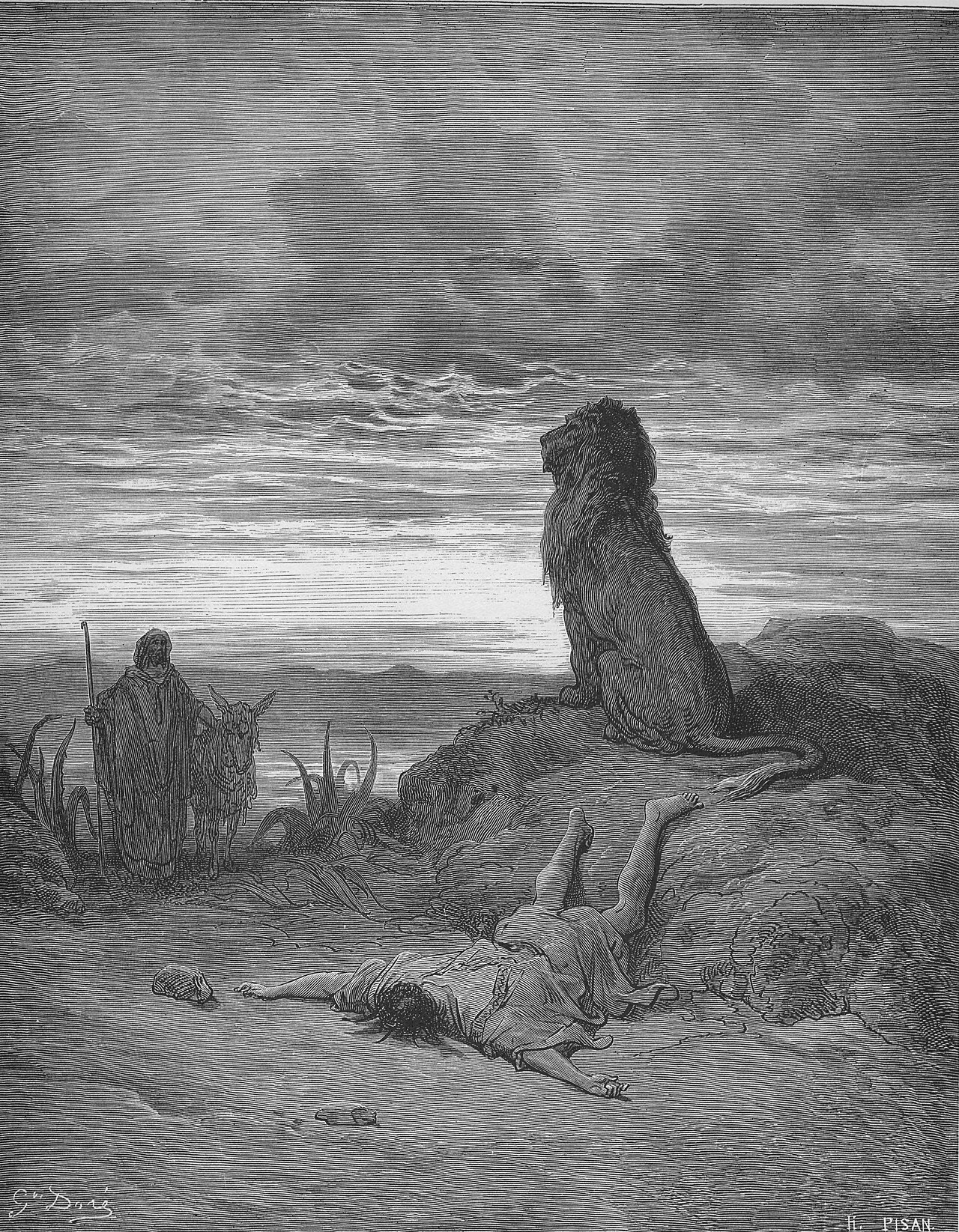
in 1 Kings 13but the man of God went back with him, ate bread in his house, and drank water.
BSB
The same verse in ASV and KJV ▾
ASV
So he went back with him, and did eat bread in his house, and drank water.
KJV
So he went back with him, and did eat bread in his house, and drank water.
⋯
This verse in 1 Kings 13
Commentary
5 notes on this verseSo he went back with him,.... In which he sinned; for as he had most certainly the command of God not to eat and drink in that place, he ought to have had the countermand from the Lord, and not trusted to another person.
This site's exposition
So he went back with him
He turns back on the strength of another man's claimed revelation and eats the bread he had twice refused. Henry calls the judgments that follow unfathomable, since the deceived man and his deceiver both answer to a Lord who does not explain every dealing in this life. The obedience that survived a king's table falls at a stranger's word.
The record, by era
The Church Fathers1 voice
For even if God does prefer the works of righteousness, still, these works are not without sacrifice, which represents a soul afflicted with fasts. He, at all events, is the God to whom neither a people incontinent of appetite nor a priest nor a prophet was pleasing. To this day the "monuments of concupiscence" remain, where the people, greedy of "flesh"—until, by devouring without digesting the quails, they brought on cholera—were buried. Eli breaks his neck before the temple doors, his sons fall in battle, his daughter-in-law expires in childbirth.
The Puritans and the Awakening1 voice
The judgments of God are unfathomable. The deceived and the deceiver are his, and he giveth not account of any of his matters. Certainly there must be a judgment to come, when these things will be called over again, and when those that sinned most and suffered least, in this world, will receive according to their works.
The Nineteenth Century1 voice
So he went back with him - He permitted himself to be imposed on; he might have thought, as he had accomplished every purpose for which God sent him, and had actually begun to return by another way, God, who had given him the charge, had authority to say, “As thy purpose was to obey every injunction, even to the letter, I now permit thee to go with this old prophet, and take some refreshment.” Now God might as well have dispensed with this part of the injunction, as he did in the case of Abraham: Take thy son Isaac, thy only son, whom thou lovest - and offer him for a burnt-offering; but, when he saw his perfect readiness, he dispensed with the actual offering, and accepted a ram in his stead.
The words behind it
7 Hebrew wordsEvery Hebrew word of this verse in the order it stands, with what it means and the door to its own study. The last column counts the times a word stands in the whole Bible: the rarer the word, the more the places it appears belong together.
| Hebrew | Sound | Meaning | Word study | In the Bible |
|---|---|---|---|---|
| וַיָּ֣שָׁב | vaiyashov | and he went back | H7725 → | 1056 times |
| אִתּ֗וֹ | ʾito | with him | H854 → | 929 times |
| וַיֹּ֥אכַל | vaiyokhal | and he ate | H398 → | 810 times |
| לֶ֛חֶם | lechem | bread | H3899 → | 298 times |
| בְּבֵית֖וֹ | beveito | in house his | H1004 → | 2046 times |
| וַיֵּ֥שְׁתְּ | vaiyeshet | and he drank | H8354 → | 217 times |
| מָֽיִם׃ | mayim | water | H4325 → | 581 times |
וַיָּ֣שָׁבand he went back
vaiyashovH7725 →1056 times
אִתּ֗וֹwith him
ʾitoH854 →929 times
וַיֹּ֥אכַלand he ate
vaiyokhalH398 →810 times
לֶ֛חֶםbread
lechemH3899 →298 times
בְּבֵית֖וֹin house his
beveitoH1004 →2046 times
וַיֵּ֥שְׁתְּand he drank
vaiyeshetH8354 →217 times
מָֽיִם׃water
mayimH4325 →581 times
A shaded row is a word that stands 400 times or fewer in the Bible.
The walk
8 stopsEach card is a verse this one points to, and under it the verses that one points to in turn. Where several paths arrive at the same place, that place is listed first: the text keeps returning to it.
Through
Genesis 3:6When the woman saw that the tree was good for food and pleasing to the eyes, and that it was desirable for obtaining wisdom, she took the fruit and ate it. She also gave…
it leads to
- 1 John 2:16
For all that is in the world—the desires of the flesh, the desires of the eyes, and the pride of life—is not from the Father but from the world.
- James 1:14–15
But each one is tempted when by his own evil desires he is lured away and enticed.
- 1 Timothy 2:14
And it was not Adam who was deceived, but the woman who was deceived and fell into transgression.
- 2 Samuel 11:2
One evening David got up from his bed and strolled around on the roof of the palace. And from the roof he saw a woman bathing—a very beautiful woman.
- Joshua 7:21
When I saw among the spoils a beautiful cloak from Shinar, two hundred shekels of silver, and a bar of gold weighing fifty shekels, I coveted them and took them. They are hidden in…
- 1 John 2:16
Through
Acts 4:19But Peter and John replied, “Judge for yourselves whether it is right in God’s sight to listen to you rather than God.
it leads to
- Acts 5:29
But Peter and the other apostles replied, “We must obey God rather than men.
- Exodus 1:17
The midwives, however, feared God and did not do as the king of Egypt had instructed; they let the boys live.
- Acts 5:29
Through
Deuteronomy 18:20But if any prophet dares to speak a message in My name that I have not commanded him to speak, or to speak in the name of other gods, that prophet must be put…
it leads to
- Jeremiah 27:15
For I have not sent them, declares the LORD, and yet they are prophesying falsely in My name; therefore I will banish you, and you will perish—you and the prophets who prophesy to you.”
- Jeremiah 27:15
Where this verse is studied
On this page
About 1 Kings
This page draws on Adam Clarke, Commentary on the Bible; John Gill, Exposition of the Old Testament (1748-1763); John Gill, Exposition of the Old Testament; Matthew Henry, Commentary on the Whole Bible and Tertullian, ON FASTING 16.