
1 Kings 13:30
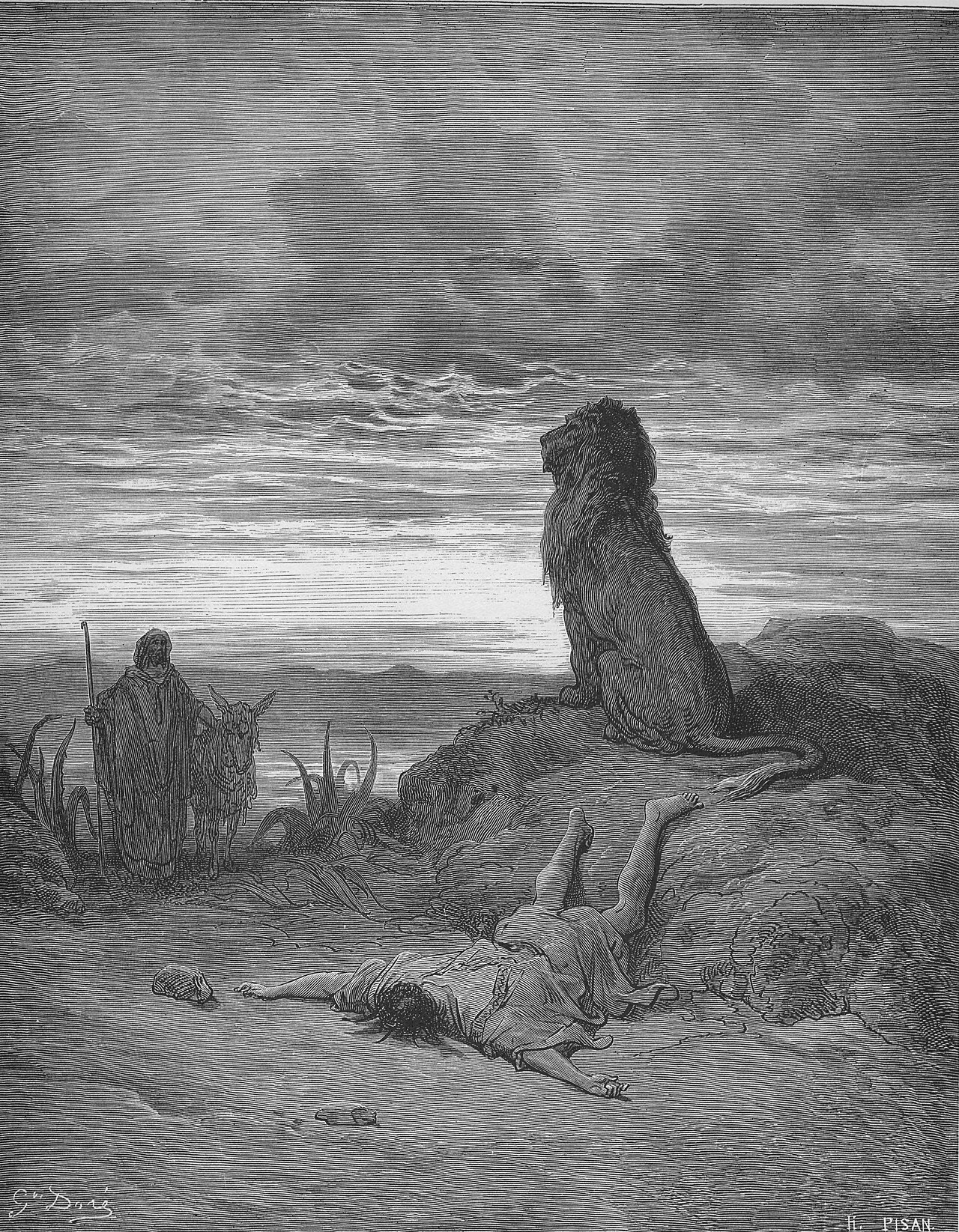
in 1 Kings 13Then he laid the body in his own tomb, and they lamented over him, “Oh, my brother!”
BSB
The same verse in ASV and KJV ▾
ASV
And he laid his body in his own grave; and they mourned over him, saying, Alas, my brother!
KJV
And he laid his carcase in his own grave; and they mourned over him, saying, Alas, my brother!
⋯
This verse in 1 Kings 13
Commentary
7 notes on this verseAnd he laid his carcass in his own grave,.... Which he had prepared for himself; for, as he came from Samaria, it could not be the sepulchre of his fathers; and this was showing all the respect, and doing all the honour to him, he well could: and they mourned over him; the prophet and his sons: saying, alas, my brother; which was an usual form of lamentation at funerals in later times, see Jer 22:18.
This site's exposition
took up the carcase of the man of God
on 1 Kings 13:29-30
The old prophet lifts the body himself, carries it home on the ass, and buries it in his own grave, the funeral rites of a man mourning someone he calls brother though they met only once. Gill notes the man of God could not lie in his fathers' sepulchre as the sentence required, since he died far from Judah, so the old prophet's own grave becomes the only honor left to give him. The lament, Alas, my brother, is the ordinary funeral cry of the period, the same form Jeremiah later uses at 22:18.
This site's exposition
Oh, my brother
John Gill and Adam Clarke both point to Jeremiah 22:18, where the same cry over a dead brother is withheld from Jehoiakim. Clarke reads the grief of the old prophet as partly for his own part in the death of the man of God. The prophet who lied to him now mourns him.
The record, by era
The Puritans and the Awakening2 voices
His grave - So that threatening, ver. 22, was fulfilled; and withal, the memory of his prophecy was revived and preserved among them, and his very carcase resting there, might be a witness of their madness and desperate wickedness, in continuing in their abominable idolatry, after such an assurance of the dreadful effects of it.
quarantine:anchor (2026-07-29) — cites-ver-22-anchored-30-30
Thy way, O God! is in the sea, and thy path in the great waters. We cannot judge of men by their sufferings, nor of sins by their present punishments; with some the flesh is destroyed that the spirit may be saved, while with others the flesh is pampered that the soul may ripen for hell.
The Nineteenth Century2 voices
Alas, my brothers - This lamentation is very simple, very short, and very pathetic. Perhaps the old prophet said it as much in reference to himself, who had been the cause of his untimely death, as in reference to the man of God, whose corpse he now committed to the tomb. But the words may be no more than the burden of each line of the lamentation which was used on this occasion. See instances of this among the Asiatics in the note on Jer 22:18 (note).
A commentator
Albert Barnes1798–1870
Notes, Explanatory and Practical, on the Old and New Testaments (1832-1869)
proposed
He laid his carcase in his own grave - As Joseph of Arimathaea did the body of our Lord Mat 27:60. The possession of rock-hewn tombs by families, or individuals, was common among the Jews from their first entrance into the holy land to their final expulsion. A sepulchre usually consisted of an underground apartment, into which opened a number of long, narrow “loculi,” or cells, placed side by side, each adapted to receive one body. The cells were 6 or 7 feet long, 2 feet wide, and 3 feet high. They were commonly closed by a stone placed at the end of each. Many such tombs still exist in Palestine.
The words behind it
8 Hebrew wordsEvery Hebrew word of this verse in the order it stands, with what it means and the door to its own study. The last column counts the times a word stands in the whole Bible: the rarer the word, the more the places it appears belong together.
| Hebrew | Sound | Meaning | Word study | In the Bible |
|---|---|---|---|---|
| וַיַּנַּ֥ח | vaiyanach | and he placed | H5117 → | 142 times |
| אֶת־ | ʾet- | <obj.> | H853 → | 10935 times |
| נִבְלָת֖וֹ | nivlato | corpse his | H5038 → | 48 times |
| בְּקִבְר֑וֹ | bekivro | in own grave his | H6913 → | 67 times |
| וַיִּסְפְּד֥וּ | vaiyispedu | and people mourned | H5594 → | 30 times |
| עָלָ֖יו | ʾalav | on him | H5921 → | 5755 times |
| ה֥וֹי | ho | alas! | H1945 → | |
| אָחִֽי׃ | ʾachi | O brother my | H251 → | 630 times |
וַיַּנַּ֥חand he placed
vaiyanachH5117 →142 times
אֶת־<obj.>
ʾet-H853 →10935 times
נִבְלָת֖וֹcorpse his
nivlatoH5038 →48 times
בְּקִבְר֑וֹin own grave his
bekivroH6913 →67 times
וַיִּסְפְּד֥וּand people mourned
vaiyispeduH5594 →30 times
עָלָ֖יוon him
ʾalavH5921 →5755 times
ה֥וֹיalas!
hoH1945 →
אָחִֽי׃O brother my
ʾachiH251 →630 times
A shaded row is a word that stands 400 times or fewer in the Bible.
The walk
8 stopsEach card is a verse this one points to, and under it the verses that one points to in turn. Where several paths arrive at the same place, that place is listed first: the text keeps returning to it.
Through
1 Kings 14:13All Israel will mourn for him and bury him. For this is the only one belonging to Jeroboam who will receive a proper burial, because only in him has the LORD, the God of…
it leads to
- 2 Chronicles 19:3
However, some good is found in you, for you have removed the Asherah poles from the land and have set your heart on seeking God.”
- 2 Chronicles 12:12
Because Rehoboam humbled himself, the anger of the LORD turned away from him, and He did not destroy him completely. Indeed, conditions were good in Judah.
- Job 19:28
If you say, ‘Let us persecute him, since the root of the matter lies with him,’
- 2 Chronicles 19:3
Through
Jeremiah 22:18Therefore this is what the LORD says concerning Jehoiakim son of Josiah king of Judah: “They will not mourn for him: ‘Alas, my brother! Alas, my sister!’ They will not mourn for him: ‘Alas,…
it leads to
- Jeremiah 22:10
Do not weep for the dead king; do not mourn his loss. Weep bitterly for the one who is exiled, for he will never return to see his native land.
Reached by 2 separate paths from here.
- Jeremiah 16:6
“Both great and small will die in this land. They will not be buried or mourned, nor will anyone cut himself or shave his head for them.
- Jeremiah 16:4
“They will die from deadly diseases. They will not be mourned or buried, but will lie like dung on the ground. They will be finished off by sword and famine, and their corpses will…
- Jeremiah 22:10
Through
Acts 8:2God-fearing men buried Stephen and mourned deeply over him.
it leads to
- Genesis 50:10–11
When they reached the threshing floor of Atad, which is across the Jordan, they lamented and wailed loudly, and Joseph mourned for his father seven days.
- 1 Samuel 28:3
Now by this time Samuel had died, and all Israel had mourned for him and buried him in Ramah, his own city. And Saul had removed the mediums and spiritists from the land.
- Genesis 50:10–11
Where this verse is studied
On this page
About 1 Kings
This page draws on Adam Clarke, Commentary on the Bible; Albert Barnes, Notes, Explanatory and Practical, on the Old and New Testaments (1832-1869); John Gill, Exposition of the Old Testament (1748-1763); John Gill, Exposition of the Old Testament; John Wesley, Explanatory Notes upon the Old Testament and Matthew Henry, Commentary on the Whole Bible.