
1 Kings 13:24
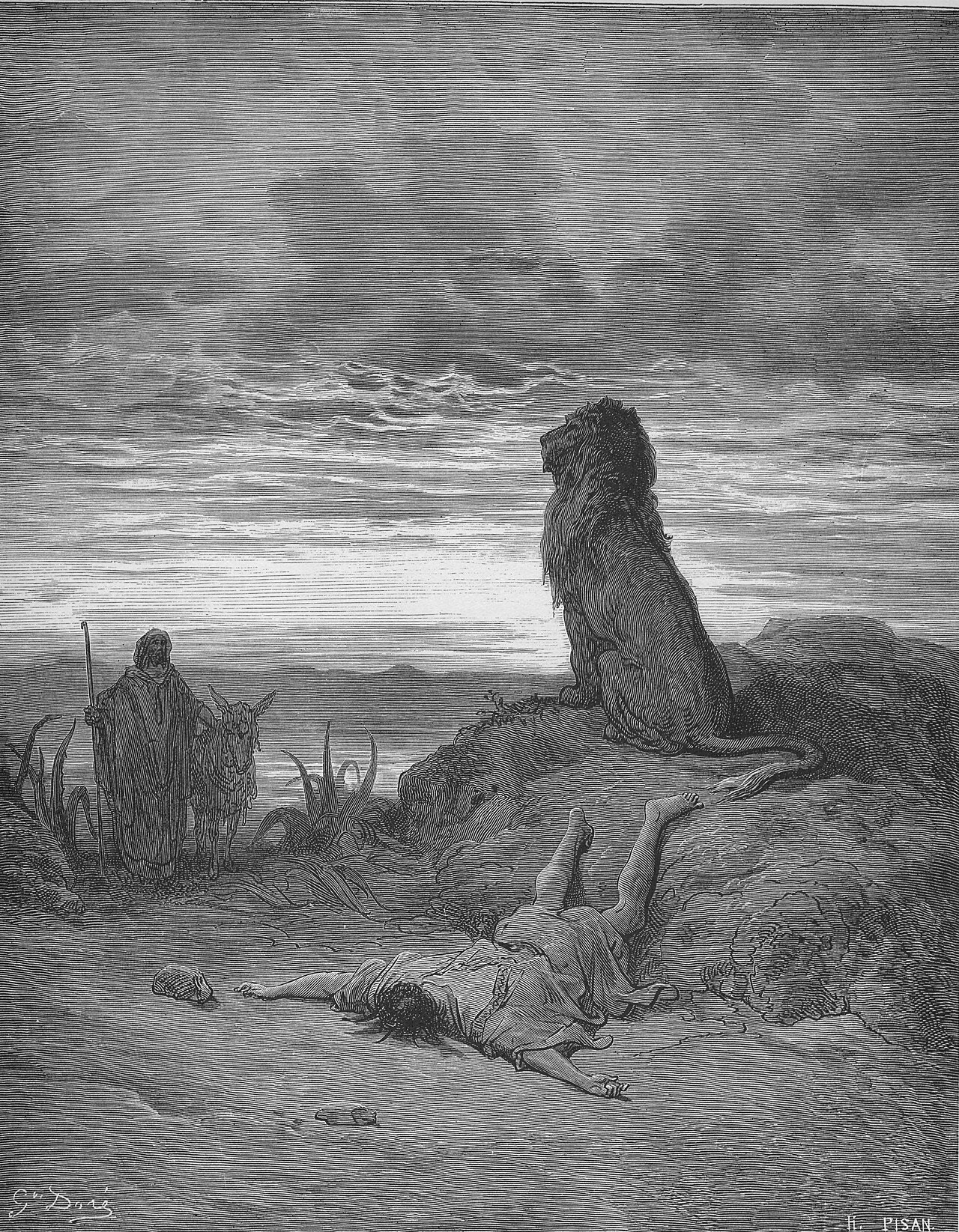
in 1 Kings 13As he went on his way, a lion met him on the road and killed him, and his body was left lying in the road, with the donkey and the lion standing beside it.
BSB
The same verse in ASV and KJV ▾
ASV
And when he was gone, a lion met him by the way, and slew him: and his body was cast in the way, and the ass stood by it; the lion also stood by the body.
KJV
And when he was gone, a lion met him by the way, and slew him: and his carcase was cast in the way, and the ass stood by it, the lion also stood by the carcase.
⋯
This verse in 1 Kings 13
Commentary
12 notes on this verseSeeing we find it written, that what death soever the just man dieth, that his justice shall not be taken from him: what hurt cometh to God's elect servants (walking no question the way to everlasting life), if for a little while they have some pitiful end? and perhaps it proceedeth from some small sin of theirs, which by such kind of death God's pleasure is that it should be purged.
This site's exposition
after he had eaten bread, and after he had drunk
on 1 Kings 13:23-25
The old prophet saddles the ass for his guest but does not ride with him, and Wesley reads the omission as a guilty conscience unwilling to share the road with a man now under sentence. A lion kills him on the way and then behaves against its nature, neither dragging off the body nor touching the ass standing beside it, and travelers report the scene exactly as they find it. Clarke calls the restraint itself the visible hand of God, a judgment stopped precisely at death and carried no further.
This site's exposition
a lion met him on the road
Adam Clarke reads the death of the man of God as a sin unto death in the sense of 1 John 5:16, the body killed on the road and the soul spared. Gregory the Dialogist held that a hard end may purge a small sin in one of God's servants. The lion kept to its commission.
The record, by era
The Church Fathers2 voices
We know that even saintly men have been given over in the flesh to Satan and to great afflictions for some very slight faults, since the divine mercy will not tolerate the very least spot or stain to be found in them on the day of judgment, and purges away in this world every spot of their filth, as the prophet, or rather God himself says, in order that he may commit them to eternity as gold or silver refined and needing no penal purification. "And," he says,"I will clean purge away your dross, and I will take away all your sin; and after this you will be called the city of the just, a faithful city." And again: "Just as silver and gold are tried in the furnace, so the Lord chooses hearts." 18 And again: "The fire tries gold and silver, but man is tried in the furnace of humiliation." And this also: "For the Lord chastens those whom he loves, and he disciplines every son whom he receives." We see a clear instance of this in the case of the prophet and man of God in the third book of Kings who was immediately destroyed by a lion for a single disobedience, in which he was implicated not of set purpose nor by the fault of his own will but by the enticement of another. As the Scripture says of him: "It is the man of God, who disobeyed the word of the Lord, and the Lord delivered him to the lion, and it killed him according to the word of the Lord, which he spoke." The punishment for his present offense and his careless error—together with the reward for his righteousness—for which the Lord gave over his prophet in this world to the destroyer appeared in the moderation and abstinence of the beast of prey, when that most savage creature did not dare even to taste the carcass that was given over to him.
It is not to be imagined that one has been so annihilated by the teeth of a beast that his soul has then been snatched away to infernal punishment, since the same lion who killed his very body guarded it. Even the beast of burden on which the man had been riding was unhurt and with great courage stood in the presence of the wild beast at the destruction of his master. By this miraculous sign it is made clear that the man of God was corrected temporarily even at the point of death rather than that he was punished after death. On this subject the apostle Paul, when he had made mention of certain unpleasant infirmities and death experienced by many, said, "But if we judged ourselves, we should not thus be judged by the Lord. But when we are judged, we are being chastised by the Lord, that we may not be condemned with the world."
The Medieval Church1 voice
Through the words "a lion killed him" [the Scripture] shows that [the lion] strangled and killed him according to God's command. And through the sentence "it did not eat him," it shows that [the animal] was not urged by hunger but acted in compliance with …
The Puritans and the Awakening2 voices
Had he never read that man lives not by bread alone? That his death was for the glory of God; for by this it appeared, (1.) That nothing is more provoking to him than disobedience to an express command, though in a small matter, which makes his proceedings against our first parents, for eating the forbidden fruit, the easier to be accounted for.
Slew him - "But why doth God punish a good man so severely for so small an offense?" His sin was not small, for it was a gross disobedience to a positive command.
4 more voices on this verse
The Puritans and the Awakening2 voices
And when he was gone, a lion met him by the way, and slew him,....
His commission was to kill the prophet; hitherto he should go, but no further. Thus God showed that, though he was angry with him, his anger was turned away, and the punishment went no further than death.
The Nineteenth Century2 voices
A lion met him - and slew him - By permitting himself to be seduced by the old prophet, when he should have acted only on the expressly declared counsel of God, he committed the sin unto death; that is, such a sin as God will punish with the death of the body, while he extends mercy to the soul. See my notes on 1Jn 5:16 (note), 1Jn 5:17 (note). From the instance here related, we see, as in various other cases, that often judgment begins at the house of God.
A commentator
Jamieson, Fausset & Brown1802–1910
Commentary Critical and Explanatory on the Whole Bible (1871)
proposed
a lion met him by the way, and slew him--There was a wood near Beth-el infested with lions (2Ki 2:24). This sad catastrophe was a severe but necessary judgment of God, to attest the truth of the message with which the prophet had been charged.
quarantine:debris (2026-07-29) — starts-lowercase
The words behind it
16 Hebrew wordsEvery Hebrew word of this verse in the order it stands, with what it means and the door to its own study. The last column counts the times a word stands in the whole Bible: the rarer the word, the more the places it appears belong together.
| Hebrew | Sound | Meaning | Word study | In the Bible |
|---|---|---|---|---|
| וַיֵּ֕לֶךְ | vaiyelekh | and he went | H1980 → | 1546 times |
| וַיִּמְצָאֵ֧הוּ | vaiyimtzaehu | and it met him | H4672 → | 455 times |
| אַרְיֵ֛ה | ʾaryeh | a lion | H738 → | 80 times |
| בַּדֶּ֖רֶךְ | baderekh | on the way | H1870 → | 707 times |
| וַיְמִיתֵ֑הוּ | vaymitehu | and it killed him | H4191 → | 839 times |
| וַתְּהִ֤י | vatehi | and it was | H1961 → | 3559 times |
| נִבְלָתוֹ֙ | nivlato | corpse his | H5038 → | 48 times |
| מֻשְׁלֶ֣כֶת | mushlekhet | thrown down | H7993 → | 125 times |
| בַּדֶּ֔רֶךְ | baderekh | in the road | H1870 → | 707 times |
| וְהַחֲמוֹר֙ | vehachamor | and the donkey | H2543 → | 96 times |
| עֹמֵ֣ד | ʾomed | [was] standing | H5975 → | 521 times |
| אֶצְלָ֔הּ | ʾetzlah | beside it | H681 → | 61 times |
| וְהָ֣אַרְיֵ֔ה | vehaaryeh | and the lion | H738 → | 80 times |
| עֹמֵ֖ד | ʾomed | [was] standing | H5975 → | 521 times |
| אֵ֥צֶל | ʾetzel | beside | H681 → | 61 times |
| הַנְּבֵלָֽה׃ | hanevelah | the corpse | H5038 → | 48 times |
וַיֵּ֕לֶךְand he went
vaiyelekhH1980 →1546 times
וַיִּמְצָאֵ֧הוּand it met him
vaiyimtzaehuH4672 →455 times
אַרְיֵ֛הa lion
ʾaryehH738 →80 times
בַּדֶּ֖רֶךְon the way
baderekhH1870 →707 times
וַיְמִיתֵ֑הוּand it killed him
vaymitehuH4191 →839 times
וַתְּהִ֤יand it was
vatehiH1961 →3559 times
נִבְלָתוֹ֙corpse his
nivlatoH5038 →48 times
מֻשְׁלֶ֣כֶתthrown down
mushlekhetH7993 →125 times
בַּדֶּ֔רֶךְin the road
baderekhH1870 →707 times
וְהַחֲמוֹר֙and the donkey
vehachamorH2543 →96 times
עֹמֵ֣ד[was] standing
ʾomedH5975 →521 times
אֶצְלָ֔הּbeside it
ʾetzlahH681 →61 times
וְהָ֣אַרְיֵ֔הand the lion
vehaaryehH738 →80 times
עֹמֵ֖ד[was] standing
ʾomedH5975 →521 times
אֵ֥צֶלbeside
ʾetzelH681 →61 times
הַנְּבֵלָֽה׃the corpse
hanevelahH5038 →48 times
A shaded row is a word that stands 400 times or fewer in the Bible.
The walk
8 stopsEach card is a verse this one points to, and under it the verses that one points to in turn. Where several paths arrive at the same place, that place is listed first: the text keeps returning to it.
Through
Proverbs 26:13The slacker says, “A lion is in the road! A fierce lion roams the public square!”
it leads to
- Proverbs 15:19
The way of the slacker is like a hedge of thorns, but the path of the upright is a highway.
Reached by 2 separate paths from here.
- Proverbs 22:13
The slacker says, “There is a lion outside! I will be slain in the streets!”
- Proverbs 19:15
Laziness brings on deep sleep, and an idle soul will suffer hunger.
- Proverbs 15:19
Through
Amos 5:19It will be like a man who flees from a lion, only to encounter a bear, or who enters his house and rests his hand against the wall, only to be bitten by a…
it leads to
- Isaiah 24:17–18
Terror and pit and snare await you, O dweller of the earth.
- Jeremiah 15:2–3
If they ask you, ‘Where shall we go?’ you are to tell them that this is what the LORD says: ‘Those destined for death, to death; those destined for the sword, to the sword;…
- Jeremiah 48:43–44
Terror and pit and snare await you, O dweller of Moab,” declares the LORD.
- Isaiah 24:17–18
Through
Proverbs 22:13The slacker says, “There is a lion outside! I will be slain in the streets!”
it leads to
- Proverbs 26:13–16
The slacker says, “A lion is in the road! A fierce lion roams the public square!”
- Numbers 13:32–33
So they gave the Israelites a bad report about the land that they had spied out: “The land we explored devours its inhabitants, and all the people we saw there are great in stature.
- Proverbs 26:13–16
Where this verse is studied
On this page
About 1 Kings
This page draws on 9 works. Open the list of works
This page draws on Adam Clarke, Commentary on the Bible; Augustine of Hippo, On the Care of the Dead 7.9; Gregory the Dialogist, Dialogues, Book 4, Chapter 24; Ishodad of Merv, BOOKS OF SESSIONS 1 KINGS 13:24-28; Jamieson, Fausset & Brown, Commentary Critical and Explanatory on the Whole Bible; John Cassian, CONFERENCE 7.25-26; John Gill, Exposition of the Old Testament (1748-1763); John Wesley, Explanatory Notes upon the Old Testament and Matthew Henry, Commentary on the Whole Bible.