
1 Kings 13:22
in 1 Kings 13but you went back and ate bread and drank water in the place where He told you not to do so, your body shall never reach the tomb of your fathers.’”
BSB
The same verse in ASV and KJV ▾
ASV
but camest back, and hast eaten bread and drunk water in the place of which he said to thee, Eat no bread, and drink no water; thy body shall not come unto the sepulchre of thy fathers.
KJV
But camest back, and hast eaten bread and drunk water in the place, of the which the Lord did say to thee, Eat no bread, and drink no water; thy carcase shall not come unto the sepulchre of thy fathers.
⋯
This verse in 1 Kings 13
Commentary
8 notes on this verseBut camest back, and hast eaten bread and drunk water in the place, of the which the Lord did say to thee, eat no bread, nor drink no water,.... Which command he observed when first there, though invited by the king; and yet, after he had got out of the place, was prevailed upon to return and transgress the command: thy carcass shall not come unto the sepulchre of thy fathers; signifying that he should die before he came to the land of Judah, and he should be buried in another place, and which was verified.
This site's exposition
as they sat at the table
on 1 Kings 13:20-22
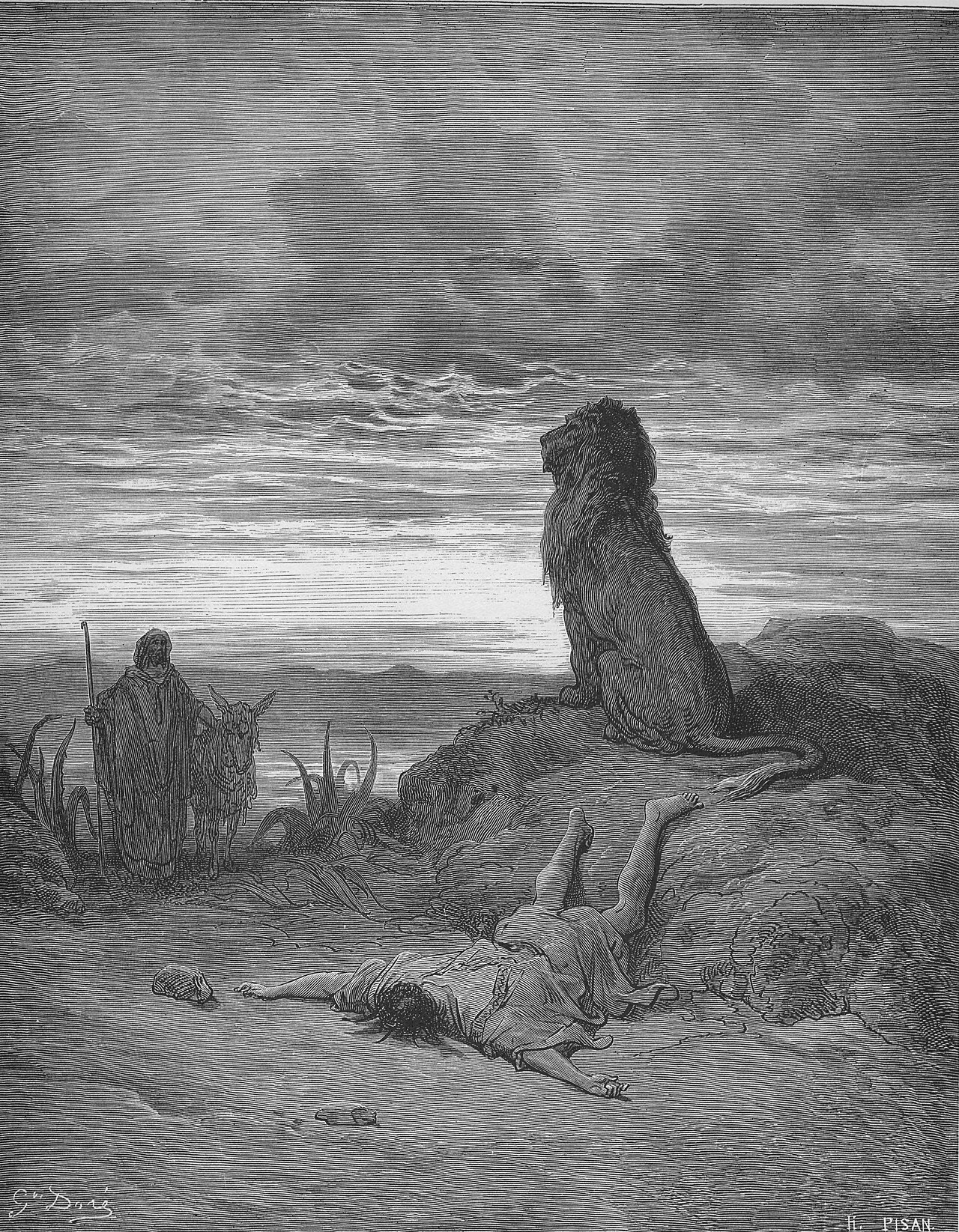
While the two men sit at the meal that broke the charge, the word of the Lord comes on the old prophet, and the sentence he speaks against his guest is the same word he had just contradicted in his own mouth. Keil and the bench read the case as obedience to a direct, personal word admitting no second revision, even one claiming a fresh angelic message, so the man of God is judged for trusting a report over the command he already had. The false prophet who lied speaks true judgment in the same breath, and the text names the irony without resolving it.
This site's exposition
the tomb of your fathers
Burial with one's fathers was the hope of every Israelite. This sentence takes it away, and Adam Clarke reads it as a warning of an early death. John Gill notes the fulfillment: verse 30 lays him in the old prophet's own tomb.
The record, by era
The Church Fathers1 voice
Yet from that love of the human heart, because of which "no one ever hated his own flesh," if people believe that anything would be lacking to their bodies after death that in their own people or country the solemnity of burial demands, they become sad ..., and before death they fear for their bodies that which has no effect on them after death. Thus we read in the book of Kings that God through a prophet threatens another prophet who transgressed his word, that his body should not be returned to the sepulcher of his ancestors. Scripture records it in these words: "Thus says the Lord: Because you have not been obedient to the Lord and have not kept the commandment that the Lord your God commanded you, and [you] have returned and eaten bread and drunk water in the place where he commanded you that you should not eat bread or drink water, your dead shall not be brought in the sepulcher of your ancestors." If we consider the extent of this punishment according to the Evangelist, where we learn that after the body has been slain there is no occasion to fear that the lifeless members will suffer, it should not be called punishment. But, if we consider it in relation to the love of a person for his own flesh, then he might have been frightened and saddened while living at what he was not to feel when dead. This, then, was the nature of the punishment: The soul grieved that something would happen to its body, although, when it did happen, the soul did not grieve. Only to this extent did the Lord wish to punish his servant, for it was not from his own obstinacy that he refused to carry out the command, but, because of the deceit of another person who was deceiving him, he thought he obeyed when he did not obey.
The Puritans and the Awakening2 voices
It was, in one word, disobedience to an express command. Judgment is given upon it: Thy carcase shall not come to the sepulchre of thy fathers, that is, "Thou shalt never reach thy own house, but shalt be a carcase quickly, nor shall thy dead body be brought to the place of thy fathers' sepulchres, to be interred." 2.
But is it not strange that the lying prophet escapes, while the man of God is so severely punished? Certainly there must be a judgment to come, when these things shall be called over again, and when those who sinned most and suffered least in this world, will receive according to their works.
The Nineteenth Century2 voices
Thy carcass shall not come - This intimated to him that he was to die an untimely death, but probably did not specify by what means.
A commentator
Albert Barnes1798–1870
Notes, Explanatory and Practical, on the Old and New Testaments (1832-1869)
proposed
On the anxiety of the Hebrews to be buried with their fathers, see Gen 47:30; Gen 49:29, Gen 49:1,Gen 49:25; 2Sa 19:37, etc.
The words behind it
21 Hebrew wordsEvery Hebrew word of this verse in the order it stands, with what it means and the door to its own study. The last column counts the times a word stands in the whole Bible: the rarer the word, the more the places it appears belong together.
| Hebrew | Sound | Meaning | Word study | In the Bible |
|---|---|---|---|---|
| וַתָּ֗שָׁב | vatashov | and you went back | H7725 → | 1056 times |
| וַתֹּ֤אכַל | vatokhal | and you ate | H398 → | 810 times |
| לֶ֙חֶם֙ | lechem | bread | H3899 → | 298 times |
| וַתֵּ֣שְׁתְּ | vateshet | and you drank | H8354 → | 217 times |
| מַ֔יִם | mayim | water | H4325 → | 581 times |
| בַּמָּקוֹם֙ | bamakom | in the place | H4725 → | 401 times |
| אֲשֶׁ֣ר | ʾasher | which | H834 → | 5497 times |
| דִּבֶּ֣ר | diber | he spoke | H1696 → | 1141 times |
| אֵלֶ֔יךָ | ʾeleikha | to you | H413 → | 5510 times |
| אַל־ | ʾal- | may not | H408 → | 724 times |
| תֹּ֥אכַל | tokhal | you eat | H398 → | 810 times |
| לֶ֖חֶם | lechem | bread | H3899 → | 298 times |
| וְאַל־ | veal- | and may not | H408 → | 724 times |
| תֵּ֣שְׁתְּ | teshet | you drink | H8354 → | 217 times |
| מָ֑יִם | mayim | water | H4325 → | 581 times |
| לֹֽא־ | lo'- | not | H3808 → | 5168 times |
| תָב֥וֹא | tavo' | it will go | H935 → | 2568 times |
| נִבְלָתְךָ֖ | nivlatekha | corpse your | H5038 → | 48 times |
| אֶל־ | ʾel- | to | H413 → | 5510 times |
| קֶ֥בֶר | kever | [the] grave of | H6913 → | 67 times |
| אֲבֹתֶֽיךָ׃ | ʾavoteikha | ancestors your | H1 → | 1212 times |
וַתָּ֗שָׁבand you went back
vatashovH7725 →1056 times
וַתֹּ֤אכַלand you ate
vatokhalH398 →810 times
לֶ֙חֶם֙bread
lechemH3899 →298 times
וַתֵּ֣שְׁתְּand you drank
vateshetH8354 →217 times
מַ֔יִםwater
mayimH4325 →581 times
בַּמָּקוֹם֙in the place
bamakomH4725 →401 times
אֲשֶׁ֣רwhich
ʾasherH834 →5497 times
דִּבֶּ֣רhe spoke
diberH1696 →1141 times
אֵלֶ֔יךָto you
ʾeleikhaH413 →5510 times
אַל־may not
ʾal-H408 →724 times
תֹּ֥אכַלyou eat
tokhalH398 →810 times
לֶ֖חֶםbread
lechemH3899 →298 times
וְאַל־and may not
veal-H408 →724 times
תֵּ֣שְׁתְּyou drink
teshetH8354 →217 times
מָ֑יִםwater
mayimH4325 →581 times
לֹֽא־not
lo'-H3808 →5168 times
תָב֥וֹאit will go
tavo'H935 →2568 times
נִבְלָתְךָ֖corpse your
nivlatekhaH5038 →48 times
אֶל־to
ʾel-H413 →5510 times
קֶ֥בֶר[the] grave of
keverH6913 →67 times
אֲבֹתֶֽיךָ׃ancestors your
ʾavoteikhaH1 →1212 times
A shaded row is a word that stands 400 times or fewer in the Bible.
The walk
8 stopsEach card is a verse this one points to, and under it the verses that one points to in turn. Where several paths arrive at the same place, that place is listed first: the text keeps returning to it.
Through
1 Kings 14:13All Israel will mourn for him and bury him. For this is the only one belonging to Jeroboam who will receive a proper burial, because only in him has the LORD, the God of…
it leads to
- 2 Chronicles 19:3
However, some good is found in you, for you have removed the Asherah poles from the land and have set your heart on seeking God.”
- 2 Chronicles 12:12
Because Rehoboam humbled himself, the anger of the LORD turned away from him, and He did not destroy him completely. Indeed, conditions were good in Judah.
- 2 Peter 2:8–9
(for that righteous man, living among them day after day, was tormented in his righteous soul by the lawless deeds he saw and heard)—
- Philemon 1:6
I pray that your partnership in the faith may become effective as you fully acknowledge every good thing that is ours in Christ.
- Ezekiel 18:14–32
Now suppose this son has a son who sees all the sins his father has committed, considers them, and does not do likewise:
- 2 Chronicles 19:3
Through
1 Kings 13:30Then he laid the body in his own tomb, and they lamented over him, “Oh, my brother!”
it leads to
- Jeremiah 22:18
Therefore this is what the LORD says concerning Jehoiakim son of Josiah king of Judah: “They will not mourn for him: ‘Alas, my brother! Alas, my sister!’ They will not mourn for him: ‘Alas,…
- 1 Kings 14:13
All Israel will mourn for him and bury him. For this is the only one belonging to Jeroboam who will receive a proper burial, because only in him has the LORD, the God of…
- Acts 8:2
God-fearing men buried Stephen and mourned deeply over him.
- Jeremiah 22:18
Where this verse is studied
On this page
About 1 Kings
This page draws on Adam Clarke, Commentary on the Bible; Albert Barnes, Notes, Explanatory and Practical, on the Old and New Testaments (1832-1869); Augustine of Hippo, On the Care of the Dead 7.9; John Gill, Exposition of the Old Testament (1748-1763); John Wesley, Explanatory Notes upon the Old Testament; Keil, The Books of the Kings and Matthew Henry, Commentary on the Whole Bible.