
1 Kings 13:28
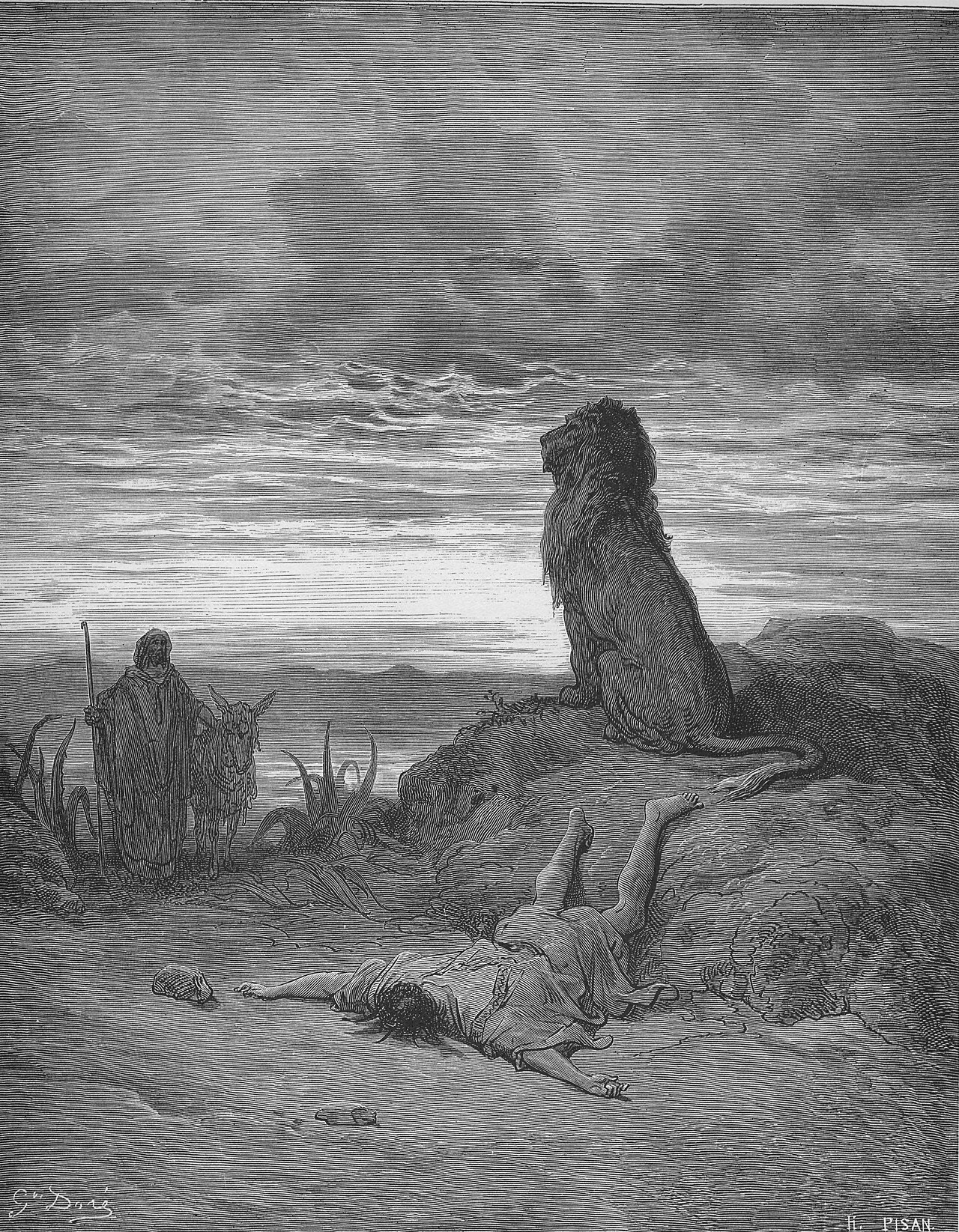
in 1 Kings 13and he went and found the body lying in the road, with the donkey and the lion standing beside it. The lion had not eaten the body or mauled the donkey.
BSB
The same verse in ASV and KJV ▾
ASV
And he went and found his body cast in the way, and the ass and the lion standing by the body: the lion had not eaten the body, nor torn the ass.
KJV
And he went and found his carcase cast in the way, and the ass and the lion standing by the carcase: the lion had not eaten the carcase, nor torn the ass.
⋯
This verse in 1 Kings 13
Commentary
10 notes on this verseThe lion had not eaten the carcass, nor torn the ass - All here was preternatural. The lion, though he had killed the man, does not devour him; the ass stands quietly by, not fearing the lion; and the lion does not attempt to tear the ass: both stand as guardians of the fallen prophet. How evident is the hand of God in all!
This site's exposition
And he spake to his sons, saying
on 1 Kings 13:27-28
The old prophet rides out himself now and finds the tableau standing exactly as reported, carcase, ass and lion together in the road. The lion had not eaten the carcase, nor torn the ass, the same restraint Clarke already called preternatural, and Keil reads the standing lion and the untouched ass together as visible proof that the beast acted under commission rather than hunger.
This site's exposition
The lion had not eaten the body
The same judgment falls again at 20:36, where a man who refuses a prophet's word is killed by a lion. Adam Clarke sees the lion and the donkey standing guard over the fallen prophet. The body was kept for burial.
The record, by era
The Church Fathers3 voices
It is not to be imagined that one has been so annihilated by the teeth of a beast that his soul has then been snatched away to infernal punishment, since the same lion who killed his very body guarded it. Even the beast of burden on which the man had been riding was unhurt and with great courage stood in the presence of the wild beast at the destruction of his master. By this miraculous sign it is made clear that the man of God was corrected temporarily even at the point of death rather than that he was punished after death. On this subject the apostle Paul, when he had made mention of certain unpleasant infirmities and death experienced by many, said, "But if we judged ourselves, we should not thus be judged by the Lord. But when we are judged, we are being chastised by the Lord, that we may not be condemned with the world."
We know that even saintly men have been given over in the flesh to Satan and to great afflictions for some very slight faults, since the divine mercy will not tolerate the very least spot or stain to be found in them on the day of judgment, and purges away in this world every spot of their filth, as the prophet, or rather God himself says, in order that he may commit them to eternity as gold or silver refined and needing no penal purification. "And," he says,"I will clean purge away your dross, and I will take away all your sin; and after this you will be called the city of the just, a faithful city." And again: "Just as silver and gold are tried in the furnace, so the Lord chooses hearts." 18 And again: "The fire tries gold and silver, but man is tried in the furnace of humiliation." And this also: "For the Lord chastens those whom he loves, and he disciplines every son whom he receives." We see a clear instance of this in the case of the prophet and man of God in the third book of Kings who was immediately destroyed by a lion for a single disobedience, in which he was implicated not of set purpose nor by the fault of his own will but by the enticement of another. As the Scripture says of him: "It is the man of God, who disobeyed the word of the Lord, and the Lord delivered him to the lion, and it killed him according to the word of the Lord, which he spoke." The punishment for his present offense and his careless error—together with the reward for his righteousness—for which the Lord gave over his prophet in this world to the destroyer appeared in the moderation and abstinence of the beast of prey, when that most savage creature did not dare even to taste the carcass that was given over to him.
A commentator
John CassianFirst Conference of Abbot Serenus, Chapters 25-26 · Written before 435.
proposed
But we know that even saintly men have been given over in the flesh to Satan and to great afflictions for some very slight faults, since the Divine mercy will not suffer the very least spot or stain to be found in them on the day of judgment, and purges away in this world every spot of their filth, as the prophet, or rather God Himself says, in order that He may commit them to eternity as gold or silver refined and needing no penal purification. "And," says He, "I will clean purge away thy dross, and I will take away all thy tin; and after this thou shall be called the city of the just, a faithful city." And again: "Like as silver and gold are tried in the furnace, so the Lord chooseth the hearts;" And again: "The fire tries gold and silver; but man is tried in the furnace of humiliation;" and this also: "For whom the Lord loveth He chasteneth, and scourgeth every son whom He receiveth." And we see clear instance of this in the case of that prophet and man of God in the third book of Kings, who was straightway destroyed by a lion for a single fault of disobedience, in which he was implicated not of set purpose nor by the fault of his own will but by the enticement of another, as the Scripture speaks thus of him: "It is the man of God, who was disobedient to the mouth of the Lord, and the Lord delivered him to the lion, and it tare him according to the word of the Lord, which He spake." In which case the punishment of the present offence and carelessness together with the reward of his righteousness, for which the Lord gave over his prophet in this world to the destroyer, are shown by the moderation and abstinence of the beast of prey, as that most savage creature did not dare even to taste the carcass that was given over to him.
The Medieval Church2 voices
Through the words "a lion killed him" [the Scripture] shows that [the lion] strangled and killed him according to God's command. And through the sentence "it did not eat him," it shows that [the animal] was not urged by hunger but acted in compliance with …
Seeing we find it written, that what death soever the just man dieth, that his justice shall not be taken from him: what hurt cometh to God's elect servants (walking no question the way to everlasting life), if for a little while they have some pitiful end? and perhaps it proceedeth from some small sin of theirs, which by such kind of death God's pleasure is that it should be purged.
2 more voices on this verse
The Puritans and the Awakening1 voice
And he went and found his carcass cast in the way, and the ass and the lion standing by the carcass,....
The Nineteenth Century1 voice
A commentator
Albert Barnes1798–1870
Notes, Explanatory and Practical, on the Old and New Testaments (1832-1869)
proposed
The lion had not eaten the carcase, nor torn the ass - These strange circumstances were of a nature to call men’s attention to the matter, and cause the whole story to be bruited abroad. By these means an incident, which Jeroboam would have wished hushed up, became no doubt the common talk of the whole people.
The words behind it
20 Hebrew wordsEvery Hebrew word of this verse in the order it stands, with what it means and the door to its own study. The last column counts the times a word stands in the whole Bible: the rarer the word, the more the places it appears belong together.
| Hebrew | Sound | Meaning | Word study | In the Bible |
|---|---|---|---|---|
| וַיֵּ֗לֶךְ | vaiyelekh | and he went | H1980 → | 1546 times |
| וַיִּמְצָ֤א | vaiyimtza' | and he found | H4672 → | 455 times |
| אֶת־ | ʾet- | <obj.> | H853 → | 10935 times |
| נִבְלָתוֹ֙ | nivlato | corpse his | H5038 → | 48 times |
| מֻשְׁלֶ֣כֶת | mushlekhet | thrown down | H7993 → | 125 times |
| בַּדֶּ֔רֶךְ | baderekh | in the road | H1870 → | 707 times |
| וַֽחֲמוֹר֙ | vachamor | and [the] donkey | H2543 → | 96 times |
| וְהָ֣אַרְיֵ֔ה | vehaaryeh | and the lion | H738 → | 80 times |
| עֹמְדִ֖ים | ʾomedim | [were] standing | H5975 → | 521 times |
| אֵ֣צֶל | ʾetzel | beside | H681 → | 61 times |
| הַנְּבֵלָ֑ה | hanevelah | the corpse | H5038 → | 48 times |
| לֹֽא־ | lo'- | not | H3808 → | 5168 times |
| אָכַ֤ל | ʾakhal | it had eaten | H398 → | 810 times |
| הָֽאַרְיֵה֙ | haaryeh | the lion | H738 → | 80 times |
| אֶת־ | ʾet- | <obj.> | H853 → | 10935 times |
| הַנְּבֵלָ֔ה | hanevelah | the corpse | H5038 → | 48 times |
| וְלֹ֥א | velo' | and not | H3808 → | 5168 times |
| שָׁבַ֖ר | shavar | it had mauled | H7665 → | 147 times |
| אֶֽת־ | ʾet- | <obj.> | H853 → | 10935 times |
| הַחֲמֽוֹר׃ | hachamor | the donkey | H2543 → | 96 times |
וַיֵּ֗לֶךְand he went
vaiyelekhH1980 →1546 times
וַיִּמְצָ֤אand he found
vaiyimtza'H4672 →455 times
אֶת־<obj.>
ʾet-H853 →10935 times
נִבְלָתוֹ֙corpse his
nivlatoH5038 →48 times
מֻשְׁלֶ֣כֶתthrown down
mushlekhetH7993 →125 times
בַּדֶּ֔רֶךְin the road
baderekhH1870 →707 times
וַֽחֲמוֹר֙and [the] donkey
vachamorH2543 →96 times
וְהָ֣אַרְיֵ֔הand the lion
vehaaryehH738 →80 times
עֹמְדִ֖ים[were] standing
ʾomedimH5975 →521 times
אֵ֣צֶלbeside
ʾetzelH681 →61 times
הַנְּבֵלָ֑הthe corpse
hanevelahH5038 →48 times
לֹֽא־not
lo'-H3808 →5168 times
אָכַ֤לit had eaten
ʾakhalH398 →810 times
הָֽאַרְיֵה֙the lion
haaryehH738 →80 times
אֶת־<obj.>
ʾet-H853 →10935 times
הַנְּבֵלָ֔הthe corpse
hanevelahH5038 →48 times
וְלֹ֥אand not
velo'H3808 →5168 times
שָׁבַ֖רit had mauled
shavarH7665 →147 times
אֶֽת־<obj.>
ʾet-H853 →10935 times
הַחֲמֽוֹר׃the donkey
hachamorH2543 →96 times
A shaded row is a word that stands 400 times or fewer in the Bible.
The walk
8 stopsEach card is a verse this one points to, and under it the verses that one points to in turn. Where several paths arrive at the same place, that place is listed first: the text keeps returning to it.
Through
1 Kings 17:4And you are to drink from the brook, and I have commanded the ravens to feed you there.”
it leads to
- 1 Kings 17:9
“Get up and go to Zarephath of Sidon, and stay there. Behold, I have commanded a widow there to provide for you.”
- Psalms 147:9
He provides food for the animals, and for the young ravens when they call.
- Job 38:41
Who provides food for the raven when its young cry out to God as they wander about for lack of food?
- Matthew 4:4
But Jesus answered, “It is written: ‘Man shall not live on bread alone, but on every word that comes from the mouth of God.’”
- 1 Kings 19:5–8
Then he lay down under the broom tree and fell asleep. Suddenly an angel touched him and said, “Get up and eat.”
- 1 Kings 17:9
Through
Job 38:11and I declared: ‘You may come this far, but no farther; here your proud waves must stop’?
it leads to
- Psalms 89:9
You rule the raging sea; when its waves mount up, You still them.
- Proverbs 8:29
when He set a boundary for the sea, so that the waters would not surpass His command, when He marked out the foundations of the earth.
- Mark 4:39–41
Then Jesus got up and rebuked the wind and the sea. “Silence!” He commanded. “Be still!” And the wind died down, and it was perfectly calm.
- Psalms 89:9
Where this verse is studied
On this page
About 1 Kings
This page draws on 9 works. Open the list of works
This page draws on Adam Clarke, Commentary on the Bible; Albert Barnes, Notes, Explanatory and Practical, on the Old and New Testaments (1832-1869); Augustine of Hippo, On the Care of the Dead 7.9; Gregory the Dialogist, Dialogues, Book 4, Chapter 24; Ishodad of Merv, BOOKS OF SESSIONS 1 KINGS 13:24-28; John Cassian, CONFERENCE 7.25-26; John Cassian, First Conference of Abbot Serenus, Chapters 25-26; John Gill, Exposition of the Old Testament (1748-1763) and Keil, The Books of the Kings.