
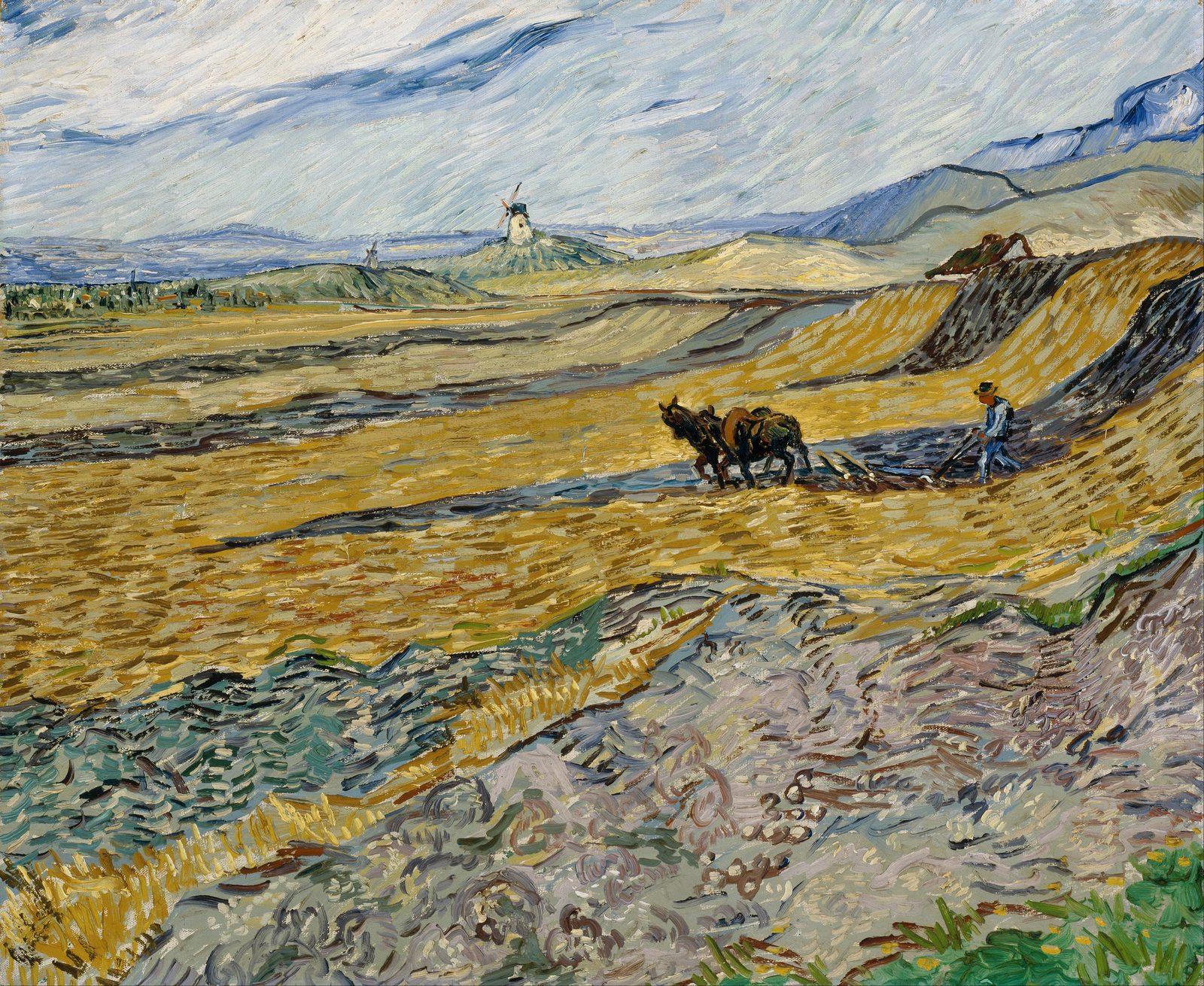
Vincent van Gogh, Enclosed Field with Ploughman, 1889. Public domain.
Isaiah 2 and Micah 4 · Passage · Featured Study
Swords into Plowshares: the Oracle Isaiah and Micah Share
Isaiah 2 and Micah 4 carry one promise of the LORD.
Then He will judge between the nations and arbitrate for many peoples. They will beat their swords into plowshares and their spears into pruning hooks. Nation will no longer take up the sword against nation, nor train anymore for war.
- The passage
- Isaiah 2:2 to 4, Micah 4:1 to 4, Joel 3:10
- Books
- Isaiah, Micah, Joel
- Hold in memory
- Isaiah 2:4
Readers still ask which of the two prophets wrote it first.
Summary
Isaiah and Micah both prophesied in the days of Jotham, Ahaz and Hezekiah, kings of Judah, and both give this oracle in their books. The two copies differ in five lines.
- Micah adds a man at rest under his own vine and fig tree.
- Joel turns the same words around and calls for plowshares beaten into swords.
- Readers divide over when the oracle comes to pass.
One Oracle in Two Books
Two prophets of Judah give the oracle in nearly the same words.
In the last days the mountain of the house of the LORD will be established as the chief of the mountains; it will be raised above the hills, and all nations will stream to it. And many peoples will come and say: “Come, let us go up to the mountain of the LORD, to the house of the God of Jacob. He will teach us His ways so that we may walk in His paths.” For the law will go forth from Zion, and the word of the LORD from Jerusalem.Isaiah's copy matches Micah's verse for verse.
In the last days the mountain of the house of the LORD will be established as the chief of the mountains; it will be raised above the hills, and the peoples will stream to it. And many nations will come and say: “Come, let us go up to the mountain of the LORD, to the house of the God of Jacob. He will teach us His ways, so that we may walk in His paths.” For the law will go forth from Zion and the word of the LORD from Jerusalem. Then He will judge between many peoples and arbitrate for strong nations far and wide. Then they will beat their swords into plowshares and their spears into pruning hooks. Nation will no longer take up the sword against nation, nor will they train anymore for war.Micah's copy carries the swords line as its third verse.
This is the message that was revealed to Isaiah son of Amoz concerning Judah and Jerusalem:Isaiah's own heading stands over words that Micah also gives.
Jamieson, Fausset and Brown, in their commentary on Micah 4, call the two passages almost identical.
Where the Two Copies Differ
Isaiah's copy and Micah's part ways in their wording of the nations and in their endings.
The swords and the plowshares stand in both copies.
| The line | Isaiah 2 | Micah 4 |
|---|---|---|
| Who streams to the mountain | all nations will stream to it | the peoples will stream to it |
| Who comes and says, Come | many peoples | many nations |
| Whom He judges | the nations ... many peoples | many peoples ... strong nations far and wide |
| After the swords | No line | each man will sit under his own vine and under his own fig tree |
| The last call | Come, O house of Jacob, let us walk in the light of the LORD | we will walk in the name of the LORD our God forever and ever |
Adam Clarke calls the vine and the fig tree a proverb of peace, safety and rural comfort, and he notes that this verse is added to the oracle as Isaiah gives it.
When It Comes to Pass
Readers set the fulfilment in three different times.
In the church since ChristJerome; Matthew Henry
Jerome, in his Commentary on Isaiah, saw the peace of the oracle in the years when Christ was born under Augustus and wars had ceased. He also read it of the heart, broken up by the plowshare of Christ so that the word of God may grow.
Matthew Henry reads the gospel that went out from Jerusalem as the means by which the church was set on the top of the mountains.
The objection: Henry himself records the Jewish answer, that the promise of peace is not fulfilled and so Jesus is not the Messiah.
In the days still to comeJamieson, Fausset and Brown
Jamieson, Fausset and Brown read the last days as the days of the Messiah, especially the days yet to come. In their reading the house of the God of Jacob at Jerusalem becomes the centre to which the converted nations gather.
The objection: Augustine, in The City of God, reads the law that goes out from Zion as the law Christ came to give, preached first in Jerusalem.
First in the return from exileJohn Wesley; Theodore of Mopsuestia
John Wesley, in his Explanatory Notes on Micah 4:1, places the last days first at the end of the seventy years of captivity. He calls that time a type of the days of the Messiah's kingdom. Theodore of Mopsuestia also read the oracle after the captivities of Assyria and Babylon.
The objection: Theodoret of Cyrus asks which nations rushed to the temple after it was rebuilt, and what law was given from there.
The War and Peace page sets out the readings on whether a Christian may bear the sword.
Where Each Book Sets It
Micah sets the oracle after a threat to Zion, and Isaiah sets it before a judgment on human pride.
Therefore, because of you, Zion will be plowed like a field, Jerusalem will become a heap of rubble, and the temple mount a wooded ridge.The elders of Jeremiah's day quote this verse word for word.
In Isaiah the call to walk in the light is followed at once by a charge against the house of Jacob.
The proud look of man will be humbled, and the loftiness of men brought low; the LORD alone will be exalted in that day.The charge against Jacob ends in this day of the LORD.
Voices on the Oracle
Athanasius of Alexandria cites the oracle in On the Incarnation of the Word.
Athanasius of Alexandria (296 to 373)
Athanasius of Alexandria reads Isaiah 2:4 as fulfilled in the peace Christ made between hostile peoples.
“Who is the one who has done this, or who is the one who has joined together in peace people who once hated one another, except for the beloved Son of the Father, the Savior of all, even Jesus Christ, who because of his own love suffered all things for our salvation? For from ages past the peace he would initiate was promised.”
Athanasius of Alexandria · On the Incarnation of the Word 52:1 · on Isaiah 2:4Patristic
Who Had the Oracle First?
Commentators hold three of the answers here, and the Pulpit Commentary on Micah calls the question one that cannot be settled.
Micah first, and Isaiah used his wordsKeil and Delitzsch; Hengstenberg
Keil and Delitzsch, on Micah 4, say that Franz Delitzsch gave the main arguments for Micah as the first writer, and they send the reader to Caspari's work on Micah for more. Albert Barnes reports that Hengstenberg supposed Isaiah copied from Micah. Ellicott, on Micah 4, reports that most opinion favours Micah as the first writer.
The objection: the Cambridge Bible notes that Micah's work began later than these chapters of Isaiah, so a borrowing would have to run from Isaiah to Micah.
Isaiah first, and Micah confirmed himJamieson, Fausset and Brown
Jamieson, Fausset and Brown hold that Isaiah began in Uzziah's reign and Micah in Jotham's. They write that Micah rests on Isaiah, whom he confirms, and that Hengstenberg made Micah the original on slight grounds.
The objection: Keil and Delitzsch, on Micah 4, call the originality of the passage in Micah open to no question.
Both used an older oracleThe Pulpit Commentary; the Cambridge Bible; Ewald and Hitzig; Ellicott on Isaiah
The Pulpit Commentary on Isaiah prefers the view that both prophets drew on an earlier document, and it names Rosenmüller, Maurer, De Wette, Meier and Cheyne as its holders. The Cambridge Bible says Koppe first put this view forward and that critics have widely accepted it. Keil and Delitzsch report that Ewald and Hitzig each came to it on their own and named Joel as the earlier prophet. Ellicott, on Isaiah 2:2, judges that this view has most to commend it.
The objection: the Cambridge Bible itself warns that a theory reached by ruling out the others cannot command much confidence. It notes a presumption for Isaiah, after Duhm.
Sources
Scripture is the Berean Standard Bible.
- Ellicott's Commentary for English Readers; Albert Barnes, Notes on the Bible; Jamieson, Fausset and Brown, Commentary (1871); the Cambridge Bible for Schools and Colleges; the Pulpit Commentary; Keil and Delitzsch, Biblical Commentary on the Old Testament; John Gill, Exposition; each on Isaiah 2:1 to 2 and Micah 4:1.
- Jamieson, Fausset and Brown, Commentary Critical and Explanatory on the Whole Bible (1871), on Isaiah 2:2 and Micah 4:1 to 3.
- Adam Clarke, Commentary on the Bible (1832), on Micah 4:4.
- Matthew Henry, Commentary on the Whole Bible (1710), on Isaiah 2:4 and Joel 3:9 to 11.
- Jerome, Commentary on Isaiah, on Isaiah 2:4.
- John Wesley, Explanatory Notes upon the Old Testament (1765), on Micah 4:1.
- Augustine of Hippo, The City of God 18.54.
- Theodore of Mopsuestia, Commentary on Micah 4:1 to 3; Theodoret of Cyrus, Commentary on Isaiah 2.
- Athanasius of Alexandria, On the Incarnation of the Word 52.
Keep Studying
Read it5
Studies4
Symbols2
Doctrines1