
Psalms 137:1
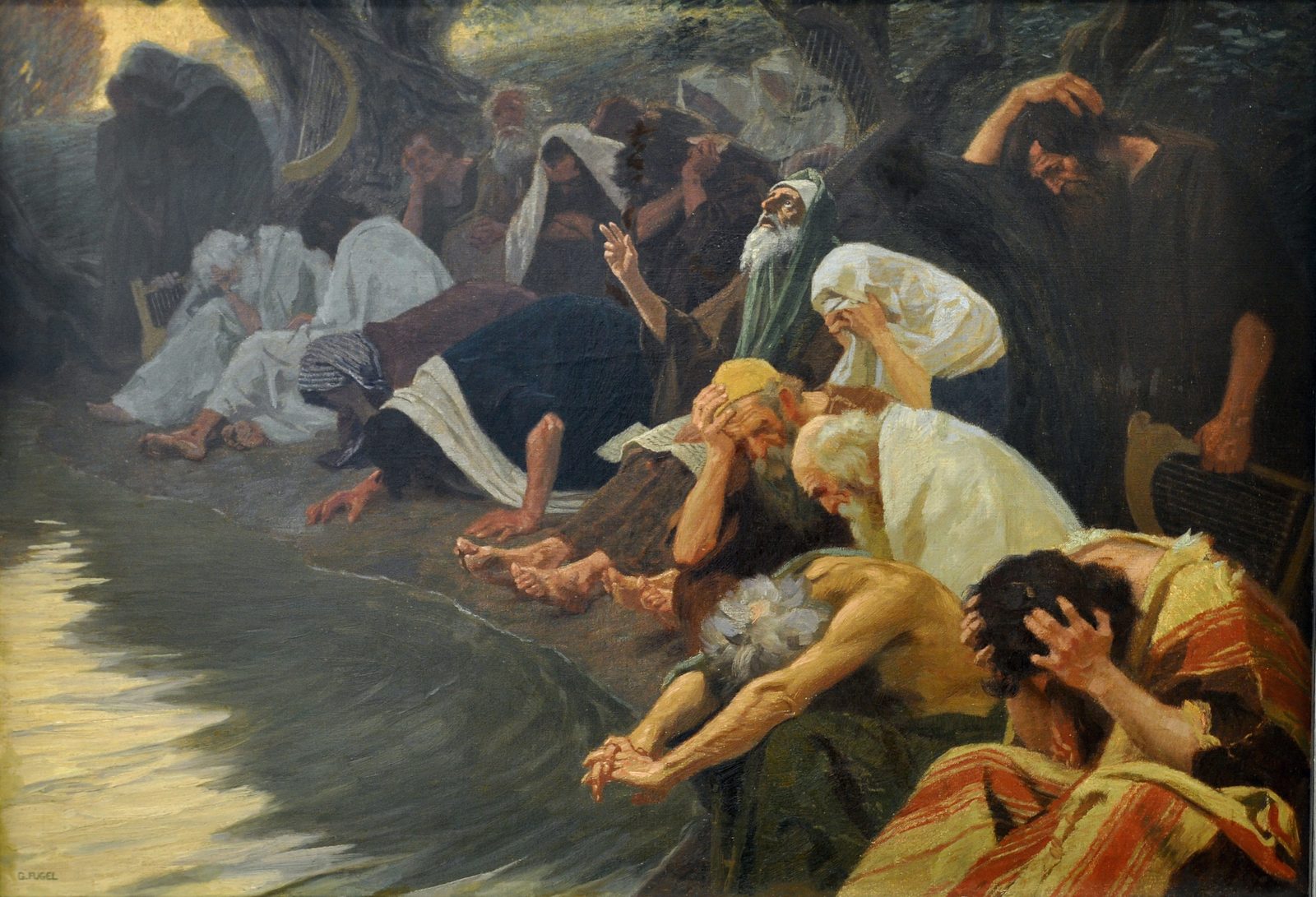
in Psalms 137By the rivers of Babylon we sat and wept when we remembered Zion.
BSB
The same verse in ASV and KJV ▾
ASV
By the rivers of Babylon, There we sat down, yea, we wept, When we remembered Zion.
KJV
By the rivers of Babylon, there we sat down, yea, we wept, when we remembered Zion.
⋯
This verse in Psalms 137
Commentary
9 notes on this verseBy the rivers of Babylon, there we sat down and wept, when we remembered Sion. If someone is not sick, he does not know how much health is worth. And again, a lame man does not know how much he is worth who is sound of foot. Likewise the blind man does not know the one who sees. All this has been said because the psalm says: "By the rivers of Babylon, there we sat down and wept, when we remembered Sion." Babylon is interpreted as "confusion": therefore Babylon is this world.
This site's exposition
By the rivers of Babylon
on Psalms 137:1-2
Exiles sat down by the rivers of Babylon and wept when they remembered Zion. There, at that same water, they hung their harps up in the willows. The instruments of praise were put away unplayed.
The record, by era
The Church Fathers2 voices
A commentator
Methodius of OlympusSYMPOSIUM OR THE BANQUET OF THE TEN VIRGINS 3:3 · Written before 311.
proposed
But not to pass away from our subject, come, let us take in our hands and examine this psalm, which the pure and stainless souls sing to God, saying: "By the rivers of Babylon there we sat down; yea, we wept, when we remembered Zion. We hanged our harps upon the willows in the midst thereof," clearly giving the name of harps to their bodies which they hung upon the branches of chastity, fastening them to the wood that they might not be snatched away and dragged along again by the stream of incontinence. For Babylon, which is interpreted "disturbance" or "confusion," signifies this life around which the water flows, while we sit in the midst of which the water flows round us, as long as we are in the world, the rivers of evil always beating upon us. Wherefore, also, we are always fearful, and we groan and cry with weeping to God, that our harps may not be snatched off by the waves of pleasure, and slip down from the tree of chastity.
Observe "the waters of Babylon." "The waters of Babylon" are all things which here are loved, and pass away. ...But then other citizens of the holy Jerusalem, understanding their captivity, mark how the natural wishes and the various lusts of men hurry and drag them hither and thither, and drive them into the sea; they see this, and they throw not themselves into the waters of Babylon, but "sit down and weep," either for those who are being carried away by them, or themselves whose deserts have placed them in Babylon, but sitting, that is, humbling themselves. O holy Sion, where all stands firm and nothing flows! Who hath thrown us headlong into this? Why have we left thy Founder and thy society? Behold, placed where all things are flowing and gliding away, scarce one, if he can grasp the tree, shall be snatched from the stream and escape. Humbling ourselves then in our captivity, let us "sit by the waters of Babylon," let us not dare to plunge ourselves in those streams, nor to be proud and lifted up in the evil and sadness of our captivity, but let us sit, and so weep. Let us sit "by" the waters, not beneath the waters, of Babylon; such be our humility, that it overwhelm us not. Sit "by" the waters, not "in" the waters, not "under" the waters; but yet sit, in humble fashion, talk not as thou wouldest in Jerusalem. ...For many weep with the weeping of Babylon, because they rejoice also with the joy of Babylon. When men rejoice at gains and weep at losses, both are of Babylon. Thou oughtest to weep, but in the remembrance of Sion. If thou weepest in the remembrance of Sion, thou oughtest to weep even when it is well with thee in Babylon.
The Puritans and the Awakening1 voice
By the rivers of Babylon, there we sat down,....
The Nineteenth Century2 voices
By the rivers of Babylon, there we sat down. Water courses were abundant in Babylon, wherein were not only natural streams but artificial canals: it was place of broad rivers and streams. Glad to be away from the noisy streets, the captives sought the river side, where the flow of the waters seemed to be in sympathy with their tears. It was some slight comfort to be out of the crowd, and to have a little breathing room, and therefore they sat down, as if to rest a while and solace themselves in their sorrow.
By the rivers of Babylon, there we sat down. Water courses were abundant in Babylon, wherein were not only natural streams but artificial canals: it was place of broad rivers and streams. Glad to be away from the noisy streets, the captives sought the river side, where the flow of the waters seemed to be in sympathy with their tears. It was some slight comfort to be out of the crowd, and to have a little breathing room, and therefore they sat down, as if to rest a while and solace themselves in their sorrow. In little groups they sat down and made common lamentation, mingling their memories and their tears. The rivers were well enough, but, alas, they were the rivers of Babylon, and the ground whereon the sons of Israel sat was foreign soil, and therefore they wept. Those who came to interrupt their quiet were citizens of the destroying city, and their company was not desired. Everything reminded Israel of her banishment from the holy city, her servitude beneath the shadow of the temple of Bel, her helplessness under a cruel enemy; and therefore her sons and daughters sat down in sorrow, Yea, we wept, when we remembered Zion. Nothing else could have subdued their brave spirits; but the remembrance of the temple of their God, the palace of their king, and the centre of their national life, quite broke them down. Destruction had swept down all their delights, and therefore they wept—the strong men wept, the sweet singers wept! They did not weep when they remembered the cruelties of Babylon; the memory of fierce oppression dried their tears and made their hearts burn with wrath: but when the beloved city of their solemnities came into their minds they could not refrain from floods of tears. Even thus do true believers mourn when they see the church despoiled, and find themselves unable to succour her: we could bear anything better than this.
2 more voices on this verse
The Nineteenth Century2 voices
By the rivers of Babylon - These might have been the Tigris and Euphrates, or their branches, or streams that flowed into them. In their captivity and dispersion, it was customary for the Jews to hold their religious meetings on the banks of rivers. Mention is made of this Act 16:13, where we find the Jews of Philippi resorting to a river side, where prayer was wont to be made. And sometimes they built their synagogues here, when they were expelled from the cities.
A commentator
Albert Barnes1798–1870
Notes, Explanatory and Practical, on the Old and New Testaments (1832-1869)
proposed
By the rivers of Babylon - The streams, the water-courses, the rivulets. There was properly only one river flowing through Babylon - the Euphrates; but the city was watered, as Damascus now is, by means of canals or water-courses cut from the main river, and conveying the water to different parts of the city. For a description of Babylon, see the introductory notes to Isa. 13. If the reference here is to Babylon proper, or the city, the allusion would be to the Euphrates flowing through it; if to Babylonia, the allusion would be to the Euphrates, and the other rivers which watered the country, as the Tigris, the Chaboras, and the Ulai. As it is most probable that the captive Hebrews were not scattered through the empire, but were concentrated in one or a few places, it is, perhaps, not improper to understand this of Babylon itself. There we sat down - There we were sitting. Perhaps a little company of friends; perhaps those assembled for worship; perhaps those who happened to come together on some special occasion; or, perhaps, a poetic representation of the general condition of the Hebrew captives, as sitting and meditating on the desolations of their native land. Yea, we wept - We sat there; we meditated; we wept. Our emotions overpowered us, and we poured forth tears. So now, there is a place in Jerusalem, at the southwest corner of the area on which the temple was built, where the Jews resort on set occasions to weep over the ruins of their city and nation. When we remembered Zion - When we thought on our native land; its former glory; the wrongs done to it; the desolations there; when we thought of the temple in ruins, and our homes as devastated; when we thought of the happy days which we had spent there, and when we contrasted them with our condition now.
How the passage was read
What the Jewish commentators add
By the rivers of Babylon, there we sat when we went down into exile, and Nebuchadnezzar asked them to sing for him as they used to sing on the stage.
This section is reception history: how the passage was read and kept in the Jewish tradition. Where a reading parts from an essential of the Christian faith, the section says so at that point.
Texts and citation data: Sefaria; each excerpt follows its version’s licence. 5 further sources are cited on this chapter that carry no English text this site may quote or only restate the verse.
The words behind it
10 Hebrew wordsEvery Hebrew word of this verse in the order it stands, with what it means and the door to its own study. The last column counts the times a word stands in the whole Bible: the rarer the word, the more the places it appears belong together.
| Hebrew | Sound | Meaning | Word study | In the Bible |
|---|---|---|---|---|
| עַ֥ל | ʾal | at | H5921 → | 5755 times |
| נַהֲר֨וֹת׀ | naharot | [the] rivers of | H5104 → | 119 times |
| בָּבֶ֗ל | bavel | Babylon | H894 → | 262 times |
| שָׁ֣ם | sham | there | H8033 → | 834 times |
| יָ֭שַׁבְנוּ | yashavnu | we sat | H3427 → | 1079 times |
| גַּם־ | gam- | also | H1571 → | 769 times |
| בָּכִ֑ינוּ | bakhinu | we wept | H1058 → | 114 times |
| בְּ֝זָכְרֵ֗נוּ | bezakherenu | when remembered we | H2142 → | 230 times |
| אֶת־ | ʾet- | <obj.> | H853 → | 10935 times |
| צִיּֽוֹן׃ | tziyon | Zion | H6726 → | 154 times |
עַ֥לat
ʾalH5921 →5755 times
נַהֲר֨וֹת׀[the] rivers of
naharotH5104 →119 times
בָּבֶ֗לBabylon
bavelH894 →262 times
שָׁ֣םthere
shamH8033 →834 times
יָ֭שַׁבְנוּwe sat
yashavnuH3427 →1079 times
גַּם־also
gam-H1571 →769 times
בָּכִ֑ינוּwe wept
bakhinuH1058 →114 times
בְּ֝זָכְרֵ֗נוּwhen remembered we
bezakherenuH2142 →230 times
אֶת־<obj.>
ʾet-H853 →10935 times
צִיּֽוֹן׃Zion
tziyonH6726 →154 times
A shaded row is a word that stands 400 times or fewer in the Bible.
The walk
8 stopsEach card is a verse this one points to, and under it the verses that one points to in turn. Where several paths arrive at the same place, that place is listed first: the text keeps returning to it.
Through
Ezekiel 1:1In the thirtieth year, on the fifth day of the fourth month, while I was among the exiles by the River Kebar, the heavens opened and I saw visions of God.
it leads to
- Ezekiel 11:24
And the Spirit lifted me up and carried me back to Chaldea, to the exiles in the vision given by the Spirit of God. After the vision had gone up from me,
- Revelation 19:11
Then I saw heaven standing open, and there before me was a white horse. And its rider is called Faithful and True. With righteousness He judges and wages war.
- Matthew 3:16
As soon as Jesus was baptized, He went up out of the water. Suddenly the heavens were opened, and He saw the Spirit of God descending like a dove and resting on Him.
- Acts 7:56
“Look,” he said, “I see heaven open and the Son of Man standing at the right hand of God.”
- Ezekiel 10:20
These were the living creatures I had seen beneath the God of Israel by the River Kebar, and I knew that they were cherubim.
- Ezekiel 11:24
Through
Ezekiel 1:3the word of the LORD came directly to Ezekiel the priest, the son of Buzi, in the land of the Chaldeans by the River Kebar. And there the LORD’s hand was upon him.
it leads to
- Ezekiel 3:22
And there the hand of the LORD was upon me, and He said to me, “Get up, go out to the plain, and there I will speak with you.”
- Ezekiel 3:14
So the Spirit lifted me up and took me away, and I went in bitterness and in the anger of my spirit, with the strong hand of the LORD upon me.
- Ezekiel 3:22
Through
Ezekiel 3:15I came to the exiles at Tel-abib who dwelt by the River Kebar. And for seven days I sat where they sat and remained there among them, overwhelmed.
it leads to
- Job 2:13
Then they sat on the ground with him for seven days and seven nights, but no one spoke a word to him because they saw how intense his suffering was.
- Job 2:13
Where this verse is studied
On this page
Studies2
On this verse
On this chapter
About Psalms
Who and where
2 names in this verse with a page on the site.
- PlaceBabil Governorate (archaeological site)BabylonAncient Mesopotamian city and imperial capital; site of the Israelite exile and a recurring biblical symbol of worldly power.
- PlaceJerusalemZionThe eastern ridge David took from the Jebusites and made his stronghold, the name the Psalms and the prophets give the city the LO…
This page draws on 9 works. Open the list of works
This page draws on Adam Clarke, Commentary on the Bible; Albert Barnes, Notes on the Book of Psalms; Albert Barnes, Notes, Explanatory and Practical, on the Old and New Testaments (1832-1869); Augustine of Hippo, Exposition on Psalm 137; Charles Spurgeon, The Treasury of David, Vol. 7; Jerome, Homily 48, on Psalm 136; John Gill, Exposition of the Old Testament (1748-1763); Matthew Henry, Commentary on the Whole Bible and Methodius of Olympus, SYMPOSIUM OR THE BANQUET OF THE TEN VIRGINS 3:3.