
Ephesians 4:11
in Ephesians 4And it was He who gave some to be apostles, some to be prophets, some to be evangelists, and some to be pastors and teachers,
BSB
The same verse in ASV and KJV ▾
ASV
And he gave some to be apostles; and some, prophets; and some, evangelists; and some, pastors and teachers;
KJV
And he gave some, apostles; and some, prophets; and some, evangelists; and some, pastors and teachers;
⋯
This verse in Ephesians 4
Commentary
20 notes on this verseFrom this passage Paul clearly confirms the divinity of the Father and Son. What Christ is here said to have bestowed [as in his first letter to the Corinthians] is nothing less than the gift of God. … Failing to understand this, Sabellius confused the Father and the Son, not grasping that, though distinguishable, they work together with single intent.
This site's exposition
he gave some, apostles; and some, prophets; and some, evangelists; and some, pastors and teachers
He gave some, apostles; and some, prophets names Christ's own continuing provision to his church, given toward the goal of verse thirteen that has not yet arrived, till we all come in the unity of the faith. Pastors and teachers share a single Greek article covering both nouns, which many read as one office named two ways rather than two separate offices, distinct from the apostles, prophets and evangelists listed before them. The gifts are Christ's own gifts to his body and the letter gives no word of their expiring; the exposition follows the site's own standing posture that apostles and prophets continue among Christ's provisions rather than having ceased.
The record, by era
The Church Fathers5 voices
Such are the preparatory exercises of gnostic discipline. And since the omnipotent God Himself "gave some apostles, and some prophets, and some evangelists, and some pastors and teachers, for the perfecting of the saints, for the work of the ministry, for the edifying of the body of Christ, till we all attain to the unity of the faith, and of the knowledge of the Son of God, to a perfect man, to the measure of the stature of the fulness of Christ;" we are then to strive to reach manhood as befits the Gnostic, and to be as perfect as we can while still abiding in the flesh, making it our study with perfect concord here to concur with the will of God, to the restoration of what is the truly perfect nobleness and relationship, to the fulness of Christ, that which perfectly depends on our perfection.
Apostles are bishops, while prophets are interpreters of the Scriptures.… Even if they are not elders they can nonetheless preach the gospel without a chair, as Stephen and Philip are recorded to have done. Shepherds may be readers, who nourish the people who hear them …
So long, however, as its form exists in its proper order, you may seek and discuss as much as you please, and give full rein to your curiosity, in whatever seems to you to hang in doubt, or to be shrouded in obscurity. You have at hand, no doubt, some learned brother gifted with the grace of knowledge, some one of the experienced class, some one of your close acquaintance who is curious like yourself; although with yourself, a seeker he will, after all, be quite aware that it is better for you to remain in ignorance, lest you should come to know what you ought not, because you have acquired the knowledge of what you ought to know.
The name prophets is given to those who, having received the Spirit of God, spoke beforehand of Christ and his advent. These were the prophets who "were until Christ." But after he arrived, was there no reason for any further prophecy? What prophets does Paul …
A commentator
Gaius Marius VictorinusEPISTLE TO THE EPHESIANS 2.4.11-12 · Written before 370.
proposed
There are five ways of speaking about the Scriptures: speaking in tongues, speaking in revelation, speaking in knowledge, speaking in prophecy, speaking in teaching.… But there is another thing apart from these. It is being an evangelist. This means to relate what Christ did and …
13 more voices on this verse
The Church Fathers4 voices
It is not to be supposed that as with the first three … he has allotted different offices to shepherds and teachers. For he does not say "some shepherds, some teachers" but "some shepherds and teachers," meaning that he who is a shepherd should at the same time be a teacher. No one in the church, even a saintly person, should take to himself the name of shepherd unless he can teach those whom he feeds.
But the mysteries are delivered mystically, that what is spoken may be in the mouth of the speaker; rather not in his voice, but in his understanding. "God gave to the Church, some apostles, and some prophets, and some evangelists, and some pastors and teachers, for the perfecting of the saints, for the work of the ministry, for the edifying of the body of Christ."
This is a house set up and ordered by Jesus.… He does not do this in a casual manner. It is with the utmost discrimination and discretion: One is assigned to the rank of an apostle, one to the place of a prophet, others to …
What he said elsewhere, "Wherefore also God hath highly exalted Him," that saith he also here. "He that descended, is the same also that ascended." It did Him no injury that He came down into the lower parts of the earth, nor was it any hindrance to His becoming far higher than the Heavens. So that the more a man is humbled, so much the more is he exalted. For as in the case of water, the more a man presses it downwards, the more he forces it up; and the further a man retires to hurl a javelin, the surer his aim; so is it also with humility. However, when we speak of ascents with reference to God, we must needs conceive a descent first; but when with reference to man, not at all so. Then he goes on to show further His providential care, and His wisdom, for He who hath wrought such things as these, who had such might, and who refused not to go down even to those lower parts for our sakes, never would He have made these distributions of spiritual gifts without a purpose. Now elsewhere he tells us that this was the work of the Spirit, in the words, "In the which the Holy Ghost hath made you bishops to feed the Church of God." And here he saith that it is the Son; and elsewhere that it is God. "And He gave to the Church some apostles, and some prophets." But in the Epistle to the Corinthians, he saith, "I planted, Apollos watered; but God gave the increase." And again, "Now he that planteth and he that watereth are one: but each shall receive his own reward according to his own labor." So is it also here; for what if thou bring in but little? Thou hast received so much. […]
The Medieval Church2 voices
And it is significant that he said: "He." For He Who so cared for us and Who for our sake did not refuse to descend even to the lowest limits, did not simply distribute the gifts, but undoubtedly with wisdom and benefit. How then do …
Here the Apostle expounds what was mentioned earlier (4:9) about the bestowal of gifts. The many different states and functions in the Church are designated as the gifts of Christ. Consider how, among the gifts of Christ, the Apostles are conceded the first place: And …
The Puritans and the Awakening2 voices
And he gave some apostles,....
Which is taken from Christ's great end and design in giving gifts unto men. The gifts of Christ were intended for the good of his church, and in order to advance his kingdom and interest among men. All these being designed for one common end is a good reason why all Christians should agree in brotherly love, and not envy one another's gifts.
The Nineteenth Century5 voices
A commentator
Albert Barnes1798–1870
Notes, Explanatory and Practical, on the Old and New Testaments (1832-1869)
And he gave some, apostles - He gave some to be apostles. The “object” here is to show that he has made ample provision for the extension and edification of his church On the meaning of the word “apostles,” and on their appointment by the Saviour, see the notes on Mat 10:1. And some, prophets - He appointed some to be prophets; see the Rom 12:7, note; 1Co 12:28, note; 1Co 14:1, notes. And some, evangelists - see the notes on Act 21:8; compare 2Ti 4:5. The word does not elsewhere occur in the New Testament.
A commentator
Jamieson, Fausset & Brown1802–1910
Commentary Critical and Explanatory on the Whole Bible (1871)
proposed
The term, "shepherd" or "pastor," is used of guiding and governing and not merely instructing, whence it is applied to kings, rather than prophets or priests (Eze 34:23; Compare the names of princes compounded of "pharnas," Hebrew, "pastor," Holophernes, Tis-saphernes (compare Isa 44:28).
quarantine:debris (2026-07-29) — unbalanced-parens
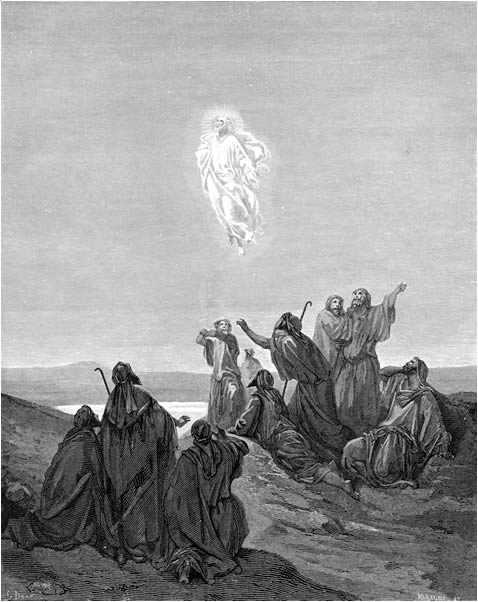
OUR blessed Lord and Master has gone from us. From the mount of Olives, the place where in dread conflict his garments were rolled in blood, he has mounted in triumph to his throne. After having shown himself for forty days amongst his beloved disciples, giving them abundant evidence that he had really risen from the dead, and enriching them by his divine counsels, he was taken up. Slowly rising before them all, he gave them his blessing as he disappeared.
OUR blessed Lord and Master has gone from us. From the mount of Olives, the place where in dread conflict his garments were rolled in blood, he has mounted in triumph to his throne. After having shown himself for forty days amongst his beloved disciples, giving them abundant evidence that he had really risen from the dead, and enriching them by his divine counsels, he was taken up. Slowly rising before them all, he gave them his blessing as he disappeared. Like good old Jacob, whose departing act was to bestow a benediction on his twelve sons and their descendants, so ere the cloud received our Lord out of our sight, he poured a blessing upon the apostles, who were looking upward, and who were the representatives of his church. He is gone! His voice of wisdom is silent for us, his seat at the table is empty, the congregation on the mountain hears him no more. It would be very easy to have found reasons why he should not have gone. Had it been a matter of choice to us, we should have entreated him to tarry with us till the dispensation closed. Unless, peradventure, grace had enabled us to say: “Not as we will! but as thou wilt,” we should have constrained him, saying, “Abide with us.” What a comfort to disciples to have their own beloved teacher visibly with them! What a consolation to a persecuted band to see their leader at their head; difficulties would disappear, problems would be solved, perplexities removed, trials made easy, temptations averted! Let Jesus himself, their own dear Shepherd be near, and the sheep will lie down in security. Had he been here we could have gone to him in every affliction, like those of whom it is said, “they went and told Jesus.” It seemed expedient for him to stay, to accomplish the conversion of the world.
He gave some, apostles - He established several offices in his Church; furnished these with the proper officers; and, to qualify them for their work, gave them the proper gifts. For a full illustration of this verse, the reader is requested to refer to the notes on 1Co 12:6-10 (note), 1Co 12:28-30 (note); and to the concluding observations at the end of that chapter.
The words behind it
17 Greek wordsEvery Greek word of this verse in the order it stands, with what it means and the door to its own study. The last column counts the times a word stands in the whole Bible: the rarer the word, the more the places it appears belong together.
| Greek | Sound | Meaning | Word study | In the Bible |
|---|---|---|---|---|
| καὶ | kai | And | G2532 → | 9120 times |
| αὐτὸς | autos | He himself | G846 → | 5565 times |
| ἔδωκεν | edoken | gave | G1325 → | 412 times |
| τοὺς | tous | some | G3588 → | 19766 times |
| μὲν | men | indeed | G3303 → | |
| ἀποστόλους, | apostolous | [to be] apostles, | G652 → | 79 times |
| τοὺς | tous | some | G3588 → | 19766 times |
| δὲ | de | however | G1161 → | 2765 times |
| προφήτας, | prophetas | prophets, | G4396 → | 144 times |
| τοὺς | tous | some | G3588 → | 19766 times |
| δὲ | de | however | G1161 → | 2765 times |
| εὐαγγελιστάς, | euangelistas | evangelists, | G2099 → | |
| τοὺς | tous | some | G3588 → | 19766 times |
| δὲ | de | however | G1161 → | 2765 times |
| ποιμένας | poimenas | shepherds | G4166 → | |
| καὶ | kai | and | G2532 → | 9120 times |
| διδασκάλους, | didaskalous | teachers, | G1320 → |
καὶAnd
kaiG2532 →9120 times
αὐτὸςHe himself
autosG846 →5565 times
ἔδωκενgave
edokenG1325 →412 times
τοὺςsome
tousG3588 →19766 times
μὲνindeed
menG3303 →
ἀποστόλους,[to be] apostles,
apostolousG652 →79 times
τοὺςsome
tousG3588 →19766 times
δὲhowever
deG1161 →2765 times
προφήτας,prophets,
prophetasG4396 →144 times
τοὺςsome
tousG3588 →19766 times
δὲhowever
deG1161 →2765 times
εὐαγγελιστάς,evangelists,
euangelistasG2099 →
τοὺςsome
tousG3588 →19766 times
δὲhowever
deG1161 →2765 times
ποιμέναςshepherds
poimenasG4166 →
καὶand
kaiG2532 →9120 times
διδασκάλους,teachers,
didaskalousG1320 →
A shaded row is a word that stands 400 times or fewer in the Bible.
The walk
8 stopsEach card is a verse this one points to, and under it the verses that one points to in turn. Where several paths arrive at the same place, that place is listed first: the text keeps returning to it.
Through
Jeremiah 3:15Then I will give you shepherds after My own heart, who will feed you with knowledge and understanding.”
it leads to
- Jeremiah 23:4
I will raise up shepherds over them who will tend them, and they will no longer be afraid or dismayed, nor will any go missing, declares the LORD.
- Acts 20:28
Keep watch over yourselves and the entire flock of which the Holy Spirit has made you overseers. Be shepherds of the church of God, which He purchased with His own blood.
- Ephesians 4:11–12
And it was He who gave some to be apostles, some to be prophets, some to be evangelists, and some to be pastors and teachers,
- Ezekiel 34:23
I will appoint over them one shepherd, My servant David, and he will feed them. He will feed them and be their shepherd.
- Jeremiah 23:4
Through
Acts 20:28Keep watch over yourselves and the entire flock of which the Holy Spirit has made you overseers. Be shepherds of the church of God, which He purchased with His own blood.
it leads to
- 1 Peter 5:2–3
Be shepherds of God’s flock that is among you, watching over them not out of compulsion, but because it is God’s will; not out of greed, but out of eagerness;
- 1 Timothy 4:16
Pay close attention to your life and to your teaching. Persevere in these things, for by so doing you will save both yourself and those who hear you.
- 1 Peter 1:18–19
For you know that it was not with perishable things such as silver or gold that you were redeemed from the empty way of life you inherited from your forefathers,
- 1 Peter 5:2–3
Through
Ephesians 2:20built on the foundation of the apostles and prophets, with Christ Jesus Himself as the cornerstone.
it leads to
- 1 Peter 2:4–5
As you come to Him, the living stone, rejected by men but chosen and precious in God’s sight,
- 1 Peter 2:4–5
Where this verse is studied
About Ephesians
This page draws on 19 works. Open the list of works
This page draws on Adam Clarke, Commentary on the Bible; Albert Barnes, Notes, Explanatory and Practical, on the Old and New Testaments (1832-1869); Ambrosiaster, EPISTLE TO THE EPHESIANS 4.12.1-2; Charles Spurgeon, The Metropolitan Tabernacle Pulpit, Sermon No. 982: “The Ascension of Christ” (lightly modernized text, CCEL edition); Clement of Alexandria, The Stromata Book 4; Clement of Alexandria, The Stromata Book 1; Didymus the Blind, ON ZECHARIAH 1.228; Gaius Marius Victorinus, EPISTLE TO THE EPHESIANS 2.4.11; Gaius Marius Victorinus, EPISTLE TO THE EPHESIANS 2.4.11-12; Jamieson, Fausset & Brown, Commentary Critical and Explanatory on the Whole Bible; Jerome, Commentary on Ephesians 4:11-12; John Chrysostom, Homily on Ephesians 11; John Gill, Exposition of the New Testament; John Gill, Exposition of the New Testament (1746-1748); John Wesley, Explanatory Notes upon the New Testament; Matthew Henry, Commentary on the Whole Bible; Tertullian, The Prescription Against Heretics; Theophylact of Ohrid, Commentary on Ephesians and Thomas Aquinas, Commentary on Ephesians.