
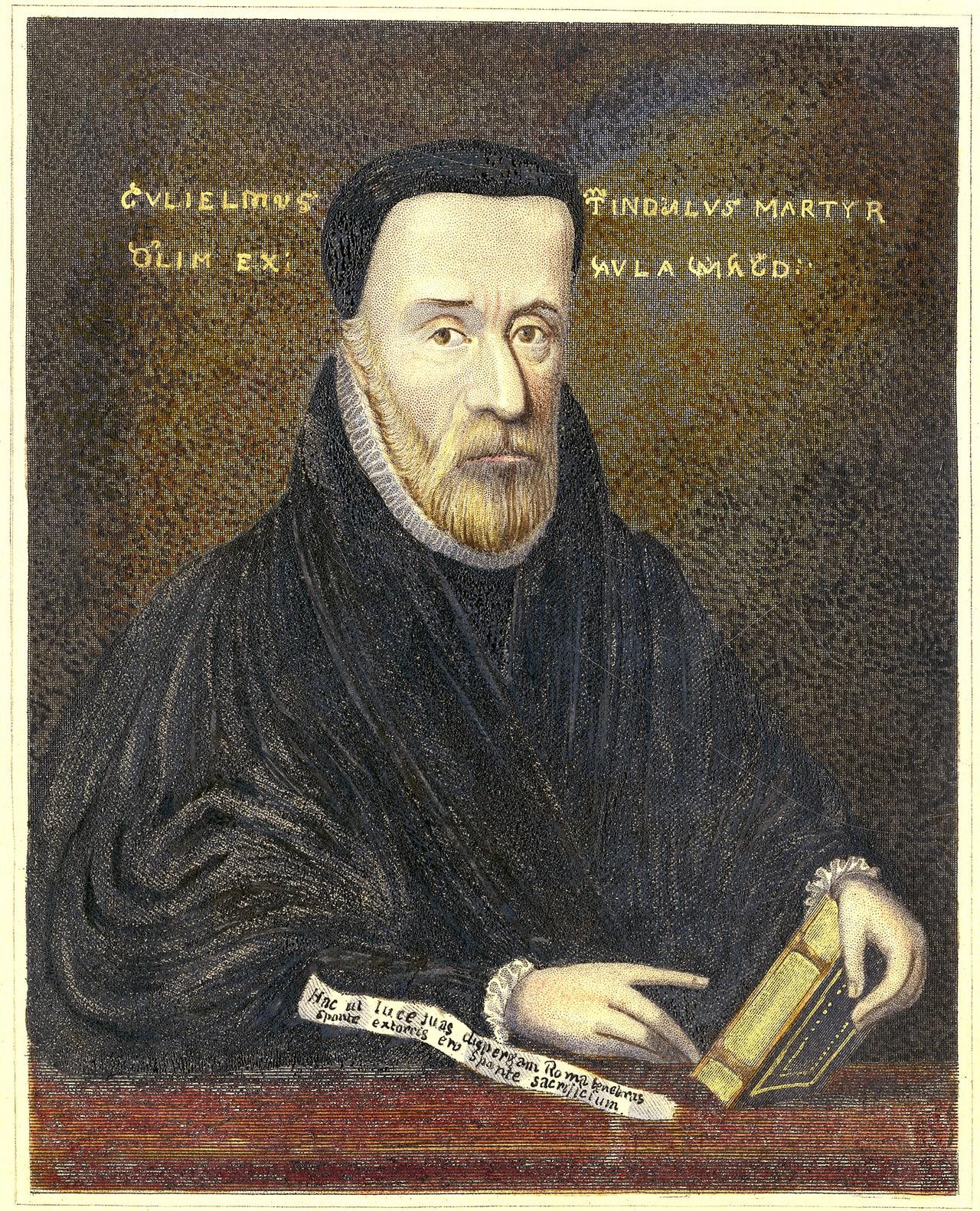
Portrait of William Tyndale, Unknown author, 1836. Public domain.
England and the Low Countries, to 1536 · Person · Featured Study
William Tyndale
He translated the New Testament into English from the Greek, and he died at Vilvoorde in 1536.
Refused a room in London, he finished his translation in exile.
How is it then that each of us hears them in his own native language?
- Born
- about 1494 in Gloucestershire; Demaus heads his early life from 1484 (proposed)
- Died
- 1536 at Vilvoorde; Demaus gives 6 October
- Places
- Little Sodbury, London, Cologne, Worms, Antwerp, Vilvoorde
Summary
William Tyndale was an English scholar. He put the New Testament into English and printed it at Worms in 1526. Copies were carried into England in secret and burned there. He was taken at Antwerp in 1535, held in the castle of Vilvoorde and put to death there.
- His Pentateuch and his New Testament fed the English Bibles that followed him.
- Sir Thomas More charged that he mistranslated priest, church and charity, and Tyndale answered him in print.
- Foxe alone reports his last words, and no eyewitness record of his death survives.
The Scripture in the Mother Tongue
Acts 2 and 1 Corinthians 14 speak of words a hearer can understand.
William Tyndale gave his reason for putting the Scripture into English in the preface to his Pentateuch of 1530. There he says the lay people could be established in no truth unless the Scripture stood before their eyes in their mother tongue.
The question of this life is what one man's translation did and how much of the story rests on one witness. John Foxe tells most of it, and Robert Demaus tested Foxe against the records in his biography.
But in the church, I would rather speak five coherent words to instruct others than ten thousand words in a tongue.Tyndale held that words a reader cannot follow instruct no one.
The Life in Order
The university record, his printers and the Brussels accounts fix the dates that can be fixed.
His years of printing and hiding fill the last eleven years of the life.
- 26 June 1515Oxford licensed him in arts as William HychynsThe Oxford register, in Demaus
- About 1521 to 1523He lived at Little Sodbury in the house of Sir John WalshFoxe; Demaus
- 1523 and 1524He sought a place with the bishop of London and found noneTyndale, preface to the Pentateuch
- 1525Cochlaeus had the Cologne quarto haltedCochlaeus, translated in Demaus
- 1526The Worms New Testament reached England from the springDemaus
- 1526Tunstall preached against it at Paul's Cross and burned itDemaus
- 1530His translation of the Pentateuch appearedTyndale, Doctrinal Treatises
- 1531He answered Sir Thomas More in printTyndale, Answer
- May 1535Henry Phillips betrayed him at AntwerpFoxe; Demaus's reckoning
- 1536He was strangled and burned at VilvoordeFoxe
Each step of the life stands with its witness.
1530, 1531, May 1535, 1536
From Little Sodbury to Vilvoorde
Foxe gives the arguments and the death, and Tyndale's own prefaces give his reasons.
Foxe says he was born about the borders of Wales and brought up at Oxford. As tutor in the house of Sir John Walsh at Little Sodbury in Gloucestershire he argued with the clergy who came to the table.
By Foxe's report, one divine said he would rather be without God's laws than the pope's. Tyndale answered, "I defy the pope, and all his laws." He added that if God spared him, a boy at the plough would know more of the Scripture than the divine did.
William Tyndale asked permission to translate the New Testament into English and was refused, so he left England and did it anyway. He worked from Erasmus's Greek text rather than the Latin, a first for English.
Cochlaeus found the first printing in the press at Cologne in 1525 and had it stopped at sheet K. Tyndale carried the sheets up the Rhine to Worms and finished there.
Printed at Worms in 1526, his New Testaments were smuggled into England concealed under other goods and burned by the bishop of London as fast as they were found.
Sir Thomas More charged in 1529 that he had mistranslated three words of great weight, and Tyndale answered in 1531. Between those years he printed the Pentateuch.
Henry Phillips made himself Tyndale's friend at the house of Thomas Poyntz in Antwerp. Foxe says Tyndale "had a great confidence in him" and showed him his books. Phillips led him out of the house to the officers who took him.
Betrayed by a friend at Antwerp, Tyndale was imprisoned for sixteen months and then executed, strangled at the stake and burned. Foxe reports that he cried out, "Lord! open the king of England's eyes."
Within three years the king had licensed an English Bible built largely on Tyndale's work.
The Words He Chose
More and Tyndale argued over what four Greek words should be in English.
Each dispute turned on who held office in the church.
| Greek | Tyndale's English | More's word |
|---|---|---|
| ekklesia, an assembly | congregation | church |
| presbyteros, an elder | senior or elder | priest |
| agape, love | love | charity |
| metanoia, repentance | repentance | penance |
Tyndale wrote that the clergy had taken the word church to themselves, so "where I found this word ecclesia, I interpreted it by this word congregation."
More's charge stands in his Dialogue of 1529. Tyndale's Answer of 1531 replies to it, and the Parker Society printed the Answer with More's words beside it in 1850.
In Their Own Words
Four passages stand in his own writing, and two sayings stand on Foxe's report.
William Tyndale (1494 to 1536)
The preface to the translation of the Pentateuch, Doctrinal Treatises, Biographical Notice, p. xx
Why he translated
“how that it was impossible to establish the lay-people in any truth, except the scripture were plainly laid before their eyes in their mother tongue, that they might see the process, order, and meaning of the text.”
Reformation translator
About this saying1 paragraph
He wrote this in the preface to his Pentateuch in 1530, looking back on Gloucestershire.
William Tyndale
The preface to the translation of the Pentateuch, Doctrinal Treatises, Biographical Notice, p. xxii
The bishop's palace
“not only that there was no room in my lord of London's palace to translate the new Testament, but also that there was no place to do it in all England, as experience doth now openly declare.”
Reformation translator
About this saying1 paragraph
In the same preface he told what he learned in London about 1524.
William Tyndale
The prologue to the New Testament of 1525, Doctrinal Treatises, p. 7, in the note
He asked to be corrected
“if they perceive in any places that I have not attained the very sense of the tongue, or meaning of the scripture, or have not given the right English word, that they put to their hands to amend it, remembering that so is their duty to do.”
Reformation translator
About this saying1 paragraph
He wrote this in his prologue to the Cologne quarto of 1525.
William Tyndale
Letter from the castle of Vilvoorde, as Demaus prints it, pp. 537 and 538
His letter from the castle
“But above all, I entreat and beseech your clemency to be urgent with the Procureur that he may kindly permit me to have my Hebrew Bible, Hebrew Grammar, and Hebrew Dictionary, that I may spend my time with that study.”
Reformation translator
About this saying1 paragraph
He wrote this in Latin at Vilvoorde in the winter of 1535 to 1536, and it stands here in the English printed beside the Latin in Demaus.
William Tyndale
Foxe, Acts and Monuments, volume 5, at Little Sodbury
The boy that drives the plough, as Foxe reports it
“if God spared him life, ere many years he would cause a boy that driveth the plough, to know more of the Scripture than he did.”
Reformation translator
About this saying1 paragraph
Foxe sets this answer at Little Sodbury between 1521 and 1523, in a quarrel with a learned divine.
William Tyndale
Foxe, Acts and Monuments, volume 5, at the stake
His last words at the stake
“Lord! open the king of England's eyes.”
Reformation translator
About this saying1 paragraph
Foxe gives these words at the stake in 1536 and names no witness.
The People Around Him
Those who sheltered him, opposed him and betrayed him are named in Foxe and in the records.
A London merchant kept him, and an English stranger sold him.
| Person | Tie to Tyndale | The witness |
|---|---|---|
| Sir John Walsh | This knight of Gloucestershire kept Tyndale as schoolmaster to his children. | Foxe; Demaus |
| Cuthbert Tunstall | As bishop of London he had no room for him and later burned his book. | Tyndale's preface; Demaus |
| Humphrey Monmouth | This London cloth merchant took him in and promised him ten pounds, as he testified in 1528. | Monmouth's testimony, in Demaus |
| Johann Cochlaeus | A writer against Luther, he had the magistrates of Cologne stop the work. | Cochlaeus, in Demaus |
| Sir Thomas More | He wrote against the translation, and Tyndale answered him. | Dialogue; Answer |
| Thomas Poyntz | Tyndale lodged at his house in Antwerp. | Foxe |
| Henry Phillips | He befriended Tyndale and delivered him to the officers. | Foxe |
| Miles Coverdale | Foxe tells of a visit to Tyndale at Hamburg, and Demaus weighs it. | Foxe; Demaus |
Henry Phillips, Miles Coverdale
The Places of His Life
He left England for the printers of the Rhine and died in the state prison of the Low Countries.
He printed his books abroad and sent them home.
| Place | What the witnesses say | The witness |
|---|---|---|
| Oxford | He was entered at Magdalen Hall and licensed in arts. | Demaus; Foxe |
| Little Sodbury | He put Erasmus's Enchiridion into English for Walsh and his lady. | Foxe; Demaus |
| London | He stayed with Monmouth and looked in vain to the bishop. | Tyndale's preface; Monmouth |
| Cologne | He began printing the New Testament here in 1525. | Cochlaeus, in Demaus |
| Worms | The New Testament was finished here, 6,000 copies by Spalatin's diary. | Demaus |
| Antwerp | He lived at the house of Poyntz, and he was taken there. | Foxe |
| Vilvoorde | He was held in the castle and put to death in the town. | Foxe; Demaus |
What His Work Did
A royal order and a count by book measure how far his work went.
Cromwell's injunctions of 1538 ordered every parish to set up "one book of the whole Bible of the largest volume, in English."
An older count that Demaus reports gives Tyndale nine-tenths of First John and five-sixths of Ephesians in the Authorized Version. Demaus names no measurer.
How the Key Verse Was Taught
Gregory of Nazianzus, John Gill and Adam Clarke read the hearing at Pentecost.
Gregory of Nazianzus (died 390)
ON PENTECOST, ORATION 41.15
Gregory of Nazianzus preached on the strange tongues in his oration on Pentecost.
“They spoke with strange tongues, and not those of their native land; and the wonder was great, a language spoken by those who had not learnt it. And the sign is to them that believe not, and not to them that believe, that it may be an accusation of the unbelievers, as it is written, With other tongues and other lips will I speak unto this people, and not even so will they listen to Me saith the Lord. But they heard. Here stop a little and raise a question, how you are to divide the words.”
on Acts 2:8Patristic
John Gill (1697 to 1771)
Exposition of the New Testament (1746-1748)
John Gill read the crowd's question through the old versions.
“And how hear we every man in our own tongue,.... Them speaking, as the Ethiopic version reads; that is, we everyone of us hear one or another, speak in the same language, wherein we were born; our native language; for though these men were Jews by descent, yet were born and brought up in other countries, which language they spake; and not the Hebrew, or Syriac, or Chaldee.”
on Acts 2:8Reformed
Adam Clarke (1762 to 1832)
Commentary on the Bible, on Acts 2:8
Adam Clarke weighed whether the miracle lay with the speakers or the hearers.
“Some have supposed from this that the miracle was not so much wrought on the disciples as on their hearers: imagining that, although the disciples spoke their own tongue, yet every man so understood what was spoken as if it had been spoken in the language in which he was born.”
Methodist
What the Witnesses Leave Open
Readers differ on his birth, the day of his death, the ploughboy's wording and how much of the 1611 Bible is his.
The year of his birthDemaus; David Daniell
Demaus heads his chapter on the early life 1484 to 1521. David Daniell's biography of 1994 is cited for about 1494.
The day of his deathFoxe; Demaus
Foxe in Townsend's edition gives the year 1536 and no day. Demaus gives 6 October and says "according to Foxe", and he writes, "No record of the martyrdom has been given by any eye-witness."
The wording of the ploughboy sayingFoxe in the later text; Foxe of 1563, as Demaus quotes it
Foxe in Townsend's edition reports the saying in indirect speech. Demaus prints it in direct speech from the edition of 1563.
His share of the King James Biblethe count Demaus reports; a common claim
A common claim gives him about four-fifths of the King James New Testament. Demaus gives his count book by book.
Books to Read Next
William Tindale: A Biography
Robert Demaus, revised by Richard Lovett · 1904
Demaus tests Foxe against the records and prints the letter from Vilvoorde.
Read Demaus free at the Internet ArchiveDoctrinal Treatises
William Tyndale, edited by Henry Walter, Parker Society · 1848
This volume holds his prefaces and The Obedience of a Christian Man.
Read the treatises free at the Internet ArchiveThe Acts and Monuments, volume 5
John Foxe, edited by George Townsend · 1838
Foxe tells the life from Little Sodbury to the stake.
Read Foxe free at the Internet ArchiveWhat Tyndale Left
Tyndale left an English New Testament, the Pentateuch and his answers to his critics. In prison he asked for his Hebrew Bible.
Sources
Scripture is the Berean Standard Bible.
- The Holy Bible, Berean Standard Bible (read 2026)
- John Foxe, The Acts and Monuments, edited by George Townsend, volume 5 (1838), the Life of William Tyndale.
- Robert Demaus, William Tindale: A Biography, revised by Richard Lovett (Religious Tract Society, 1904)
- William Tyndale, Doctrinal Treatises, edited by Henry Walter, Parker Society (1848), with the Biographical Notice.
- William Tyndale, An Answer to Sir Thomas More's Dialogue, Parker Society (1850), quoting More's Dialogue of 1529.
- Henry Gee and William John Hardy, Documents Illustrative of English Church History (1896), no. LXIII.
- Gregory of Nazianzus, On Pentecost, Oration 41.15.
- John Gill, Exposition of the New Testament (1746 to 1748), on Acts 2:8.
- Adam Clarke, Commentary on the Bible (1832), on Acts 2:8.
Keep Studying
People and groups7
Doctrines1
Subjects6
Go further2